

At Imigrar, we understand that nothing is more important than family. Our mission, "Keep Families Together," drives every action we take, especially when it comes to navigating the complex world of U.S. family-based immigration. For families in Orlando, across Florida, and nationwide, the path to obtaining a green card for a loved one can seem daunting. This comprehensive guide aims to demystify the process, offering clear, actionable steps and expert advice.
Need Help? Our Orlando immigration team is ready to assist. Call +1 786-791-3106 for a free consultation, or message us online. Se Habla Español.
The reporting that sparked this guide
The ongoing discussion and interest in family reunification within the U.S. immigration system highlight its critical importance to countless families. Recent reporting continually emphasizes the need for clear, accessible information for those seeking to bring their loved ones to the United States.
This guide is inspired by the constant demand for clarity surrounding the family-based immigration process, a topic frequently covered in general immigration news:
Family-Based Immigration Petition Guide (Immigration)
What This News Means for Immigrants in Orlando and Across Florida
Understanding the intricacies of family-based immigration is not just an academic exercise; it's a vital pathway for real families seeking to build their lives together in the United States. For residents of Orlando and the greater Florida area, staying informed about these processes is particularly crucial.
Why this news is showing up now
Family-based immigration is a cornerstone of the U.S. immigration system, and discussions around it are perennially relevant. While there might not be a single, dramatic policy shift causing this "news" to surface right now, several factors contribute to its ongoing prominence:
- Consistent Demand: Millions of U.S. citizens and lawful permanent residents (LPRs) wish to sponsor their relatives each year, ensuring a constant need for information.
- Processing Backlogs: Despite efforts, backlogs for certain family preference categories persist and can even grow, making understanding timelines and strategies more important than ever.
- Policy Discussions: Immigration policy is a frequent topic in political discourse. Even without new laws, the existing framework is often under review, leading to public interest in how it functions.
- Digital Accessibility: The internet allows for broader dissemination of legal information, and firms like Imigrar are committed to filling the need for clear, accurate guides.
- Post-Pandemic Adjustments: While the pandemic's direct impacts on processing have largely subsided, residual effects on efficiency and the general desire for family unity remain strong.
Therefore, the "news" isn't necessarily about a sudden change but rather a continuous, critical need for comprehensive guidance on a fundamental immigration pathway.
How it can affect Florida residents
Florida is one of the most diverse states in the nation, with a significant immigrant population. For Central Florida residents, particularly those in Orlando, Kissimmee, and surrounding Orange County, family-based immigration is a direct and personal issue:
- High Demand for Services: Florida's large immigrant communities mean a higher volume of family-based petitions originating from or destined for the state. This can sometimes impact local processing times or interview availability at the Orlando USCIS Field Office.
- Local Resources: Having access to local legal expertise, like that offered by Imigrar in Orlando, is invaluable. Our attorneys are familiar with the specific nuances that might arise when interacting with the Orlando Field Office or local U.S. Citizenship and Immigration Services (USCIS) personnel.
- Economic and Social Impact: Successful family reunification strengthens Florida's communities and economy. New arrivals contribute to the workforce, start businesses, and enrich the cultural fabric of cities like Orlando, which are experiencing rapid growth along the I-4 corridor.
- Language Accessibility: Given Florida's large Spanish-speaking population, the availability of legal services in both English and Spanish (Se Habla Español) is not just a convenience but a necessity, ensuring that language barriers do not impede access to justice.
For families living in or moving to Florida, navigating the family petition process correctly can mean the difference between prolonged separation and timely reunification. This guide is designed to empower you with the knowledge needed to take the right steps.
What Family-Based Immigration Petitions Are (and Why They Matter)
At its heart, U.S. immigration policy prioritizes keeping families together. Family-based immigration petitions are the legal mechanism through which U.S. citizens and lawful permanent residents (green card holders) can sponsor eligible relatives to come to or remain in the United States permanently. This process leads to the sponsored relative obtaining a green card, granting them lawful permanent resident status.
A plain-English definition
Think of a family-based immigration petition as a formal request to the U.S. government. If you are a U.S. citizen or a green card holder, you can ask the government to allow certain family members to become lawful permanent residents of the United States. This request starts with filing a specific form – most commonly, Form I-130, Petition for Alien Relative – with USCIS. Once approved, and a visa becomes available, your family member can then apply for their green card, either from within the U.S. (Adjustment of Status) or from their home country (Consular Processing).
This process is foundational to our country's immigration system, recognizing the inherent value of family unity. For Imigrar, it's the core of our "Keep Families Together" mission.
Key terms you need to know
Navigating immigration law requires understanding specific terminology. Here are some essential terms related to family-based petitions:
- Petitioner: The U.S. citizen or lawful permanent resident who files the immigration petition on behalf of their relative.
- Beneficiary: The foreign national relative for whom the petition is filed.
- Immediate Relative: A specific category of family members who are not subject to annual visa quotas, meaning there is generally no waiting list for a visa once the petition is approved. This includes:
- Spouses of U.S. citizens
- Unmarried children under 21 of U.S. citizens
- Parents of U.S. citizens (if the U.S. citizen is 21 or older)
- Family Preference Categories: Other family relationships that are subject to annual visa quotas, meaning there is often a waiting list for a visa to become available. These categories are:
- First Preference (F1): Unmarried sons and daughters (21 or older) of U.S. citizens.
- Second Preference (F2A): Spouses and unmarried children (under 21) of lawful permanent residents.
- Second Preference (F2B): Unmarried sons and daughters (21 or older) of lawful permanent residents.
- Third Preference (F3): Married sons and daughters of U.S. citizens.
- Fourth Preference (F4): Brothers and sisters of U.S. citizens (if the U.S. citizen is 21 or older).
- Priority Date: The date USCIS receives your properly filed Form I-130 petition. This date establishes your place in line for a visa, especially for Family Preference Categories. You can check visa availability based on your priority date in the Visa Bulletin published monthly by the U.S. Department of State.
- Adjustment of Status (AOS): The process of applying for a green card from within the United States. This is generally available if the beneficiary entered the U.S. legally, has maintained their status (or is an Immediate Relative), and a visa is immediately available. This involves filing Form I-485, Application to Register Permanent Residence or Adjust Status.
- Consular Processing: The process of applying for an immigrant visa at a U.S. Embassy or Consulate abroad. This is required if the beneficiary is outside the U.S. or is ineligible for Adjustment of Status. This involves filing Form DS-260, Immigrant Visa Application.
- Affidavit of Support (Form I-864): A legally binding document signed by the petitioner (and sometimes a joint sponsor) to demonstrate that the beneficiary will not become a "public charge" in the U.S. This is a crucial financial requirement.
Is Your Family Member Eligible? Don't guess. Our Orlando immigration lawyers can assess your unique situation. Call +1 786-791-3106 today for expert guidance. Se Habla Español.
Current Immigration Law: The Foundation
Family-based immigration is governed primarily by the Immigration and Nationality Act (INA), a comprehensive body of law that dictates who can immigrate to the U.S. and under what conditions. While the INA is complex, understanding its core principles is essential for any petitioner or beneficiary.
Federal requirements
The INA sets forth the fundamental requirements for family-based petitions. Here are the key federal stipulations:
- Eligible Petitioner:
- Must be a U.S. citizen or a lawful permanent resident (green card holder).
- Must be at least 18 years old to file the Affidavit of Support (Form I-864), though they can file Form I-130 at any age if they meet the relationship requirements.
- Must reside in the U.S. or its territories (or prove a U.S. domicile if living abroad).
- Eligible Beneficiary Relationship:
- U.S. Citizens can petition for: Spouses, unmarried children under 21, unmarried sons and daughters 21 or older, married sons and daughters of any age, parents (if the U.S. citizen is 21 or older), and brothers and sisters (if the U.S. citizen is 21 or older).
- Lawful Permanent Residents can petition for: Spouses and unmarried children of any age.
- Financial Sponsorship (Affidavit of Support):
- The petitioner must demonstrate the financial ability to support the beneficiary at 125% of the federal poverty guidelines. This is done by filing Form I-864.
- If the petitioner's income is insufficient, a joint sponsor can be used. The joint sponsor must also be a U.S. citizen or LPR and meet the income requirements.
- This is a legally binding contract, obligating the sponsor to support the immigrant.
- Admissibility:
- The beneficiary must be "admissible" to the United States. This means they must not fall under any grounds of inadmissibility, which can include certain criminal offenses, health issues, prior immigration violations, or security risks.
- Waivers may be available for some grounds of inadmissibility, but these are complex and require careful legal analysis.
For official information on these requirements and to access necessary forms, always refer to the USCIS official website. You can also find a comprehensive list of all forms at USCIS Forms.
Florida-specific considerations
While U.S. immigration law is federal, certain practical aspects can be influenced by your location in Florida:
- Orlando USCIS Field Office: If your beneficiary is applying for Adjustment of Status within the U.S. and resides in Central Florida (including Orange County, Seminole County, Osceola County, etc.), their interview will likely be scheduled at the Orlando USCIS Field Office. Familiarity with local office procedures and common interview questions can be an advantage.
- Local Legal Expertise: An immigration law firm based in Orlando, like Imigrar, is uniquely positioned to assist Central Florida residents. We understand local filing trends, potential delays, and can provide personalized support based on our experience with the Orlando Field Office.
- State-Specific Document Access: Obtaining state-issued documents, such as birth certificates, marriage licenses, or divorce decrees, from Florida's Department of Health or County Clerks' offices for your petition can be streamlined with local knowledge.
- Community Resources: Florida has a vibrant network of immigrant support organizations that can provide additional resources, especially for new arrivals, though legal advice should always come from a qualified attorney.
No state laws in Florida directly contradict or alter federal immigration law; however, understanding the local operational environment is a crucial aspect of a successful petition.

How to File a Family-Based Immigration Petition: A Complete Step-by-Step Guide
The journey to obtaining a green card for your loved one involves several distinct phases. This detailed guide will walk you through each step, ensuring you understand the requirements and actions needed.
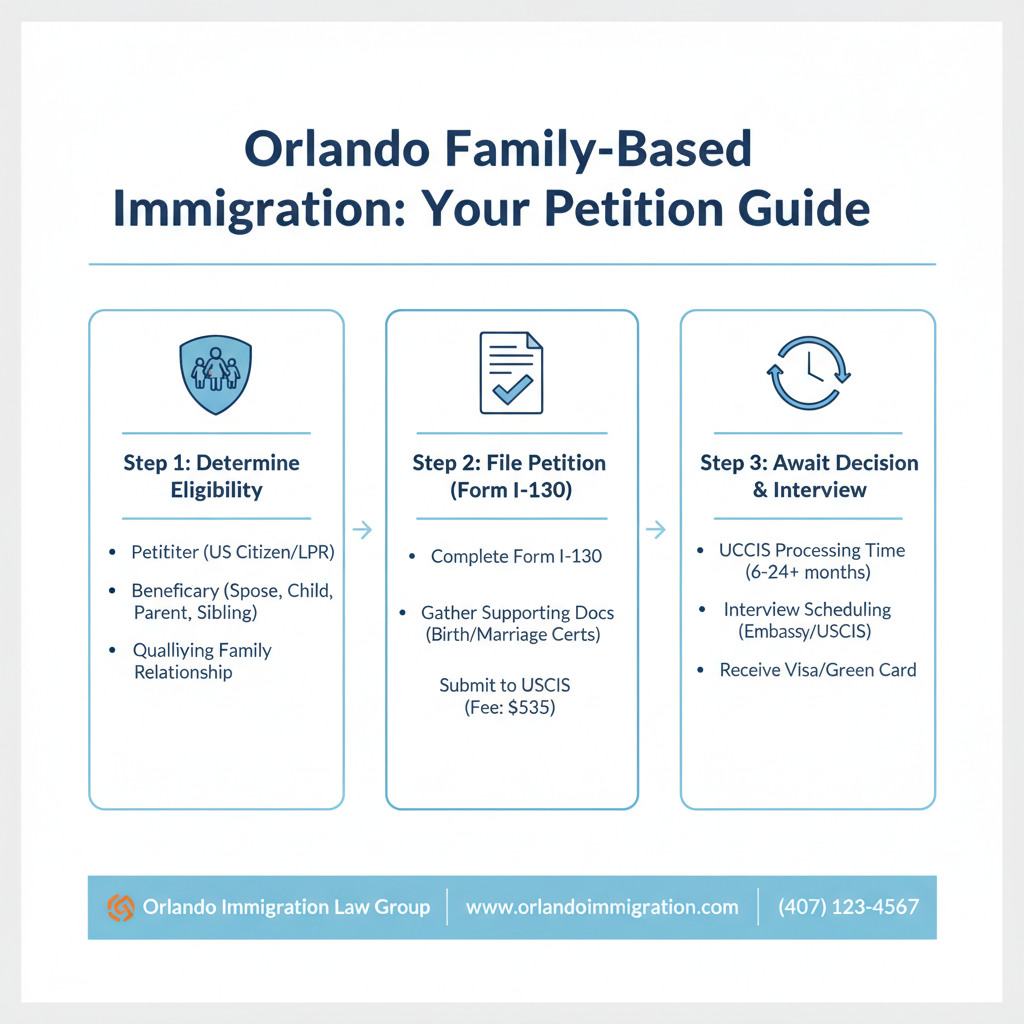
1) Determine Eligibility and Gather Initial Documents
Before you even fill out a form, you must confirm that both the petitioner and the beneficiary meet the fundamental eligibility criteria. This foundational step is critical to avoid wasted time and resources.
- Petitioner Eligibility:
- Are you a U.S. citizen or a lawful permanent resident (LPR)? You must provide proof of your status.
- Are you at least 18 years old (for financial sponsorship)?
- Beneficiary Relationship:
- Is the beneficiary your spouse, child, parent, or sibling?
- Is the relationship bona fide (genuine)? USCIS scrutinizes relationships, especially marriages, to prevent fraud.
- For children, is the relationship established legally (biological, adopted, or step-child as defined by immigration law)?
- Initial Documents to Gather:
- For the Petitioner:
- Proof of U.S. Citizenship (e.g., U.S. birth certificate, naturalization certificate, unexpired U.S. passport) OR Proof of Lawful Permanent Resident Status (e.g., green card - Form I-551, copy of both sides).
- If you've changed your name, copies of legal name change documents (e.g., marriage certificate, court order).
- For the Beneficiary and Petitioner (to prove relationship):
- Spouse: Marriage certificate, divorce decrees from any prior marriages for both parties, birth certificates for any shared children, joint financial documents (bank accounts, taxes), shared utility bills, photos together.
- Child (under 21, unmarried): Child's birth certificate, parent's marriage certificate (if applicable), proof of petitioner's U.S. citizenship/LPR status.
- Parent: Petitioner's birth certificate (showing parent's name), parent's marriage certificate (if applicable), proof of petitioner's U.S. citizenship (must be 21+).
- Sibling: Petitioner's birth certificate, beneficiary's birth certificate (showing common parent(s)), parents' marriage certificate, proof of petitioner's U.S. citizenship (must be 21+).
- Any other civil documents establishing the relationship.
- Two identical passport-style photos for both petitioner and beneficiary (if filing concurrently).
- For the Petitioner:
Reminder: All foreign language documents must be accompanied by a complete English translation certified by the translator.
2) File Form I-130, Petition for Alien Relative
This is the official start of the process. The petitioner files Form I-130 with USCIS to establish the qualifying relationship between themselves and the beneficiary.
- Complete Form I-130: Fill out the form accurately and completely. Any errors or omissions can lead to delays or denial.
- Assemble the Petition Package:
- The signed and dated Form I-130.
- All supporting documents gathered in Step 1 (copies only, unless USCIS specifically requests originals).
- The appropriate USCIS filing fee (check USCIS Fee Schedule for current amounts). You can pay by money order, personal check, cashier's check, or credit card using Form G-1450, Authorization for Credit Card Transactions.
- Two identical passport-style photos for the beneficiary (and petitioner, if filing concurrently).
- Mail to the Correct USCIS Lockbox: The filing address depends on where you live and the type of petition. Always check the "Direct Filing Addresses for Form I-130" page on USCIS.gov.
- Receive Receipt Notice: USCIS will send you a Form I-797C, Notice of Action, confirming receipt of your petition and providing a receipt number. This number allows you to track your case online. The date on this notice is your Priority Date.
3) Wait for I-130 Approval and Visa Availability
After filing, there's a waiting period. The length varies significantly based on the relationship category and the volume of applications.
- Immediate Relatives: For spouses, unmarried children under 21, and parents of U.S. citizens, there is generally no visa quota, so the wait primarily involves USCIS processing time for the Form I-130.
- Family Preference Categories: For other relatives (F1, F2A, F2B, F3, F4), there are annual limits on the number of visas issued. This creates a waiting list. You must wait for your Priority Date to become "current" in the Visa Bulletin, which is published monthly by the U.S. Department of State.
- I-130 Approval: Once USCIS reviews your petition, they will send an approval notice (Form I-797, Approval Notice) if the relationship is established. If denied, it's crucial to consult an attorney to understand the reasons and potential next steps.
- Tracking Processing Times: You can check estimated processing times for Form I-130 on the USCIS Processing Times website. Select Form I-130 and your service center.
4) Choose the Path: Adjustment of Status or Consular Processing
Once your Form I-130 is approved and a visa is available (if applicable), the beneficiary can apply for their green card. The path depends on whether the beneficiary is in the U.S. or abroad.
- Option A: Adjustment of Status (AOS) - For Beneficiaries in the U.S.
- Eligibility: Generally, the beneficiary must have entered the U.S. legally (e.g., with a visa) and maintained their lawful status. Immediate Relatives of U.S. citizens have more flexibility even if they overstayed a visa. Certain bars to adjustment apply.
- Concurrent Filing: Immediate Relatives can often file Form I-130 and Form I-485 (Application to Register Permanent Residence or Adjust Status) concurrently. For preference categories, you can only file Form I-485 when your Priority Date is current.
- Required Forms for AOS Package:
- Form I-485, Application to Register Permanent Residence or Adjust Status
- Form I-130 (if filing concurrently or if you need to resubmit previously filed petition documents)
- Form I-864, Affidavit of Support (from petitioner, and joint sponsor if needed)
- Form I-765, Application for Employment Authorization (optional, allows work while AOS is pending)
- Form I-131, Application for Travel Document (optional, allows travel outside U.S. while AOS is pending - Advance Parole)
- Form I-693, Report of Medical Examination and Vaccination Record (completed by a USCIS-approved civil surgeon)
- Copies of birth certificate, passport, visa, I-94 arrival record, marriage certificate (if applicable), divorce decrees (if applicable).
- Two identical passport-style photos.
- Certified English translations for any foreign language documents.
- Relevant filing fees.
- Biometrics Appointment: USCIS will schedule an appointment for fingerprinting and photos.
- Option B: Consular Processing - For Beneficiaries Outside the U.S.
- National Visa Center (NVC): Once USCIS approves Form I-130, the case is sent to the National Visa Center (NVC), part of the U.S. Department of State.
- NVC Processing: The NVC will instruct the petitioner and beneficiary to pay fees, submit additional forms (e.g., Form DS-260, Immigrant Visa Application), and upload civil documents to the NVC's online portal.
- Required Forms/Documents for Consular Processing:
- Form DS-260, Immigrant Visa Application.
- Form I-864, Affidavit of Support.
- Civil documents: birth certificates, marriage certificates, divorce decrees, police certificates from all countries lived in (for 6+ months since age 16), military records.
- Passport photos.
- Passport valid for at least six months beyond the intended date of entry into the U.S.
- Medical examination from an authorized panel physician in the beneficiary's country.
- Relevant fees.
- Interview Scheduling: Once all documents are processed and reviewed by the NVC, they will schedule an immigrant visa interview at the U.S. Embassy or Consulate in the beneficiary's home country.
5) Prepare for Interview
The interview is a crucial step for both Adjustment of Status and Consular Processing. Thorough preparation is key.
- Medical Examination: For both AOS and Consular Processing, the beneficiary must undergo a medical exam by a USCIS-approved civil surgeon (for AOS) or an embassy-approved panel physician (for Consular Processing). This must be completed before the interview, and the sealed results brought to the interview.
- Gather Original Documents: Although you submitted copies, you MUST bring all original civil documents (birth certificates, marriage certificates, divorce decrees, passports, etc.), along with copies, to your interview.
- Financial Documents: Bring updated income tax returns, W-2s, pay stubs, and any other evidence to support the Form I-864.
- Proof of Relationship: Bring additional evidence of your bona fide relationship, especially for spouses (e.g., photos, joint accounts, cards, letters, lease agreements).
- Review Application: Go over your submitted forms (I-13


