


The reporting that sparked this guide: Family-Based Immigration Petition Guide (Immigration)
What This News Means for Immigrants in Orlando and Across Florida
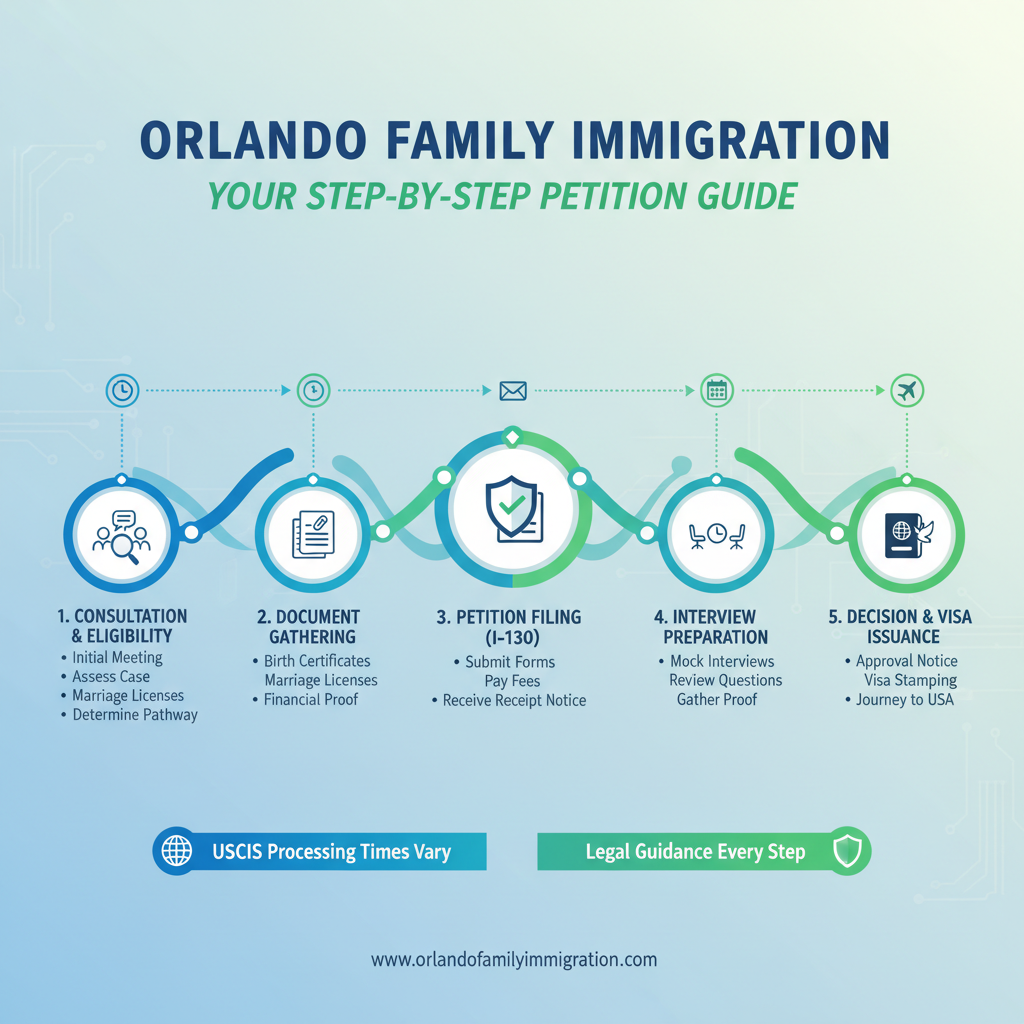
For countless families in Orlando, Central Florida, and throughout the United States, the dream of uniting with loved ones is paramount. Immigration news, particularly concerning family-based petitions, directly impacts these aspirations. At Imigrar, we understand that every piece of news, every update, carries significant weight for our clients striving to keep their families together.
Why this news is showing up now
The topic of family-based immigration petitions is perennially relevant, but its prominence often fluctuates with policy discussions, legislative proposals, and shifts in processing priorities at U.S. Citizenship and Immigration Services (USCIS) and the U.S. Department of State. Currently, there's a heightened focus on streamlining processes and addressing backlogs, making comprehensive guides like this more crucial than ever. Many families are eager to understand the most current requirements and navigate the system efficiently, especially with the ongoing efforts to improve processing times post-pandemic.
How it can affect Florida residents
Florida is home to one of the largest and most diverse immigrant populations in the nation. For residents across the state, from Miami to Orlando, Tampa to Jacksonville, family-based immigration is a cornerstone of community growth and personal well-being. This guide provides clarity on the specific steps and requirements for petitioning family members, which is critical for Florida residents who may be navigating the complexities of the immigration system. Whether you're a U.S. citizen or a lawful permanent resident (LPR) in Orange County or along the I-4 corridor, understanding the nuances of these petitions can significantly impact your ability to bring your loved ones to the U.S. or help them adjust their status here. Timelines and local USCIS office procedures, such as those at the Orlando USCIS Field Office, can directly affect your case, making accurate and up-to-date information invaluable.
What Family-Based Immigration Petition Is (and Why It Matters)
Family-based immigration is the bedrock of the U.S. immigration system, designed to allow U.S. citizens and lawful permanent residents (LPRs) to sponsor certain family members for a Green Card, granting them permanent residence in the United States. This process is often initiated by filing a petition with USCIS, affirming the familial relationship.
A plain-English definition
At its core, a family-based immigration petition is a formal request to the U.S. government to recognize a familial relationship between a U.S. citizen or lawful permanent resident (the Petitioner) and a foreign national (the Beneficiary). Once this relationship is established and approved, it creates a pathway for the beneficiary to apply for a Green Card, allowing them to live and work permanently in the United States. It's the first critical step in a multi-stage journey to unite families.
Key terms you need to know
Navigating immigration law requires understanding specific terminology. Here are some key terms vital to family-based petitions:
- Petitioner: The U.S. citizen or lawful permanent resident who files the immigration petition on behalf of a family member.
- Beneficiary: The foreign national family member for whom the petition is filed, seeking a Green Card.
- Immediate Relative: A specific category of family members who do not have to wait for a visa to become available. This includes spouses of U.S. citizens, unmarried children under 21 of U.S. citizens, and parents of U.S. citizens (if the U.S. citizen is 21 or older).
- Family Preference Categories: Other family relationships that are subject to annual numerical limits and often involve a waiting period for a visa to become available. These include:
- First Preference (F1): Unmarried sons and daughters (21 years of age or older) of U.S. citizens.
- Second Preference (F2A): Spouses and children (unmarried and under 21) of lawful permanent residents.
- Second Preference (F2B): Unmarried sons and daughters (21 years of age or older) of lawful permanent residents.
- Third Preference (F3): Married sons and daughters of U.S. citizens.
- Fourth Preference (F4): Brothers and sisters of U.S. citizens (if the U.S. citizen is 21 or older).
- Priority Date: The date USCIS receives your properly filed Form I-130 petition. This date is crucial for Family Preference Categories, as it determines your place in the visa queue.
- Visa Bulletin: A monthly publication from the U.S. Department of State that lists the Priority Dates for which immigrant visas are available for each family preference category and country of chargeability.
- Adjustment of Status (AOS): The process of applying for a Green Card while physically present in the United States. This is typically done by filing Form I-485.
- Consular Processing: The process of applying for an immigrant visa (Green Card) through a U.S. embassy or consulate abroad. This is for beneficiaries who are outside the United States.
- Affidavit of Support (Form I-864): A legally binding document signed by the Petitioner (and sometimes a joint sponsor) promising to financially support the Beneficiary and ensure they do not become a public charge.
Need Help? Our Orlando immigration team is ready to assist. Call +1 786-791-3106 for a free consultation, or message us online. Se Habla Español.
Current Immigration Law: The Foundation
Family-based immigration is primarily governed by the Immigration and Nationality Act (INA), specifically sections related to immigrant visas. Understanding these legal underpinnings is crucial for successfully navigating the process.
Federal requirements
The core legal framework for family petitions is found within the Immigration and Nationality Act (INA). Key sections include:
- INA Section 201: Defines immediate relatives and establishes the numerical limitations for other family preference categories.
- INA Section 203: Outlines the allocation of immigrant visas for family-sponsored immigrants, detailing the preference categories and their annual limits.
- INA Section 204: Describes the process for petitioning for alien relatives, including the requirement for the Petitioner to establish a bona fide relationship with the Beneficiary.
All family-based petitions begin with filing Form I-130, Petition for Alien Relative, with U.S. Citizenship and Immigration Services (USCIS). This form is used by U.S. citizens or lawful permanent residents to establish their relationship with an eligible foreign national. The purpose of Form I-130 is to prove that a qualifying family relationship exists. Without an approved Form I-130, no further steps toward a Green Card can be taken through family sponsorship.
For individuals seeking to adjust status within the U.S., Form I-485, Application to Register Permanent Residence or Adjust Status, is the primary application. For those abroad, the U.S. Department of State's Consular Processing procedures apply.
Another vital federal requirement is the Affidavit of Support, typically filed using Form I-864. This form is a contract between the Petitioner (and any joint sponsors) and the U.S. government, ensuring the Beneficiary will not become a public charge. The sponsor must demonstrate income at or above 125% of the federal poverty guidelines for their household size. This financial sponsorship is a mandatory component for almost all family-based immigrant visas.
For more detailed information on specific forms and requirements, always refer to the USCIS official website.
Florida-specific considerations
While immigration law is federal, certain aspects can feel more immediate or complex in specific states. Florida, with its large and diverse immigrant communities, presents unique considerations:
- High Volume: Florida's significant immigrant population means USCIS field offices, such as the Orlando USCIS Field Office, and local immigration courts handle a high volume of cases. This can sometimes lead to longer processing times for certain steps, although USCIS continually works to manage its caseload.
- Local Resources: Central Florida, including Orlando and surrounding areas in Orange County, has a robust network of community organizations and legal aid services that can provide support and resources, often in multiple languages, including Spanish.
- Language Access: Given the diverse population, accessibility to information and services in languages like Spanish is crucial. Imigrar proudly offers services in both English and Spanish (Se Habla Español) to ensure clear communication and understanding for all our clients.
- Navigating Local Procedures: While the law is federal, local USCIS field offices have specific procedures for interviews, appointments, and walk-ins. Understanding the nuances of the Orlando Field Office can be beneficial.
Staying informed about federal requirements and understanding local dynamics are both key to a successful family-based immigration process in Florida.
How to Petition for a Family Member: A Complete Step-by-Step Guide
Petitioning for a family member to receive a Green Card is a multi-step process that requires careful attention to detail, accurate documentation, and patience. Here’s a comprehensive guide to help you navigate each stage:
1) Determine Eligibility and Relationship
Before you even begin filling out forms, the most critical first step is to establish eligibility. The U.S. citizen or lawful permanent resident (Petitioner) must determine if they have a qualifying relationship with the foreign national (Beneficiary) they wish to sponsor.
- Who can petition?
- U.S. Citizens can petition for: spouses, unmarried children under 21, unmarried sons and daughters 21 or older, married sons and daughters, and brothers and sisters (if the U.S. citizen is 21 or older), and parents (if the U.S. citizen is 21 or older).
- Lawful Permanent Residents (Green Card holders) can petition for: spouses, and unmarried sons and daughters of any age.
- Immediate Relatives vs. Family Preference Categories:
- Immediate Relatives (spouses, unmarried children under 21, and parents of U.S. citizens) have visas immediately available, meaning they don't have to wait for a Priority Date to become current.
- Family Preference Categories (all others) are subject to annual numerical limits and often involve a waiting period, as determined by the Visa Bulletin.
Required Documents for Eligibility:
- For U.S. Citizen Petitioner: U.S. birth certificate, U.S. passport, Certificate of Naturalization, or Consular Report of Birth Abroad.
- For LPR Petitioner: Copy of Green Card (Form I-551).
- Proof of Relationship:
- Spouse: Marriage certificate, joint bank statements, utility bills, photos, affidavits from friends/family, birth certificates of common children.
- Child: Child’s birth certificate showing names of parents, marriage certificate of parents (if applicable).
- Parent: Petitioner’s birth certificate showing names of parents, marriage certificate of parents (if applicable).
- Sibling: Petitioner’s birth certificate and sibling’s birth certificate, showing at least one common parent, and parents’ marriage certificate (if applicable).
- Any divorce decrees, death certificates, or annulment papers for prior marriages of either the Petitioner or Beneficiary.
Important: All documents not in English must be accompanied by a certified English translation.
2) File Form I-130, Petition for Alien Relative
Once you’ve confirmed eligibility and gathered your initial documents, the next step is to prepare and file Form I-130 with USCIS. This form formally requests USCIS to recognize the qualifying family relationship.
- Complete Form I-130 accurately and thoroughly. Any errors or omissions can lead to delays or Requests for Evidence (RFEs).
- Attach all required supporting documents proving the relationship, your status as a U.S. citizen or LPR, and any necessary identity documents.
- Include the appropriate filing fee. Always check the USCIS Forms page for current fees.
- Consider filing Form G-1145, E-Notification of Application/Petition Acceptance, to receive electronic updates on your petition.
Required Documents for Form I-130 Filing:
- Completed and signed Form I-130.
- Copy of Petitioner’s proof of U.S. citizenship or LPR status (e.g., birth certificate, passport, naturalization certificate, Green Card).
- Copy of Beneficiary’s birth certificate and passport biographic page.
- Proof of relationship (as detailed in Step 1).
- Two passport-style photos of the Petitioner and two of the Beneficiary (if filing concurrently for Adjustment of Status or if requested).
- Payment for the filing fee (check, money order, or credit card via Form G-1450).
3) USCIS Processing, Approval, and Priority Date (if applicable)
After filing Form I-130, USCIS will send you a receipt notice (Form I-797C) confirming they have received your petition. This notice will include your case number and, for Family Preference Categories, your Priority Date. USCIS will then review your petition. This stage involves:
- Initial Review: USCIS checks for completeness.
- Requests for Evidence (RFEs): If information or documents are missing, USCIS will send an RFE. Responding promptly and thoroughly is crucial.
- Approval or Denial: If approved, USCIS sends an approval notice (Form I-797). If denied, they will provide a reason, and you may have options to appeal or refile.
Reminder: For Immediate Relatives, once the Form I-130 is approved, the Beneficiary can immediately proceed to the next step (either Adjustment of Status or Consular Processing). For Family Preference Categories, the Beneficiary must wait until their Priority Date becomes current on the Visa Bulletin.
You can check your case status online using your receipt number at the USCIS Case Status Online tool.
4) Wait for Visa Availability (for Preference Categories)
This step is only for Beneficiaries in the Family Preference Categories. After your Form I-130 is approved, you enter a waiting period until an immigrant visa number becomes available for your specific category and country of chargeability. This wait can range from a few years to over a decade, depending on demand and country of origin.
- Monitor the U.S. Department of State's monthly Visa Bulletin. The bulletin shows the "cut-off dates" for each category. When your Priority Date is earlier than the listed cut-off date, a visa is available.
- The Visa Bulletin has two charts: "Dates for Filing Applications" and "Final Action Dates." USCIS will indicate which chart should be used for filing Adjustment of Status applications in a given month.
Important: Do not proceed to the next steps for Family Preference Categories until your Priority Date is current. Attempting to file for Adjustment of Status or begin Consular Processing prematurely will result in rejection and wasted fees.
5) Path to Green Card: Adjustment of Status OR Consular Processing
Once an immigrant visa is available (or immediately for Immediate Relatives), the Beneficiary can apply for a Green Card. The path depends on whether the Beneficiary is already in the U.S. or abroad.
Option A: Adjustment of Status (for Beneficiaries in the U.S.)
If the Beneficiary is legally present in the U.S. and an immigrant visa is available, they can apply for Adjustment of Status. This means they apply for their Green Card without leaving the country. This involves filing Form I-485, Application to Register Permanent Residence or Adjust Status, along with several other forms.
Required Documents for Adjustment of Status (Form I-485):
- Completed and signed Form I-485.
- Copy of Form I-130 approval notice.
- Two passport-style photos.
- Copy of Beneficiary’s birth certificate.
- Copy of Beneficiary’s passport biographic page, visa page, and I-94 arrival record.
- Form I-864, Affidavit of Support, with supporting financial documents (tax returns, W-2s, employment verification letters) from the Petitioner and any joint sponsors.
- Form I-693, Report of Medical Examination and Vaccination Record, completed by a USCIS-authorized civil surgeon. This should be submitted in a sealed envelope.
- Form I-765, Application for Employment Authorization (optional, allows work authorization while AOS is pending).
- Form I-131, Application for Travel Document (optional, allows travel outside the U.S. while AOS is pending – also known as Advance Parole).
- Certified police and court records for any arrests or convictions (if applicable).
- Payment for filing fees.
Option B: Consular Processing (for Beneficiaries outside the U.S.)
If the Beneficiary is outside the U.S., they will go through Consular Processing. After Form I-130 is approved and a visa is available, USCIS forwards the approved petition to the National Visa Center (NVC), which then coordinates with the appropriate U.S. embassy or consulate abroad.
Required Documents for Consular Processing (NVC Stage):
- Payment of NVC fees (Affidavit of Support fee and Immigrant Visa Application fee).
- Completed Form DS-260, Immigrant Visa Application.
- Scanned copies of civil documents for the Beneficiary and Petitioner (birth certificates, marriage certificates, divorce decrees, police certificates from all countries lived in for more than 6 months after age 16).
- Scanned copy of Form I-864, Affidavit of Support, with supporting financial documents.
- Passport biographic page for Beneficiary.
The NVC will review all submitted documents. Once everything is accepted as "documentarily qualified," the NVC will schedule an interview at the U.S. embassy or consulate in the Beneficiary's home country.
Navigating the complex forms and requirements can be overwhelming. Let Imigrar's experienced Orlando team guide you. Call +1 786-791-3106 today for a free consultation. Se Habla Español.
6) Biometrics, Interview, and Medical Exam
Regardless of whether the Beneficiary pursues Adjustment of Status or Consular Processing, certain common steps are required:
- Biometrics Appointment: For Adjustment of Status, USCIS will send a notice for a biometrics appointment (fingerprints, photos, and signature) at an Application Support Center (ASC). This is used for background checks. For Consular Processing, biometrics are typically taken at the interview.
- Medical Examination: Both paths require a medical exam by an authorized physician. For AOS, this is done by a USCIS-approved civil surgeon (Form I-693). For Consular Processing, it's done by a panel physician designated by the U.S. embassy/consulate. The exam checks for certain medical conditions and ensures required vaccinations are up to date.
- Interview:
- Adjustment of Status: The Petitioner and Beneficiary will typically attend an interview at a local USCIS field office (e.g., the Orlando USCIS Field Office). The officer will verify the relationship, review the application, and confirm eligibility.
- Consular Processing: The Beneficiary (and sometimes the Petitioner for spousal cases) attends an interview at the U.S. embassy or consulate abroad. The consular officer will review the case and make a final decision.
Required Documents for Interview:
- Interview appointment notice.
- Originals of all documents submitted with the petition and application (birth certificates, marriage certificates, passports, etc.).
- Any updated evidence of relationship or financial support.
- For AOS, the sealed Form I-693 (if not submitted with the application).
- For Consular Processing, the original medical exam results provided by the panel physician.
7) Final Decision and Green Card Issuance
The final step is the decision on the Green Card application:
- Adjustment of Status: If the interview is successful, USCIS will typically approve the Form I-485, and the Green Card will be mailed to the Beneficiary within a few weeks.
- Consular Processing: If the interview is successful, the consular officer will approve the immigrant visa. The Beneficiary's passport will be stamped with a visa, allowing them to travel to the U.S. Upon entry, they become a lawful permanent resident, and the physical Green Card will be mailed later.
Congratulations! Receiving the Green Card is the culmination of a long and often challenging journey, signifying permanent residency in the United States.

Practical Steps You Can Take Today
While the family-based immigration process can be lengthy, there are several actionable steps you can take right now to prepare and ensure a smoother journey:
Actionable Checklist:
- Gather Core Documents: Start collecting all birth certificates, marriage certificates, divorce decrees, passports, and any other identity or relationship documents for both the Petitioner and Beneficiary.
- Check Your Eligibility: Reconfirm your relationship category (Immediate Relative vs. Preference) and ensure the Petitioner meets the U.S. citizenship or LPR requirements.
- Review the USCIS Website: Visit USCIS official website to download the latest versions of Form I-130 and instructions. Instructions often contain crucial details that can prevent common mistakes.
- Understand Financial Requirements: Familiarize yourself with the Affidavit of Support (Form I-864) requirements. Begin gathering your financial documents (tax returns, W-


