

At Imigrar, we understand that family is everything. Our tagline, "Keep Families Together," isn't just a motto; it's the driving force behind everything we do. For countless individuals and families in Orlando, across Florida, and nationwide, the dream of uniting with loved ones in the United States is a powerful one. Navigating the complex world of U.S. immigration law can be daunting, but with the right guidance, it's a journey that can lead to profound joy and stability.
This comprehensive guide is designed to demystify the family-based immigration petition process. We'll walk you through each step, explain key terminology, highlight common pitfalls, and provide actionable advice to help you on your path to family unity. Whether you're a U.S. citizen or a lawful permanent resident (LPR) looking to sponsor a relative, this resource is for you.
Need Help? Our Orlando immigration team is ready to assist. Call +1 786-791-3106 for a free consultation, or message us online. Se Habla Español.
The reporting that sparked this guide
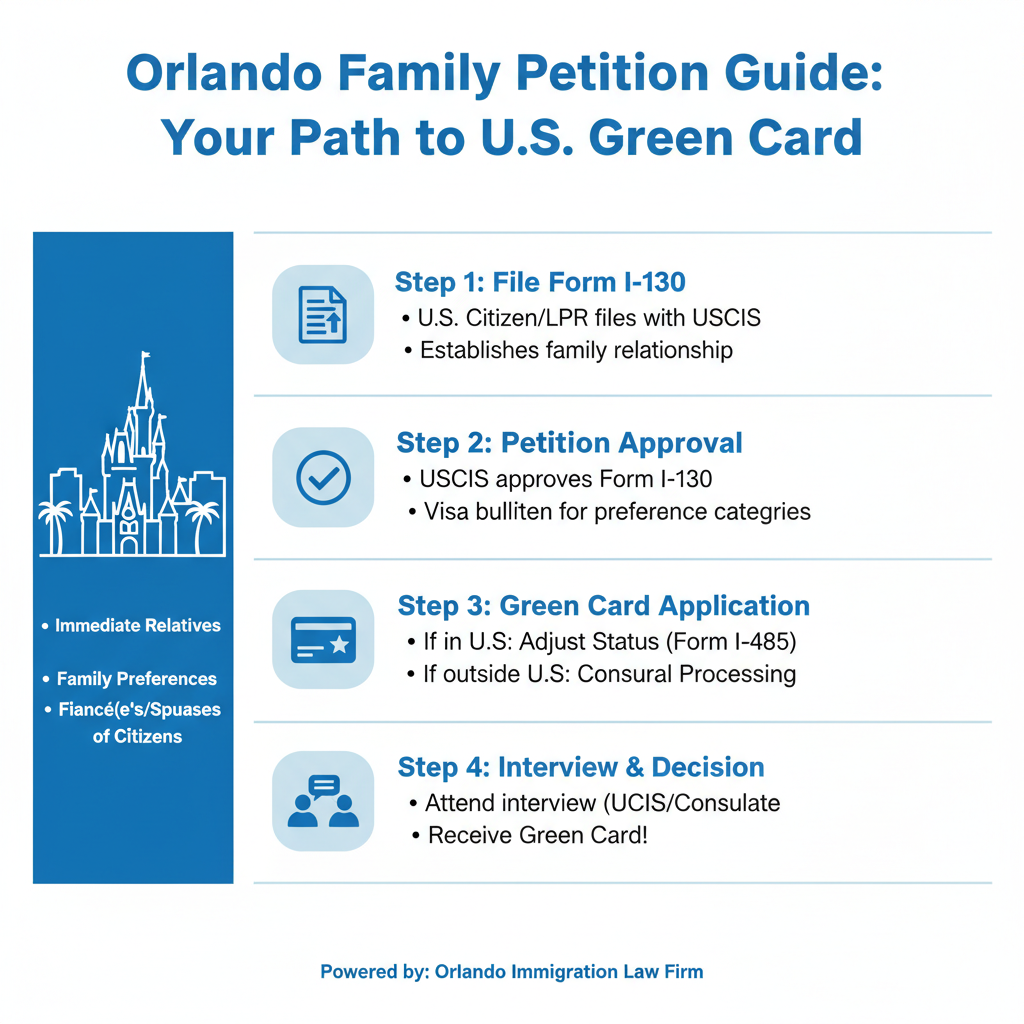
The constant conversation around Family-Based Immigration Petition Guide (Immigration) highlights the enduring importance of family reunification in the American immigration system. This ongoing trend in news and public discourse underscores the need for clear, accurate, and accessible information for those embarking on this life-changing journey.
What This News Means for Immigrants in Orlando and Across Florida
Why this news is showing up now
While there might not be a single, dramatic new policy change driving the current focus on family-based immigration, the topic consistently trends for several reasons. First, family reunification remains a cornerstone of U.S. immigration policy, meaning there's a continuous stream of petitions being filed, processed, and discussed. Second, processing times for various visa categories can fluctuate, leading to heightened public interest as families await decisions. Third, ongoing debates in Congress and public discourse about immigration reform often bring the importance of family unity to the forefront, prompting individuals to seek updated information and guidance. For many, the desire to bring loved ones to safety and opportunity is a constant and pressing concern, making guides like this perpetually relevant.
How it can affect Florida residents
Florida, and particularly Central Florida like Orlando, is home to a vibrant and diverse immigrant community. This means that family-based immigration is a daily reality for thousands of residents. The implications for Floridians are significant:
- High Demand: With a large immigrant population, there's a consistently high demand for family petitions in Florida. This can sometimes lead to longer processing times at local USCIS field offices or a greater need for legal assistance to ensure applications are filed correctly the first time.
- Local Resources: Florida residents benefit from local USCIS Field Offices, such as the one in Orlando, which handle interviews and other in-person appointments for those pursuing Adjustment of Status. Understanding the local office's procedures and typical processing speeds can be crucial.
- Community Support: Orlando's diverse communities offer robust support networks, but also highlight the critical need for accurate information. Misinformation can spread quickly, making reliable legal guidance essential.
- Economic Impact: Successful family reunification brings stability, allowing new residents to contribute to Florida's economy and cultural fabric, from Orange County to the entire I-4 corridor.
For families in Orlando seeking to navigate these complex processes, having an experienced legal team like Imigrar, right here in your community, can make all the difference. We understand the unique challenges and opportunities faced by Central Florida residents.
What Family-Based Immigration Is (and Why It Matters)
At its heart, family-based immigration is the process by which U.S. citizens and lawful permanent residents (LPRs), often referred to as Green Card holders, can sponsor certain eligible family members to come to the United States and obtain a Green Card (lawful permanent residence). This pathway is a fundamental component of U.S. immigration policy, reflecting the nation's commitment to family unity, which is central to Imigrar's mission: "Keep Families Together."
A plain-English definition
Simply put, if you are a U.S. citizen or an LPR, you can ask the U.S. government to allow certain relatives to live permanently in the United States. This involves filing a petition with U.S. Citizenship and Immigration Services (USCIS) on behalf of your family member. Once approved, and after further processing, your relative can receive a Green Card, granting them the right to live and work permanently in the U.S.
Key terms you need to know
Navigating family-based immigration requires understanding specific terminology. Here are some essential terms:
- Petitioner: This is the U.S. citizen or LPR who files the immigration petition for their relative.
- Beneficiary: This is the foreign national family member for whom the petition is filed, hoping to obtain a Green Card.
- Immediate Relative: This is a special category for close family members of U.S. citizens. It includes spouses, unmarried children under 21, and parents of U.S. citizens (if the citizen is 21 or older). The crucial advantage of immediate relatives is that there are an unlimited number of visas available each year, meaning they do not have to wait in line for a visa to become available, unlike preference categories.
- Preference Category: These categories are for other family members of U.S. citizens and LPRs. Unlike immediate relatives, there are annual limits on the number of visas available for these categories, which means beneficiaries must often wait for a visa number to become current. The categories are:
- First Preference (F1): Unmarried sons and daughters (21 or older) of U.S. citizens.
- Second Preference (F2A): Spouses and unmarried children (under 21) of LPRs.
- Second Preference (F2B): Unmarried sons and daughters (21 or older) of LPRs.
- Third Preference (F3): Married sons and daughters of U.S. citizens.
- Fourth Preference (F4): Brothers and sisters of U.S. citizens (if the citizen is 21 or older).
- Priority Date: This is the date USCIS receives your properly filed Form I-130 petition. For preference categories, this date determines your place in the visa queue. You cannot move forward with your Green Card application until your Priority Date becomes "current" according to the Visa Bulletin.
- Visa Bulletin: Published monthly by the U.S. Department of State, the Visa Bulletin lists the dates for when Green Cards are available for different preference categories and countries.
- Adjustment of Status (AOS): This is the process for eligible beneficiaries already present in the U.S. to apply for a Green Card without leaving the country. It typically involves filing Form I-485.
- Consular Processing: This is the process for beneficiaries living outside the U.S. to apply for an immigrant visa at a U.S. embassy or consulate in their home country. Once approved, they enter the U.S. as lawful permanent residents.
- Affidavit of Support (Form I-864): A legally binding document signed by the petitioner (and sometimes a joint sponsor) to demonstrate that the beneficiary will not become a "public charge" in the U.S. The sponsor must meet specific income requirements.
Need Help? Our Orlando immigration team is ready to assist. Call +1 786-791-3106 for a free consultation, or message us online. Se Habla Español.
Current Immigration Law: The Foundation
Family-based immigration is primarily governed by the Immigration and Nationality Act (INA). Specifically, Sections 201 and 203 of the INA establish the framework for family-sponsored immigration, defining who is eligible to petition for relatives and the categories under which visas are allocated. Understanding these foundational laws is crucial for a successful petition.
Federal requirements
The core requirements for family-based immigration are set at the federal level by the U.S. government, primarily enforced by USCIS and the U.S. Department of State.
- Petitioner Eligibility:
- Must be a U.S. citizen or a lawful permanent resident (Green Card holder).
- Must be able to prove their U.S. citizenship or LPR status.
- Must be able to prove a qualifying relationship with the beneficiary.
- Must meet specific income requirements (or find a joint sponsor) to demonstrate financial ability to support the beneficiary and prevent them from becoming a public charge. This is done through Form I-864, Affidavit of Support.
- For U.S. citizens petitioning parents, the citizen must be at least 21 years old.
- Beneficiary Eligibility:
- Must have a qualifying relationship to the petitioner as defined by the INA (spouse, child, parent, sibling).
- Must be admissible to the United States. This means they must not have certain criminal records, past immigration violations, specific health conditions, or other grounds of inadmissibility. Waivers may be available for some grounds.
- If pursuing Adjustment of Status, must generally have entered the U.S. legally (with inspection), though exceptions exist for some immediate relatives.
The primary form used to initiate the family-based immigration process is Form I-130, Petition for Alien Relative. This form establishes the qualifying relationship between the petitioner and the beneficiary. For those seeking to adjust their status within the U.S., Form I-485, Application to Register Permanent Residence or Adjust Status, is the main application for the Green Card itself.
You can find all official forms and detailed instructions on the USCIS official website.
Florida-specific considerations
While immigration law is federal, certain aspects touch upon local realities in Florida:
- Orlando USCIS Field Office: For residents of Orlando and Central Florida, the local USCIS Field Office is where interviews for Adjustment of Status applications typically take place. Understanding local office procedures, wait times, and common interview questions can be beneficial.
- State-Specific Documentation: When submitting documents like birth certificates or marriage licenses issued in Florida, ensure they are certified copies as required by USCIS.
- Community Resources: Florida has numerous immigrant communities and organizations that can offer support. However, it's crucial to distinguish between community support and professional legal advice. Always rely on qualified immigration attorneys for legal guidance.
Imigrar, located in Orlando, is deeply familiar with the nuances of family-based immigration for Florida residents. Our team is equipped to guide you through the federal requirements while considering any local-specific factors that might impact your case.

How to File a Family-Based Petition: A Complete Step-by-Step Guide
The family-based immigration process can be lengthy and involves multiple stages. Here’s a comprehensive, step-by-step guide to help you understand what to expect:
1) Determine Eligibility and Category
Before filing any forms, the first crucial step is to determine if you, as the petitioner, are eligible to sponsor your relative and to identify the correct visa category for your beneficiary. This dictates the forms, required documents, and processing times.
- Petitioner Status: Are you a U.S. Citizen or a Lawful Permanent Resident (LPR)? Your status determines who you can sponsor.
- Relationship: What is your exact relationship to the beneficiary (spouse, unmarried child under 21, unmarried child 21 or over, married child, parent, sibling)?
- Category: Based on your status and the relationship, determine if the beneficiary is an Immediate Relative (IR) or falls into a Preference Category (F1, F2A, F2B, F3, F4).
Required Documents (for initial determination):
- Proof of Petitioner's U.S. Citizenship: U.S. birth certificate, U.S. passport, Certificate of Naturalization, or Certificate of Citizenship.
- Proof of Petitioner's LPR Status: Green Card (Form I-551), foreign passport with I-551 stamp.
- Proof of Relationship: Birth certificates (for parent-child relationships), marriage certificates (for spousal relationships), adoption decrees (for adopted children).
Important: Gathering these foundational documents accurately and completely is vital for a smooth process.
2) File Form I-130, Petition for Alien Relative
This is the cornerstone of the family-based immigration process. The U.S. citizen or LPR petitioner files Form I-130 with USCIS to establish the legal relationship between themselves and the foreign national beneficiary. This form, along with supporting documents, proves that a genuine relationship exists.
Required Documents to Submit with Form I-130:
- Completed and signed Form I-130.
- Copy of petitioner's proof of U.S. citizenship or LPR status (e.g., U.S. passport, birth certificate, Green Card).
- Copy of beneficiary's birth certificate.
- Copy of beneficiary's passport identity page (if available).
- For Spousal Petitions:
- Copy of marriage certificate.
- Proof of bona fide marriage (evidence that the marriage is real and not just for immigration purposes). This can include:
- Joint bank accounts, credit card statements.
- Joint leases, mortgages, utility bills.
- Birth certificates of children born to the marriage.
- Affidavits from friends/family attesting to the marriage.
- Photos together (wedding, vacations, daily life).
- Life insurance policies listing each other as beneficiaries.
- Joint tax returns.
- Proof of termination of prior marriages for both petitioner and beneficiary (divorce decrees, death certificates).
- For Parent/Child Petitions:
- Petitioner's birth certificate showing parent's name (for U.S. citizen petitioning parent).
- Beneficiary's birth certificate showing parent's name (for U.S. citizen/LPR petitioning child).
- Marriage certificate of parents (if applicable, for legitimation).
- Passport-style photos of both petitioner and beneficiary.
- Applicable filing fee for Form I-130.
Warning: Any documents in a foreign language must be accompanied by a certified English translation.
3) Wait for I-130 Approval and Priority Date Current (If Applicable)
After filing Form I-130, USCIS will send a receipt notice (Form I-797C, Notice of Action). They will then review the petition. If approved, you will receive an approval notice (Form I-797, Notice of Action).
- Immediate Relatives (Spouses, Unmarried Children Under 21, and Parents of U.S. Citizens): Once the Form I-130 is approved, they can generally proceed immediately to the next step, as visas are always available.
- Preference Categories (All other family categories): This is where the Priority Date becomes critical. After Form I-130 approval, beneficiaries in preference categories must wait for their Priority Date to become "current" according to the monthly U.S. Department of State Visa Bulletin. This waiting period can range from a few years to over a decade, depending on the category and the beneficiary's country of origin.
Reminder: Regularly check the Visa Bulletin if your beneficiary is in a preference category. You can also check your case status online at USCIS Case Status Online.
4) Pursue Adjustment of Status (AOS) or Consular Processing
Once the Form I-130 is approved and a visa is available (immediately for IRs, or when the Priority Date is current for preference categories), the beneficiary can apply for their Green Card. The method depends on whether the beneficiary is inside or outside the U.S.
Option A: Adjustment of Status (for beneficiaries *inside* the U.S.)
If the beneficiary is physically present in the U.S. and meets certain eligibility criteria (e.g., lawful entry, no disqualifying immigration violations), they can apply for Adjustment of Status.
Required Documents to Submit with Form I-485 (AOS Package):
- Completed and signed Form I-485, Application to Register Permanent Residence or Adjust Status.
- Completed and signed Form I-864, Affidavit of Support, with supporting financial documents (tax returns, W-2s, pay stubs, employment verification letter).
- Completed and signed Form I-693, Report of Medical Examination and Vaccination Record (sealed by a USCIS-approved civil surgeon).
- Completed and signed Form I-765, Application for Employment Authorization (optional, allows work while AOS is pending).
- Completed and signed Form I-131, Application for Travel Document (optional, allows travel while AOS is pending).
- Copy of petitioner's Form I-130 approval notice.
- Copy of beneficiary's birth certificate.
- Copy of beneficiary's passport identity page and visa page (if applicable).
- Copy of Form I-94, Arrival/Departure Record (proof of lawful entry).
- Two passport-style photos of the beneficiary.
- Copies of any previous immigration documents (EADs, advance paroles, notices of approval).
- Copies of police records and court records (if any criminal history).
- Marriage certificate (for spousal petitions).
- Applicable filing fees for Form I-485, Form I-765, Form I-131 (often combined into one fee for AOS).
For Central Florida residents: Your AOS interview will likely be scheduled at the Orlando USCIS Field Office.
Option B: Consular Processing (for beneficiaries *outside* the U.S.)
If the beneficiary is living outside the U.S., or is ineligible for Adjustment of Status, they will go through Consular Processing. After Form I-130 approval, USCIS sends the approved petition to the National Visa Center (NVC), part of the U.S. Department of State. The NVC collects fees and documents before forwarding the case to the appropriate U.S. embassy or consulate abroad for an interview.
Required Documents for Consular Processing (NVC Stage):
- Payment of immigrant visa fees and Affidavit of Support fees.
- Completed Form DS-260, Immigrant Visa Application, online.
- Scanned copies of all civil documents for both petitioner and beneficiary (birth certificates, marriage certificates, divorce decrees, police certificates, court records, passport biographical page, etc.).
- Scanned copy of Form I-864, Affidavit of Support, with all supporting financial documents.
- Beneficiary's passport-style photos.
Once all documents are accepted by the NVC, they will schedule an interview at the U.S. embassy or consulate in the beneficiary's country of residence.
5) Attend Biometrics Appointment and Interview
Regardless of whether you pursue Adjustment of Status or Consular Processing, both processes typically involve an in-person appointment:
- Biometrics Appointment (AOS): For those adjusting status, USCIS will schedule a biometrics appointment (fingerprints, photos, signature) at an Application Support Center (ASC) near you in Orlando or elsewhere in Florida. This is used for background checks.
- Interview (AOS & Consular Processing):
- AOS: The petitioner and beneficiary will typically attend an interview at a USCIS Field Office (e.g., Orlando USCIS Field Office) to verify the information on the forms and the bona fides of the relationship.
- Consular Processing: The beneficiary will attend an interview at the U.S. embassy or consulate abroad.
Important: Be prepared to answer questions about your relationship and provide any additional documents requested by the interviewing officer. Honesty and consistency are paramount.
6) Receive Decision and Green Card
If the interview is successful and all requirements are met:
- For AOS: USCIS will approve the Form I-485. The beneficiary will receive their Green Card by mail within a few weeks.
- For Consular Processing: The embassy/consulate will issue an immigrant visa stamp in the beneficiary's passport. The beneficiary will then travel to the U.S. and upon entry, will officially become a Lawful Permanent Resident. The Green Card will be mailed to their U.S. address.
7) Post-Approval Considerations (Conditional Green Card, Removing Conditions)
If the beneficiary received a Green Card based on a marriage to a U.S. citizen and the marriage was less than two years old on the day the Green Card was approved, they will receive a Conditional Green Card, valid for two years. To remove these conditions and obtain a 10-year permanent Green Card:
- The petitioner and beneficiary must jointly file


