


The journey to reunite families through immigration can often feel complex and overwhelming. At Imigrar, we understand that behind every form and every regulation is a family yearning to be together. We are committed to helping you navigate this path with clarity and confidence, ensuring your loved ones can join you in the United States.
The reporting that sparked this guide:
The continuous public interest and ongoing discussions around Family-Based Immigration Petition Guide (Immigration) highlight the enduring importance of family reunification in the U.S. immigration system. This guide aims to demystify the process for you.
Need Help? Our Orlando immigration team is ready to assist. Call +1 786-791-3106 for a free consultation, or message us online. Se Habla Español.
What This News Means for Immigrants in Orlando and Across Florida
The topic of family-based immigration is not just a headline; it's a lifeline for countless individuals and families seeking to build a life together in the United States. For residents in Orlando, Central Florida, and throughout the Sunshine State, understanding this process is crucial.
Why this news is showing up now
Family-based immigration has always been a cornerstone of U.S. immigration policy, reflecting the nation's values of family unity. The continuous focus on this topic in news and public discourse stems from several factors:
- Ongoing Demand: There is a consistent and high demand for family-based visas, with millions of people globally seeking to join their loved ones in the U.S.
- Processing Times: Fluctuations in processing times by U.S. Citizenship and Immigration Services (USCIS) and the U.S. Department of State often generate news as families experience longer or shorter waits. Updates to processing methods or backlogs can significantly impact individuals.
- Policy Discussions: Immigration policies are frequently debated, and family-based immigration is often at the forefront of these discussions. While the core statutes remain largely stable, administrative policies and enforcement priorities can shift, affecting how petitions are processed and perceived.
- Public Interest: The human stories behind family reunification resonate deeply. News outlets frequently cover individual cases, policy changes, and practical guides to help their audiences navigate this vital aspect of immigration law.
Today, as of 2026-09-12, the underlying demand for family reunification remains strong, making comprehensive guides like this more relevant than ever for those embarking on this journey.
How it can affect Florida residents
Florida is one of the most diverse states in the U.S., home to a vibrant immigrant population from across the globe. This means that family-based immigration processes are particularly impactful for residents here:
- High Volume of Applicants: Florida, especially metropolitan areas like Orlando, Miami, and Tampa, sees a significant number of family-based petitions filed annually. This high volume can sometimes contribute to longer processing times at local USCIS field offices or through consular processing for beneficiaries abroad.
- Local USCIS Field Offices: For those undergoing Adjustment of Status, the Orlando USCIS Field Office plays a critical role in interviews and local processing. Understanding its procedures and potential backlogs is important for Central Florida residents.
- Diverse Kinship Ties: Florida's immigrant communities maintain strong ties with their countries of origin. This often means petitioners in Florida are sponsoring relatives from a wide array of nations, necessitating familiarity with various consular processing requirements worldwide.
- Economic and Social Impact: Successful family reunification strengthens Florida’s economy and enriches its social fabric. Newcomers contribute to the workforce, start businesses, and integrate into communities along the I-4 corridor and beyond.
For Floridians, staying informed about the requirements, processes, and potential challenges of family-based immigration is not just a legal necessity but a pathway to keeping families together and fostering stronger communities.
What Family-Based Immigration Petitions Are (and Why It Matters)
At its heart, U.S. immigration law prioritizes the principle of family unity. Family-based immigration petitions are the primary legal mechanism through which U.S. citizens and lawful permanent residents (LPRs) can sponsor eligible relatives to come to or remain in the United States permanently.
A plain-English definition
A Family-Based Immigration Petition is essentially a formal request filed with the U.S. government by a U.S. citizen or Lawful Permanent Resident (Green Card holder) on behalf of a close family member who wishes to immigrate to the United States. This petition establishes that a valid family relationship exists, which is the first crucial step toward that family member obtaining a Green Card (permanent residency).
The goal is simple: to allow families to live together in the U.S., contributing to society and sharing in the American dream. This process is how spouses, children, parents, and siblings can legally immigrate and gain permanent resident status.
Key terms you need to know
Navigating the immigration system requires understanding specific terminology. Here are some essential terms related to family-based petitions:
- Petitioner: The U.S. citizen or Lawful Permanent Resident (LPR) who files Form I-130 on behalf of their relative.
- Beneficiary: The foreign national relative for whom the petition is filed, seeking to immigrate to the U.S.
- Immediate Relative: A specific category of beneficiaries who are not subject to annual visa quotas, meaning there is no waiting list for a visa to become available once the petition is approved. This category includes:
- Spouses of U.S. citizens.
- Unmarried children under 21 of U.S. citizens.
- Parents of U.S. citizens (if the U.S. citizen is 21 or older).
- Preference Categories: Family members who are not Immediate Relatives fall into preference categories and are subject to annual visa quotas. This means there is often a waiting period (sometimes years or even decades) for a visa to become available. These categories include:
- First Preference (F1): Unmarried sons and daughters (21 or older) of U.S. citizens.
- Second Preference (F2A): Spouses and unmarried children (under 21) of Lawful Permanent Residents.
- Second Preference (F2B): Unmarried sons and daughters (21 or older) of Lawful Permanent Residents.
- Third Preference (F3): Married sons and daughters of U.S. citizens.
- Fourth Preference (F4): Brothers and sisters of U.S. citizens (if the U.S. citizen is 21 or older).
- Priority Date: The date Form I-130 is properly filed and accepted by USCIS. This date determines a beneficiary's place in the visa queue for preference categories. When their Priority Date becomes "current" according to the Visa Bulletin, they can apply for a Green Card.
- Visa Bulletin: A monthly publication by the U.S. Department of State that provides updated information on visa availability for preference categories. It lists cut-off dates that determine whose Priority Date is current. You can check the U.S. Department of State Visa Bulletin.
- Adjustment of Status (AOS): The process of applying for a Green Card while physically present in the United States. This is generally available to Immediate Relatives or those in preference categories whose Priority Date is current and who entered the U.S. legally.
- Consular Processing: The process of applying for an immigrant visa at a U.S. embassy or consulate abroad. This is for beneficiaries living outside the U.S. or those ineligible for Adjustment of Status.
- Affidavit of Support (Form I-864): A legally binding document signed by the petitioner (and sometimes a joint sponsor) to demonstrate that the beneficiary will not become a public charge in the U.S. The sponsor must meet specific income requirements.
Understanding these terms is your first step towards confidently navigating the family-based immigration process. They will come up repeatedly, and knowing what they mean will empower you to make informed decisions.
Current Immigration Law: The Foundation
Family-based immigration is governed primarily by the Immigration and Nationality Act (INA), which establishes the legal framework for how foreign nationals can immigrate to the United States. This law delineates who can petition for whom and under what conditions, creating the distinction between immediate relatives and preference categories that dictates visa availability and processing times.
Federal requirements
The core of family-based immigration lies in establishing a qualifying relationship and ensuring the beneficiary will not become a public charge. Key federal requirements include:
- Qualifying Relationship: The petitioner must be a U.S. citizen or Lawful Permanent Resident (LPR) and must establish a bona fide (real) family relationship with the beneficiary. This relationship must fall into one of the Immediate Relative or Preference Categories defined by the INA. For spouses, this requires proving a genuine marriage, not one entered into solely for immigration purposes.
- Petitioner's Status: The petitioner must provide proof of their U.S. citizenship (e.g., birth certificate, naturalization certificate, U.S. passport) or LPR status (e.g., Green Card, Form I-551).
- Financial Sponsorship: The petitioner must demonstrate the financial ability to support the beneficiary at 125% of the federal poverty guidelines by filing Form I-864, Affidavit of Support. This is a crucial requirement to prevent the immigrant from becoming a public charge. If the petitioner's income is insufficient, a joint sponsor may be required.
- Admissibility: The beneficiary must be admissible to the United States. This means they must not fall under any grounds of inadmissibility, such as certain criminal convictions, health issues, prior immigration violations, or security risks. Waivers may be available for some grounds of inadmissibility, but they are often complex.
- Proper Documentation: All required forms must be accurately completed and submitted with all necessary supporting evidence, including civil documents (birth certificates, marriage certificates, divorce decrees, etc.), photographs, and other proofs of relationship.
The primary form for initiating this process is Form I-130, Petition for Alien Relative. This form establishes the qualifying relationship between the petitioner and the beneficiary. Subsequent forms, like Form I-485, Application to Register Permanent Residence or Adjust Status (for those in the U.S.) or Form DS-260, Immigrant Visa Electronic Application (for those abroad), complete the Green Card application process.
For detailed information and forms, always refer to the USCIS official website.
Florida-specific considerations
While immigration law is federal, certain aspects touch upon state-level considerations for Florida residents:
- Orlando USCIS Field Office: For individuals residing in Central Florida, interviews for Adjustment of Status are typically conducted at the Orlando USCIS Field Office. Familiarity with this office's procedures and typical interview questions can be advantageous.
- High Volume of Cases: As a major hub for immigrants, Florida's USCIS offices and immigration courts process a high volume of cases. This can sometimes lead to localized variations in processing times compared to the national average.
- State-issued Documents: Florida residents will primarily use state-issued documents (e.g., Florida birth certificates, marriage licenses issued in Orange County or other Florida counties, Florida driver's licenses) as proof of identity and for civil records. Ensuring these documents are valid and readily available is essential.
- Access to Legal Services: Florida has a robust network of immigration legal professionals. For Central Florida residents, access to experienced immigration attorneys in Orlando is readily available to provide guidance and representation.
Understanding these local nuances, while adhering to federal law, is key to a smooth process for Florida residents.
Overwhelmed by forms and regulations? Let Imigrar guide you. We serve clients nationwide, with a strong presence in Orlando. Call us at +1 786-791-3106 for a free consultation. Se Habla Español.
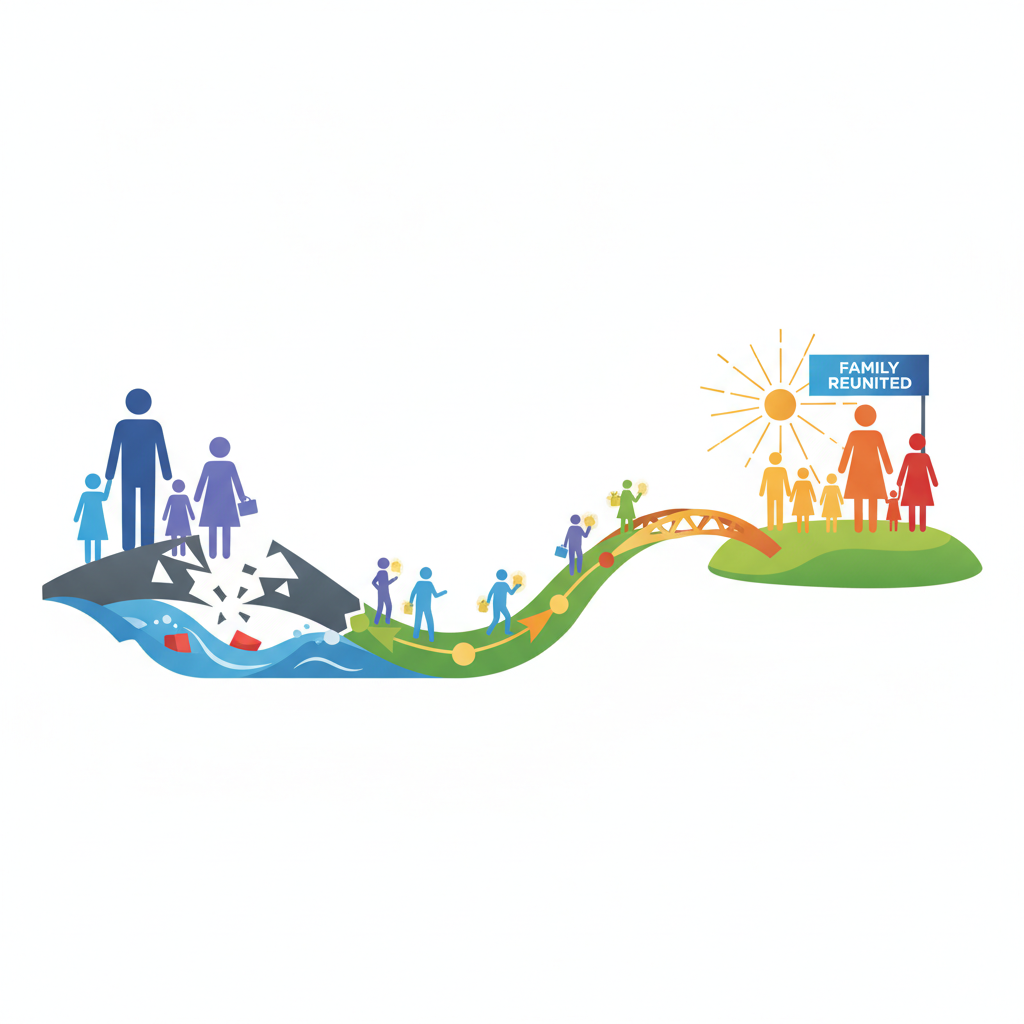
How to File a Family-Based Immigration Petition: A Complete Step-by-Step Guide
Filing a family-based immigration petition is a multi-step process that requires precision, patience, and meticulous attention to detail. This guide outlines the typical steps involved, whether your relative is in the U.S. or abroad.
1) Determine Eligibility and Category: Immediate Relative vs. Preference
Before filing any forms, the first crucial step is to determine if you (the petitioner) are eligible to sponsor your relative (the beneficiary) and, if so, which immigration category they fall into. This dictates the forms, fees, and most importantly, the waiting time.
- Petitioner Eligibility: You must be a U.S. citizen or a Lawful Permanent Resident (LPR).
- U.S. citizens can petition for spouses, unmarried children (under 21), parents (if the citizen is 21+), unmarried sons/daughters (21+), married sons/daughters, and siblings (if the citizen is 21+).
- LPRs can petition for spouses and unmarried children (all ages).
- Beneficiary Eligibility: The relationship must be genuine and legally recognized.
- Category Impact:
- Immediate Relatives (spouses, unmarried children under 21, and parents of U.S. citizens) do not have visa quotas, meaning no waiting for a visa number to become available once the I-130 is approved.
- Preference Categories (all other eligible relatives) are subject to annual limits, resulting in significant waiting times determined by the Priority Date and the Visa Bulletin.
Required Documents for Step 1:
- Proof of petitioner's U.S. citizenship (e.g., U.S. birth certificate, naturalization certificate, U.S. passport) OR Lawful Permanent Resident status (e.g., Green Card - Form I-551).
- Proof of relationship:
- For spouses: Marriage certificate, divorce decrees from any previous marriages for both parties.
- For children: Beneficiary's birth certificate showing petitioner as parent.
- For parents: Petitioner's birth certificate showing beneficiary as parent.
- For siblings: Birth certificates for both petitioner and beneficiary showing common parent(s).
- Any name change documents (e.g., marriage certificates, court orders) if names on documents differ.
2) File Form I-130, Petition for Alien Relative
This is the foundational step. The U.S. citizen or LPR petitioner files Form I-130 with USCIS to establish the qualifying relationship with the foreign national beneficiary. This form must be accurately completed and accompanied by all required supporting documents and the correct filing fee.
- Complete the Form: Fill out Form I-130 completely and accurately. Pay close attention to all questions.
- Gather Supporting Documents: Collect all necessary evidence to prove the relationship. For spousal petitions, this is critical and includes joint financial documents, leases, utility bills, photos, affidavits from friends/family, and any other evidence proving a bona fide marriage.
- Prepare Fee: Include the correct filing fee. Check the USCIS Forms page for the most current fee.
- Mail the Petition: Submit the completed Form I-130, supporting documents, and fee to the correct USCIS filing address (which varies by form type and petitioner's residence, check USCIS I-130 page for current instructions).
Required Documents for Step 2:
- Completed and signed Form I-130.
- Proof of U.S. citizenship or LPR status for the petitioner (copies only).
- Proof of qualifying relationship (e.g., marriage certificate, birth certificates, divorce decrees, adoption decrees).
- Passport-style photos for both petitioner and beneficiary (if required by instructions).
- Evidence of a bona fide relationship (especially for spouses):
- Joint bank accounts, credit cards, property deeds, leases.
- Utility bills, insurance policies, tax returns showing joint filing.
- Photographs together from different periods, social media posts.
- Affidavits from friends or family attesting to the relationship.
- Children's birth certificates (if applicable).
- Copy of beneficiary's passport or birth certificate (translations if not in English).
- Correct filing fee.
3) Wait for Form I-130 Approval and Monitor Priority Date (if applicable)
After filing, USCIS will send a receipt notice (Form I-797C, Notice of Action) confirming they received your petition. This notice will contain your Priority Date. For Immediate Relatives, this waiting period is typically for the I-130 to be processed. For Preference Categories, you will need to monitor the Visa Bulletin.
- Receipt Notice: Expect this within a few weeks of filing. Keep it safe as it contains your receipt number, which you can use to track your case online via the USCIS Case Status Online Tool.
- I-130 Approval: Once USCIS reviews your petition and finds the relationship bona fide, they will send an approval notice (Form I-797, Notice of Action).
- Monitoring the Visa Bulletin (Preference Categories Only): If your relative is in a preference category, you must regularly check the U.S. Department of State Visa Bulletin. Your Priority Date must be "current" before the beneficiary can apply for their Green Card. This waiting period can range from a few years to over a decade, depending on the category and the beneficiary's country of origin.
Required Documents for Step 3:
- Original Form I-797C receipt notice.
- Original Form I-797 approval notice.
4) Apply for Green Card: Adjustment of Status (AOS) or Consular Processing
Once the I-130 is approved (and the Priority Date is current for preference categories), the beneficiary can apply for their Green Card. The method depends on whether the beneficiary is in the U.S. or abroad.
- Option A: Adjustment of Status (AOS) - For Beneficiaries in the U.S.
- If the beneficiary is in the U.S. and entered legally (or is an Immediate Relative who entered without inspection but qualifies for a waiver), they may be eligible to file Form I-485, Application to Register Permanent Residence or Adjust Status.
- Immediate Relatives can often file Form I-485 concurrently with Form I-130, or after I-130 approval.
- Beneficiaries in preference categories can only file I-485 when their Priority Date is current.
- This process includes filing for work authorization (Form I-765) and travel permission (Form I-131) concurrently with I-485, if desired.
- Option B: Consular Processing - For Beneficiaries Abroad
- If the beneficiary is outside the U.S., or ineligible for Adjustment of Status, their case will be forwarded to the National Visa Center (NVC) after I-130 approval.
- The NVC will collect fees, Form DS-260, Immigrant Visa Electronic Application, Form I-864, Affidavit of Support, and all civil documents.
- Once all documents are processed, the NVC will schedule an interview at the appropriate U.S. embassy or consulate in the beneficiary's home country.
Required Documents for Step 4 (Summary):
- For Adjustment of Status (AOS - I-485):
- Completed Form I-485.
- Copy of Form I-130 approval notice.
- Two U.S. passport-style photos.
- Copy of birth certificate (with certified translation if not in English).
- Copy of passport biographical page and visa page.
- Copy of Form I-94, Arrival/Departure Record (if applicable).
- Completed Form I-864, Affidavit of Support, with petitioner's tax returns, W-2s, and employment letters.
- Completed Form I-693, Report of Medical Examination and Vaccination Record (in a sealed envelope).
- Form I-765, Application for Employment Authorization (optional, filed concurrently).
- Form I-131, Application for Travel Document (optional, filed concurrently).
- Correct filing fees for all forms.
- For Consular Processing (DS-260):
- NVC fee payments (Affidavit of Support Fee, Immigrant Visa Application Processing Fee).
- Completed Form DS-260 online.
- Scanned copies of civil documents (birth certificates, marriage certificates, police certificates, court records, etc.).
- Scanned copy of Form I-864, Affidavit of Support, with petitioner's financial documents.
- Beneficiary's passport photos.
- Beneficiary's passport valid for at least six months beyond the intended date of entry.


