


At Imigrar, our core mission is to "Keep Families Together." We understand that for many, the path to living legally in the United States begins with a family connection. Navigating the complex world of family-based immigration can be daunting, filled with intricate forms, specific deadlines, and ever-evolving legal requirements. This comprehensive guide aims to demystify the process, offering a clear, step-by-step roadmap for individuals and families in Orlando, Central Florida, and across the nation.
Today, we delve into the critical steps involved in securing a family-based green card, providing you with the knowledge and actionable advice needed to pursue your immigration goals confidently. Whether you are a U.S. citizen or a lawful permanent resident hoping to bring a loved one to the U.S., or an immigrant seeking to reunite with your family, understanding this process is paramount.
The reporting that sparked this guide
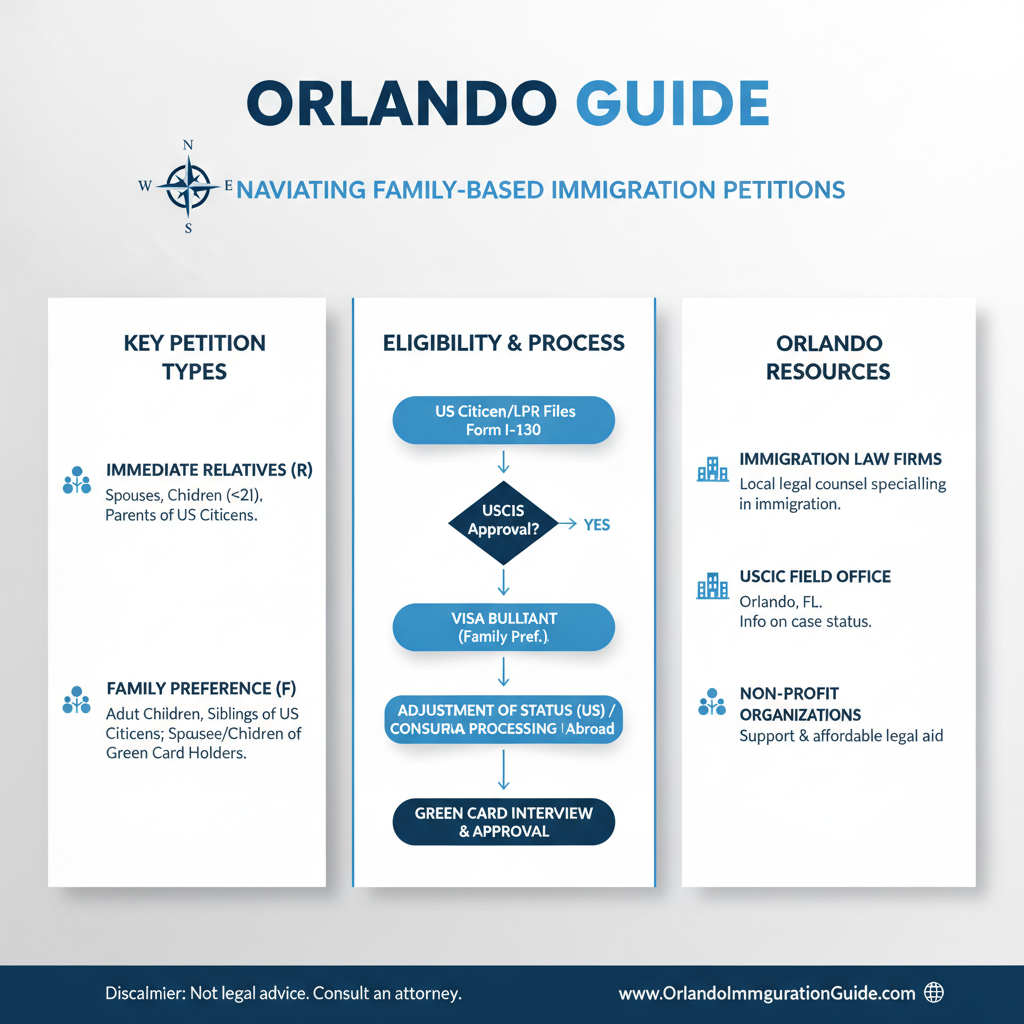
The constant stream of news surrounding immigration law highlights the ongoing need for clear, reliable information. The topic of family-based immigration petitions is a perennial focus, reflecting its fundamental role in the U.S. immigration system. This guide is inspired by the continuous public interest in understanding and successfully navigating these vital pathways to family reunification.
Family-Based Immigration Petition Guide (Immigration)
What This News Means for Immigrants in Orlando and Across Florida
The principles and procedures of family-based immigration are foundational to U.S. immigration policy. While specific laws and regulations may see minor adjustments, the core framework remains consistent. For immigrants and their families, staying informed about these fundamental processes is always relevant and crucial for successful outcomes.
Why this news is showing up now
Family-based immigration is not a new concept; it's the bedrock of the U.S. immigration system. News about family petitions consistently appears because millions of people worldwide seek to reunite with relatives in the United States. As of 2026, the demand for family visas continues to be high, and processing times, policy changes, and legislative discussions frequently bring this topic into the spotlight. Furthermore, continuous updates from government agencies like USCIS regarding form revisions, fee adjustments, or processing priorities keep the conversation active. For Imigrar, "Keep Families Together" isn't just a tagline; it's a daily commitment, making guides like this perpetually relevant.
How it can affect Florida residents
Florida, with its diverse population and vibrant immigrant communities, is significantly impacted by family-based immigration policies. Many residents across Orlando, Miami, Tampa, and other cities are either U.S. citizens or Lawful Permanent Residents (LPRs) sponsoring family members, or they are beneficiaries seeking to join their loved ones. For Central Florida residents, understanding the specific procedures, required documentation, and potential challenges is essential.
The Orlando USCIS Field Office plays a crucial role for many applicants, particularly for those undergoing the Adjustment of Status process. Local resources, community organizations, and the availability of experienced immigration attorneys like Imigrar are vital for navigating the process effectively. Changes in federal processing priorities or even state-level discussions can influence the environment for immigrants, underscoring the need for up-to-date, accurate information tailored to those living along the I-4 corridor and throughout the Sunshine State.
Need Help? Our Orlando immigration team is ready to assist. Call +1 786-791-3106 for a free consultation, or message us online. Se Habla Español.
What Family-Based Immigration Is (and Why It Matters)
Family-based immigration is the primary pathway for U.S. citizens and Lawful Permanent Residents (green card holders) to sponsor eligible family members for immigration to the United States. It's a cornerstone of American immigration policy, reflecting the country's commitment to family unity.
A plain-English definition
Simply put, family-based immigration allows certain U.S. citizens and green card holders to petition for their relatives to come and live permanently in the United States. This usually leads to the sponsored relative obtaining a green card (Lawful Permanent Resident status). The process involves proving a legitimate family relationship and ensuring the sponsor meets financial requirements to support the incoming family member.
Key terms you need to know
- Petitioner: The U.S. citizen or Lawful Permanent Resident who files the immigration petition for their family member.
- Beneficiary: The foreign national family member for whom the petition is filed.
- Green Card (Lawful Permanent Resident - LPR): Official status granted to immigrants allowing them to live and work permanently in the United States.
- Form I-130, Petition for Alien Relative: The initial form filed by the petitioner to establish the qualifying family relationship with the beneficiary.
- Priority Date: The date USCIS receives a properly filed Form I-130. This date is crucial for tracking a beneficiary's place in the visa queue, especially for preference categories.
- Visa Bulletin: A monthly publication by the U.S. Department of State that lists when immigrant visas are available for various family-based and employment-based categories, based on the beneficiary's Priority Date and country of chargeability.
- Immediate Relatives (IR): Spouses, unmarried children under 21, and parents of U.S. citizens. There are no annual visa limits for this category, meaning no wait based on the Visa Bulletin once the Form I-130 is approved.
- Family Preference Categories: Relatives of U.S. citizens and LPRs who are subject to annual visa limits and often face waiting periods based on the Visa Bulletin. These include:
- First Preference (F1): Unmarried sons and daughters (21 years of age or older) of U.S. citizens.
- Second Preference (F2A): Spouses and unmarried children (under 21 years of age) of Lawful Permanent Residents.
- Second Preference (F2B): Unmarried sons and daughters (21 years of age or older) of Lawful Permanent Residents.
- Third Preference (F3): Married sons and daughters of U.S. citizens.
- Fourth Preference (F4): Brothers and sisters of U.S. citizens (if the U.S. citizen is 21 years of age or older).
- Adjustment of Status (AOS): The process of applying for a green card while physically present in the United States. This typically involves filing Form I-485.
- Consular Processing: The process of applying for an immigrant visa at a U.S. embassy or consulate abroad if the beneficiary is outside the United States.
- Affidavit of Support (Form I-864): A legally binding document signed by the petitioner (sponsor) to accept financial responsibility for the beneficiary.
Current Immigration Law: The Foundation
Family-based immigration is primarily governed by the Immigration and Nationality Act (INA). Key sections of the INA, such as Section 201 and 203, define who is eligible for immediate relative visas and the various family preference categories, respectively. Section 204 outlines the petitioning process. Understanding these legal underpinnings is crucial for a successful application.
You can find detailed information and the latest updates on the USCIS official website.
Federal requirements
To qualify for family-based immigration, several federal requirements must be met:
- Qualifying Relationship: The petitioner must prove a legitimate familial relationship with the beneficiary that falls into one of the immediate relative or family preference categories defined by the INA.
- U.S. Citizens can petition for: spouses, unmarried children under 21, married children of any age, unmarried children 21 or older, parents (if the U.S. citizen is 21 or older), and brothers/sisters (if the U.S. citizen is 21 or older).
- Lawful Permanent Residents (LPRs) can petition for: spouses and unmarried children of any age.
- Financial Sponsorship: The petitioner must demonstrate the financial ability to support the beneficiary at 125% of the federal poverty guidelines for their household size. This is typically done by filing Form I-864, Affidavit of Support. If the petitioner's income is insufficient, a joint sponsor may be required.
- Admissibility: The beneficiary must be admissible to the United States, meaning they must not have any grounds of inadmissibility (e.g., certain criminal convictions, health issues, prior immigration violations). Waivers may be available for some grounds of inadmissibility.
- Proper Forms and Documentation: All required forms, such as Form I-130 and Form I-485 (if adjusting status), must be correctly filled out and submitted with all supporting documentation and fees.
Important: The annual numerical limits for family preference categories mean that beneficiaries in these categories may face significant wait times based on their country of birth and Priority Date, as indicated in the monthly Visa Bulletin published by the U.S. Department of State.
Florida-specific considerations
While immigration law is federal, certain aspects touch upon Florida residents more directly:
- USCIS Field Office in Orlando: For those in Central Florida, interviews for Adjustment of Status (Form I-485) are typically conducted at the Orlando USCIS Field Office. Familiarity with this office's procedures and local traffic patterns can be helpful.
- Local Resources: Florida has numerous non-profit organizations and community groups that provide support and resources to immigrant families, sometimes offering assistance with document translation or legal referrals.
- Healthcare Access: Florida's healthcare system requires navigating for new immigrants. Understanding eligibility for state-specific programs (though often limited for new immigrants) or private insurance options is critical.
- Driver's Licenses: Once green card status is obtained, Florida residents will need to apply for a Florida driver's license at the Department of Highway Safety and Motor Vehicles (DHSMV).
Navigating these local nuances, alongside the federal requirements, can be smoother with the guidance of an experienced Orlando immigration lawyer.
Need Help? Our Orlando immigration team is ready to assist. Call +1 786-791-3106 for a free consultation, or message us online. Se Habla Español.
How to Petition for a Family Member: A Complete Step-by-Step Guide
The family-based immigration process can be lengthy and complex. This guide outlines the typical steps involved, whether your family member is applying from within the U.S. (Adjustment of Status) or from abroad (Consular Processing).
1) File Form I-130, Petition for Alien Relative
This is the crucial first step. The U.S. citizen or LPR petitioner files Form I-130 with USCIS to establish the qualifying relationship with the beneficiary.
Required Documents (Petitioner):
- Proof of U.S. citizenship (e.g., U.S. birth certificate, naturalization certificate, U.S. passport) OR proof of Lawful Permanent Resident status (e.g., copy of green card - both sides).
- Proof of name change (if applicable, e.g., marriage certificate, court order).
- Form I-130, Petition for Alien Relative.
- Form G-1145, E-Notification of Application/Petition Acceptance (optional, for email/text alerts).
- Filing fee (check USCIS Forms for current fees).
Required Documents (Beneficiary & Relationship Proof):
- For Spouses:
- Marriage certificate.
- Proof of bona fide marriage (e.g., joint bank accounts, joint leases/mortgages, utility bills in both names, birth certificates of common children, photos, affidavits from friends/family).
- Divorce decrees or death certificates for any prior marriages of both petitioner and beneficiary.
- For Children:
- Beneficiary's birth certificate showing names of both parents.
- Petitioner's marriage certificate (if petitioning for a stepchild).
- Proof of legitimation (if child was born out of wedlock and petitioner is the father).
- For Parents:
- Petitioner's birth certificate showing names of both parents.
- Petitioner's marriage certificate (if petitioning for a stepparent).
- For Siblings:
- Petitioner's birth certificate.
- Beneficiary's birth certificate.
- Parents' marriage certificate (to show common parentage).
- If related through one common parent only, proof of that parent's relationship to both.
Reminder: All documents not in English must be accompanied by a certified English translation.
2) USCIS Processes Form I-130 and Establishes a Priority Date
After filing, USCIS will send a receipt notice (Form I-797C, Notice of Action), acknowledging receipt of your petition. This notice will contain your Priority Date. USCIS then reviews the petition to determine if the familial relationship is valid.
- Immediate Relatives (IR): Once Form I-130 is approved, there is no further wait time due to visa availability. The beneficiary can proceed to the next step (Adjustment of Status or Consular Processing).
- Family Preference Categories: The Priority Date becomes critical. The beneficiary must wait until their Priority Date becomes "current" according to the Visa Bulletin.
Important: USCIS processing times vary significantly. You can check current processing times on the USCIS Processing Times page.
3) Visa Availability: The Visa Bulletin (for Preference Categories)
If the beneficiary is in a family preference category (F1, F2A, F2B, F3, F4), their application cannot proceed until their Priority Date is current. This is determined by the monthly Visa Bulletin, published by the U.S. Department of State.
- Monitor the Visa Bulletin monthly. When the "Final Action Dates" chart or "Dates for Filing" chart (depending on the stage) for your category and country of chargeability shows a date later than your Priority Date, your visa is considered available.
- For beneficiaries outside the U.S., the National Visa Center (NVC) will contact them when their Priority Date is current and begin the immigrant visa pre-processing.
4) Applying for the Green Card: Adjustment of Status or Consular Processing
Once Form I-130 is approved and a visa is available (if applicable), the beneficiary can apply for their green card.
Option A: Adjustment of Status (if beneficiary is in the U.S.)
If the beneficiary is lawfully present in the U.S. and an immigrant visa is immediately available (or if they are an Immediate Relative), they can file Form I-485, Application to Register Permanent Residence or Adjust Status.
Required Documents (Beneficiary for AOS):
- Form I-485, Application to Register Permanent Residence or Adjust Status.
- Copy of the approved Form I-130 (or filed concurrently if Immediate Relative).
- Form I-864, Affidavit of Support, signed by the petitioner, along with their tax returns and proof of income/assets.
- Form I-693, Report of Medical Examination and Vaccination Record (completed by a USCIS-approved civil surgeon).
- Form I-765, Application for Employment Authorization (optional, can be filed concurrently with Form I-485 to get a work permit while waiting).
- Form I-131, Application for Travel Document (optional, can be filed concurrently for advance parole to travel abroad).
- Birth certificate.
- Passport photos.
- Copy of passport biographical page and visa stamp.
- Copies of all I-94 arrival/departure records.
- Proof of continuous lawful presence since last entry (e.g., student visas, work visas, entry stamps).
- Police clearances (if required).
- Certified copies of court records for any arrests or convictions (even if dismissed).
- Filing fees for Form I-485, Form I-765, Form I-131 (if filed concurrently) and biometrics fee.
Warning: Filing Form I-485 if you entered the U.S. unlawfully or have certain immigration violations can lead to denial. Consult an attorney before filing.
Option B: Consular Processing (if beneficiary is outside the U.S.)
If the beneficiary is outside the U.S. or ineligible for Adjustment of Status, their case will be processed through the National Visa Center (NVC) and a U.S. embassy or consulate in their home country.
Required Documents (Beneficiary for Consular Processing):
- Payment of NVC fees (Affidavit of Support fee and Immigrant Visa Application fee).
- Form DS-260, Immigrant Visa Application (completed online).
- Form I-864, Affidavit of Support, signed by the petitioner, along with their tax returns and proof of income/assets.
- Beneficiary's birth certificate.
- Marriage certificate (if applicable).
- Divorce decrees or death certificates for any prior marriages.
- Police certificates from all countries lived in for specified periods.
- Court and prison records (if applicable).
- Military records (if applicable).
- Passport biographical page.
- Passport photos.
- Medical examination results from an authorized panel physician in their home country.
Reminder: The NVC will provide specific instructions on submitting documents. The medical exam is typically done closer to the interview date.
5) Interview
Whether applying for Adjustment of Status in the U.S. or Consular Processing abroad, an interview is generally required.
- AOS Interview (Orlando USCIS Field Office): The petitioner and beneficiary typically attend together. An officer will ask questions about their relationship and background to verify the information provided in the petition and application.
- Consular Interview (U.S. Embassy/Consulate Abroad): The beneficiary attends the interview. The consular officer will review documents and ask questions to determine eligibility and admissibility.
Important: Bring all original documents and copies to the interview, even if you submitted them previously. Be honest and consistent in your answers.
6) Decision and Green Card Issuance
If the interview is successful and all requirements are met, the application will be approved.
- For AOS: USCIS will mail a notice of approval, and the green card will typically arrive within a few weeks.
- For Consular Processing: The beneficiary will receive an immigrant visa stamp in their passport. They must enter the U.S. before the visa expires. The physical green card will then be mailed to their U.S. address after entry.
Practical Steps You Can Take Today
Starting the family-based immigration process can feel overwhelming, but taking proactive steps can significantly streamline your journey. Here's what you can do:
Actionable checklist
- Gather Key Documents: Start collecting birth certificates, marriage certificates, divorce decrees, passports, and any other identity or relationship documents for both the petitioner and beneficiary. Ensure they are current and valid.
- Assess Financial Eligibility: Review the USCIS Poverty Guidelines to determine if the petitioner meets the income requirements for the Affidavit of Support (Form I-864). If not, consider a joint sponsor.
- Review Prior Immigration History: Compile a detailed history of both the petitioner's and beneficiary's immigration entries, exits, visas, and any prior applications or interactions with immigration authorities. This helps identify potential issues early.
- Understand Your Category: Clearly identify whether the beneficiary falls under an Immediate Relative or a specific Family Preference category. This will dictate potential waiting times.
- Check USCIS Fees: Verify the most current filing fees for Form I-130, Form I-485, and associated forms on the USCIS Forms page. Fees can change periodically.
Document preparation guidance
- Organize Everything: Create a system for organizing your documents (e.g., binders, digital folders). Label everything clearly.
- Copies and Originals: Always keep original documents safe and submit only copies unless USCIS specifically requests originals. For interviews, bring originals.
- Certified Translations: Any document not in English MUST be accompanied by a complete and accurate English translation, certified by the translator. The certification must include a statement that the translator is competent to translate and that the translation is accurate.
- Photographs: Ensure all passport-style photos meet USCIS specifications (2x2 inches, white background, no glasses, etc.).
Timeline expectations
Family-based immigration timelines vary widely based on the relationship category, the beneficiary's country of birth, and current USCIS/NVC workloads. While precise predictions are impossible, here's a general idea:
- Immediate Relatives (Spouses, Unmarried Children Under 21, Parents of U.S. Citizens):
- Form I-130 processing: Typically 6-18 months.
- Adjustment of Status (Form I-485) processing (concurrent filing possible): Can add another 8-24 months after I-130 approval.
- Consular Processing: Once I-130 is approved, NVC processing and interview scheduling can take 6-12 months.
- Family Preference Categories (F1, F2A, F2B, F3, F4):
- Form I-130 processing: Similar to Immediate Relatives (6-18 months).
- Visa Availability Wait Time: This is the longest part. Depending on the category and country, this could range from 2 years (e.g., F2A for some countries) to over 20 years (e.g., F4 for countries like Mexico or the Philippines). You must consult the Visa Bulletin for current estimates.
- Once the Priority Date is current, the subsequent processing (AOS or Consular Processing) generally follows the timelines for Immediate Relatives.
Warning: These are estimates only. Processing times can change without notice. The best way to stay informed is to regularly check the USCIS Processing Times page and the monthly Visa Bulletin.
How Imigrar Helps Immigrants in Orlando
At Imigrar, we are dedicated to simplifying the complex immigration journey for families in Orlando, Central Florida, and across the nation. We understand the emotional and practical stakes involved in seeking to "Keep Families Together."
Our team of experienced immigration lawyers provides comprehensive legal support throughout the entire family-based immigration process. From the initial filing of Form I-130 to navigating the Visa Bulletin, preparing for interviews at the Orlando USCIS Field Office, and ultimately securing a green card, we are with you every step of the way.
We pride ourselves on our meticulous attention to detail, ensuring all forms are correctly filled out, all necessary documentation is submitted, and all deadlines are met. We anticipate potential challenges and proactively work to mitigate them, providing clear communication and personalized strategies tailored to your unique situation.
Don't face the U.S. immigration system alone. Let our expertise guide you. We offer a free consultation to discuss your specific case, assess your eligibility, and outline a clear path forward. Our firm is proud to serve a diverse community, and we are fluent in both English and Spanish.
Se Habla Español.
Need Help? Our Orlando immigration team is ready to assist. Call +1 786-791-3106 for a free consultation, or message us online. Se Habla Español.

Frequently Asked Questions
Q: Who is eligible to be a petitioner for family-based immigration?
A: Only U.S. citizens and Lawful Permanent Residents (green card holders) can be petitioners. U.S. citizens can petition for a wider range of relatives (spouses, unmarried children under 21, married children, unmarried children 21+, parents, siblings). LPRs can petition for spouses and unmarried children of any age. The petitioner must be at least 21 years old to petition for parents or siblings.
Q: How does the beneficiary's current immigration status affect the process?
A: The beneficiary's current status is critical. If they are in the U.S. and maintained lawful status, they might be eligible for Adjustment of Status (filing Form I-485). If they entered without inspection, overstayed a visa for a long period, or have other immigration violations, they may be subject to bars of inadmissibility, requiring them to leave the U.S. for Consular Processing and potentially apply for a waiver. This is a complex area where legal advice is essential.
Q: What are the typical timelines for family-based petitions?
A: Timelines vary greatly. For Immediate Relatives (spouses, minor children, parents of U.S. citizens), the process can take 1.5 to 3 years from start to finish, assuming no complications. For Family Preference Categories, the wait can be much longer, often ranging from 2 to over 20 years, depending on the category and the beneficiary's country of birth due to annual visa limits. The monthly Visa Bulletin is the key to tracking these wait times. You can check USCIS Processing Times for current estimates.
Q: What documents are absolutely essential for a family petition?
A: At a minimum, you will need proof of the petitioner's U.S. citizenship or LPR status,


