


At Imigrar, our mission is simple: "Keep Families Together." We understand that for many, the dream of living and thriving in the United States begins with reuniting with loved ones. Family-based immigration petitions are the cornerstone of this process, providing a pathway for U.S. citizens and lawful permanent residents to sponsor their eligible relatives for green cards.
Navigating the intricacies of U.S. immigration law can be overwhelming. The forms are complex, the requirements are strict, and the waiting times can be long. That's why we’ve created this comprehensive guide, drawing on the latest information and our deep expertise, to help you understand every step of the family-based immigration petition process.
Need Help? Our Orlando immigration team is ready to assist. Call +1 786-791-3106 for a free consultation, or message us online. Se Habla Español.
The reporting that sparked this guide
The constant flow of information regarding immigration procedures can be daunting. Recent discussions and queries across various platforms highlight the ongoing need for clear, actionable guidance on family-based immigration. This evergreen topic remains at the forefront of many families' concerns, leading to frequent searches and news coverage around the process of family reunification. This guide is inspired by the continuous demand for reliable information on this vital pathway:
Family-Based Immigration Petition Guide (Immigration)
What This News Means for Immigrants in Orlando and Across Florida
Why this news is showing up now
While family-based immigration is a long-standing component of U.S. immigration law, the landscape is constantly evolving. What makes this topic "trending" isn't a sudden new law, but rather the ongoing adjustments to processing times, policy interpretations, and the sheer volume of applications. USCIS and the Department of State regularly update their procedures, forms, and most critically, their processing times. These continuous updates, coupled with periodic policy clarifications or changes in administrative focus, keep family petitions in the news cycle. For families eagerly awaiting reunification, any shift, no matter how small, can feel like significant news. Furthermore, with the current administration's focus on streamlining legal immigration pathways, discussions around family petitions are always relevant.
How it can affect Florida residents
Florida, particularly Central Florida and the Orlando metropolitan area, is home to a vibrant and diverse immigrant community. For Florida residents, especially those along the I-4 corridor in Orange County, understanding the latest in family-based immigration is crucial. Many families in Orlando have relatives abroad or non-citizen family members within the U.S. who wish to adjust their status. The state's large population of U.S. citizens and lawful permanent residents means there's a constant demand for family-based immigration services.
Local USCIS Field Offices, such as the one in Orlando, handle a significant volume of interviews for Adjustment of Status cases. The efficiency and policies of these local offices directly impact Florida residents. Moreover, Florida's position as a hub for international travel means many beneficiaries arriving via consular processing will eventually settle in our state. Staying informed ensures that Florida families can properly plan, prepare, and navigate their immigration journey, avoiding unnecessary delays or complications that could jeopardize their chances of keeping their families together.
What Family-Based Immigration Petitions Are (and Why They Matter)
A plain-English definition
A family-based immigration petition is a formal request made by a U.S. citizen or a lawful permanent resident (Green Card holder) to the U.S. government, asking permission for a qualifying foreign national relative to come to live permanently in the United States and obtain a Green Card. It's essentially the first step in a multi-stage process to bring family members together. This system is a cornerstone of U.S. immigration policy, designed to foster family unity.
Key terms you need to know
- Petitioner: The U.S. citizen or lawful permanent resident who files the immigration petition for their relative.
- Beneficiary: The foreign national relative who wishes to immigrate to the U.S.
- Green Card: Also known as a Permanent Resident Card, it grants the holder the right to live and work permanently in the United States.
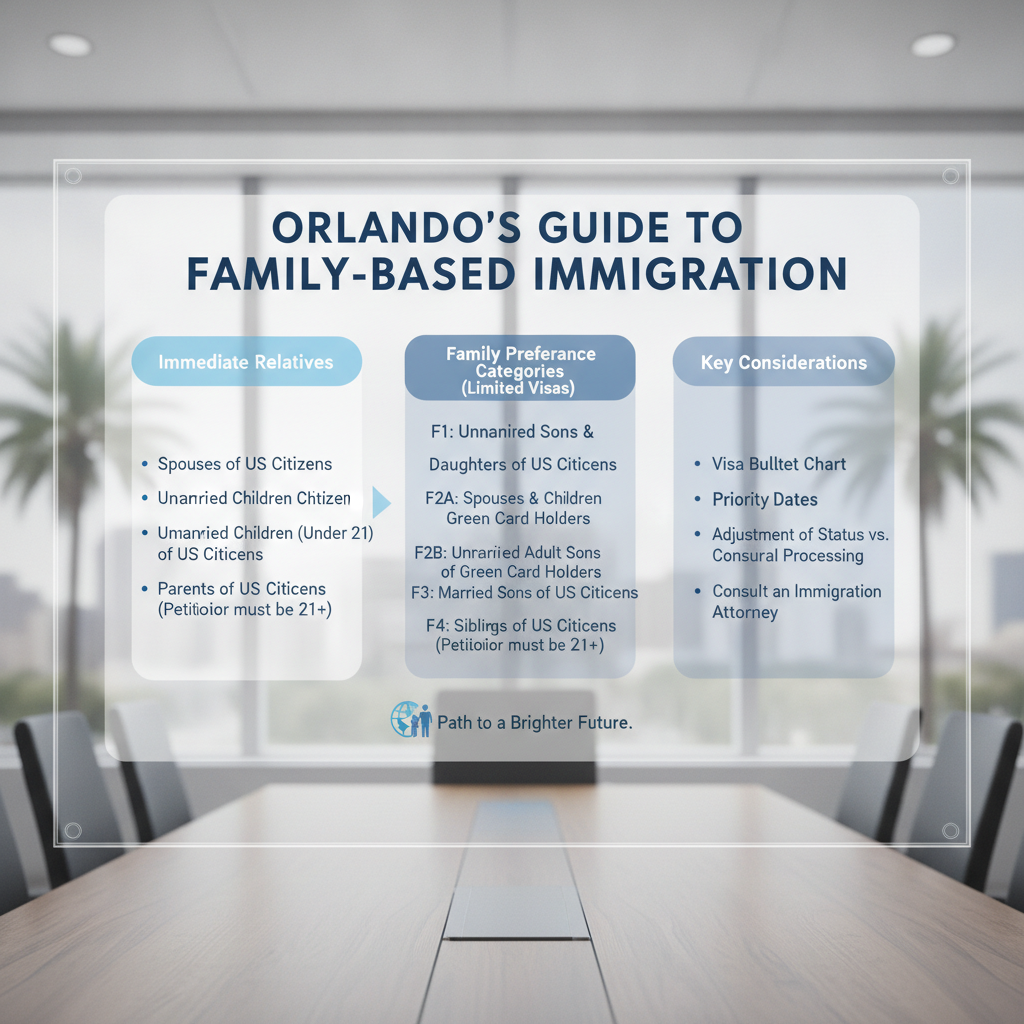
- Immediate Relative: This category includes spouses of U.S. citizens, unmarried children under 21 of U.S. citizens, and parents of U.S. citizens (if the U.S. citizen is 21 or older). There are an unlimited number of visas available for Immediate Relatives, meaning they do not have to wait for a visa number to become available once their petition is approved.
- Preference Categories: For relatives of U.S. citizens who are not Immediate Relatives, and for most relatives of lawful permanent residents, immigration is categorized into "preference categories." These categories have annual limits on the number of visas issued, leading to waiting lists.
- Priority Date: For preference categories, this is the date USCIS receives your Form I-130 petition. It determines your place in the waiting line for a visa number.
- Visa Bulletin: A monthly publication by the U.S. Department of State that lists the "cut-off dates" for each preference category, indicating whose Priority Dates are current and thus eligible to move forward with their Green Card application.
- Adjustment of Status (AOS): The process of applying for a Green Card while physically present in the United States.
- Consular Processing: The process of applying for an immigrant visa at a U.S. embassy or consulate in a foreign country. This is for beneficiaries living outside the U.S.
- Affidavit of Support (Form I-864): A legally binding document signed by the petitioner, promising to financially support the sponsored immigrant(s) if they cannot support themselves, preventing them from becoming a "public charge."
Current Immigration Law: The Foundation of Family Petitions
The legal framework for family-based immigration is primarily established under the Immigration and Nationality Act (INA). Specifically, Section 201 of the INA defines the categories of immigrants, including Immediate Relatives, while Section 203 outlines the Preference Categories for family-sponsored immigrants. These statutes dictate who can petition for whom and the numerical limitations that apply to certain categories.
Federal requirements
To file a family-based petition, both the petitioner and the beneficiary must meet specific federal requirements:
- Petitioner Eligibility: The petitioner must be a U.S. citizen or a lawful permanent resident (Green Card holder) and must be able to prove this status. They must also be able to demonstrate a valid family relationship with the beneficiary.
- Beneficiary Eligibility: The beneficiary must be related to the petitioner in one of the legally defined ways (e.g., spouse, child, parent, sibling). They must also be admissible to the U.S., meaning they do not have certain criminal records, communicable diseases, or other grounds of inadmissibility.
- Financial Sponsorship (Affidavit of Support): The petitioner must be able to demonstrate they can financially support the beneficiary(ies) at 125% of the federal poverty guidelines. This is done by filing Form I-864, Affidavit of Support. If the petitioner's income is insufficient, a joint sponsor may be required. This is a critical component to prevent the sponsored immigrant from becoming a public charge.
- Bona Fide Relationship: For spousal petitions, USCIS rigorously scrutinizes the relationship to ensure it is genuine and not entered into solely for immigration purposes. Evidence of a shared life is paramount.
For detailed information on forms and requirements, always refer to the USCIS official website.
Florida-specific considerations
While immigration law is federal, certain state-level factors can indirectly influence your case. For Florida residents, these considerations mainly revolve around documentation and local resources:
- Documentation: Birth certificates, marriage certificates, and divorce decrees issued by the State of Florida or its counties (like Orange County) must be official and often certified copies. Ensure these documents are readily available and in compliance with USCIS requirements.
- Local USCIS Field Office: If your case involves an Adjustment of Status while you reside in Central Florida, your interview will likely take place at the Orlando USCIS Field Office. Understanding local office procedures and typical wait times can be beneficial.
- Criminal Records: Any criminal history in Florida, even minor offenses, must be fully disclosed. State court records will be reviewed, and certain convictions can render a beneficiary inadmissible.
Reminder: State laws do not dictate immigration eligibility; federal law does. However, your documentation and interactions within Florida's legal system can impact your federal immigration process.
How to File a Family-Based Immigration Petition: A Complete Step-by-Step Guide
The family-based immigration process typically involves several stages, from establishing eligibility to obtaining the Green Card. Here’s a detailed breakdown:
1) Determine Eligibility and Family Category
Before filing, confirm that you (the petitioner) are a U.S. citizen or lawful permanent resident and that your relative (the beneficiary) falls into one of the eligible family categories. This is the most crucial first step, as it dictates the entire process and potential waiting times.
- U.S. Citizens can petition for:
- Spouses (Immediate Relative)
- Unmarried Children under 21 (Immediate Relative)
- Parents (if the U.S. citizen is 21 or older) (Immediate Relative)
- Unmarried Sons and Daughters 21 or older (First Preference - F1)
- Married Sons and Daughters of any age (Third Preference - F3)
- Brothers and Sisters (if the U.S. citizen is 21 or older) (Fourth Preference - F4)
- Lawful Permanent Residents (Green Card holders) can petition for:
- Spouses (Second Preference - F2A)
- Unmarried Children under 21 (Second Preference - F2A)
- Unmarried Sons and Daughters 21 or older (Second Preference - F2B)
Important: The category you fall into determines whether your relative is an "Immediate Relative" (no visa number wait) or a "Preference Category" (subject to annual visa limits and potential long waits based on the Visa Bulletin).
Required Documents (for this stage - mostly internal assessment):
- Petitioner's proof of U.S. citizenship (U.S. birth certificate, naturalization certificate, U.S. passport) or LPR status (Green Card).
- Beneficiary's birth certificate to prove relationship.
- Marriage certificate (for spousal petitions).
- Divorce decrees or death certificates for any prior marriages of both petitioner and beneficiary.
2) File Form I-130, Petition for Alien Relative
This is the initial formal step. The U.S. citizen or LPR petitioner files Form I-130 with USCIS to establish the qualifying relationship between themselves and the beneficiary.
Actions:
- Complete Form I-130 accurately and completely.
- Gather all supporting documentation to prove the relationship.
- Pay the required filing fee (currently $535, but subject to change – always check USCIS Forms & Fees).
- Mail the petition to the correct USCIS lockbox facility or file online if available for your category.
Required Documents to include with Form I-130:
- Form I-130, Petition for Alien Relative.
- Copy of Petitioner's proof of U.S. citizenship or LPR status.
- Copy of Beneficiary's birth certificate.
- Copy of Marriage Certificate (if applicable).
- Copies of divorce decrees/death certificates for any prior marriages (if applicable).
- For spousal petitions: evidence of a bona fide marriage (e.g., joint bank statements, utility bills, photos, affidavits from friends/family, birth certificates of children together).
- Passport-style photos for both petitioner and beneficiary (for spousal petitions).
- Any other relevant documents proving the relationship (e.g., adoption decrees, official name change documents).
3) Wait for I-130 Approval and Priority Date to Become Current (if applicable)
After filing, USCIS will send a receipt notice (Form I-797C, Notice of Action). They will then review the petition. If approved, you will receive an approval notice (Form I-797, Notice of Action).
- For Immediate Relatives: Once the Form I-130 is approved, the beneficiary can immediately proceed to the next step (either Adjustment of Status or Consular Processing) because a visa number is always available.
- For Preference Categories: After the Form I-130 is approved, the beneficiary must wait for their Priority Date to become current according to the monthly Visa Bulletin issued by the U.S. Department of State. This wait can be several years, depending on the category and the beneficiary's country of birth.
Important: You can check your case status and estimated processing times on the USCIS Processing Times page using your receipt number.
4) Choose the Path: Adjustment of Status or Consular Processing
Once the Form I-130 is approved and a visa number is available (if applicable), the beneficiary can apply for their Green Card. The path depends on whether the beneficiary is already in the U.S. or living abroad.
- Adjustment of Status (AOS): If the beneficiary is legally present in the U.S. and meets all eligibility requirements, they can apply for a Green Card without leaving the country. This typically involves filing Form I-485, Application to Register Permanent Residence or Adjust Status.
- Consular Processing: If the beneficiary lives outside the U.S. or is ineligible for Adjustment of Status, their case will be forwarded to the National Visa Center (NVC) for Consular Processing. They will then apply for an immigrant visa at a U.S. embassy or consulate in their home country.
Need Help? Our Orlando immigration team is ready to assist. Call +1 786-791-3106 for a free consultation, or message us online. Se Habla Español.
5) Submit Required Forms and Documents (I-485/DS-260, I-864)
This is the stage where the actual Green Card application is submitted, along with critical financial support documents.
For Adjustment of Status (Beneficiary in U.S.):
- Form I-485, Application to Register Permanent Residence or Adjust Status.
- Form I-864, Affidavit of Support (filed by the petitioner).
- Form I-693, Report of Medical Examination and Vaccination Record (completed by a USCIS-approved civil surgeon in Orlando or elsewhere).
- Form I-765, Application for Employment Authorization (optional, allows work permit while I-485 is pending).
- Form I-131, Application for Travel Document (optional, allows travel outside U.S. while I-485 is pending – Warning: Traveling without this can abandon your I-485 application).
- Copies of birth certificate, passport pages, visa, I-94 arrival record.
- Two passport-style photos.
- Police clearance certificates (if applicable).
- Certified copies of court and prison records (if applicable).
- Proof of petitioner's income (tax returns, W-2s, employment verification letter) for Form I-864.
For Consular Processing (Beneficiary abroad):
- The NVC will instruct the petitioner to pay fees and submit the Form I-864, Affidavit of Support, and supporting financial documents.
- The NVC will instruct the beneficiary to complete Form DS-260, Immigrant Visa Application, online.
- The beneficiary will submit civil documents (birth certificates, marriage certificates, police certificates, military records, etc.) to the NVC.
- Beneficiary will undergo a medical examination by an authorized panel physician in their country.
6) Attend Interview
After all documents are submitted and reviewed, an interview will be scheduled.
- For Adjustment of Status: The interview will take place at a local USCIS Field Office, such as the Orlando office for Central Florida residents. Both the petitioner and beneficiary typically attend. The interviewing officer will verify the information provided and confirm the validity of the relationship.
- For Consular Processing: The interview will take place at a U.S. embassy or consulate in the beneficiary's home country. Only the beneficiary attends, though the petitioner's presence may be requested in specific cases.
Required Documents to bring to interview:
- Originals of all documents submitted with the petition and application (birth certificates, marriage certificates, passports, etc.).
- Any additional evidence of a bona fide relationship (especially for spousal cases).
- Updated financial documents (e.g., recent pay stubs, employment verification).
- Proof of ongoing shared life (for spousal cases).
7) Receive Decision and Green Card/Visa
If the interview is successful and all requirements are met:
- For Adjustment of Status: The beneficiary's application for permanent residence will be approved, and the Green Card will be mailed to their address in the U.S.
- For Consular Processing: The beneficiary will receive an immigrant visa stamped in their passport. They will then use this visa to enter the U.S. within its validity period (usually six months), becoming a lawful permanent resident upon entry. The Green Card will be mailed to their U.S. address shortly after arrival.
Practical Steps You Can Take Today for Your Family Petition
Starting the immigration process can feel overwhelming, but taking small, organized steps can make a significant difference. Here’s an actionable checklist:
- Gather Essential Documents: Start collecting birth certificates, marriage certificates, passports, divorce decrees, and any other vital records for both the petitioner and beneficiary. Ensure they are certified copies and consider obtaining official translations if not in English.
- Verify Petitioner's Status: Double-check that the U.S. citizen or LPR petitioner has valid, unexpired proof of their status (e.g., U.S. passport, naturalization certificate, Green Card).
- Assess Financial Eligibility: Review the USCIS Poverty Guidelines (Form I-864P) to see if the petitioner's income meets the 125% threshold. If not, begin exploring options for a joint sponsor.
- Check the Visa Bulletin (if applicable): If your relative is in a preference category, start familiarizing yourself with the monthly Visa Bulletin to understand potential waiting times.
- Organize Records: Create a dedicated physical and digital folder for all immigration-related documents. Label clearly and keep copies of everything you submit.
- Seek Professional Guidance: Immigration law is complex. A free consultation with an experienced attorney, like those at Imigrar, can clarify your specific situation and prevent costly mistakes.
Document Preparation Guidance
- Accuracy is Key: Ensure all information on forms exactly matches supporting documents. Discrepancies can cause delays.
- Translations: Any document not in English must be accompanied by a complete and certified English translation. The translator must certify that they are competent to translate and that the translation is accurate.
- Copies, Not Originals (Initially): Generally, USCIS requires copies of documents, not originals, unless specifically requested. Keep your originals safe.
- Organize and Label: Use cover letters, tabs, and clear labels for each document to help the immigration officer quickly locate information.
Timeline Expectations
Timelines for family-based petitions vary significantly based on the type of relationship, the beneficiary's country of origin, and current USCIS/NVC processing loads.
- Immediate Relatives (Spouses, unmarried children under 21, parents of U.S. citizens): These cases generally have the fastest processing times because no visa number wait is involved. The Form I-130 approval can take several months to over a year. If adjusting status in the U.S., the entire process from I-130 filing to Green Card can range from 12 to 24 months, sometimes more depending on the local field office (e.g., Orlando USCIS Field Office).
- Preference Categories (F1, F2A, F2B, F3, F4): These categories involve long waits for a visa number to become available, which can range from a few years to over two decades for some countries and categories. The Form I-130 approval is just the first step; the longer wait is for the Priority Date to become current.
Reminder: Check the USCIS Processing Times page and the monthly Visa Bulletin regularly for the most up-to-date estimates.
How Imigrar Helps Immigrants in Orlando and Nationwide
At Imigrar, we are dedicated to helping families navigate the complex and often stressful journey of family-based immigration. Our Orlando-based team serves clients not just in Central Florida, but across the entire nation, offering personalized and compassionate legal representation.
- Our Experience and Expertise: Our attorneys possess extensive knowledge of U.S. immigration law and stay current with all policy changes and processing updates. We have successfully assisted countless families in filing Form I-130 petitions, Adjustment of Status applications, and Consular Processing cases.
- Personalized Guidance: We understand that every family's situation is unique. We provide tailored advice, helping you determine the correct petition category, gather the right documentation, and prepare thoroughly for interviews.
- Minimizing Delays and Denials: Our meticulous approach helps prevent common errors that lead to Requests for Evidence (RFEs) or denials, saving you time, money, and emotional distress.
- Comprehensive Support: From the initial consultation to the final Green Card approval, we are with you every step of the way, providing clear communication and peace of mind.
We believe in keeping families together, and we are here to fight for yours. We understand the cultural nuances and specific needs of our diverse community in Orlando, Kissimmee, and surrounding areas.
Se Habla Español.
Frequently Asked Questions About Family-Based Petitions
Q: Who can I petition for as a U.S. citizen vs. a lawful permanent resident?
A: As a U.S. citizen, you can petition for your spouse, unmarried children under 21, parents (if you are 21 or older), unmarried sons/daughters 21 or older, married sons/daughters of any age, and brothers/sisters (if you are 21 or older). As a lawful permanent resident, you can petition for your spouse, unmarried children under 21, and unmarried sons/daughters 21 or older. The specific categories determine whether your relative is an "Immediate Relative" or falls into a "Preference Category" with potential waiting times.
Q: How does my immigration status (U.S. Citizen vs. LPR) impact the timeline for my family petition?
A: Your status significantly impacts the timeline. If you are a U.S. citizen, your spouse, unmarried children under 21, and parents are considered Immediate Relatives and do not have to wait for a visa number to become available, leading to generally faster processing. Other relatives of U.S. citizens and all relatives of lawful permanent residents fall into Preference Categories, which have annual visa limits and can involve waits of several years (or even decades for some categories/countries) for a visa number to become current.
Q: How long does the entire family-based immigration process typically take?
A: The timeline varies greatly. For Immediate Relatives of U.S. citizens, the process can take anywhere from 12 to 24 months from filing Form I-130 to Green Card. For Preference Categories, the wait can be much longer, often ranging from 2 years to over 20 years, depending on the specific category and the beneficiary's country of birth. The wait for a visa number to become current is the longest part for these categories. Always check the USCIS Processing Times and the Visa Bulletin for the most current estimates.


