


Supreme Court Narrows Universal Injunctions in Trump v. CASA
In a major federal courts decision from the current U.S. Supreme Court Term, the Court held in Trump v. CASA, Inc. that so‑called “universal” or “nationwide” injunctions generally exceed the equitable authority Congress has granted to federal courts, and it granted the federal government’s request for a partial stay of injunctions blocking implementation of a presidential executive order ending birthright citizenship.[1]
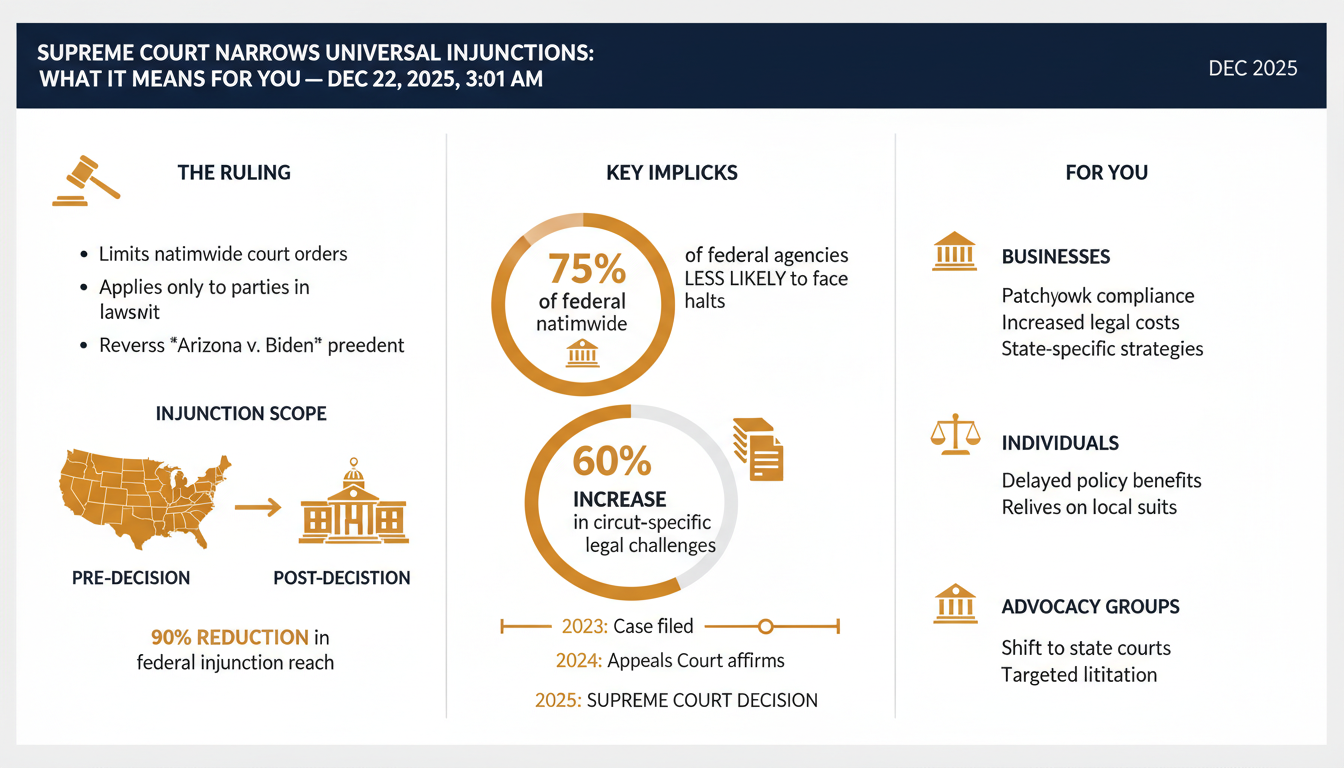
According to the National Governors Association’s summary of the 2024–2025 Supreme Court Term, the Court concluded that injunctions protecting nonparties across the country are ordinarily improper unless clearly authorized, and that lower courts must narrowly tailor relief to the parties before them.[1]
This decision reshapes how federal courts may block federal immigration, administrative, and civil-rights policies and has immediate implications for immigrants and other individuals who have relied on nationwide injunctions issued in a single case.[1]
What Is a Universal (Nationwide) Injunction?
Basic definition
A universal injunction (often called a ���nationwide injunction”) is a court order that prohibits the federal government from enforcing a law or policy against anyone—not just the plaintiffs in the lawsuit—usually on a nationwide basis.
Before Trump v. CASA, Inc., some district courts routinely issued nationwide injunctions in high‑profile immigration and administrative-law cases, effectively halting major federal policies based on a single case brought by a limited set of plaintiffs.[1]
Why universal injunctions mattered
Nationwide injunctions became prominent in cases involving:
- Immigration programs and enforcement priorities
- Presidential executive orders and agency rules
- Civil-rights protections affecting large populations
- Education, healthcare, and labor regulations with national scope
For many years, both Democratic and Republican administrations faced nationwide injunctions from district courts that disagreed with federal policies; the Supreme Court’s new ruling attempts to curb that practice.[1]
The Supreme Court’s Decision in Trump v. CASA, Inc.
Case background
In Trump v. CASA, Inc., advocacy organizations challenged a presidential executive order that ended recognition of birthright citizenship for certain categories of children born in the United States, arguing that the order violated the Fourteenth Amendment’s Citizenship Clause and exceeded executive authority.[1]
One or more lower federal courts issued broad injunctions preventing the federal government from implementing or enforcing the executive order nationwide, extending protection beyond the named plaintiffs and across all states.[1]
The federal government sought emergency relief in the Supreme Court, arguing that the lower courts had exceeded their authority by issuing universal injunctions rather than limiting relief to the plaintiffs.
Key holdings
As summarized by the National Governors Association, the Supreme Court held that “universal injunctions likely exceed the equitable authority that Congress has granted to federal courts” and granted the government’s request for a partial stay of the lower courts’ injunctions.[1]
Although the Court’s full opinion is not quoted in the summary, the NGA explanation indicates several core principles:[1]
- Injunctive relief should ordinarily be limited to the parties before the court.
- District courts must tailor remedies to redress the specific injuries shown by plaintiffs, not hypothetical or future injuries to nonparties.
- Universal injunctions that bind the federal government with respect to everyone, regardless of party status or location, are generally beyond the courts’ statutory equitable authority unless Congress clearly authorizes such relief.
- Appellate courts and the Supreme Court may stay or narrow overbroad injunctions issued by lower courts.
Effect of the partial stay
By granting a partial stay, the Supreme Court allowed at least some implementation of the executive order ending birthright citizenship to go forward while litigation continues, though the details depend on the precise contours of the stay and any remaining party‑specific protections.[1]
In practical terms, individuals not directly involved in the cases that produced the original injunctions may no longer be protected by a nationwide bar on enforcement of the executive order.
Legal Implications of Trump v. CASA, Inc.
1. Narrower remedies in federal court
The ruling signals that lower federal courts must default to party‑specific injunctions and justify any broader relief with clear statutory or constitutional authority.[1]
Instead of immediately blocking a federal policy nationwide, courts are more likely to:
- Restrict enforcement against the named plaintiffs only
- Issue geographically narrower relief tied to the court’s jurisdiction
- Rely on class actions to extend relief to clearly defined groups when appropriate
2. Increased importance of class actions
Because universal injunctions are disfavored, civil-rights and immigration advocates may respond by more frequently seeking certification of plaintiff classes under Federal Rule of Civil Procedure 23.
A certified nationwide class can, in some circumstances, lawfully obtain broad relief covering all class members, which may achieve many of the same practical effects as a former nationwide injunction but with clearer procedural safeguards.
3. Forum shopping becomes less powerful
One reason nationwide injunctions sparked controversy is that litigants could “shop” for a favorable district court and secure an order halting federal policy across the country.[1]
By limiting universal injunctions, the Supreme Court reduces the ability of a single judge, in any one district, to control national policy for everyone, at least on an emergency basis.
4. Higher stakes for Supreme Court emergency review
The decision comes in a Term where the Supreme Court has actively used its emergency docket to address disputes involving immigration enforcement and other executive actions.[1]
Going forward, the Court may more quickly stay or narrow any lower‑court injunctions that appear to extend beyond the parties, especially in politically sensitive areas like immigration and national security.
5. Uncertainty for individuals relying on prior nationwide orders
Individuals who previously benefited from broad injunctions—without being named plaintiffs—now face greater uncertainty. Protection will often depend on:
- Whether they are parties or class members in existing litigation
- Whether their jurisdiction has specific, local relief in place
- How quickly new cases are filed and classes are certified
Implications for Immigrants and Mixed-Status Families
Birthright citizenship challenges
The executive order at issue in Trump v. CASA, Inc. attempts to restrict or end birthright citizenship for some children born in the United States to non‑citizen parents, a direct challenge to long‑standing interpretations of the Fourteenth Amendment.[1]
Although the constitutionality of such a measure will ultimately turn on the Court’s merits decision, the immediate effect of limiting universal injunctions is that:
- Not all potentially affected children are automatically covered by a nationwide bar on enforcement.
- Legal status questions may differ from state to state while litigation proceeds.
- Hospitals, state agencies, and local officials could confront inconsistent federal guidance and evolving policies.
Practical risks for families
Families may face, among other issues:
- Disputes over issuance of U.S. birth certificates and passports
- Questions about eligibility for federal benefits tied to citizenship
- Heightened scrutiny in immigration and consular processing based on parental status
Because injunctions are narrower, a family that is not part of a specific lawsuit might not share in any protection that a court grants to the plaintiffs.
Implications for States, Agencies, and Employers
State and local governments
The NGA summary notes that this Term included multiple cases affecting the scope of federal and state powers, including disputes over injunctions and executive authority.[1]
For state and local governments, narrowing universal injunctions means:
- Less reliance on a single nationwide court order to resolve conflicts with federal policy
- Greater need for coordinated, multi‑state litigation strategies
- Potentially divergent obligations in different federal circuits while cases are pending
Federal agencies and regulated entities
For federal agencies and regulated parties (such as large employers, universities, and healthcare systems):
- Policies may be enforceable in some jurisdictions but not in others, increasing compliance complexity.
- Agencies may issue interim guidance acknowledging geographically limited injunctions.
- Risk assessments must account for patchwork enforcement and accelerated appellate review.
What This Means for Individuals: Actionable Steps
If you are concerned about birthright citizenship or immigration status
Individuals and families potentially affected by the executive order or related policies should take proactive steps:
- Confirm documentation: Ensure you have certified copies of birth certificates, passports, and any prior USCIS or State Department decisions documenting U.S. citizenship or lawful status.
- Consult an immigration attorney: Because protection may no longer be nationwide, ask a qualified immigration lawyer whether litigation in your jurisdiction offers any injunctive relief that may apply to you.
- Track your case status: If you or your child are part of a pending lawsuit or class action, monitor court filings to understand what relief remains in effect and whether it protects you as a named party or class member.
- Avoid relying on headlines alone: Media reports about “blocked” or “reinstated” policies may not reflect the narrower, party‑specific nature of relief after Trump v. CASA, Inc..
If you are part of a civil-rights or advocacy organization
Legal and advocacy groups should adjust litigation strategy in light of the ruling:
- Evaluate class certification early: Consider whether your case should be filed as a putative class action from the outset to allow broader, but properly structured, relief.
- Coordinate across jurisdictions: Multi‑state or multi‑district litigation can help mitigate the loss of a single nationwide injunction.
- Develop evidence of widespread harm: Detailed records showing systemic impact can support the argument for class-wide relief or broader, carefully justified injunctions.
- Prepare for rapid appellate review: Expect the federal government to seek emergency stays quickly; design your record and briefing to withstand accelerated scrutiny.
If you are an employer, school, or healthcare provider
Entities that serve large immigrant or mixed‑status populations should implement compliance and risk‑management measures:
- Update internal policies: Ensure your HR, admissions, and intake procedures reflect any changes in federal guidance following the executive order and subsequent court rulings.
- Train staff: Provide staff with clear instructions on handling documentation and inquiries where citizenship or immigration status is relevant.
- Develop contingency plans: Prepare for scenarios where federal policy shifts rapidly as different courts issue or narrow injunctions.
- Coordinate with counsel: Work with counsel experienced in immigration and federal regulatory compliance to interpret overlapping federal and state obligations.
Relevant Legal Authorities and How to Monitor Them
Supreme Court and federal appellate dockets
The Supreme Court’s official website and major legal reporting services track new opinions, emergency orders, and argument calendars for each Term.[5][2]
In addition, summaries like the National Governors Association’s Term overview provide accessible analyses of how key decisions, including Trump v. CASA, Inc., affect the balance of powers between federal and state governments.[1]
Key case citations
- Trump v. CASA, Inc., U.S. Supreme Court, 2024–2025 Term (decision addressing limits on universal injunctions and granting partial stay of lower‑court injunctions against the executive order ending birthright citizenship).[1]
While the full text of the Court’s opinion must be consulted for exact language and controlling holdings, authoritative summaries confirm that the decision substantially narrows federal courts’ authority to issue universal injunctions and emphasizes party‑specific relief as the default.[1]
Practical Guidance: How to Protect Your Rights Now
Step 1: Get individualized legal advice
Because injunctions are less likely to automatically protect nonparties nationwide, your legal rights may differ from someone in another state or in a different lawsuit. A personalized consultation can clarify:
- Whether any existing court order directly covers you or your family
- What risks you face under the executive order and related policies
- What actions—such as applying for documentation or filing a petition—might help secure your status
Step 2: Document your eligibility and history
For individuals potentially affected by changes to birthright citizenship or immigration enforcement:
- Gather evidence of residence and physical presence in the United States.
- Maintain records of parents’ immigration status at the time of birth.
- Keep copies of prior government communications that recognize citizenship or lawful status.
These documents may be critical in both administrative processes and litigation challenging any denial of rights.
Step 3: Stay informed but verify
Follow reliable legal updates from bar associations, established legal news outlets, and official court sources. Always verify whether any reported injunction:
- Applies nationwide or only within certain jurisdictions
- Covers all individuals or only specific parties or certified classes
- Has been stayed, modified, or reversed on appeal
Step 4: Consider strategic participation in litigation
In some circumstances, joining an existing lawsuit or class action may be appropriate. Factors to consider with your attorney include:
- Whether the case addresses the specific policy affecting you
- The relief requested (individual, class‑wide, or otherwise)
- The jurisdiction’s prior approach to injunctive relief
How an Immigration Law Firm Can Help
Individual case assessment
An experienced immigration law firm can evaluate how Trump v. CASA, Inc. and related executive actions intersect with your particular circumstances, including citizenship claims for U.S.


