


What This News Means for Immigrants in Orlando and Across Florida
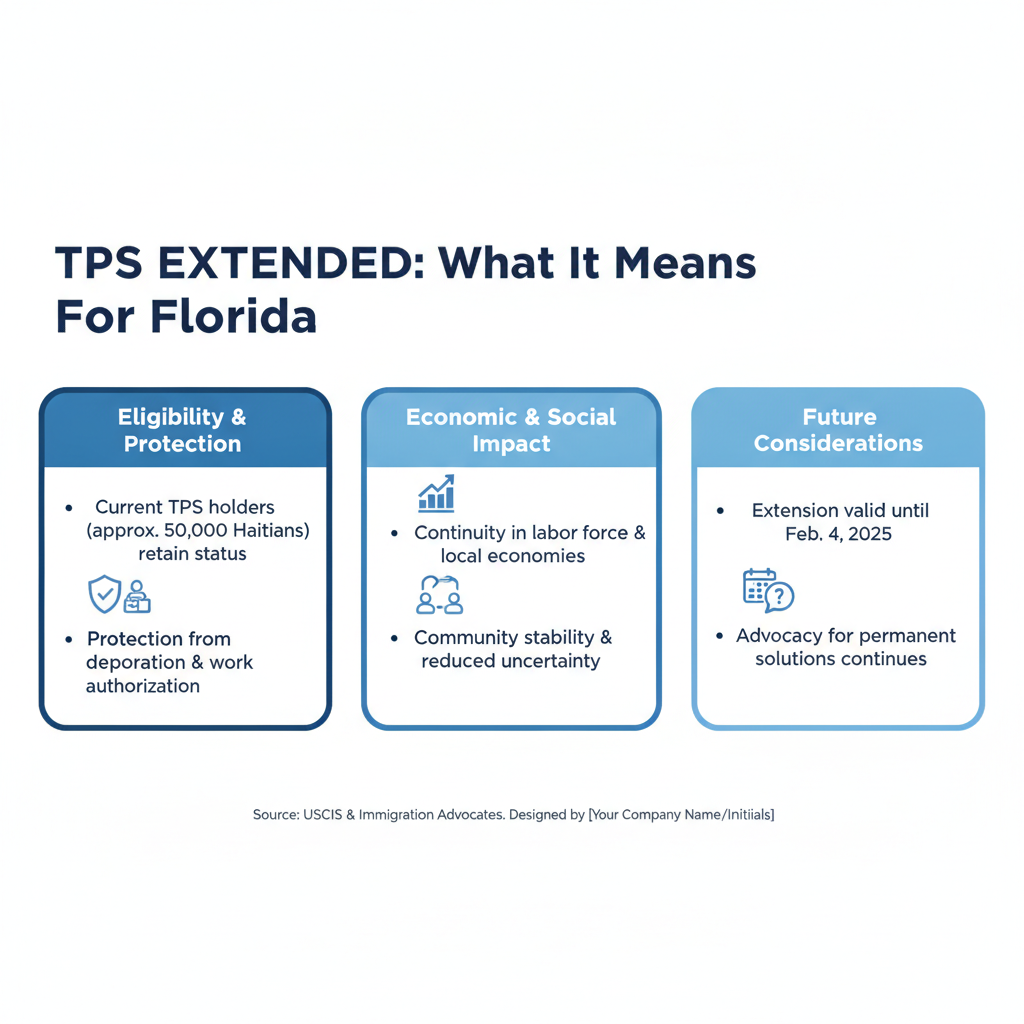
Why this news is showing up now
Temporary Protected Status is, by its very nature, temporary. Designations are granted to countries experiencing conditions that prevent their nationals from returning safely, such as ongoing armed conflict, environmental disasters, or other extraordinary and temporary conditions. The Secretary of Homeland Security periodically reviews these country conditions to determine whether to extend, redesignate, or terminate TPS for each country. When conditions in a designated country have not improved sufficiently to allow for the safe return of its nationals, DHS typically announces an extension of the TPS designation. This decision process involves careful consideration of reports from the U.S. Department of State, humanitarian organizations, and other government agencies. The news of a TPS extension surfacing now signifies that, for the countries involved, the U.S. government has assessed that the conditions warranting TPS continue to exist. These announcements are critical because they provide a window for current TPS beneficiaries to re-register and maintain their protected status, including their work authorization, for an additional period.How it can affect Florida residents
Florida is home to a significant and diverse immigrant population, including many individuals from countries currently or previously designated for TPS. For residents across Central Florida, from Orange County to the surrounding areas, an extension of TPS can have profound effects:- Continued Protection from Deportation: The most immediate benefit is the continued protection from removal from the United States. This allows individuals and families to remain together, avoiding the fear and uncertainty of potential deportation.
- Work Authorization: TPS beneficiaries are eligible for an Employment Authorization Document (EAD), which allows them to legally work in the U.S. An extension means they can continue to renew their EAD, maintaining their ability to support themselves and their families. For many, this is their sole means of legal employment.
- Travel Authorization: With an approved Form I-131, Application for Travel Document (Advance Parole), TPS beneficiaries can request permission to travel outside the U.S. and return, provided they meet specific criteria. An extension of TPS means this option remains available.
- Family Stability: The ability to live and work legally in the U.S. without fear of deportation brings immense stability to families. Children can continue their education without disruption, and families can plan for their future with greater certainty.
- Economic Contribution: TPS beneficiaries are integral parts of Florida’s economy, working in various sectors from agriculture and hospitality to healthcare and construction. Their continued legal status allows them to contribute to local economies, including those in Orlando and along the I-4 corridor.
Need Help? Our Orlando immigration team is ready to assist. Call +1 786-791-3106 for a free consultation, or message us online. Se Habla Español.
What Temporary Protected Status (TPS) Is (and Why It Matters)
Temporary Protected Status (TPS) is a humanitarian immigration program established by the U.S. Congress to provide temporary relief to foreign nationals whose home countries are experiencing severe, unsafe conditions. It's a crucial lifeline for many, allowing them to live and work in the United States legally for a designated period.A plain-English definition
Imagine your home country is suddenly facing a devastating natural disaster, like a massive earthquake or hurricane, or is engulfed in a brutal civil war. Returning there would be dangerous, perhaps even life-threatening. The U.S. government, recognizing these dire circumstances, can designate that country for Temporary Protected Status. This means that nationals of that specific country who are already in the U.S. on a certain date can apply for TPS. If approved, they are temporarily protected from deportation, granted permission to work, and can obtain authorization to travel internationally. It is a temporary status, not a path to a Green Card or permanent residency, but it offers a critical period of safety and stability.Key terms you need to know
Navigating immigration law requires understanding specific terminology. Here are some key terms related to TPS:- Designated Country: A country for which the Secretary of Homeland Security has determined that conditions prevent its nationals from returning safely, thus making them eligible for TPS. Examples in the past have included countries like El Salvador, Haiti, Honduras, Nepal, Nicaragua, Somalia, South Sudan, Sudan, Syria, Ukraine, Venezuela, and Yemen, among others. The specific list changes over time.
- Eligibility Criteria: The specific requirements an individual must meet to be granted TPS, including continuous physical presence (CPP) and continuous residence (CR) in the U.S. since a specified date, and not having certain criminal convictions or other disqualifying factors.
- Initial Registration: The first period during which nationals of a newly designated country can apply for TPS.
- Re-registration Period: A specific window of time, usually 60 days, during which current TPS beneficiaries must file their application to extend their TPS and work authorization when a country's designation is extended. Missing this deadline can have serious consequences.
- Employment Authorization Document (EAD): Often referred to as a "work permit," this document (Form I-766) allows TPS beneficiaries to legally work in the United States.
- Advance Parole: A document (Form I-512L) issued by USCIS that grants permission to certain non-citizens, including TPS beneficiaries, to travel outside the U.S. and return without jeopardizing their immigration status. Applying for Advance Parole is done using Form I-131.
- Continuous Physical Presence (CPP): Refers to being physically present in the U.S. without leaving since a specific date set by the TPS designation. Brief, casual, and innocent departures do not necessarily break CPP.
- Continuous Residence (CR): Refers to having maintained a residence in the U.S. since a specific date, even if there were brief departures.
Current Immigration Law: The Foundation of TPS
Temporary Protected Status is rooted in federal immigration law, specifically the Immigration and Nationality Act (INA). It is a program administered by the U.S. Department of Homeland Security (DHS) through U.S. Citizenship and Immigration Services (USCIS).Federal requirements
The authority for TPS is found in Section 244 of the Immigration and Nationality Act (INA), 8 U.S.C. § 1254a. This section grants the Secretary of Homeland Security the power to designate a foreign country for TPS if certain conditions exist. These conditions include:- Ongoing armed conflict within the state, posing a serious threat to the personal safety of nationals if returned.
- A natural disaster (e.g., earthquake, hurricane, flood) resulting in a substantial, but temporary, disruption of living conditions, and the foreign state is unable to handle the return of its nationals adequately.
- Other extraordinary and temporary conditions in the foreign state that prevent nationals from returning safely.
- Be a national of a country designated for TPS (or a person without nationality who last habitually resided in that country).
- Have been continuously physically present (CPP) in the U.S. since the effective date of the most recent TPS designation for their country.
- Have been continuously residing (CR) in the U.S. since a date specified by the Secretary of Homeland Security for their country's designation.
- Apply for TPS during the initial registration period or during any extension's re-registration period. Failure to apply within the designated window can result in denial, unless there are good cause exceptions.
- Not be inadmissible under certain grounds (e.g., certain criminal convictions, national security grounds).
- Not have been convicted of any felony or two or more misdemeanors committed in the U.S.
- Not be subject to certain bars to asylum.
Florida-specific considerations
While TPS is a federal program, its implementation touches individuals at the local level. For residents of Florida, especially those in Orlando and the surrounding areas:- Application Processing: All TPS applications, including Form I-821 (Application for Temporary Protected Status), Form I-765 (Application for Employment Authorization), and Form I-131 (Application for Travel Document), are processed by U.S. Citizenship and Immigration Services (USCIS) service centers, not state or local agencies.
- Biometrics Appointments: Applicants in Florida may be required to attend a biometrics appointment at a local Application Support Center (ASC), such as the one serving the Orlando area. This appointment is for collecting fingerprints, photographs, and signatures.
- Local Field Office Interaction: While most TPS processing is handled centrally, some complex cases or interviews might involve the Orlando USCIS Field Office.
- Community Impact: The large number of immigrants from TPS-designated countries residing in Florida means that extensions directly impact local communities, schools, and economies.
Need Help? Our Orlando immigration team is ready to assist. Call +1 786-791-3106 for a free consultation, or message us online. Se Habla Español.
How to Re-register for TPS: A Complete Step-by-Step Guide
When the Department of Homeland Security announces an extension of TPS for a particular country, current beneficiaries must re-register during a specific window to maintain their status. This is not an automatic process. Failing to re-register correctly and on time can lead to the loss of your TPS benefits, including protection from deportation and work authorization. Here’s a detailed guide to help you navigate the re-registration process.1) Determine Your Eligibility and Re-registration Window
The first and most crucial step is to confirm that you are eligible for re-registration and to identify the specific re-registration period for your country. USCIS publishes Federal Register notices for each country’s TPS designation and extension, which detail the eligibility requirements and deadlines.- Check Official Announcements: Regularly monitor the USCIS official website for announcements regarding your country’s TPS status. Look for the Federal Register Notice that specifically addresses the extension.
- Confirm Continuous Physical Presence (CPP) and Continuous Residence (CR): Ensure you have maintained CPP and CR in the U.S. since the dates specified in your country’s designation. Minor, brief, and innocent departures may not break CPP/CR, but significant travel could.
- Verify No Disqualifying Factors: Reconfirm that you have no new felony convictions or two or more misdemeanor convictions, or other grounds of inadmissibility that would disqualify you from TPS.
- Identify the Re-registration Window: The Federal Register Notice will specify the exact start and end dates of the re-registration period, which is typically a 60-day window. Mark these dates clearly.
- Previous TPS approval notice (Form I-797).
- Proof of your nationality (e.g., passport, birth certificate with photo ID).
- Records of your entry and continuous residence in the U.S. (e.g., previous EAD, utility bills, leases, school records).
2) Gather Necessary Documents
Thorough documentation is key to a successful re-registration. Begin collecting all required supporting documents well in advance of the deadline.- Proof of Identity and Nationality:
- Passport or national identity document from your country of origin.
- Birth certificate with photo identification.
- Proof of Continuous Residence (CR) in the U.S.: Documents demonstrating your presence in the U.S. since the specified date. Examples include:
- Rental agreements, mortgage statements, utility bills (electricity, water, gas) in your name.
- Employment records (pay stubs, W-2 forms, employment letters).
- School records (transcripts, enrollment letters).
- Medical records (hospital bills, doctor's notes).
- Bank statements.
- Receipts for any services or purchases.
- Affidavits from individuals who can attest to your continuous residence (with their contact information).
- Proof of Continuous Physical Presence (CPP) in the U.S.: Similar documents to CR, focusing on physical presence.
- Photos: Two recent, identical passport-style color photographs.
- Previous TPS Documentation:
- Copy of your most recent TPS approval notice (Form I-797).
- Copy of your most recent EAD (front and back).
- Criminal Records (if applicable): If you have any arrests or convictions, you must provide certified court dispositions for each incident. Even if charges were dismissed, it's safer to include documentation.
3) Complete and File Form I-821, Application for Temporary Protected Status
This is the primary form for re-registration.- Obtain the Latest Form: Download the most current version of Form I-821 from the USCIS Forms page. Ensure it is the correct edition date for your application.
- Fill Out Accurately: Complete all sections of the form truthfully and accurately. Any discrepancies or omissions can lead to delays or denial. If a question does not apply to you, write "N/A" (not applicable).
- Sign the Form: An unsigned form will be rejected. If you are unable to sign, a legal guardian or representative may sign on your behalf, providing appropriate documentation.
- Include Filing Fee or Fee Waiver Request:
- The filing fee for Form I-821 is typically zero for re-registration, but there is usually a biometrics fee unless you are exempt or request a fee waiver. Check the current fees on the USCIS website.
- If you cannot afford the biometrics fee, you may file Form I-912, Request for Fee Waiver. Provide all required documentation to support your inability to pay.
- Assemble Your Application: Organize your application packet with the completed Form I-821, all supporting documents, and the fee/fee waiver request.
- Mail Your Application: Send your application to the correct USCIS filing address as specified in the Federal Register Notice or on the USCIS website for your country’s TPS designation. Use a mailing service that provides tracking (e.g., USPS Certified Mail, FedEx, UPS) to confirm delivery.
4) File Form I-765, Application for Employment Authorization (Optional but Recommended)
If you wish to continue working legally in the U.S., you must file Form I-765 to renew your Employment Authorization Document (EAD).- Obtain the Latest Form: Download the most current version of Form I-765 from the USCIS Forms page.
- Complete Accurately: Fill out all sections. For TPS re-registrants, your eligibility category is usually (c)(10).
- Sign the Form: An unsigned form will be rejected.
- Include Filing Fee or Fee Waiver Request:
- The filing fee for Form I-765 is typically required unless you are exempt or request a fee waiver. Check current fees on the USCIS website.
- If you cannot afford the fee, you may file Form I-912, Request for Fee Waiver, along with supporting documentation.
- Attach Supporting Documents:
- Copy of your most recent EAD (front and back).
- Copy of your TPS approval notice (Form I-797).
- Two identical passport-style photos.
- Mail Your Application: You can typically file Form I-765 concurrently with Form I-821, sending both to the same USCIS filing address. Clearly label your packet if sending multiple forms.
5) Consider Filing Form I-131 for Advance Parole (If You Plan to Travel)
If you anticipate needing to travel outside the U.S. while your TPS is active, you must apply for Advance Parole. Traveling without Advance Parole can be risky and may lead to issues upon re-entry or even abandonment of your TPS application.- Obtain the Latest Form: Download the most current version of Form I-131 from the USCIS Forms page.
- Complete Accurately: Fill out all sections, providing a clear reason for your proposed travel.
- Sign the Form: An unsigned form will be rejected.
- Include Filing Fee or Fee Waiver Request:
- There is usually a filing fee for Form I-131. Check current fees on the USCIS website.
- You may file Form I-912 for a fee waiver if eligible.
- Attach Supporting Documents:
- Copy of your TPS approval notice.
- Two identical passport-style photos.
- Documentation supporting the reason for your travel (e.g., medical emergency, family event, work trip).
- Mail Your Application: Form I-131 can often be filed concurrently with Form I-821 and Form I-765, or it can be filed separately. Ensure you send it to the correct USCIS filing address.
6) Attend Biometrics Appointment (If Required)
After USCIS receives your application, you will likely receive an appointment notice for biometrics collection at an Application Support Center (ASC).- Check Your Mail: Look for Form I-797C, Notice of Action, which will schedule your biometrics appointment.
- Attend the Appointment: It is mandatory to attend your scheduled appointment. Bring your appointment notice and a valid photo ID (e.g., passport, state ID).
- Purpose of Biometrics: At the ASC, your fingerprints, photograph, and signature will be collected. This data is used for background checks.
- Rescheduling: If you cannot attend, you must request to reschedule the appointment by following the instructions on the notice, but this can delay your application processing.
7) Track Your Application Status and Respond to RFEs
After filing, it’s essential to monitor the progress of your application and be prepared to respond to any requests from USCIS.- Receipt Notices: USCIS will send you a receipt notice (Form I-797C) for each form you filed (I-821, I-765, I-131). Keep these notices as they contain your receipt number, which you can use to track your case online.
- Online Case Status: Use the receipt number on the USCIS official website’s "Case Status Online" tool to track your application’s progress.
- Requests for Evidence (RFEs): USCIS may send you an RFE if they need more information or documents to make a decision on your case.
- Respond Promptly: An RFE will specify a deadline (usually 30-90 days) for your response. Failure to respond fully and on time can lead to denial.
- Provide All Requested Information: Carefully read the RFE and provide all requested documents and information.
- Consult an Attorney: If you receive an RFE, it is highly recommended to consult an immigration attorney to ensure your response is comprehensive and appropriate.
- Approval Notices: If your application is approved, you will receive an approval notice (Form I-797) for your TPS and, if applicable, your new EAD and Advance Parole document.

Practical Steps You Can Take Today
Navigating TPS re-registration can feel overwhelming, but taking proactive steps can significantly ease the process and increase your chances of success. Here’s an actionable checklist and practical advice for immigrants in Orlando and beyond.Actionable Checklist:
- Confirm Your Country’s Status: Check the USCIS official website for the latest Federal Register Notice regarding your country’s TPS extension and the specific re-registration window. Don't rely on rumors or unofficial sources


