

The landscape of U.S. immigration law is constantly shifting, and staying informed is crucial for immigrants and their families. Today, we delve into significant developments concerning Temporary Protected Status (TPS), a vital form of humanitarian relief that impacts hundreds of thousands nationwide, including a substantial population right here in Florida.
At Imigrar, an immigration law firm based in Orlando, Florida, our mission is to "Keep Families Together." We understand the anxiety and uncertainty that immigration changes can bring. This comprehensive guide is designed to clarify the latest TPS extension news, provide actionable steps, and offer the expert legal support you need to navigate these complex updates.
Immediate Concerns About Your TPS Status? Don't wait. Our Orlando immigration team is ready to assist. Call +1 786-791-3106 for a free consultation, or message us online. Se Habla Español.
NEWS SOURCE REFERENCE SECTION
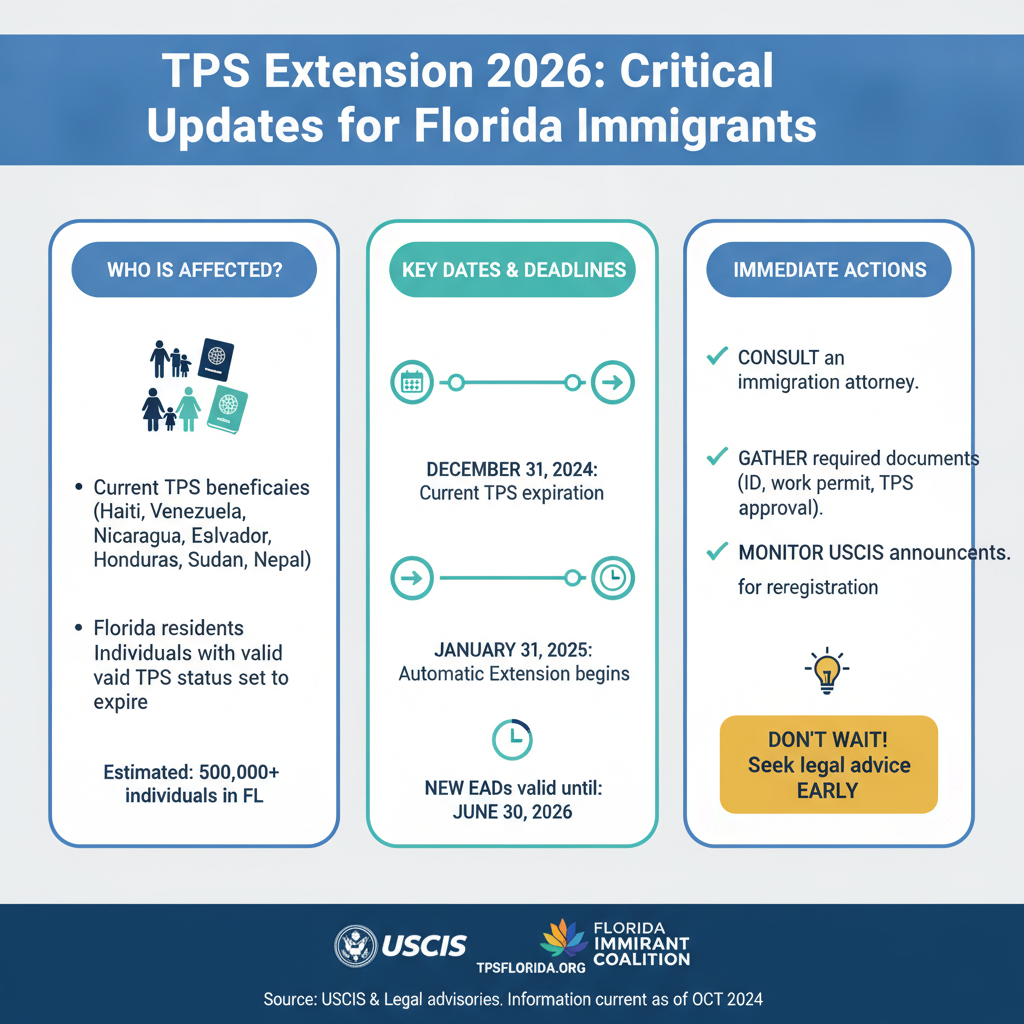
The reporting that sparked this guide: TPS (Temporary Protected Status) Extension News (Legal News)
What This News Means for Immigrants in Orlando and Across Florida
The recent news regarding Temporary Protected Status (TPS) extensions is a critical development for many immigrant communities, particularly those residing in Florida. For individuals from designated countries, these extensions often mean continued protection from deportation, the ability to work legally, and a temporary sense of stability in the United States.
Why this news is showing up now
Temporary Protected Status is, by its very nature, temporary. The Secretary of Homeland Security designates countries for TPS when conditions there prevent their nationals from returning safely. These conditions can include ongoing armed conflict, environmental disasters, or other extraordinary and temporary circumstances. The initial designation period is typically 6, 12, or 18 months, but the Secretary can extend it if the conditions persist. This means that every few months or years, depending on the country's designation cycle, the U.S. Department of Homeland Security (DHS) must review the conditions in each designated country. When conditions have not improved sufficiently, or have even worsened, DHS typically announces an extension of TPS for that country. This triggers a new re-registration period for current beneficiaries and sometimes a re-designation or new designation, which can allow new eligible individuals to apply. The news you're seeing now is a direct result of these periodic reviews and the humanitarian commitment to not return individuals to unsafe conditions.
For example, countries like El Salvador, Honduras, Nicaragua, Haiti, Nepal, Syria, and others have seen multiple extensions over the years due to persistent challenges. These extensions are not automatic; they require a formal review and announcement by the Secretary of Homeland Security, often accompanied by a Federal Register notice detailing the new deadlines and procedures. The current news cycle reflects these ongoing evaluations and the subsequent official announcements affecting specific nationalities.
How it can affect Florida residents
Florida is home to one of the largest and most diverse immigrant populations in the United States. Many individuals from TPS-designated countries have established deep roots here, contributing significantly to our economy and culture, especially in vibrant cities like Orlando and across the I-4 corridor. For these residents, a TPS extension is nothing short of life-changing.
- Continued Protection from Deportation: The most immediate and significant impact is the continued protection from removal from the United States. This means families can remain together in Florida, without the constant fear of being sent back to unsafe conditions.
- Work Authorization: An extension typically comes with an automatic extension of Employment Authorization Documents (EADs), commonly known as work permits, or the opportunity to apply for a new one. This allows TPS beneficiaries to continue working legally, supporting themselves and their families, and contributing to Florida's economy. For many, this means maintaining jobs in critical sectors across Central Florida.
- Travel Authorization: With an extension, beneficiaries may also be able to apply for Advance Parole (Form I-131), which allows them to travel outside the U.S. and return legally. This can be crucial for visiting sick relatives or attending important family events, although careful planning and legal advice are always recommended before international travel.
- Stability and Planning: For families, an extension provides a crucial period of stability. It allows parents to plan for their children's education, individuals to pursue further training, and communities to thrive without the immediate threat of disruption. This stability is particularly important in areas like Orange County, where immigrant communities are integral to the fabric of local life.
Important: It is crucial for all TPS beneficiaries in Florida to understand the specific details of any extension, including the new re-registration deadlines. Missing a deadline can jeopardize your status and protection.
What Temporary Protected Status (TPS) Is (and Why It Matters)
Temporary Protected Status (TPS) is a unique humanitarian immigration benefit in the United States. It's not a green card or a pathway to permanent residency on its own, but it offers crucial temporary relief to individuals who cannot safely return to their home countries.
A plain-English definition
Imagine your home country suddenly faces a devastating earthquake, a civil war, or a widespread epidemic. If you are already in the United States when such a crisis occurs, the U.S. government might decide it's too dangerous for you to be forced to return. That's where Temporary Protected Status (TPS) comes in. It allows eligible individuals from certain designated countries to live and work legally in the U.S. for a temporary period. It’s a protection from deportation, not a permanent immigration status. Think of it as a temporary safe harbor until conditions in your home country improve enough for you to return safely.
The decision to grant or extend TPS rests with the Secretary of Homeland Security. They assess the conditions in a country and, if the criteria are met, designate that country for TPS. This designation is reviewed periodically, which is why news of extensions and re-registration periods is common.
Key terms you need to know
Navigating immigration law requires understanding specific terminology. Here are some key terms related to TPS:
- Designated Country: A country whose nationals are eligible for TPS due to ongoing armed conflict, environmental disaster, or other extraordinary and temporary conditions. Examples include Haiti, El Salvador, Honduras, Nicaragua, Syria, and others. The list of designated countries can change.
- Beneficiary: An individual who has been granted Temporary Protected Status.
- Re-registration Period: A specific, often limited, window of time during which current TPS beneficiaries must apply to extend their status. Missing this deadline can lead to loss of TPS.
- Employment Authorization Document (EAD): Also known as a work permit, this document (Form I-765) allows TPS beneficiaries to work legally in the United States. TPS extensions often come with provisions for extending the validity of EADs.
- Advance Parole: A travel document (Form I-131) that allows a TPS beneficiary to travel outside the United States and legally return. Traveling without Advance Parole can lead to serious immigration consequences, including the loss of TPS or inadmissibility.
- Continuous Physical Presence (CPP): A requirement for TPS eligibility, meaning the applicant has been physically present in the U.S. for a specified period since the country's initial designation.
- Continuous Residence (CR): Another requirement, meaning the applicant has resided in the U.S. for a specified period since the country's initial designation.
- Secretary of Homeland Security: The head of the U.S. Department of Homeland Security (DHS), who has the authority to designate and extend TPS for countries.
- Federal Register Notice: The official publication where DHS announces TPS designations, extensions, and re-registration procedures, including specific deadlines and eligibility criteria.
Understanding these terms is fundamental to understanding your rights and responsibilities as a TPS beneficiary or applicant. At Imigrar, we ensure our clients understand every step and every term, making the process transparent and manageable.
Confused by TPS terminology or eligibility? Let our Orlando immigration attorneys simplify it for you. Call +1 786-791-3106 for a free consultation, or message us online. Se Habla Español.
Current Immigration Law: The Foundation of TPS
Temporary Protected Status (TPS) is not granted arbitrarily; it is rooted in specific U.S. immigration law, primarily the Immigration and Nationality Act (INA). Understanding the legal framework provides clarity on eligibility, process, and the authority behind these decisions.
The legal basis for Temporary Protected Status is found in Section 244 of the Immigration and Nationality Act (INA), codified at 8 U.S.C. § 1254a. This section grants the Secretary of Homeland Security the authority to designate a foreign country for TPS. The designation can occur if the Secretary finds that:
- There is an ongoing armed conflict within the state, posing a serious threat to the personal safety of nationals if they were to return.
- There has been an earthquake, flood, drought, epidemic, or other environmental disaster resulting in a substantial, but temporary, disruption of living conditions, and the foreign state is unable to handle the return of its nationals adequately.
- There exist extraordinary and temporary conditions in the foreign state that prevent nationals from returning safely, unless the Secretary finds that permitting the nationals to remain in the U.S. would be contrary to the national interest of the U.S.
Once a country is designated, eligible nationals of that country who are already in the U.S. can apply for TPS. The status is granted for an initial period of 6 to 18 months and can be extended if the conditions in the home country persist.
Federal requirements
To be eligible for TPS, applicants must meet several federal requirements:
- Nationality: Be a national of a country designated for TPS, or a person without nationality who last habitually resided in that designated country.
- Continuous Physical Presence (CPP): Have been continuously physically present in the U.S. since the effective date of the most recent TPS designation for their country.
- Continuous Residence (CR): Have been continuously residing in the U.S. since the date specified by the Secretary of Homeland Security for their country's designation.
- Admissibility: Meet admissibility requirements under U.S. immigration law. Certain criminal convictions (felonies, two or more misdemeanors) and national security grounds can render an individual ineligible.
- Timely Application: Apply for TPS during the initial registration period or any subsequent re-registration period announced by USCIS.
Warning: Individuals with certain criminal records or those who have participated in the persecution of others are generally barred from receiving TPS, regardless of their country of origin. It is crucial to be honest and transparent about your background when applying.
Florida-specific considerations
While Temporary Protected Status is a federal immigration benefit, its practical implications can vary slightly based on where you live. For Florida residents, particularly those in Orlando and the surrounding Central Florida area, several factors are worth considering:
- Access to Legal Aid: Florida has a robust network of immigration legal service providers. While Imigrar serves clients nationwide, our local presence in Orlando means we are deeply familiar with the needs of Central Florida's diverse immigrant communities. We understand the local USCIS Field Office procedures and how to best navigate the system for our clients in Orange County and beyond.
- Community Support: Florida hosts large communities from many TPS-designated countries, such as Haiti, Honduras, and El Salvador. These communities often provide vital support networks, but also highlight the critical need for accurate, timely legal information regarding TPS extensions.
- State-Level Impact: TPS status itself is federal, meaning Florida state laws do not directly affect your eligibility for TPS. However, having a valid Employment Authorization Document (EAD) based on your TPS can impact your ability to obtain a driver's license or state ID in Florida. Generally, a valid EAD is sufficient proof of lawful presence for these purposes.
- USCIS Field Offices: If your case requires an in-person interview or a biometrics appointment, you would typically report to the Orlando USCIS Field Office, or another office if you reside outside Central Florida. Understanding the local office's procedures can be beneficial.
The forms involved in applying for or re-registering for TPS are standard across the U.S.:
- Form I-821, Application for Temporary Protected Status
- Form I-765, Application for Employment Authorization (EAD)
- Form I-131, Application for Travel Document (for Advance Parole)
For official information and to download these forms, always refer to the USCIS official website. This is your primary source for accurate government information.
How to Re-register for TPS: A Complete Step-by-Step Guide
For existing TPS beneficiaries, an extension announcement means it's time to re-register. This process is critical to maintain your protected status and associated benefits, such as your work permit. Missing the re-registration deadline can lead to the loss of your TPS. Follow this detailed guide to ensure a smooth process.
1) Determine Your Eligibility and Re-registration Window
The very first step is to confirm that your country has received a TPS extension and to identify the specific re-registration period. USCIS publishes this information in a Federal Register notice and on its website.
- Verify Your Country's Status: Check the official USCIS TPS webpage or the Department of Homeland Security's (DHS) Federal Register notices for the latest announcements concerning your country.
- Note the Deadline: The re-registration window is typically 60 days. It is a strict deadline. Make sure you know the exact start and end dates.
- Confirm Continued Eligibility: Ensure you still meet all TPS eligibility criteria, including continuous physical presence and residence, and that you haven't become inadmissible due to new criminal activity or other bars to eligibility.
2) Gather Required Documents
Thorough documentation is paramount for a successful re-registration. Begin collecting these documents as soon as possible:
- Proof of Identity and Nationality:
- Copy of your passport from your designated country.
- Copy of your birth certificate with photo identification.
- Any national identity document from your country with your photograph and/or fingerprint.
- Copy of your previous TPS approval notice (Form I-797C, Notice of Action).
- Proof of Continuous Residence and Continuous Physical Presence: These are often the same documents and should cover the entire period from your country's initial designation until now. Examples include:
- Tax returns (IRS transcripts or actual returns).
- Employment records (pay stubs, W-2s, employment verification letters).
- Utility bills (electricity, water, gas, internet).
- Rent receipts or lease agreements.
- School records (transcripts, enrollment letters for yourself or your children).
- Medical records (hospital bills, doctor's notes, vaccination records).
- Bank statements.
- Affidavits from friends, family, or employers attesting to your presence.
- Photographs: Two identical passport-style photos (2x2 inches) taken within 30 days of filing.
- Previous Immigration Documents: Copies of any prior EADs, Advance Parole documents, or other immigration-related notices.
Reminder: All foreign language documents must be accompanied by a complete English translation and a certification by the translator that the translation is accurate and that the translator is competent to translate from the foreign language into English.
3) Complete and File Form I-821, Application for Temporary Protected Status
This is the primary form for TPS re-registration.
- Download the Latest Form: Always use the most current version of Form I-821 from the USCIS Forms page.
- Fill Out Accurately: Complete all sections thoroughly and accurately. Any discrepancies or omissions can cause delays or even a denial. Be especially careful with dates and addresses.
- Sign the Form: An unsigned form will be rejected.
- Attach Supporting Documents: Organize your gathered documents clearly and attach them to Form I-821.
4) File Form I-765, Application for Employment Authorization (Optional but Recommended)
If you wish to continue working legally, you must apply for or renew your Employment Authorization Document (EAD).
- Complete Form I-765: Fill out the latest version of Form I-765 from the USCIS website.
- Category Code: For TPS beneficiaries, the category is typically (c)(19).
- File Concurrently: It is highly recommended to file Form I-765 along with your Form I-821 to ensure your work authorization is processed in conjunction with your TPS re-registration.
5) Consider Filing Form I-131, Application for Travel Document (Advance Parole)
If you anticipate needing to travel outside the U.S. during your TPS period, you must apply for Advance Parole.
- Complete Form I-131: Use the latest version of Form I-131. Indicate you are applying for "Advance Parole Document."
- Reason for Travel: Clearly state the reason for your travel (e.g., humanitarian, educational, employment).
- File Concurrently or Separately: You can file Form I-131 with your re-registration or at a later date. However, plan well in advance as processing times can vary.
- Warning: Traveling outside the U.S. without an approved Advance Parole document can lead to the termination of your TPS and potentially make you inadmissible to the U.S. This is a common and serious mistake.
6) Pay Filing Fees or Apply for a Fee Waiver
Filing fees can be substantial, but options exist.
- Check Current Fees: USCIS fees can change. Always verify the current fees for Form I-821, Form I-765, and Form I-131 on the USCIS Fee Schedule. For re-registration, there is typically no fee for Form I-821, but there are fees for Form I-765 and Form I-131, and a biometrics fee.
- Fee Waiver (Form I-912): If you cannot afford the fees, you may be eligible to apply for a fee waiver using Form I-912, Request for Fee Waiver. This requires demonstrating financial hardship. Filing a fee waiver correctly is crucial to avoid rejection of your application.
- Payment Method: Pay by money order, personal check, cashier's check, or credit card (using Form G-1450, Authorization for Credit Card Transactions).
7) Mail Your Application and Attend Biometrics Appointment
Once all forms are complete and documents are assembled:
- Mail Your Packet: Send your complete application packet to the correct USCIS lockbox facility. The address depends on the form you are filing and your residence. Check the USCIS Direct Filing Addresses for Form I-821.
- Receive Receipt Notice: USCIS will send you a Form I-797C, Notice of Action, confirming receipt of your application. Keep this safe.
- Biometrics Appointment: You will likely receive an appointment notice for biometrics (fingerprints, photos, signature) at an Application Support Center (ASC). Attend this appointment promptly. For Central Florida residents, this would typically be at a local ASC convenient to Orlando.
- Monitor Your Case: You can check your case status online using the receipt number on your Form I-797C via the USCIS Case Status Online tool.
This process can be intricate, and a single mistake can lead to significant delays or even denial. Our team at Imigrar specializes in guiding clients through every step, ensuring accuracy and compliance.
Practical Steps You Can Take Today
The news of a TPS extension is a call to action. Proactive steps can significantly reduce stress and ensure your continued protected status. Here’s an actionable checklist and guidance:
Actionable Checklist:
- Verify Your Country's Status: Immediately check the official USCIS website for announcements regarding your country's TPS extension and the specific re-registration window. Don't rely on rumors or social media.
- Locate All Previous Immigration Documents: Gather your previous TPS approval notices (Form I-797C), EADs, passports, and any other immigration-related correspondence.
- Start Collecting Proofs of Residence and Presence: Begin compiling documents like utility bills, rent receipts, school records, employment records, and medical bills from the date of your country


