


The reporting that sparked this guide: TPS (Temporary Protected Status) Extension News (Legal News)
What This News Means for Immigrants in Orlando and Across Florida
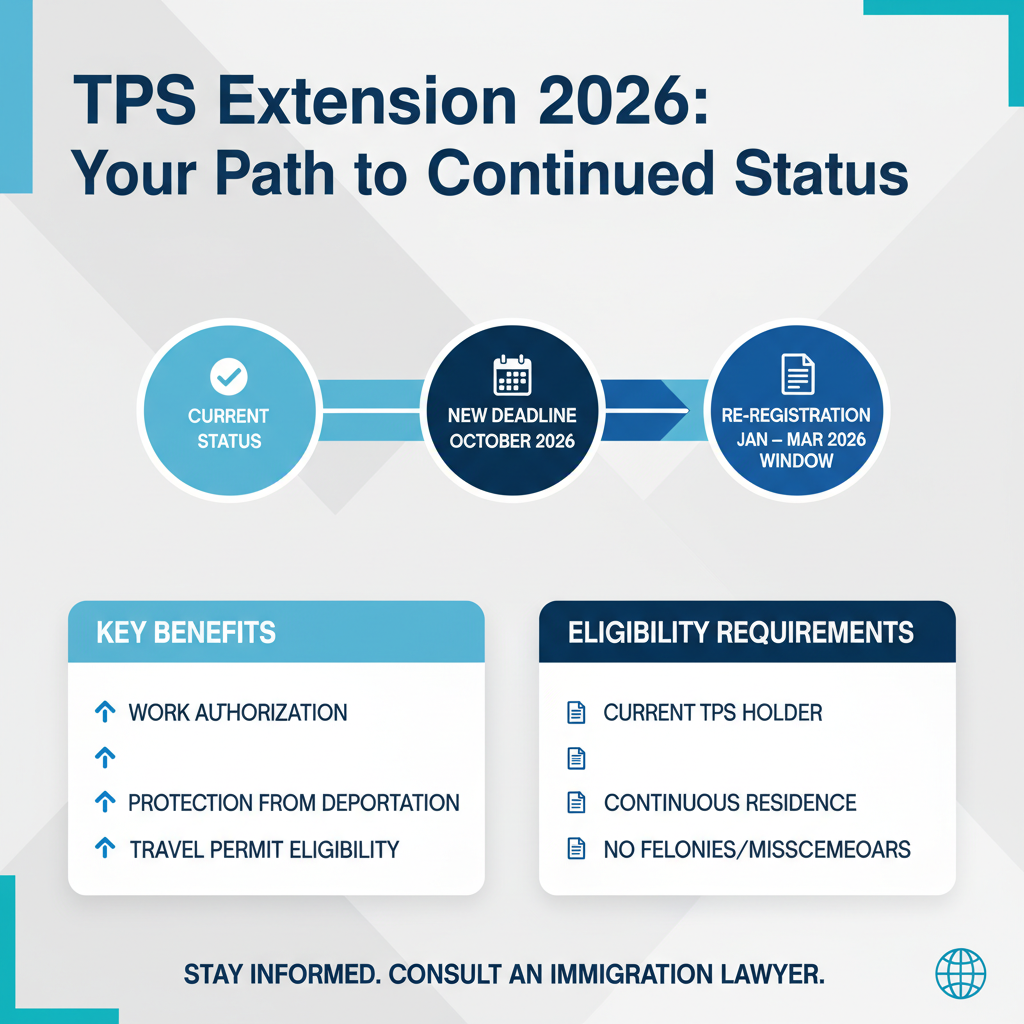
For thousands of immigrants living in the United States, particularly those from countries designated for Temporary Protected Status (TPS), recent announcements regarding TPS extensions are a beacon of hope and a call to action. As of 2026-05-31, the immigration landscape continues to evolve, and updates on TPS designations are among the most significant developments for many families striving for stability.
Why this news is showing up now
Temporary Protected Status is not a permanent solution, but a temporary one, granted by the Secretary of Homeland Security to eligible nationals of certain countries facing ongoing armed conflict, environmental disaster, or other extraordinary and temporary conditions. These designations are periodically reviewed and, if conditions persist, are often extended. The "trending news" you're seeing now reflects the U.S. government's recent decisions to extend TPS for several designated countries. This means that individuals from these nations who currently hold TPS will have an opportunity to re-register and maintain their protected status, along with their work authorization, for another period. These extensions are not automatic; they require prompt and precise action from beneficiaries.
How it can affect Florida residents
Florida, and particularly Central Florida, is home to a significant and diverse immigrant population. Cities like Orlando and its surrounding areas in Orange County and along the I-4 corridor host vibrant communities from many TPS-designated countries. For these residents, TPS extensions are profoundly impactful:
- Continued Legal Presence: An extension means beneficiaries can continue to live and work legally in the U.S. without fear of deportation, offering a crucial sense of security for themselves and their families.
- Work Authorization: With TPS comes eligibility for an Employment Authorization Document (EAD), which allows individuals to work legally. Extensions often come with automatic extensions of existing EADs, followed by the need to apply for a new one. This is vital for economic stability and supporting families.
- Stability for Families: For families where some members are U.S. citizens or lawful permanent residents and others hold TPS, these extensions help Keep Families Together, preventing separation due to immigration status issues.
- Planning for the Future: While temporary, extensions provide beneficiaries with more time to explore other potential avenues for permanent residency, if available, or to continue building their lives in the U.S.
Understanding these extensions and acting swiftly is paramount for all eligible Florida residents. Missing the re-registration window can lead to loss of status and potential enforcement actions.
Need Help? Our Orlando immigration team is ready to assist. Call +1 786-791-3106 for a free consultation, or message us online. Se Habla Español.
What Temporary Protected Status (TPS) Is (and Why It Matters)
Temporary Protected Status, or TPS, is a humanitarian immigration benefit that offers a critical lifeline to individuals who cannot safely return to their home countries due to extreme circumstances. It is a temporary status, not a path to permanent residency or citizenship, but it provides significant protections.
A plain-English definition
Imagine your home country suddenly becomes unsafe. Perhaps there's a devastating earthquake, a civil war breaks out, or a widespread epidemic makes daily life impossible. If you are already in the U.S. when such a crisis occurs, the U.S. government might designate your country for TPS. This means that for a specific period, you can legally remain in the U.S., obtain work authorization, and be protected from deportation. It's a temporary haven until conditions in your home country improve enough for you to return safely.
Key terms you need to know
- Designation: The act by the Secretary of Homeland Security to identify a country as eligible for TPS due to specific, temporary conditions. This is published in the Federal Register.
- Extension: When the Secretary of Homeland Security determines that the conditions in a designated country have not improved sufficiently, the TPS designation period is extended, allowing current beneficiaries to re-register.
- Re-registration: The process by which current TPS beneficiaries apply to extend their protected status and work authorization for the new designated period. This is mandatory to maintain benefits.
- Employment Authorization Document (EAD): Also known as a work permit, this document (Form I-766) allows TPS beneficiaries to work legally in the U.S.
- Continuous Physical Presence (CPP): A requirement that an applicant has been physically present in the U.S. since a specific date set for their country's TPS designation.
- Continuous Residence (CR): A requirement that an applicant has continuously resided in the U.S. since a specific date set for their country's TPS designation. Brief, casual, and innocent absences do not break continuous residence.
- Federal Register Notice: Official government publication where all TPS designations, extensions, and re-registration instructions are announced. This is your primary source for official dates and requirements.
TPS is a vital program that allows individuals to contribute to American society and support their families while their home countries recover. It embodies the principle of Keep Families Together, offering a crucial safety net.
Current Immigration Law: The Foundation
Temporary Protected Status is authorized by Section 244 of the Immigration and Nationality Act (INA), found at 8 U.S.C. § 1254a. This statute outlines the criteria for designation, the eligibility requirements for individuals, and the procedures for applying and re-registering for TPS.
Federal requirements
The Secretary of Homeland Security may designate a country for TPS if:
- There is an ongoing armed conflict within the state, posing a serious threat to the personal safety of nationals if returned.
- There has been an earthquake, flood, drought, epidemic, or other environmental disaster resulting in a substantial, but temporary, disruption of living conditions, and the foreign state is unable to handle the return of its nationals adequately.
- There are extraordinary and temporary conditions in the foreign state that prevent nationals from returning safely, and granting TPS is consistent with U.S. national interests.
To be eligible for TPS, an individual must:
- Be a national of a country designated for TPS (or a person without nationality who last habitually resided in that designated country).
- File during the initial registration period or during any extension/re-registration period.
- Have been continuously physically present in the U.S. since the effective date of the most recent designation.
- Have been continuously residing in the U.S. since the date specified for the country's designation.
- Not be inadmissible under certain grounds (e.g., certain criminal or national security grounds).
- Not have been convicted of any felony or two or more misdemeanors committed in the U.S.
- Not be subject to any of the mandatory bars to asylum, such as having persecuted others.
The primary forms used for TPS are:
- Form I-821, Application for Temporary Protected Status
- Form I-765, Application for Employment Authorization (often filed concurrently with Form I-821 for work authorization)
- Form I-912, Request for Fee Waiver (if applicable)
All official forms and detailed instructions can be found on the USCIS official website.
Florida-specific considerations
While TPS is a federal program, its impact and application have local implications. For Florida residents, especially those in the Orlando area:
- USCIS Field Office: The Orlando USCIS Field Office processes certain immigration matters, though TPS applications are typically centralized at specific service centers. However, if you are called for an interview or need specific local assistance, this is your point of contact.
- State ID/Driver's License: With an approved TPS and EAD, Florida residents can apply for or renew a Florida driver's license or state identification card, which is crucial for daily life and mobility along the I-4 corridor and throughout Central Florida.
- Community Resources: Various non-profit organizations and community centers in Orlando and surrounding Orange County offer assistance and information to immigrant communities, often working in conjunction with legal professionals like Imigrar.
It is crucial to adhere to all federal requirements, regardless of your specific location in Florida. However, understanding local resources can provide additional support.
Don't risk your status. For personalized guidance on TPS re-registration in Orlando, contact Imigrar. Call +1 786-791-3106 or reach out online. Se Habla Español.
How to Re-register for TPS: A Complete Step-by-Step Guide
Re-registration for TPS is a critical process that ensures you maintain your protected status and work authorization. It requires meticulous attention to detail and adherence to strict deadlines. Follow this guide carefully.
1) Determine Your Eligibility and Re-registration Window
The very first step is to confirm that your country's TPS designation has indeed been extended and to identify the specific re-registration period. This information is always published in a Federal Register Notice by USCIS.
- Check the Official Source: Always refer to the latest Federal Register Notice or the USCIS TPS webpage for your country. This notice will announce the extension, the new validity period, and the re-registration window (typically a 60-day period).
- Confirm Your Eligibility: Ensure you meet all general TPS eligibility requirements, including continuous physical presence and continuous residence since your country's initial designation or the most recent extension.
- Note the Deadline: Mark the re-registration deadline prominently. Missing this deadline without good cause can result in the loss of your TPS.
Required Documents for this step (for your reference):
- Copy of your previous Form I-797 Approval Notice for TPS.
- Access to the internet to check USCIS official website and Federal Register.
2) Gather All Necessary Supporting Documents
Even for re-registration, you will need to provide evidence to support your application. While less extensive than initial registration, ensure you have these readily available:
- Proof of Identity and Nationality:
- Copy of your passport (valid or expired).
- Copy of your birth certificate with photo identification.
- Any national identity document from your country of origin with a photograph and/or fingerprint.
- Copy of your previous Form I-797 Approval Notice for TPS.
- Copy of your last EAD (Form I-766).
- Proof of Continuous Residence (CR) since your initial grant of TPS:
- Employment records (pay stubs, W-2 forms, letters from employer).
- Rent receipts, utility bills (gas, electric, water), or mortgage statements.
- School records (transcripts, report cards).
- Hospital or medical records.
- Affidavits from friends, relatives, or employers attesting to your residence.
- Bank statements.
- Religious organization records.
- Any other dated documents showing your presence in the U.S. (e.g., car registration, insurance bills).
Important: Provide copies, not originals, unless specifically requested by USCIS. Keep your originals safe.
3) Complete and Prepare Forms I-821 and I-765
These are the core forms for re-registration. Always download the latest versions from the USCIS Forms page, as forms are frequently updated.
- Form I-821, Application for Temporary Protected Status:
- Fill out every section completely and accurately. If a question doesn't apply, write "N/A."
- Ensure your name, date of birth, and other biographical information match your previous TPS application and identity documents exactly.
- Provide your Alien Registration Number (A-Number).
- Answer all eligibility questions truthfully.
- Form I-765, Application for Employment Authorization:
- File this form concurrently if you wish to obtain a new EAD.
- For TPS re-registration, your eligibility category is generally (c)(19).
- Ensure all information matches your Form I-821.
Reminder: For re-registration, you generally do not need to resubmit evidence of the initial continuous physical presence and continuous residence, as this was established during your initial application. Focus on documents proving your continuous residence since your last TPS approval.
4) Calculate and Pay Required Fees (or Apply for a Fee Waiver)
There are fees associated with filing Form I-821 and Form I-765. Fees can change, so always check the USCIS Fee Schedule.
- Form I-821 Filing Fee: There is typically NO fee for re-registering for TPS (Form I-821).
- Form I-765 Filing Fee: There IS a fee for filing Form I-765 for an EAD.
- Biometrics Services Fee: There IS a fee for biometrics (fingerprinting). This fee is required for all applicants 14 years of age or older.
- Fee Waiver (Form I-912): If you cannot afford the fees, you may apply for a fee waiver by filing Form I-912, Request for Fee Waiver. You must provide strong evidence of your inability to pay, such as proof of receiving means-tested benefits, household income below 150% of the poverty level, or financial hardship. If requesting a fee waiver for the EAD, you must also request a waiver for the biometrics fee.
Payment Method: You can pay by money order, personal check, cashier’s check, or by credit card using Form G-1450, Authorization for Credit Card Transactions. Make checks payable to "U.S. Department of Homeland Security."
5) Assemble and Mail Your Application Package
Proper assembly and mailing are crucial to avoid delays or rejection.
- Organize Your Documents:
- Place your check or money order (or Form G-1450 or Form I-912) on top.
- Followed by Form I-821.
- Then Form I-765.
- Next, your supporting documents, clearly labeled. Consider using cover sheets for different categories of evidence (e.g., "Proof of Identity," "Proof of Residence").
- Make a complete copy of the entire application package for your records. This is a critical step.
- Mailing Address: Send your package to the specific USCIS Lockbox Facility address designated for your country's TPS re-registration. These addresses are published in the Federal Register Notice and on the USCIS website. DO NOT send it to a general USCIS address or a local field office.
- Shipping Method: Use a reputable mail service that provides tracking and delivery confirmation (e.g., USPS Certified Mail, FedEx, UPS). This provides proof of timely submission.
6) Attend Your Biometrics Appointment
After filing, USCIS will send you a notice (Form I-797C, Notice of Action) scheduling a biometrics appointment at an Application Support Center (ASC).
- What to Bring: Take the appointment notice, a valid photo ID (e.g., passport, state ID), and a copy of your application.
- Purpose: At the ASC, your fingerprints, photograph, and signature will be collected. This is for identity verification and background checks.
- Important: Do not miss this appointment. If you have an unavoidable conflict, follow the instructions on the notice to reschedule immediately.
7) Track Your Application and Receive Your EAD
Once your biometrics are processed, your application will be reviewed.
- Online Tracking: Use the receipt number from your Form I-797C to track your case status on the USCIS Case Status Online tool.
- Processing Times: Check USCIS Processing Times for an estimate of how long it might take.
- EAD and Approval Notice: If approved, you will receive a new EAD (Form I-766) and an approval notice for your TPS (Form I-797). Ensure all information on these documents is correct.
- Automatic EAD Extensions: Often, when TPS is extended, USCIS will automatically extend the validity of existing EADs for a certain period (e.g., 180 days or longer) to allow for processing time. Check the Federal Register Notice for specifics on your country.
Following these steps meticulously is key to maintaining your TPS and work authorization. If you have any doubts, consulting with an experienced immigration attorney, like those at Imigrar, is highly recommended.
Practical Steps You Can Take Today
The re-registration period for TPS is often limited, so taking proactive steps is crucial. Here’s an actionable checklist:
- Verify Your Country's Status: Immediately check the USCIS TPS webpage and the Federal Register for the latest announcement regarding your specific country's TPS designation and extension. Note the exact re-registration window and deadline.
- Locate Your Previous Documents: Gather your previous TPS approval notices (Form I-797), EADs (Form I-766), and any other immigration documents. These contain vital information like your A-Number.
- Collect Proof of Continuous Residence: Start compiling documents that demonstrate your continuous residence in the U.S. since your last TPS approval. Think utility bills, bank statements, pay stubs, and school records from the entire period.
- Update Your Address with USCIS: If you have moved, file Form AR-11, Alien's Change of Address Card, online or by mail, within 10 days of moving. This ensures you receive all notices from USCIS. Missing an important notice can jeopardize your case.
- Review Your Criminal History (if any): If you have any arrests or convictions since your last TPS application, gather all court disposition documents. These must be reviewed by an attorney to determine their impact on your eligibility.
- Set Aside Funds for Fees: If you plan to apply for a new EAD, prepare for the filing fees. If you anticipate needing a fee waiver, start gathering documentation to support your Form I-912.
- Consult with an Immigration Attorney: Even if you've re-registered before, an attorney can help review your application for accuracy, advise on complex issues, and ensure timely submission. This is especially important if your situation has changed since your last application, or if you have any arrests or convictions.
Timeline Expectations:
- Re-registration Window: Typically 60 days from the date of the Federal Register Notice. You must file within this period.
- Biometrics Appointment: Usually scheduled within 3-8 weeks after filing.
- EAD Processing: Can range from a few months to over a year, depending on USCIS processing times. Check the USCIS Processing Times page for the most current estimates. Remember that automatic EAD extensions might be in effect, providing temporary work authorization while your new EAD is pending.
Document Preparation Guidance:
- Always submit clear photocopies, not originals, unless specifically requested.
- If documents are not in English, you must include a complete English translation certified by a competent translator.
- Organize your documents neatly, perhaps with tabs or cover sheets, to make review easier for USCIS officers.
Confused by the process? Imigrar provides expert assistance for TPS re-registration in Orlando and nationwide. Call +1 786-791-3106 for a free consultation. Se Habla Español.
How Imigrar Helps Immigrants in Orlando
At Imigrar, we understand the complexities and anxieties that come with navigating the U.S. immigration system, especially concerning temporary statuses like TPS. Our firm, based in Orlando, Florida, is dedicated to providing compassionate, expert legal assistance to immigrants and their families, ensuring they can Keep Families Together.
- Our Experience and Expertise: Our legal team possesses extensive knowledge of TPS regulations, re-registration procedures, and the specific requirements for various designated countries. We stay current on all Federal Register Notices and USCIS policy updates, ensuring your application is always based on the most accurate and recent information. Whether your case is in Orlando or elsewhere, we have the experience to guide you.
- Personalized Guidance: We don't believe in one-size-fits-all solutions. We meticulously review each client's unique situation, identify potential challenges, and prepare a comprehensive, error-free application package. For Central Florida residents, we offer local insights and support.
- Meticulous Document Preparation: We assist with gathering, organizing, and preparing all required supporting documents, including certified translations, ensuring your application is complete and compelling.
- Fee Waiver Assistance: If you qualify for a fee waiver, we help you prepare and submit Form I-912 with the necessary supporting evidence, alleviating financial burdens.
- Peace of Mind: Our goal is to remove the stress from the re-registration process, allowing you to focus on your family and work, confident that your immigration matters are in capable hands. We are here to answer your questions and provide clear explanations every step of the way.
We are proud to serve our diverse community, and we understand the importance of clear communication. Se Habla Español, ensuring that language is never a barrier to receiving top-tier legal assistance.
Don't face the re-registration process alone. Let Imigrar be your trusted partner.

Frequently Asked Questions
Q: What happens if I miss the TPS re-registration deadline?
A: Missing the re-registration deadline can be very serious. Generally, you risk losing your TPS and associated benefits, including your work authorization. In some limited circumstances, USCIS may accept a late re-registration if you can demonstrate "good cause" for the delay. However, this is not guaranteed and requires a compelling explanation and supporting evidence. It's always best to file within the designated window. If you miss the deadline, consult with an attorney immediately to assess your options.
Q: Does TPS lead to a Green Card or permanent residency?
A: No, TPS itself does not provide a direct path to a Green Card or permanent residency. It is a temporary humanitarian status. However, being granted TPS does not prevent you from applying for other immigration benefits for which you might be eligible, such as Adjustment of Status through a family petition (e.g., marriage to a U.S. citizen) or asylum, if you meet the requirements for those separate programs. A TPS beneficiary who travels outside the U.S. with advance parole and lawfully returns may be considered "inspected and admitted," which can be a prerequisite for adjusting status under certain circumstances. Consult with an attorney to explore all potential pathways.
Q: Can I travel outside the U.S. if I have TPS?
A: Yes, but only with specific authorization from USCIS called advance parole (Form I-131, Application for Travel Document). Leaving the U.S. without advance parole can result in the termination of your TPS upon your return and may trigger inadmissibility issues. If you plan to travel, you must apply for and receive advance parole before departing. The purpose of travel must also be consistent with TPS regulations.


