

The landscape of U.S. immigration law is constantly evolving, and for many, news regarding Temporary Protected Status (TPS) can bring significant hope and clarity. As an immigration law firm based in Orlando, Florida, Imigrar is dedicated to helping individuals and families navigate these complex changes, ensuring they understand their rights and the steps needed to secure their future in the United States. Today, we delve into the latest TPS extension news, providing a comprehensive guide for those impacted.
Is your TPS status expiring soon? Confused about the latest extensions? Our Orlando immigration team is ready to assist. Call +1 786-791-3106 for a free consultation, or message us online. Se Habla Español.
NEWS SOURCE REFERENCE SECTION
The reporting that sparked this guide: TPS (Temporary Protected Status) Extension News (Legal News)
What This News Means for Immigrants in Orlando and Across Florida
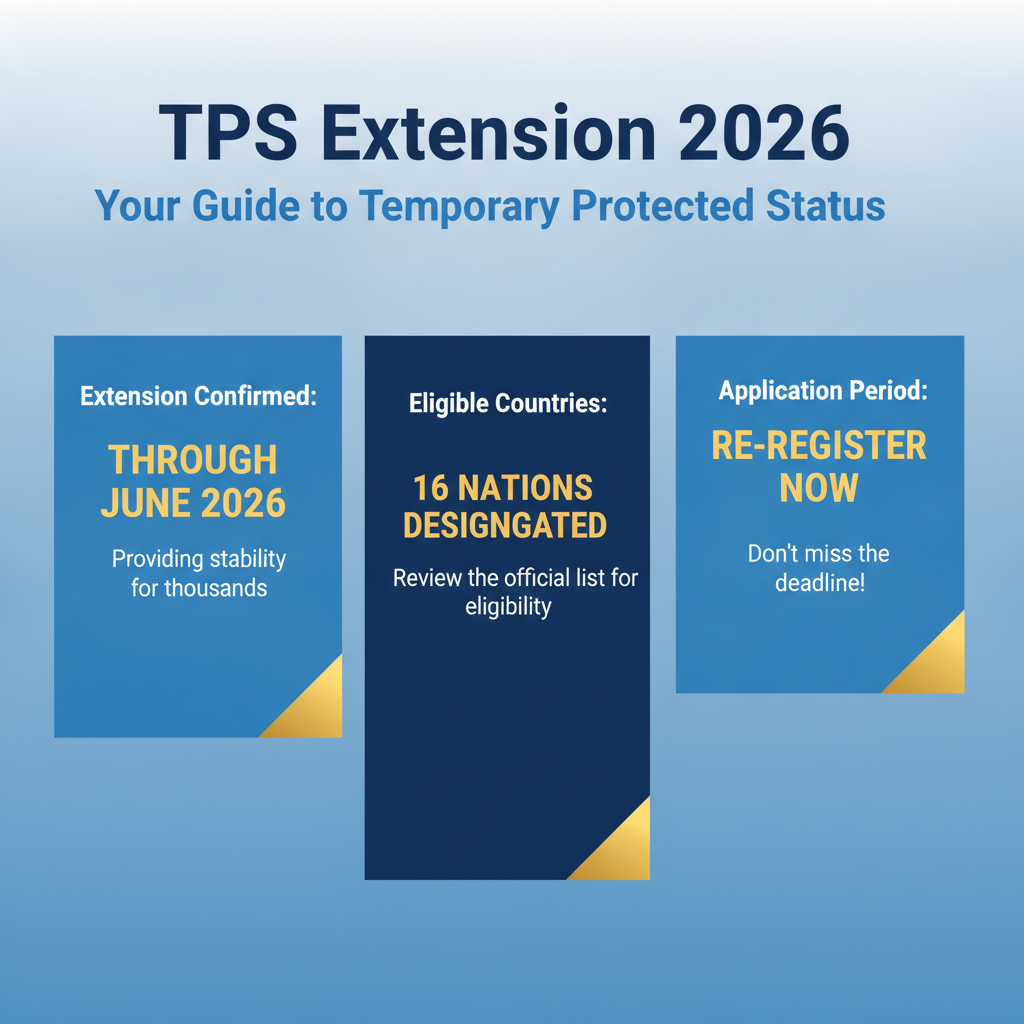
As of July 18, 2026, recent announcements regarding Temporary Protected Status (TPS) extensions have brought both relief and a renewed sense of urgency for thousands of individuals. These updates, often published through Federal Register notices by the Department of Homeland Security (DHS), signify a continuation of protection for eligible nationals of specific designated countries who cannot safely return to their homelands due to ongoing armed conflict, environmental disaster, or other extraordinary and temporary conditions.
Why this news is showing up now
The cycle of TPS designations and extensions is driven by ongoing assessments of conditions in designated countries. When a country is initially designated for TPS, that status is granted for a period of 6, 12, or 18 months. Before that period expires, the Secretary of Homeland Security must review the conditions in the country and determine whether the designation should be extended, re-designated, or terminated. This process typically involves a detailed analysis of the prevailing humanitarian, security, and political circumstances in the country.
In recent months, the DHS has been conducting its mandated reviews for several countries whose TPS designations were set to expire. The current wave of news reflects the outcome of these reviews, with the Secretary determining that the conditions warranting TPS continue to exist for specific nations. For example, recent Federal Register notices published in late June and early July 2026 have confirmed extensions for countries such as Haiti, Venezuela, and Honduras, citing persistent instability, violence, and ongoing recovery efforts that make safe return unfeasible. These extensions are not arbitrary; they are the result of comprehensive evaluations, often influenced by reports from the U.S. Department of State and other international bodies.
How it can affect Florida residents
Florida, and particularly Central Florida, is home to vibrant and diverse immigrant communities, many of whom are directly impacted by TPS decisions. Orlando, situated in Orange County along the bustling I-4 corridor, has significant populations from countries frequently designated for TPS. For residents of Orlando, Kissimmee, Sanford, and throughout the Sunshine State, these extensions carry immense weight:
- Continued Legal Presence: For current TPS beneficiaries, an extension means they can maintain their lawful presence in the U.S. for an additional period, typically 18 months. This provides stability and prevents forced returns to dangerous conditions.
- Work Authorization: With an extension, beneficiaries can apply for or extend their Employment Authorization Documents (EADs), allowing them to continue working legally to support themselves and their families. This is crucial for economic stability in Central Florida households.
- Protection from Deportation: TPS provides temporary protection from removal from the United States. The extension solidifies this protection, allowing individuals to live without immediate fear of deportation.
- Family Stability: The "Keep Families Together" mission of Imigrar resonates deeply here. TPS extensions mean families can remain united in the U.S., avoiding separation that would result from a parent or spouse being forced to return to an unsafe country.
- Economic Impact: TPS beneficiaries contribute significantly to Florida's economy, working in various sectors from tourism and hospitality to agriculture and construction. Their continued ability to work supports local businesses and communities, including those in the Orlando metropolitan area.
- Re-registration Urgency: The news of an extension immediately triggers a re-registration period. This is a critical, often time-sensitive window during which current TPS holders must re-apply to maintain their status. Missing this deadline can lead to loss of status and potential removal proceedings.
For individuals residing in Orlando and surrounding areas, understanding these updates and acting promptly is paramount. The Orlando USCIS Field Office processes many applications from Central Florida residents, and being prepared with accurate information and documentation is key.
What Temporary Protected Status (TPS) Is (and Why It Matters)
Temporary Protected Status (TPS) is a humanitarian immigration benefit established by the U.S. Congress through the Immigration Act of 1990. It is a temporary immigration status granted to eligible nationals of designated countries who are already in the United States. The Secretary of Homeland Security may designate a country for TPS when conditions in that country prevent its nationals from returning safely, or when the country is unable to handle the return of its nationals adequately.
A plain-English definition
Think of TPS as a temporary safe harbor. If your home country is experiencing severe problems – like a massive earthquake, a devastating hurricane, a widespread epidemic, or a civil war – the U.S. government might decide it's too dangerous for its citizens living in America to go back. In such cases, the U.S. can grant them Temporary Protected Status. This means you can stay and work legally in the U.S. for a set period (usually 6, 12, or 18 months) without fear of deportation. It's not a path to a Green Card on its own, but it offers crucial stability and protection for those who would face extreme hardship or danger if forced to return.
The key word here is "temporary." The status is regularly reviewed, and if conditions in the home country improve sufficiently, TPS can be terminated. However, as we've seen with recent extensions, if dangerous conditions persist, TPS can be extended multiple times, sometimes for many years.
Key terms you need to know
Navigating TPS requires understanding specific terminology. Here are some essential terms:
- Designated Country: A country whose nationals are eligible for TPS due to ongoing armed conflict, environmental disaster, or other extraordinary and temporary conditions. Examples include Haiti, Venezuela, Honduras, El Salvador, Nicaragua, Ukraine, Afghanistan, and Cameroon.
- Re-registration Period: A specific, often limited, window of time (e.g., 60 days or 180 days) during which current TPS beneficiaries must file an application to maintain their status when a country's designation is extended. Missing this deadline can result in the loss of TPS.
- Employment Authorization Document (EAD): Also known as a work permit, this document (Form I-766) allows TPS beneficiaries to legally work in the United States. An EAD is typically granted for the duration of the TPS designation or extension.
- Advance Parole: A travel document (Form I-512) issued by USCIS that allows certain non-citizens, including TPS beneficiaries, to travel outside the United States and lawfully return. Traveling without advance parole can lead to serious immigration consequences, including denial of re-entry or even termination of TPS.
- Continuous Physical Presence (CPP): A requirement for TPS eligibility, meaning the applicant must have been continuously physically present in the U.S. since a specific date set by the DHS for their country's designation. Brief, casual, and innocent departures generally do not break CPP.
- Continuous Residence (CR): A requirement for TPS eligibility, meaning the applicant must have continuously resided in the U.S. since a specific date set by the DHS.
- Prima Facie Eligible: This means that, based on the initial evidence provided, an applicant appears to meet all the eligibility requirements for TPS. USCIS may grant temporary benefits (like an interim EAD) to individuals who are prima facie eligible while their application is pending.
- Federal Register Notice: The official daily publication for rules, proposed rules, and notices of federal agencies and organizations, as well as executive orders and other presidential documents. All TPS designations, extensions, re-designations, and terminations are announced via Federal Register notices.
- Form I-821, Application for Temporary Protected Status: The primary form used to apply for or re-register for TPS.
- Form I-765, Application for Employment Authorization: The form used to apply for a work permit. TPS applicants usually file this concurrently with Form I-821.
Have questions about these key terms or your TPS eligibility? Imigrar's experienced immigration attorneys can clarify your situation. Call +1 786-791-3106 for a free consultation. Se Habla Español.
Current Immigration Law: The Foundation of TPS
Temporary Protected Status is rooted in Section 244 of the Immigration and Nationality Act (INA), specifically INA Section 244(b). This section outlines the criteria and procedures for the Secretary of Homeland Security to designate countries for TPS. The legal framework is clear: TPS is a discretionary humanitarian relief, not an entitlement, and its application is strictly tied to the conditions within the designated country.
Federal requirements
The authority to grant or extend TPS rests solely with the Secretary of Homeland Security. Under federal law, the Secretary can designate a country for TPS if:
- There is an ongoing armed conflict within the state that poses a serious threat to the personal safety of nationals returning to that state.
- There has been an earthquake, flood, drought, epidemic, or other environmental disaster in the state resulting in a substantial, but temporary, disruption of living conditions, and the state is unable to handle adequately the return of its nationals.
- There are extraordinary and temporary conditions in the foreign state that prevent nationals of the state from returning safely, unless the Secretary finds that permitting such nationals to remain in the U.S. would be contrary to the national interest of the U.S.
For an individual to be eligible for TPS, they must meet several federal requirements:
- Be a national of a country designated for TPS, or a person without nationality who last habitually resided in that designated country.
- Have been continuously physically present (CPP) in the United States since the effective date of the most recent designation or extension.
- Have continuously resided (CR) in the United States since a date specified for their country's designation.
- Meet specific statutory eligibility requirements, including:
- Not having been convicted of any felony or two or more misdemeanors committed in the U.S.
- Not being inadmissible under certain grounds of the INA (e.g., certain criminal, national security, or terrorism-related grounds).
- Not being subject to certain mandatory bars to asylum.
- Timely file the required application forms, primarily Form I-821, Application for Temporary Protected Status, within the designated re-registration period.
All official information regarding TPS designations, extensions, and re-registration procedures, including specific dates and deadlines, is published on the USCIS official website and through notices in the Federal Register. It is critical to refer to these official sources for the most accurate and up-to-date information.
Florida-specific considerations
While TPS is a federal immigration benefit, its impact and administration have local considerations, especially in a state like Florida. There are no Florida-specific laws that alter TPS eligibility or benefits; the federal requirements apply uniformly nationwide. However, for residents of Central Florida:
- Access to Legal Services: Orlando and the surrounding areas (such as Kissimmee, known for its large immigrant populations) have numerous legal aid organizations and private law firms like Imigrar that specialize in immigration law. Access to knowledgeable legal counsel is crucial for navigating the re-registration process.
- Community Resources: Various community centers and non-profit organizations in Orange County and along the I-4 corridor provide assistance with document preparation, language translation, and information sessions for TPS beneficiaries.
- USCIS Field Office: The Orlando USCIS Field Office may handle interviews or biometrics appointments for some TPS applicants, though many TPS cases are processed through service centers. Knowing the location and procedures for this local office can be helpful.
- State-Specific IDs: While TPS provides federal work authorization, obtaining a Florida driver's license or state ID card requires valid immigration documentation, which a renewed EAD provides.
It is important to remember that while state resources can be helpful, all legal aspects of TPS, including eligibility and application processing, are governed by federal law and administered by U.S. Citizenship and Immigration Services (USCIS).
How to Re-Register for TPS: A Complete Step-by-Step Guide
The news of a TPS extension means a critical re-registration period is opening or has recently opened. This is your opportunity to maintain your protected status. Do not miss it. Here's a detailed, step-by-step guide for re-registering for TPS:
1) Determine Your Eligibility and Re-registration Window
Before you do anything else, confirm that you are eligible for the extension and identify your specific re-registration window. This information is found in the official Federal Register notice published by DHS for your country's extension. This notice will state the new expiration date for TPS, the beginning and end dates of the re-registration period (e.g., July 15, 2026, to September 13, 2026 for a 60-day window), and any specific instructions or requirements.
- Required Documents for this Step:
- Copy of your previous TPS approval notice (Form I-797).
- Copy of your most recent EAD (Form I-766).
- Proof of your country of origin (e.g., passport, birth certificate).
- Access to the Federal Register notice for your country's extension.
- Action: Verify the re-registration dates and ensure you meet the continuous physical presence and continuous residence requirements since the initial designation or last extension.
2) Complete and File Form I-821, Application for Temporary Protected Status
This is the primary form for re-registering. Download the latest version of Form I-821 from the USCIS Forms page. Read all instructions carefully. Ensure all questions are answered accurately and completely. Any omissions or inconsistencies can lead to delays or denials.
- Required Documents for this Step (to be submitted with I-821):
- Copy of your previous Form I-797, Notice of Action, showing your last TPS approval.
- Copy of your most recent Employment Authorization Document (EAD), if applicable.
- Proof of identity and nationality (e.g., passport, birth certificate with photo ID, national identity document).
- Evidence of your residence in the U.S. since the designated "Continuous Residence" date (e.g., utility bills, rent receipts, school records, employment records, medical records).
- Evidence of your continuous physical presence in the U.S. since the designated "Continuous Physical Presence" date (similar documents as for CR).
- Any court dispositions or police records for any arrests or convictions, even minor ones.
- If applicable, documentation supporting any waivers of inadmissibility.
- Action: Fill out Form I-821 meticulously. If you are unsure about any section, consult with an immigration attorney.
3) Complete and File Form I-765, Application for Employment Authorization (EAD)
If you wish to continue working legally, you must file Form I-765. Most TPS re-registrants file this concurrently with Form I-821. On Form I-765, ensure you select the correct eligibility category, which is (c)(19) for TPS applicants/beneficiaries.
- Required Documents for this Step (to be submitted with I-765):
- Two identical, passport-style color photographs taken within 30 days of filing.
- Copy of your last EAD (front and back), if applicable.
- Copy of a government-issued identity document (e.g., passport, birth certificate with photo ID).
- Copy of Form I-94, Arrival/Departure Record (if available).
- Copy of your last TPS approval notice (Form I-797).
- Action: Complete Form I-765 accurately. If you don't need a new EAD immediately but might in the future, it's often advisable to file it now to benefit from concurrent processing.
4) Consider Filing Form I-131, Application for Travel Document (Advance Parole)
If you anticipate needing to travel outside the U.S. during your extended TPS period, you must apply for Advance Parole using Form I-131. Traveling without Advance Parole can result in the termination of your TPS and prevent your re-entry into the U.S. This is a critical step for many families who may need to travel for emergencies or to visit relatives.
- Required Documents for this Step (to be submitted with I-131):
- Two identical, passport-style color photographs taken within 30 days of filing.
- Copy of your TPS approval notice (Form I-797).
- Copy of your government-issued photo identification.
- Evidence of the purpose of your travel (e.g., letter from employer, medical documents for family illness, birth certificate for family visit).
- If you have a pending Adjustment of Status application, include a copy of your Form I-485 receipt notice.
- Action: If travel is a possibility, file Form I-131 concurrently with your TPS re-registration. Do not travel until you have received and possess the approved Advance Parole document.
5) Pay the Required Fees or Request a Fee Waiver
Filing fees apply to Form I-821 (for initial filers, usually not for re-registration), Form I-765, and Form I-131. Check the current fee schedule on the USCIS website. If you cannot afford the fees, you may be eligible for a fee waiver by filing Form I-912, Request for Fee Waiver.
- Required Documents for this Step:
- Check or money order payable to "U.S. Department of Homeland Security" for the exact amount.
- If requesting a fee waiver (Form I-912), provide evidence of inability to pay, such as:
- Proof of receiving a means-tested public benefit (e.g., Medicaid, SNAP, SSI).
- Proof of household income below 150% of the Federal Poverty Guidelines.
- Proof of financial hardship (e.g., medical bills, unemployment).
- Action: Calculate your fees accurately or prepare your fee waiver request with strong supporting documentation. Incorrect fees or inadequate fee waiver requests will delay processing.
6) Attend Biometrics Appointment (If Required)
After filing, USCIS may send you an appointment notice (Form I-797C) for a biometrics appointment at an Application Support Center (ASC). This is typically required for identity verification and background checks.
- Required Documents for this Step:
- The official biometrics appointment notice.
- A valid government-issued photo identification (e.g., passport, driver's license).
- Action: Attend your appointment on time. If you cannot make it, follow the instructions on the notice to reschedule immediately. For Central Florida residents, your appointment will likely be at the Orlando ASC.
7) Monitor Your Case Status and Respond to RFEs
Once you've submitted your application, you can track its progress online using the receipt number provided by USCIS. You might receive a Request for Evidence (RFE) if USCIS needs more information or clarification. Respond to RFEs promptly and comprehensively.
- Required Documents for this Step:
- Your USCIS receipt number.
- Any RFE notice received.
- Additional documents requested in the RFE.
- Action: Create an online account with USCIS to track your case. If you receive an RFE, gather the requested documents immediately and consider consulting an attorney to ensure your response is complete and persuasive.

Practical Steps You Can Take Today for Your TPS Extension
Don't wait until the last minute. Proactive preparation can significantly reduce stress and the risk of errors. Here's an actionable checklist:
- Confirm Your Country's Extension: Double-check the latest Federal Register notices or the USCIS TPS page to ensure your country's TPS designation has indeed been extended and note the exact re-registration period dates.
- Locate Existing Documents: Gather all previous TPS approval notices (Form I-797), EADs, passports, birth certificates, marriage certificates, and any other immigration-related documents.
- Update Your Address with USCIS: If you've moved since your last TPS application, immediately file Form AR-11, Alien's Change of Address Card, online or by mail. Failure to do so can result in missed notices and critical deadlines.
- Collect Proof


