


The immigration landscape is constantly evolving, and staying informed is crucial for immigrants and their families. At Imigrar, an immigration law firm based in Orlando, Florida, we are committed to providing the most up-to-date and actionable information to help you navigate these changes. Today, we delve into significant news regarding Temporary Protected Status (TPS) extensions.
Need Help? Our Orlando immigration team is ready to assist. Call +1 786-791-3106 for a free consultation, or message us online. Se Habla Español.
The reporting that sparked this guide
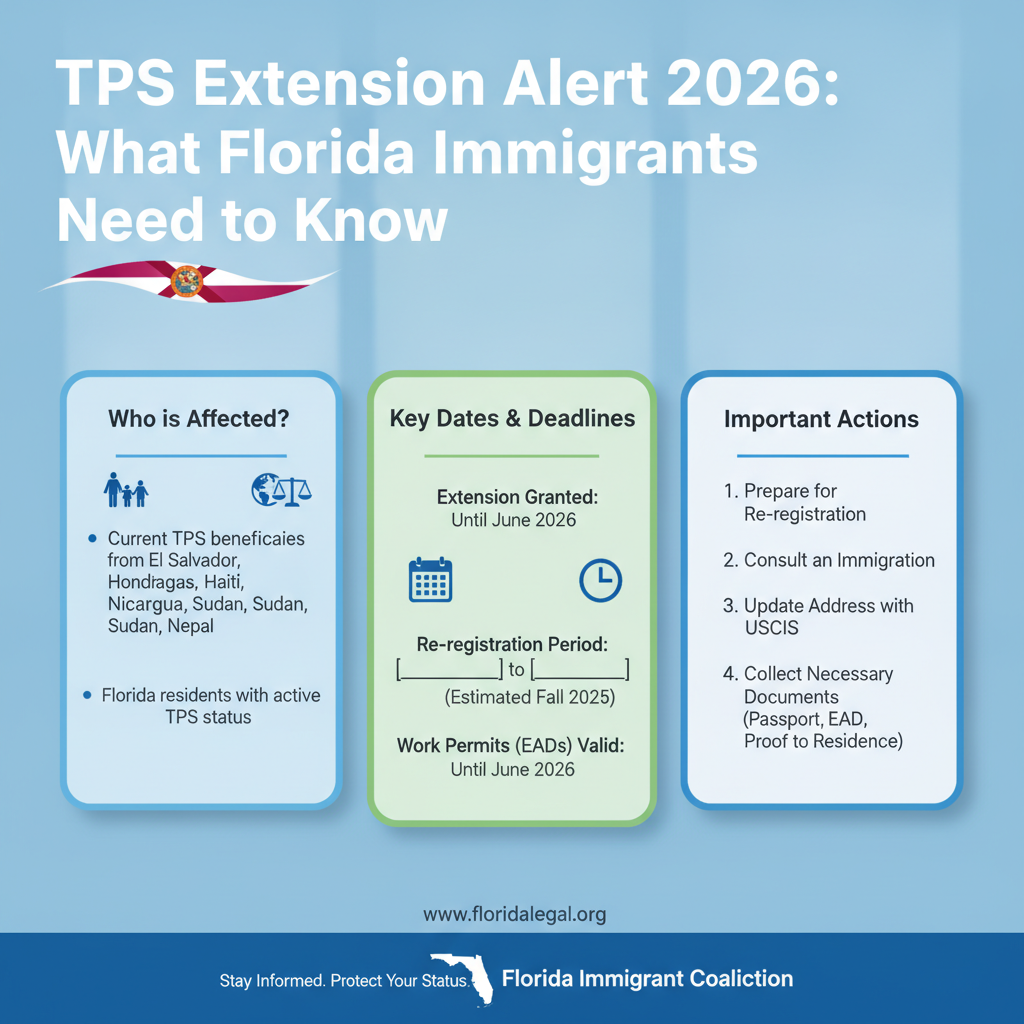
Recent developments in immigration law, particularly concerning humanitarian relief programs, have brought Temporary Protected Status (TPS) back into the spotlight. News outlets continue to report on the U.S. government’s decisions to extend and sometimes redesignate TPS for various countries facing ongoing crises. This continuous coverage highlights the critical nature of these protections for hundreds of thousands of individuals living in the United States.
For the latest updates and context, you can refer to general immigration news sources:
TPS (Temporary Protected Status) Extension News (Legal News)
What This News Means for Immigrants in Orlando and Across Florida
For individuals holding Temporary Protected Status, or those who might now become eligible, these extensions are not just bureaucratic announcements; they represent continued safety, stability, and the ability to contribute to their communities without fear of immediate deportation. For families, it means continuity and the chance to plan for a more secure future.
Why this news is showing up now
Temporary Protected Status is, by its very nature, temporary. It is granted by the Secretary of Homeland Security to eligible nationals of designated countries who are already in the United States. A country may be designated for TPS due to ongoing armed conflict, environmental disasters (like earthquakes or hurricanes), or other extraordinary and temporary conditions that prevent its nationals from safely returning home. These designations are typically for periods of 6, 12, or 18 months and are subject to periodic review and extension.
The news you're seeing now reflects the Department of Homeland Security's (DHS) ongoing assessments of conditions in various TPS-designated countries. As of mid-2026, the global landscape continues to present challenges that warrant the extension of TPS for numerous nations. Countries such as El Salvador, Honduras, Nicaragua, Haiti, Venezuela, Sudan, South Sudan, Afghanistan, Cameroon, Burma/Myanmar, Ukraine, Ethiopia, Syria, and Yemen have seen, or are currently awaiting, decisions on extensions or redesignations. These decisions are critical because they determine the continuation of protection and work authorization for hundreds of thousands of individuals.
Each extension decision involves a thorough review of current conditions in the designated country by the Secretary of Homeland Security. This process ensures that TPS continues to serve its humanitarian purpose, offering a safe haven when return is unsafe.
How it can affect Florida residents
Florida, particularly Central Florida and the Orlando metropolitan area, is home to a vibrant and diverse immigrant population. Many communities within the state have significant populations from countries currently or previously designated for TPS. For these Florida residents, TPS extensions carry immense weight:
- Continued Protection from Deportation: The most immediate benefit is the continued protection from removal from the United States. This allows individuals to remain in the U.S. legally and safely.
- Work Authorization: An extension of TPS typically comes with an extension of an individual's Employment Authorization Document (EAD or work permit). This means TPS holders can continue to work legally in Florida, support their families, and contribute to the local economy. For many, this is their sole authorization to work.
- Family Stability: TPS provides a crucial layer of stability for families. Parents can continue to raise their children in a safe environment, attend school, and build lives without the constant fear of separation due to deportation. This is especially vital in family-centric communities across Florida.
- Economic Contribution: TPS holders are integral to Florida’s workforce, contributing to various sectors, from hospitality in Orlando to agriculture and healthcare statewide. Their continued ability to work supports local businesses and the state’s economy.
- Planning for the Future: While temporary, TPS extensions offer a period of certainty, allowing individuals to pursue educational opportunities, establish businesses, and engage more fully in their communities, from Orange County to the greater I-4 corridor.
For those living in Orlando and surrounding areas, understanding these extensions is paramount. It dictates their ability to renew driver's licenses, maintain employment, and simply live without daily apprehension. Imigrar is here to ensure that you have the most accurate information and guidance to navigate these critical updates.
What Temporary Protected Status (TPS) Is (and Why It Matters)
Temporary Protected Status (TPS) is a humanitarian immigration benefit that offers a temporary haven in the United States to foreign nationals unable to return safely to their home countries due to specific, dire conditions. It’s a vital program that underscores the U.S. commitment to international humanitarian principles.
A plain-English definition
Imagine your home country is experiencing a major crisis—perhaps a devastating earthquake, an ongoing civil war, or an epidemic that makes daily life dangerous. If you are already in the United States when this crisis occurs, the U.S. government might decide it's unsafe for you to return home. That's where Temporary Protected Status comes in.
TPS allows eligible individuals from designated countries to live and work legally in the U.S. for a temporary period. It's not a path to a Green Card or U.S. citizenship on its own, but it offers protection from deportation and the ability to obtain an **Employment Authorization Document (EAD)**, which allows you to work legally. It's a temporary lifeline, offering safety and stability until conditions in your home country improve.
Key terms you need to know
Understanding these terms is crucial when dealing with TPS:
- Designated Country: A country whose nationals are eligible for TPS due to specific conditions as determined by the Secretary of Homeland Security. Examples include ongoing armed conflict, environmental disaster, or other extraordinary and temporary conditions.
- Eligibility: The specific criteria an individual must meet to be granted TPS. This includes being a national of a designated country, being physically present in the U.S. on the date of designation, and continuously residing in the U.S. since a specified date.
- Re-registration: The process by which current TPS beneficiaries apply to extend their status when the Secretary of Homeland Security extends a country's designation. This is typically done within a specific **90-day re-registration window**.
- Employment Authorization Document (EAD): Also known as a work permit, this document (Form I-766) allows TPS beneficiaries to work legally in the United States.
- Travel Authorization (Advance Parole): A document (Form I-512, issued based on **Form I-131**) that allows a TPS beneficiary to travel outside the U.S. and return legally. Traveling without this can jeopardize your TPS status.
- Non-removable: A key benefit of TPS, meaning you cannot be deported from the U.S. while your status is valid.
- Continuous Physical Presence (CPP): The requirement that an applicant has been physically present in the U.S. since a specific date set for their country's designation. Brief, casual, and innocent departures typically do not break CPP.
- Continuous Residence (CR): The requirement that an applicant has resided in the U.S. since a specific date set for their country's designation.
- Initial Filer: Someone applying for TPS for the first time. This can be during the initial designation period or as a "late initial filer" if they meet certain exceptions.
- Biometrics: The collection of fingerprints, photographs, and signature by USCIS for identity verification and background checks. This is a mandatory step for most TPS applications.
TPS matters because it provides a critical humanitarian safety net. It allows individuals to escape dangerous conditions, contribute to their new communities, and maintain a semblance of normalcy while awaiting improvements in their home countries. For many, it’s the difference between living in fear and living with dignity.
Need Help? Our Orlando immigration team is ready to assist. Call +1 786-791-3106 for a free consultation, or message us online. Se Habla Español.
Current Immigration Law: The Foundation of TPS
Temporary Protected Status is rooted in federal immigration law, specifically the Immigration and Nationality Act (INA). Understanding these legal foundations is key to appreciating how TPS operates and its importance.
Reference specific laws and statutes
The authority for TPS derives from **Section 244 of the Immigration and Nationality Act (INA)**, codified at **8 U.S.C. § 1254a**. This section grants the Secretary of Homeland Security (or previously the Attorney General) the discretionary power to designate a foreign country for TPS. The designation can occur if conditions in that country fall into one of three categories:
- Ongoing Armed Conflict: Making return unsafe due to serious threat to personal safety.
- Environmental Disaster: Such as earthquake, hurricane, or flood, resulting in a substantial, but temporary, disruption of living conditions, and the foreign state is unable to handle the return of its nationals adequately.
- Extraordinary and Temporary Conditions: Other conditions in the foreign state that prevent nationals from returning safely. This is a broad category that can cover various crises.
Once a country is designated, the Secretary also sets the specific start and end dates for the designation period, as well as the dates for **Continuous Physical Presence (CPP)** and **Continuous Residence (CR)** that applicants must meet.
For more details on the legal framework, consult the USCIS official website.
Federal requirements
To be eligible for TPS, individuals must meet several federal requirements:
- Nationality: Be a national of a country designated for TPS, or a person without nationality who last habitually resided in that country.
- Continuous Physical Presence (CPP): Have been physically present in the U.S. since the effective date of the most recent TPS designation for their country.
- Continuous Residence (CR): Have continuously resided in the U.S. since the date specified for their country's designation.
- Timely Application: Apply for TPS during the initial registration period or, for extensions, during the **90-day re-registration window**. Late initial filers may be eligible under specific circumstances.
- Admissibility: Meet certain admissibility requirements. Certain criminal convictions (e.g., two misdemeanors or one felony) or national security grounds can disqualify an applicant.
- No Disqualifying Factors: Not be subject to certain bars to eligibility, such as persecution of others or certain severe criminal offenses.
The primary form used for TPS application or re-registration is **Form I-821, Application for Temporary Protected Status**. If you wish to work, you must also file **Form I-765, Application for Employment Authorization**. For travel outside the U.S., you'll need to apply for **Advance Parole** using **Form I-131, Application for Travel Document**.
Important: Each country's designation notice on the USCIS website will provide specific dates and detailed eligibility criteria. Always check the most recent notice for your country.
Florida-specific considerations
While TPS is a federal program, its implementation has practical implications for Florida residents:
- No State-Specific TPS Laws: Florida does not have its own TPS laws; federal law governs all aspects of TPS. However, state agencies and employers in Florida must recognize valid federal TPS documents.
- USCIS Field Office and Application Support Center: Florida residents applying for TPS will interact with federal agencies. Biometrics appointments for TPS applicants typically occur at a USCIS Application Support Center (ASC). For Central Florida residents, the closest ASC might be in Orlando or a neighboring city.
- Driver's Licenses and State IDs: With a valid EAD and TPS approval notice, TPS holders in Florida can apply for or renew state driver's licenses or identification cards. These documents are crucial for daily life, employment, and navigating the extensive I-4 corridor.
- Community Impact: Florida has large communities from many TPS-designated countries. Therefore, TPS extensions directly impact the social fabric and economic stability of cities like Orlando, Miami, and Tampa. Local community organizations and legal aid groups often play a vital role in assisting TPS applicants.
Understanding these federal requirements and their local application is essential for a successful TPS application or re-registration in Florida. Imigrar is deeply familiar with these nuances and can guide you through the process effectively.
How to Re-register for TPS or Apply as a Late Initial Filer: A Complete Step-by-Step Guide
Whether you are re-registering for an extended TPS period or applying for the first time as a late initial filer, the process requires careful attention to detail. This guide outlines the essential steps to ensure a smooth application.
1) Understand Your Eligibility and the Specific Designation
Before you begin, confirm that your country's TPS designation has been extended, or that you qualify as a late initial filer for a new designation. Each country’s notice from USCIS specifies crucial dates and requirements.
- Check the Official USCIS Notice: Go to USCIS official website and search for your country’s TPS page. This page will announce the extension, the new validity dates, and the **90-day re-registration window**.
- Verify Individual Eligibility: Ensure you meet the **Continuous Physical Presence (CPP)** and **Continuous Residence (CR)** dates. Review any disqualifying factors (e.g., certain criminal offenses).
- Late Initial Filers: If you are applying for TPS for the first time outside the initial registration period, you must demonstrate "good cause" for the delay and meet specific criteria outlined in the Federal Register notice for your country.
Warning: Missing specific deadlines or eligibility criteria can lead to denial.
2) Gather All Necessary Documents
Thorough documentation is paramount. Organize your documents well in advance. Make copies of everything you plan to submit, and keep the originals safe.
- Proof of Identity and Nationality:
- Passport (current or expired)
- Birth certificate (with photo ID)
- National identity document from your country of origin (with photo and/or fingerprint)
- Proof of Entry into the U.S. (if available):
- **Form I-94, Arrival/Departure Record**
- Passport entry stamps
- Proof of Continuous Residence (CR) in the U.S. since the specified date: (Provide as many as possible, covering the entire period)
- Employment records (pay stubs, W-2s, employment letters)
- Rent receipts, utility bills, mortgage payments, or lease agreements
- School records (transcripts, enrollment letters)
- Medical records or hospital bills
- Affidavits from friends, relatives, or employers attesting to your residence
- Bank statements
- Dated photographs with location information
- Proof of Continuous Physical Presence (CPP) in the U.S. since the specified date: (Often overlaps with CR documents)
- Any of the CR documents listed above.
- Criminal History Records (if applicable):
- Certified copies of arrest records, court dispositions, and sentencing documents for *any* arrests or convictions, no matter how minor. Even if charges were dismissed, you must disclose them.
- Marriage Certificates/Birth Certificates: If you are applying as a spouse or child and your eligibility depends on the primary applicant's status.
- Previous USCIS Filings: Copies of previous TPS approval notices, EADs, or other immigration documents.
3) Complete and File Form I-821, Application for Temporary Protected Status
This is the core application form for TPS. Fill it out completely and accurately.
- Download the Latest Form: Always use the most current version from the USCIS Forms page.
- Answer All Questions: Do not leave any fields blank. If a question doesn't apply, write "N/A" (Not Applicable).
- Sign the Form: An unsigned form will be rejected.
- Provide Supporting Documents: Attach all required supporting evidence as outlined in the form's instructions and the specific country designation notice.
- Re-registration Specifics: For re-registration, you generally do not need to resubmit evidence of nationality, entry, or **CR/CPP** unless USCIS specifically requests it or your circumstances have changed. However, always confirm with the latest Federal Register notice for your country.
Warning: Incomplete or inaccurate forms are a leading cause of delays and denials. Double-check all information.
4) Complete and File Form I-765, Application for Employment Authorization (EAD) (Optional but Recommended)
If you wish to work legally in the U.S., you must apply for an EAD.
- Download the Latest Form: Use the current **Form I-765** from the USCIS Forms page.
- Category for TPS: Mark the appropriate category, usually **(c)(10)** for TPS beneficiaries.
- Passport-Style Photos: Include two identical, color passport-style photos taken within 30 days of filing. Write your name and A-number lightly on the back of each photo.
- Fees: Be prepared to pay the filing fee for **Form I-765**, unless you are eligible for a fee waiver (see step 6).
5) Complete and File Form I-131, Application for Travel Document (Advance Parole) (Optional)
If you anticipate needing to travel outside the United States, you must apply for **Advance Parole** *before* you depart.
- Download the Latest Form: Use the current **Form I-131** from the USCIS Forms page.
- Purpose of Travel: Clearly state the reason for your international travel.
- Fees: There is a separate filing fee for **Form I-131**, unless you are concurrently filing **Form I-821** and **Form I-765** and fall under specific fee waiver rules for initial TPS applicants. Re-registrants typically pay the fee or apply for a waiver.
Important: Traveling outside the U.S. without an approved **Advance Parole** document can terminate your TPS status and make you inadmissible upon return. Consult with an attorney before making any international travel plans.
6) Pay the Required Fees or Apply for a Fee Waiver
Filing fees can be substantial. Understand what you owe and your options for relief.
- Form I-821 Fee: For re-registration, there is typically no fee for **Form I-821** itself. However, there is a biometric services fee.
- Form I-765 Fee: There is a fee for **Form I-765**, unless you are filing for initial TPS and simultaneously requesting an EAD. Check the current fee schedule.
- Form I-131 Fee: There is a fee for **Form I-131**.
- Biometric Services Fee: A separate fee is required for biometrics, regardless of fee waivers for the forms.
- Fee Waiver Eligibility: If you cannot afford the fees, you may be eligible to apply for a fee waiver using **Form I-912, Request for Fee Waiver**. You must provide evidence of your inability to pay, such as proof of receiving means-tested benefits, household income below 150% of the poverty level, or financial hardship.
- Payment Method: You can pay by money order, personal check, cashier’s check,


