


The immigration landscape is constantly evolving, and staying informed is crucial for individuals and families navigating its complexities. At Imigrar, an immigration law firm based in Orlando, Florida, we are committed to keeping you updated on the latest developments that impact your life. Today, we're focusing on significant news regarding Temporary Protected Status (TPS) extensions, a vital lifeline for many in our community.
Need Clarity on Your TPS Status? Don't navigate the complexities alone. Our Orlando immigration team is ready to assist. Call +1 786-791-3106 for a free consultation, or message us online. Se Habla Español.
The reporting that sparked this guide:
Recent TPS (Temporary Protected Status) Extension News (Legal News) highlights ongoing discussions and decisions by the Department of Homeland Security (DHS) regarding the continuation of TPS for several designated countries. These developments are critical as they directly affect the legal status, work authorization, and stability of hundreds of thousands of individuals and their families living in the United States, including many right here in Florida.
What This News Means for Immigrants in Orlando and Across Florida
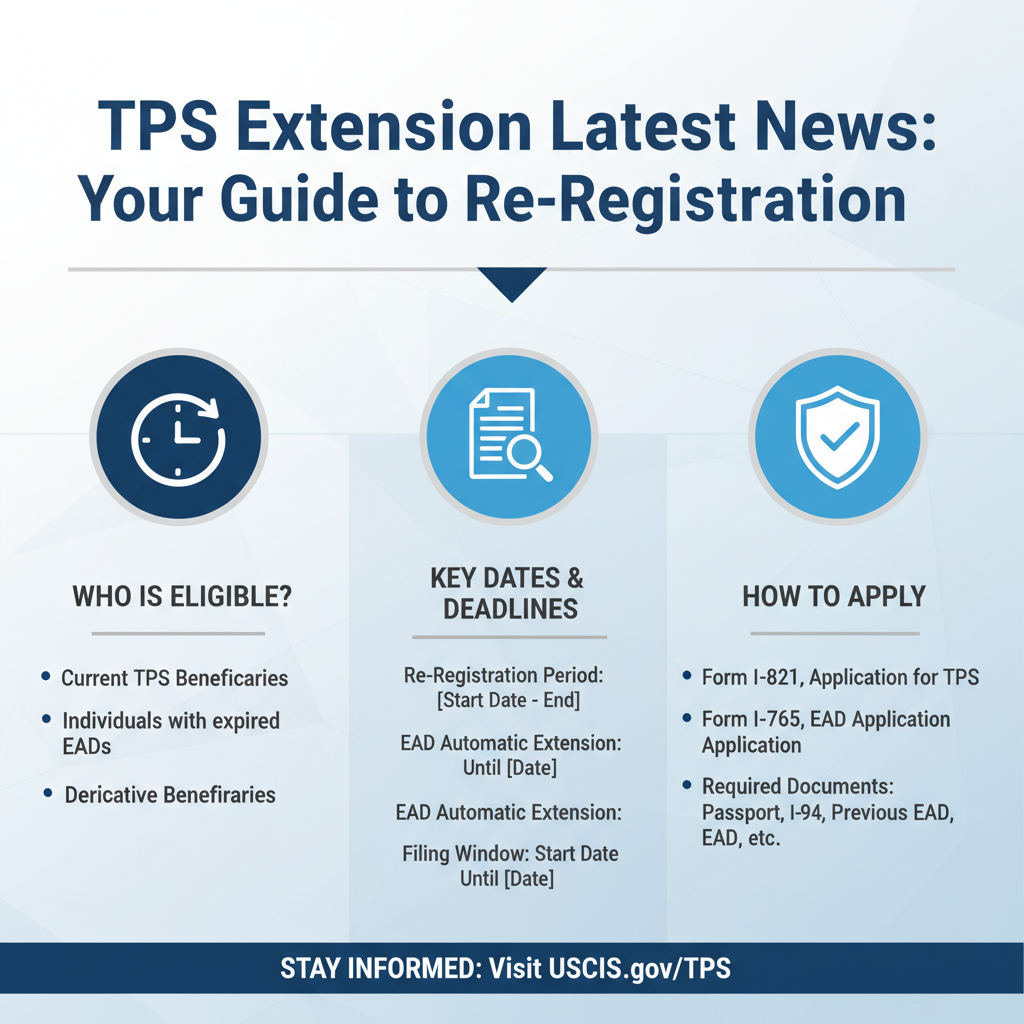
For individuals currently holding Temporary Protected Status (TPS) or those who may be eligible, news of extensions is a beacon of hope and a call to action. It signifies continued protection from deportation, ongoing authorization to work legally in the U.S., and an opportunity to maintain a stable life while conditions in their home countries remain unsafe.
Why this news is showing up now
The issuance of TPS extensions is not a random event but a result of a mandated review process by the Secretary of Homeland Security. Under U.S. immigration law, the Secretary must periodically assess the conditions in countries designated for TPS. This assessment determines whether the extraordinary and temporary conditions that led to the initial designation (such as ongoing armed conflict, environmental disaster, or other extraordinary and temporary conditions) continue to exist. If these conditions persist, the Secretary may decide to extend the country's TPS designation for a period, typically 18 months. This ensures that beneficiaries are not forced to return to dangerous situations. The current news cycle reflects these ongoing reviews and subsequent announcements for various designated countries, providing updated deadlines and procedures for re-registration.
How it can affect Florida residents
Florida, particularly Central Florida with its vibrant and diverse immigrant communities, is home to a significant number of TPS beneficiaries. For residents in Orlando, Kissimmee, and throughout the I-4 corridor, these extensions provide crucial stability:
- Continued Protection: If your country's TPS designation has been extended, you retain your protection from removal (deportation) from the United States. This is the fundamental benefit of TPS, offering peace of mind to families who might otherwise face the threat of being uprooted.
- Work Authorization: An extended TPS status typically comes with an automatic extension of your Employment Authorization Document (EAD) or work permit, often for a specified period. This means you can continue to work legally in the U.S., support your family, and contribute to the local economy. It's vital to understand the specific dates and automatic extension rules for your country's designation, as employers will need this information for I-9 verification.
- Travel Authorization: While not automatic, TPS beneficiaries can apply for travel authorization (advance parole) using Form I-131. An extension of TPS means that once approved, you can continue to travel internationally without jeopardizing your TPS status upon return.
- Planning for the Future: For many, TPS provides a temporary haven. An extension grants more time to explore other potential long-term immigration pathways, such as family-based petitions (e.g., Form I-130, Petition for Alien Relative) or employment-based visas, if eligible. It allows for continued residence and planning without the immediate pressure of an expiring status.
- Community Impact: The stability provided by TPS extensions strengthens local communities. Families can continue to live, work, and send their children to school without disruption, contributing to the social and economic fabric of places like Orlando and Orange County.
Important: While extensions offer relief, they also come with specific deadlines and re-registration requirements. Missing these deadlines can lead to the loss of your TPS status. It is crucial to act promptly and correctly.
What Temporary Protected Status (TPS) Is (and Why It Matters)
Temporary Protected Status (TPS) is a humanitarian immigration benefit provided by the United States government. It offers a lifeline to individuals from specific countries who are already in the U.S. and cannot safely return to their homelands due to extraordinary and temporary conditions. Understanding TPS is critical for anyone whose country has been designated.
A plain-English definition
Imagine your home country is experiencing a severe crisis – perhaps a devastating natural disaster like an earthquake or hurricane, an ongoing armed conflict, or other exceptional circumstances that make it unsafe for people to live there. If you are a national of that country and are already in the United States, the U.S. government can grant you "Temporary Protected Status."
This status is temporary because it's meant to last only as long as the dangerous conditions persist in your home country. While you have TPS, you are protected from being deported from the U.S. and you are allowed to live and work here legally. It is not a path to a Green Card or U.S. citizenship on its own, but it provides a crucial period of safety and stability.
Key terms you need to know
Navigating TPS requires familiarity with several important terms:
- Designated Country: A country for which the Secretary of Homeland Security has determined that conditions prevent its nationals from returning safely, or that the country is unable to handle the return of its nationals adequately. Examples often include Haiti, El Salvador, Honduras, Nicaragua, Syria, Venezuela, Afghanistan, Cameroon, and Ukraine, among others.
- Eligibility Criteria: The specific requirements an individual must meet to be granted TPS. These typically include being a national of a designated country, having been continuously physically present (CPP) in the U.S. since a specified date, having continuously resided (CR) in the U.S. since a specified date, and passing security and criminal background checks.
- Initial Registration: The first time an individual applies for TPS for a newly designated country or a new designation period. This typically involves filing Form I-821, Application for Temporary Protected Status, along with supporting documents and fees.
- Re-registration: The process by which current TPS beneficiaries apply to extend their status when their country's designation is extended. This also involves filing Form I-821, often with Form I-765 for a new work permit. Missing the re-registration deadline can lead to loss of status.
- Employment Authorization Document (EAD): Also known as a work permit, this document (Form I-766) allows TPS beneficiaries to work legally in the United States. When TPS is extended, USCIS often provides an automatic extension of existing EADs for a certain period to prevent gaps in work authorization.
- Travel Authorization (Advance Parole): A document issued by USCIS (Form I-512) that allows a TPS beneficiary to travel outside the United States and return without jeopardizing their TPS status. This is obtained by filing Form I-131, Application for Travel Document.
- Extension: A decision by the Secretary of Homeland Security to continue a country's TPS designation for an additional period, usually 18 months, because the unsafe conditions in the country persist.
- Termination: A decision by the Secretary of Homeland Security to end a country's TPS designation, meaning beneficiaries will lose their TPS status on a future date and must either depart the U.S. or find another legal immigration pathway.
- Continuous Physical Presence (CPP) & Continuous Residence (CR): Specific dates set by DHS. To be eligible for TPS, applicants must prove they have been physically present in the U.S. and have resided in the U.S. since these designated dates. Brief, casual, and innocent departures do not necessarily break CR.
Understanding these terms is fundamental to navigating the TPS process, especially during periods of extension. It empowers individuals to understand their rights, responsibilities, and the steps necessary to maintain their protected status.
Facing a TPS Deadline? Don't risk your status. Imigrar provides expert legal guidance for TPS re-registration and related immigration matters. Call +1 786-791-3106 today for a free consultation. Se Habla Español.
Current Immigration Law: The Foundation of TPS
Temporary Protected Status (TPS) is not a discretionary program without legal backing; it is firmly rooted in U.S. immigration law. The authority for TPS is found in Section 244 of the Immigration and Nationality Act (INA), specifically 8 U.S.C. § 1254a. This statute empowers the Secretary of Homeland Security (or formerly the Attorney General) to designate a foreign country for TPS if certain conditions are met.
The law outlines three primary grounds for designation:
- Ongoing Armed Conflict: The country is experiencing an ongoing armed conflict that poses a serious threat to the personal safety of its nationals if they were to return.
- Environmental Disaster: The country has experienced an earthquake, flood, drought, epidemic, or other environmental disaster resulting in a substantial, but temporary, disruption of living conditions, and the country is unable to handle the return of its nationals adequately.
- Extraordinary and Temporary Conditions: There are other extraordinary and temporary conditions in the foreign state that prevent nationals from returning safely, and granting TPS is consistent with U.S. foreign policy interests.
Once a country is designated, the Secretary must periodically review the conditions to determine whether the designation should be extended, terminated, or redesignated. This legal framework provides the basis for the extensions we are seeing today.
Federal requirements for TPS eligibility
Beyond the country designation, individual applicants must meet specific federal requirements to be eligible for TPS, whether for initial registration or re-registration:
- Nationality: You must be a national of a country designated for TPS, or a person without nationality who last habitually resided in that designated country.
- Continuous Physical Presence (CPP): You must have been continuously physically present in the United States since the effective date of the most recent designation for your country. Brief, casual, and innocent departures generally do not break CPP.
- Continuous Residence (CR): You must have been continuously residing in the United States since the effective date specified for your country's designation. Again, brief, casual, and innocent departures are usually permissible.
- Admissibility: You must be admissible to the U.S. as an immigrant, or eligible for a waiver of any applicable grounds of inadmissibility. Certain criminal convictions (felonies or two or more misdemeanors) and other grounds (such as persecution of others) can make you ineligible.
- Timely Application: You must apply for TPS (Form I-821) during the initial registration period or during any re-registration period announced by USCIS. Failure to apply within the specified window can result in denial, unless you meet specific exceptions.
Warning: Certain criminal offenses, national security concerns, or participation in the persecution of others can disqualify an applicant for TPS. It is crucial to be forthright about your history and seek legal counsel if you have any concerns about your eligibility.
Florida-specific considerations
While TPS is a federal program, and the eligibility requirements are uniform across the United States, there are practical considerations for Florida residents:
- USCIS Field Office: If your case requires an in-person interview (rare for re-registration but possible) or if you need to attend a biometrics appointment, you will likely be directed to a local USCIS Application Support Center (ASC) or the Orlando USCIS Field Office. Knowing your local office is helpful for scheduling and understanding processing times.
- Community Support: Florida has a robust network of non-profit organizations and legal aid groups that offer assistance to immigrants. For Central Florida residents, leveraging these resources can be beneficial, though consulting a private immigration law firm like Imigrar ensures personalized and comprehensive legal representation.
- State IDs and Driver's Licenses: With your TPS status and Employment Authorization Document (EAD), you can apply for a Florida driver's license or state identification card. This provides crucial mobility and identification for daily life in Orlando and beyond.
For more detailed information on TPS and other immigration forms, always refer to the USCIS official website. You can find all necessary forms and instructions at USCIS Forms.
How to Re-Register for TPS: A Complete Step-by-Step Guide
When your country's Temporary Protected Status (TPS) is extended, it's not an automatic continuation of your benefits. You must actively re-register with U.S. Citizenship and Immigration Services (USCIS) within the specified window. This guide provides a detailed, step-by-step process to ensure you maintain your protected status and work authorization.
1) Determine Your Eligibility and Re-registration Window
The first and most critical step is to confirm that your country's TPS designation has indeed been extended and to identify the specific re-registration period. USCIS announces these details in a Federal Register notice.
- Check Your Country's Designation: Verify that your country is among those whose TPS designation has been extended. USCIS provides official announcements.
- Note the Re-registration Period: There is a strict window, typically 60 days, during which you must file your application. Missing this deadline can lead to the loss of your TPS status. Reminder: USCIS often allows for late re-registration under certain extraordinary circumstances, but it's best to apply on time.
- Understand Automatic EAD Extensions: Check if USCIS has announced an automatic extension of your existing Employment Authorization Document (EAD) based on the new TPS extension. This often bridges the gap while your new EAD is being processed.
2) Gather All Necessary Documents
Thorough document preparation is key to a smooth re-registration process. While re-registration typically requires fewer documents than initial registration, you still need to provide proof of your identity, nationality, and previous TPS grants.
-
Proof of Identity and Nationality:
- Copy of your passport from your designated country (if available)
- Copy of your birth certificate (with a certified translation if not in English)
- Copy of your national identity document from your country of origin
-
Proof of Previous TPS Grant:
- Copy of your most recent Form I-797, Approval Notice for TPS
- Copy of your most recent Employment Authorization Document (EAD) (Form I-766)
-
Proof of Continuous Residence and Physical Presence (if requested or if there's a significant gap):
- Lease agreements, utility bills, or rent receipts
- Employment records, pay stubs, W-2 forms
- School records for children
- Medical records
- Bank statements
- Affidavits from friends/family attesting to your residence
-
Marriage Certificate and Birth Certificates (if applying for family members or if your name changed):
- For spouse and children, if they are also re-registering or applying for the first time.
- Photographs: Two recent, identical passport-style color photographs.
Important: Always provide copies, not originals, unless USCIS specifically requests them. Ensure all foreign language documents are accompanied by a complete English translation and a certification from the translator.
3) Complete and File Form I-821 and Form I-765
These are the core forms for TPS re-registration and work authorization.
-
Complete Form I-821, Application for Temporary Protected Status:
- Fill out every section accurately and completely. If a section does not apply, write "N/A."
- Be truthful about your immigration history, including any previous encounters with law enforcement, even if minor.
- Sign the form. An unsigned form will be rejected.
-
Complete Form I-765, Application for Employment Authorization:
- File this form if you want an EAD (work permit) or if your current EAD is expiring.
- For TPS re-registration, the category code is usually (c)(10).
- Sign the form.
-
Calculate and Submit Fees:
- Form I-821: No fee for re-registration.
- Form I-765: There is a fee for the EAD application. Check the current fee schedule on the USCIS Forms page.
- Biometrics Fee: There is a separate biometrics services fee.
- Fee Waivers: You may be eligible for a fee waiver (Form I-912, Request for Fee Waiver) if you meet certain poverty guidelines or receive public benefits. Filing a fee waiver correctly is crucial.
- Mail Your Application: Send your completed forms, supporting documents, and fees (check or money order payable to "U.S. Department of Homeland Security") to the correct USCIS lockbox facility. The address depends on your mailing state and the specific form. Check the USCIS website instructions for Form I-821 for the precise address.
4) Attend Biometrics Appointment (If Required)
After USCIS accepts your application, you will typically receive an appointment notice (Form I-797C, Notice of Action) for a biometrics services appointment at an Application Support Center (ASC). This is where USCIS collects your fingerprints, photograph, and signature.
- What to Bring: Your appointment notice, a valid photo ID (e.g., passport, driver's license), and any other documents specified in the notice.
- Location: For Central Florida residents, your appointment will likely be at an ASC in Orlando or a nearby city.
- Importance: Attending this appointment is mandatory. Failure to appear will likely result in a denial of your application.
5) Respond to Requests for Evidence (RFE) or Notices of Intent to Deny (NOID)
It's possible that USCIS may need more information or clarification regarding your application.
- Requests for Evidence (RFE): USCIS will send you an RFE if they need additional documents or information to make a decision. You will have a specific deadline to respond, usually 87 days.
- Notice of Intent to Deny (NOID): A NOID indicates that USCIS intends to deny your application and provides reasons. You will have a chance to respond and provide arguments or evidence to counter their findings.
- Seek Legal Help: Responding to an RFE or NOID is critical and often complex. It is highly recommended to seek assistance from an experienced immigration attorney at Imigrar to ensure a timely and compelling response.
6) Monitor Your Case Status
After filing, you can track the progress of your application online.
- Receipt Notice: Within a few weeks of filing, you should receive a Form I-797C, Notice of Action, acknowledging receipt of your application and providing a 13-digit receipt number.
- USCIS Online Tools: Use your receipt number to check your case status on the USCIS Case Status Online tool.
- Processing Times: You can also check estimated processing times for Form I-821 and Form I-765 at USCIS Processing Times. Keep in mind these are estimates and can fluctuate.
7) Understand the Implications of Approval or Denial
- Approval: If approved, you will receive a new Form I-797, Approval Notice for your TPS and, if applied for, a new EAD (Form I-766). This confirms your continued protected status and work authorization.
- Denial: If your application is denied, USCIS will provide a reason. You may have options to appeal the decision or reapply if the denial was due to correctable errors. It's crucial to consult an attorney immediately if you receive a denial notice to understand your options and next steps.
Practical Steps You Can Take Today for TPS Re-registration
Proactive preparation is your best defense against missing deadlines or making errors in your TPS re-registration. Here’s an actionable checklist to help you get started today, especially if you're in Orlando or anywhere in Florida.
Actionable Checklist:
- Verify Your Country's Status: Immediately check the official USCIS website (USCIS TPS page) for the latest Federal Register notice regarding TPS extensions for your country. Confirm the new expiration date and, most importantly, the exact re-registration window.
- Locate Previous TPS Documents: Gather all prior TPS approval notices (Form I-797), EAD cards (Form I-766), and any travel documents (Form I-512) you may have received. These are crucial for your re-registration application.
- Compile Supporting Identity and Residency Evidence: Even if not explicitly required for re-registration, having updated copies of your passport, birth certificate, and proof of continuous residence in the U.S. (e.g., utility bills, bank statements, school records) on hand is always a good practice.
- Review Your Personal History: Reflect on any significant life changes since your last TPS application, such as new arrests, criminal charges (even minor ones), or extensive travel outside the U.S. These must be disclosed and can impact your eligibility.
- Check USCIS Fee Schedules: Visit the USCIS Forms page to confirm the current fees for Form I-765 (EAD) and the biometrics fee. If you plan to apply for a fee waiver (Form I-912), start preparing the necessary financial documentation.
- Consult with an Immigration Attorney: This is perhaps the most critical step. An experienced attorney at Imigrar can review your specific situation, confirm your eligibility, ensure all forms are correctly filled out, and help you gather the necessary documentation. This is especially important if you have any criminal history, prior immigration issues, or questions about eligibility.
Document Preparation Guidance:
- Organize Everything: Create a dedicated folder for all your TPS documents. Keep originals safe and only send copies to USCIS.
- Translations: If any documents are not in English (e.g., birth certificates, marriage certificates), ensure you have complete and accurate English translations, certified by the translator.
- Copies: Make at least two complete sets of copies of your entire application


