


The reporting that sparked this guide
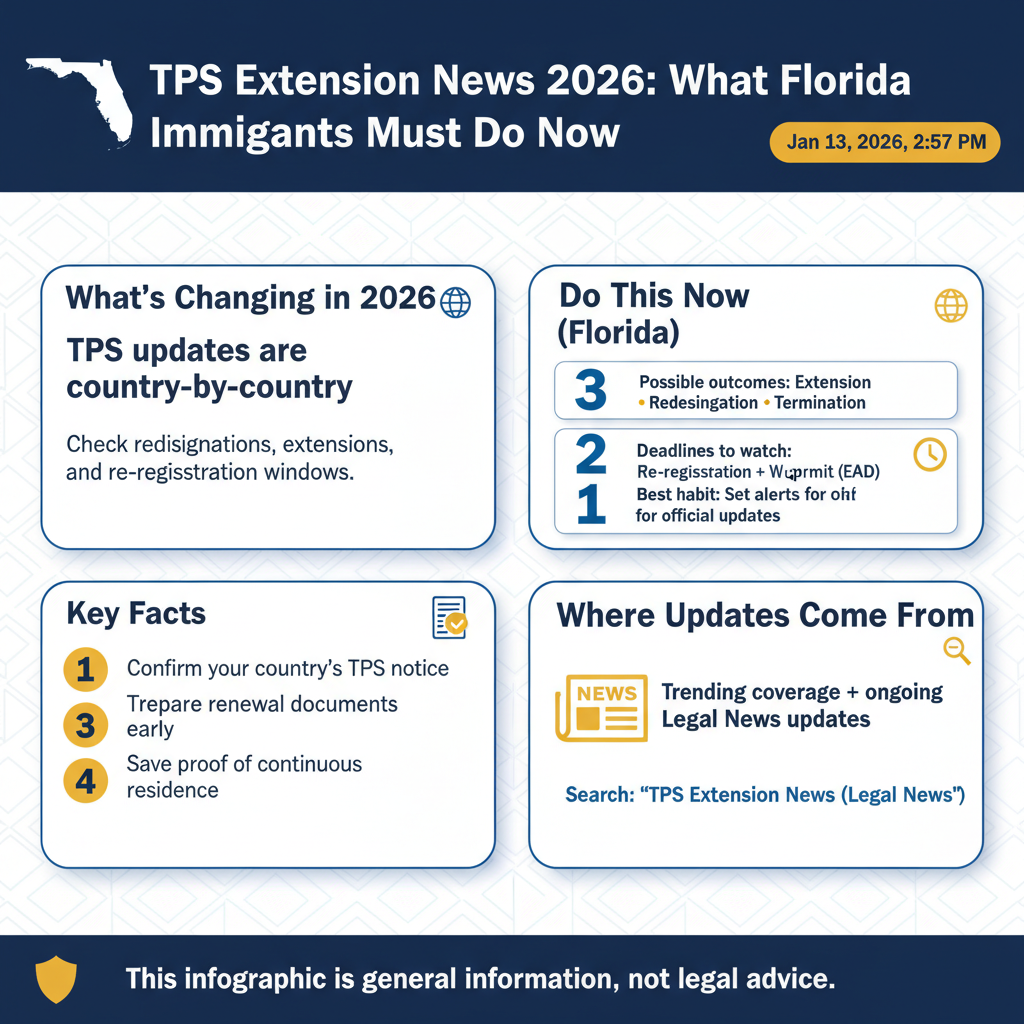
This article is based on trending coverage and ongoing updates about TPS redesignations, extensions, and re-registration periods reported in Legal News. For the latest headlines and developing coverage, see: TPS (Temporary Protected Status) Extension News (Legal News).
Important: TPS is decided country-by-country and changes quickly. Always confirm the most current dates and instructions directly with the government and your attorney before filing.
Need Help? Our Orlando immigration team is ready to assist. Call +1 786-791-3106 for a free consultation, or message us online. Se Habla Español.
What This News Means for Immigrants in Orlando and Across Florida
Why this news is showing up now
TPS “extension news” trends whenever the U.S. government makes (or is expected to make) a decision about:
- Extending TPS for a currently designated country (often 6, 12, or 18 months at a time).
- Redesignating TPS (adding a later “continuous residence” date so more people from that country may qualify).
- Terminating TPS (ending the designation after a wind-down period).
- Opening (or closing) the TPS re-registration window—often described as a 90-day window in public-facing guidance, though the exact timeframe depends on each Federal Register notice.
- Automatically extending certain Employment Authorization Documents (EADs) while USCIS processes renewals.
These announcements typically appear in official notices first (Federal Register and DHS/USCIS updates), then spread through national outlets and local Florida media because TPS affects work authorization, driver’s license renewals, and family stability.
How it can affect Florida residents
Florida is home to large immigrant communities from countries that have historically received TPS designations. For Central Florida residents—especially along the I-4 corridor (Orlando, Kissimmee, Sanford, and surrounding Orange County areas)—TPS updates can affect:
- Work authorization: Whether you can keep working lawfully and when you must renew your EAD using Form I-765.
- Driver’s license/Real ID renewals: Florida DHSMV often requires updated proof of lawful presence; TPS approval notices and EAD validity dates matter.
- Travel plans: TPS holders generally need advance permission (advance parole) using Form I-131 to travel internationally without risking serious immigration consequences.
- Immigration court cases: If you are in removal proceedings, TPS can be relevant to continuances, prosecutorial discretion, and work authorization. Court details and schedules are managed through the Executive Office for Immigration Review.
- Pathways beyond TPS: An extension is helpful, but TPS is temporary. Many families use this time to explore family-based options like Form I-130 and Adjustment of Status with Form I-485, when eligible.
Reminder: TPS is not a direct green card. An extension can buy time and stability, but it does not automatically create permanent residence or citizenship.
What TPS (Temporary Protected Status) Extension News Is (and Why It Matters)
A plain-English definition
Temporary Protected Status (TPS) is a humanitarian protection the U.S. government can grant to eligible nationals of certain countries (or people with no nationality who last habitually resided in that country) when conditions there make it unsafe to return—such as armed conflict, environmental disaster, or other extraordinary and temporary conditions.
When you see “TPS extension news,” it usually means the Department of Homeland Security (DHS) is continuing TPS for a country that already has it, allowing current TPS holders to:
- Remain in the United States for the extension period (if they re-register properly and remain eligible).
- Apply for or renew work authorization (EAD) through USCIS.
- Request travel authorization (advance parole) in certain circumstances.
For families in Orlando and across Florida, TPS extensions often mean continued employment, stable housing, and the ability to plan for school, healthcare, and long-term immigration strategies.
Key terms you need to know
- Designation: DHS’s decision to grant TPS to a specific country for a set period.
- Extension: DHS continues TPS for the same country and generally requires current holders to re-register.
- Redesignation: DHS extends TPS and updates eligibility dates so additional people from that country may qualify.
- Re-registration: The process current TPS holders must complete during the announced period to keep TPS.
- Initial registration: First-time TPS filing for people newly eligible (often after redesignation).
- EAD (work permit): Employment Authorization Document, usually requested with Form I-765.
- Advance parole: Travel permission requested with Form I-131.
- Unlawful presence: A complex concept that can trigger 3/10-year bars if you depart after accruing it; TPS may protect you from being removed, but it does not erase prior unlawful presence.
- Adjustment of Status and Form I-485: A process to apply for a green card from inside the U.S. when eligible.
- Priority Date: The “place in line” date for certain immigrant visa categories; relevant to some family- and employment-based green card cases.
Warning: TPS rules can interact with prior immigration history (entries without inspection, prior removal orders, criminal issues, missed deadlines). Do not assume an extension automatically fixes older problems.
Current Immigration Law: The Foundation
TPS is governed by federal statute and implemented through DHS regulations and country-specific notices. Understanding the legal foundation helps you spot misinformation and follow the correct process.
Federal requirements
The primary legal authority for TPS is:
- Immigration and Nationality Act (INA) § 244 (8 U.S.C. § 1254a) — establishes TPS, eligibility, registration, and termination/extension authority.
Key federal requirements typically include:
- You must be a national of a TPS-designated country (or last habitually resided there if stateless).
- You must meet “continuous residence” and “continuous physical presence” requirements set by the designation notice.
- You must file during the correct registration or re-registration period unless you qualify for late initial filing rules.
- You must not be barred due to certain criminal convictions or security-related grounds.
Official guidance and filing instructions are published by USCIS. Start with the USCIS official website and the country-specific TPS page. Form downloads and instructions are on the USCIS Forms portal.
Common USCIS forms connected to TPS include:
- Form I-821 (Application for Temporary Protected Status) – the core TPS application (initial and re-registration, depending on instructions).
- Form I-765 (Application for Employment Authorization) – to request or renew your EAD.
- Form I-131 (Application for Travel Document) – to request advance parole for travel.
TPS extensions can also be a strategic moment to review longer-term options such as:
- Form I-130 (Petition for Alien Relative) – family-based petition.
- Form I-485 (Application to Register Permanent Residence or Adjust Status) – Adjustment of Status when eligible.
Florida-specific considerations
Immigration law is federal, but Florida residents often face practical, state-level impacts:
- Driver’s license and ID renewals: Florida agencies often verify immigration status through SAVE; an automatically extended EAD or pending renewal can create delays. Keep copies of Federal Register notices and USCIS receipt notices.
- Employment verification: Employers complete Form I-9; TPS EAD automatic extensions may require employers to update I-9 records properly. Bring the official notice and your EAD/receipt.
- Local logistics: If your case is in Orlando, plan for biometrics appointments and document gathering while balancing work and family responsibilities. The Orlando area’s growth means appointments can be harder to reschedule quickly.
Reminder: The Orlando USCIS Field Office is relevant for some in-person services and interviews for other benefits (like green cards). TPS itself is typically handled through USCIS service centers, but your broader immigration strategy may involve the field office.
Need Help? Our Orlando immigration team is ready to assist. Call +1 786-791-3106 for a free consultation, or message us online. Se Habla Español.
How to Maintain TPS After an Extension: A Complete Step-by-Step Guide
When TPS is extended for your country, most current TPS holders must re-register and many must also renew their work permit. Below is a practical, Florida-friendly roadmap. Always follow the exact instructions in the Federal Register notice for your country and the USCIS TPS page.
1) Confirm your country’s TPS extension details and deadlines
Start by verifying whether DHS announced an extension, a redesignation, or both—and the precise filing period. Do not rely on social media summaries.
- Check the USCIS official website TPS page for your country.
- Read the Federal Register notice (USCIS links it on the TPS country page).
- Verify whether USCIS announced an automatic EAD extension and which card categories and expiration dates qualify.
Documents to gather for this step:
- Your current EAD (front/back copy).
- Your last TPS approval notice (I-797) if available.
- Any USCIS receipt notices for pending filings.
- A copy (PDF/print) of the Federal Register notice for your country (for employer/DMV use).
Important: Missing the re-registration deadline can put your TPS at risk unless you qualify for late re-registration under limited rules.
2) Decide whether you are re-registering, filing initial TPS, or both
TPS extension news can create two different groups:
- Current TPS holders who need to re-register to keep TPS.
- Newly eligible applicants (often due to redesignation) who may file initial TPS.
Some people also need to address complications, such as a prior TPS denial, a gap in registration, or a criminal issue. That is where legal review matters.
Documents to gather for this step:
- Passport and/or birth certificate (identity and nationality proof).
- Proof of entry and residence in the U.S. (I-94, travel records, leases, pay stubs).
- Any prior immigration decisions (RFEs, NOIDs, denials, removal orders).
- Certified court dispositions for any arrests (even if charges were dropped).
3) Prepare and file Form I-821 and (if needed) Form I-765
For most TPS extensions, re-registration involves submitting Form I-821 during the designated period. If you want to work (or keep working), you typically also file Form I-765.
USCIS may allow online filing for certain forms in some categories, but many TPS filings are still paper-based depending on the country and instructions. Follow the USCIS filing address precisely.
Documents to gather for this step:
- Completed Form I-821 (signed).
- Completed Form I-765 (signed), if requesting an EAD.
- Two passport-style photos if required by the instructions (varies by filing method).
- Filing fees or a fee waiver request (if eligible), following USCIS instructions.
- Copy of government-issued photo ID.
- Copies of prior EADs and TPS approval notices.
Warning: Filing the wrong edition of a form, using the wrong fee, or mailing to the wrong address can cause rejection and lost time—especially risky if you are near the end of the re-registration period.
4) Track receipts, biometrics, and USCIS requests (RFEs)
After filing, USCIS typically issues receipt notices (Form I-797). You may also receive a biometrics appointment notice. If you receive a Request for Evidence (RFE), respond by the deadline.
For timelines, check: USCIS Processing Times.
Documents to gather for this step:
- USCIS receipt notices (I-797C) for Form I-821 and Form I-765.
- Biometrics notice and photo ID for the appointment.
- Any RFE/NOID letters and your response packet (copies).
- Proof of delivery for mailings (USPS/UPS/FedEx tracking).
Important: If your case is in Orlando and you need to reschedule biometrics, do it immediately. Missed biometrics can lead to denial.
5) Maintain work authorization and update your employer correctly
Many TPS holders are most affected by EAD timing. Depending on the country notice, USCIS may automatically extend certain EADs for a set period while you re-register and/or renew. Even with an automatic extension, employers must document it correctly for Form I-9 compliance.
Documents to gather for this step:
- Your EAD (even if expired, if covered by automatic extension).
- The Federal Register notice showing automatic extension details.
- Your Form I-765 receipt notice (if you filed to renew).
- Any updated I-797 approval notices.
Reminder: If your employer is confused, you can reference USCIS guidance on TPS automatic EAD extensions and provide the official notice. Avoid relying on unofficial summaries.
6) Consider travel carefully: advance parole and re-entry risks
TPS does not automatically allow international travel. If you leave the U.S. without proper authorization, you may trigger serious consequences, including losing TPS or making it harder to pursue a green card later.
Many TPS holders request advance parole with Form I-131 when they have urgent family reasons, medical needs, or other qualifying purposes. Always consult an attorney before traveling.
Documents to gather for this step:
- Completed Form I-131 (signed).
- Evidence supporting travel purpose (medical letters, death certificates, school letters).
- Proof of current TPS (approval/receipts) and identity documents.
- Any immigration court documents if you are in proceedings.
Warning: Travel can be especially risky if you have prior removal orders, unlawful presence issues, or certain criminal histories. Get individualized advice.
7) Use the extension period to plan permanent options (when eligible)
A TPS extension is often the best time to assess longer-term pathways. Depending on your family situation and immigration history, options may include:
- Family petition through a U.S. citizen or permanent resident relative using Form I-130.
- Adjustment of Status using Form I-485 (if eligible).
- Consular processing through the U.S. Department of State if adjustment is not available.
Important: Whether TPS counts as an “admission” for Adjustment of Status can be legally complex and fact-specific. Do not assume you qualify without a careful review of your entry history and current status.
Documents to gather for this step:
- Marriage certificate, birth certificates, and proof of bona fide relationship (if family-based).
- All I-94 records, entry stamps, and travel history.
- Prior immigration filings and decisions.
- Proof of continuous presence and employment history.
Practical Steps You Can Take Today
TPS extension announcements often create a rush. Taking organized steps early can prevent missed deadlines, job interruptions, and avoidable denials.
- Checklist item #1: Print/save the official TPS country notice and highlight the re-registration dates and any automatic EAD extension language.
- Checklist item #2: Make a “TPS folder” (paper + digital) with: EAD copies, TPS approval notices, receipts, passport/ID, and proof of address in Orange County or your Florida county.
- Checklist item #3: If you moved, update your address with USCIS immediately using the required method (address changes are time-sensitive).
- Checklist item #4: If your EAD expires soon, prepare Form I-765 right away—do not wait for the last week of the re-registration period.
- Checklist item #5: If you have any arrest history, request certified dispositions now; some Florida clerks take weeks to produce records.
- Checklist item #6: If you are in immigration court, check hearing dates and keep your attorney updated; consult the Executive Office for Immigration Review for official information and avoid missing hearings.
Timeline expectations (general):
- Re-registration window: Often described as a 90-day window, but it varies by country notice.
- Work permit renewal timing: USCIS processing times vary; check the official tool at USCIS Processing Times.
- Automatic EAD extension: If granted, it can bridge gaps—but only if your EAD category and expiration date match the notice.
- Travel authorization: Advance parole processing can take months; do not buy nonrefundable tickets until approved.
Reminder: Many TPS-related problems in Florida happen because someone assumes an automatic extension applies to them when it does not. Always match your EAD category code and dates to the official notice.
Need Help? Our Orlando immigration team is ready to assist. Call +1 786-791-3106 for a free consultation, or message us online. Se Habla Español.
How Imigrar Helps Immigrants in Orlando
At Imigrar, we help TPS holders and their families protect their ability to live and work in the U.S. and plan beyond TPS. Our team supports clients in Orlando, throughout Central Florida, and nationwide.
- TPS re-registration and initial filings: We prepare Form I-821 and Form I-765 packets tailored to the country notice and your immigration history.
- Work permit strategy: We help you understand automatic EAD extensions, renewal timing, and how to document work authorization for employers and Florida agencies.
- Travel planning: We advise on advance parole through Form I-131 and risk factors before you travel.
- Long-term planning: We evaluate family-based options like Form I-130 and Adjustment of Status using Form I-485, including how your Priority Date and entry history may affect eligibility.
- Removal defense coordination: If you are in proceedings, we coordinate TPS strategy with your court posture and EOIR schedules.
Se Habla Español. We offer a free consultation to help you understand what the latest TPS extension news means for your specific case and what to do next.
Frequently Asked Questions
Q: Am I automatically protected when TPS is extended for my country?
A: Not necessarily. Most TPS extensions require current beneficiaries to re-register during the announced period. Some notices also provide an automatic EAD extension for certain card categories and expiration dates, but you must confirm your documents match the notice. If you miss re-registration without qualifying for late filing, you can lose TPS.
Q: Does TPS give me a green card or citizenship?
A: No. TPS is temporary and does not directly lead to permanent residence or citizenship. However, it can provide stability and work authorization while you pursue other options. Some TPS holders may qualify for family-based immigration through Form I-130 and, if eligible, Adjustment of Status with Form I-485. Your entry history and other factors matter.
Q: How long does it take to get my renewed work permit after filing Form I-765?
A: Processing times vary by workload and eligibility category. Use the official tool at USCIS Processing Times and track your case with your receipt number. If USCIS announces an automatic extension for your country, that may allow you to keep working while the renewal is pending—if you qualify under the notice.
Q: What documents do I need to re-register for TPS?
A: For re-registration, USCIS typically focuses on identity, prior TPS approval, and continued eligibility. Common documents include: your current/previous EAD, TPS approval notice, government photo ID, and any court dispositions if you have an arrest history. Follow the country-specific instructions for Form I-821 and Form I-765 on the USCIS Forms page and your TPS country page.
Q: How much does it cost to file TPS and renew my EAD?
A: Costs depend on whether you are filing Form I-821, Form I-765, biometrics requirements, and whether a fee waiver is available for your situation. USCIS fees can change, so confirm current amounts on the USCIS official website before filing. If cost is a concern, speak with an attorney about eligibility for a fee waiver and the risks of filing incorrectly.
Q: What happens if my TPS re-registration or work permit is denied?
A: A denial can have serious consequences, including loss of work authorization and possible exposure to removal proceedings depending on your overall immigration status. Next steps may include filing a motion, correcting a filing error, reapplying if permitted, or exploring alternative relief. If you are in immigration court, coordinate immediately with counsel and monitor EOIR through the Executive Office for Immigration Review. Get legal advice quickly because deadlines can be short (sometimes measured in 180 days or less depending on the remedy, and often far shorter).
Q: Can I travel outside the U.S. if I have TPS?
A: Only if you obtain proper travel authorization in advance, typically through Form I-131 (advance parole). Traveling without authorization can cause you to lose TPS and may trigger other immigration consequences. Warning: If you have prior unlawful presence, removal orders, or criminal issues, travel can be especially risky—consult an attorney before making plans.
Q: If my case is in Orlando, do I have to go to the Orlando USCIS Field Office for TPS?
A: Most TPS filings are handled through USCIS lockboxes/service centers, not the local field office. However, you may still be scheduled for biometrics at a local Application Support Center, and your broader immigration options (like Form I-485 interviews) may involve the Orlando USCIS Field Office. For Central Florida residents, planning for appointments and document requests early helps avoid delays.
Common Mistakes (and How to Avoid Them)
Mistake #1: Assuming an automatic EAD extension applies to everyone
Automatic extensions are country- and document-specific. The notice usually lists exact EAD category codes and expiration dates that qualify. How to avoid it: Compare your EAD category and dates to the official notice and keep a printed copy for your employer and Florida agencies.
Mistake #2: Missing the re-registration deadline (or filing at the last minute)
Late filings can be risky and may require special justification. How to avoid it: File early in the re-registration period, track delivery, and keep receipts. If you are waiting on court records or documents, talk to a lawyer before the deadline.
Mistake #3: Traveling without advance parole or without understanding your risks
International travel can create unexpected consequences, especially for people with prior unlawful presence, prior orders, or certain arrests. How to avoid it: Consult counsel, file Form I-131 properly, and do not depart until you have the approved travel document in hand.
Need Help? Our Orlando immigration team is ready to assist. Call +1 786-791-3106 for a free consultation, or message us online. Se Habla Español.

Closing: Protect Your TPS and Plan Your Next Step
TPS extension news can be a lifeline for families—but only if you act on the correct deadlines and file the right way. If you are unsure whether you must re-register, whether your EAD is automatically extended, or whether you have a path beyond TPS through Form I-130, Form I-485, Adjustment of Status, or a strategy tied to your Priority Date, get individualized legal guidance.
Need help in Orlando or anywhere in the U.S.? Call Imigrar at +1 786-791-3106 for a free consultation, or message us online. Se Habla Español. Our mission is to Keep Families Together.


