


Today is 2026-04-14.
The reporting that sparked this guide
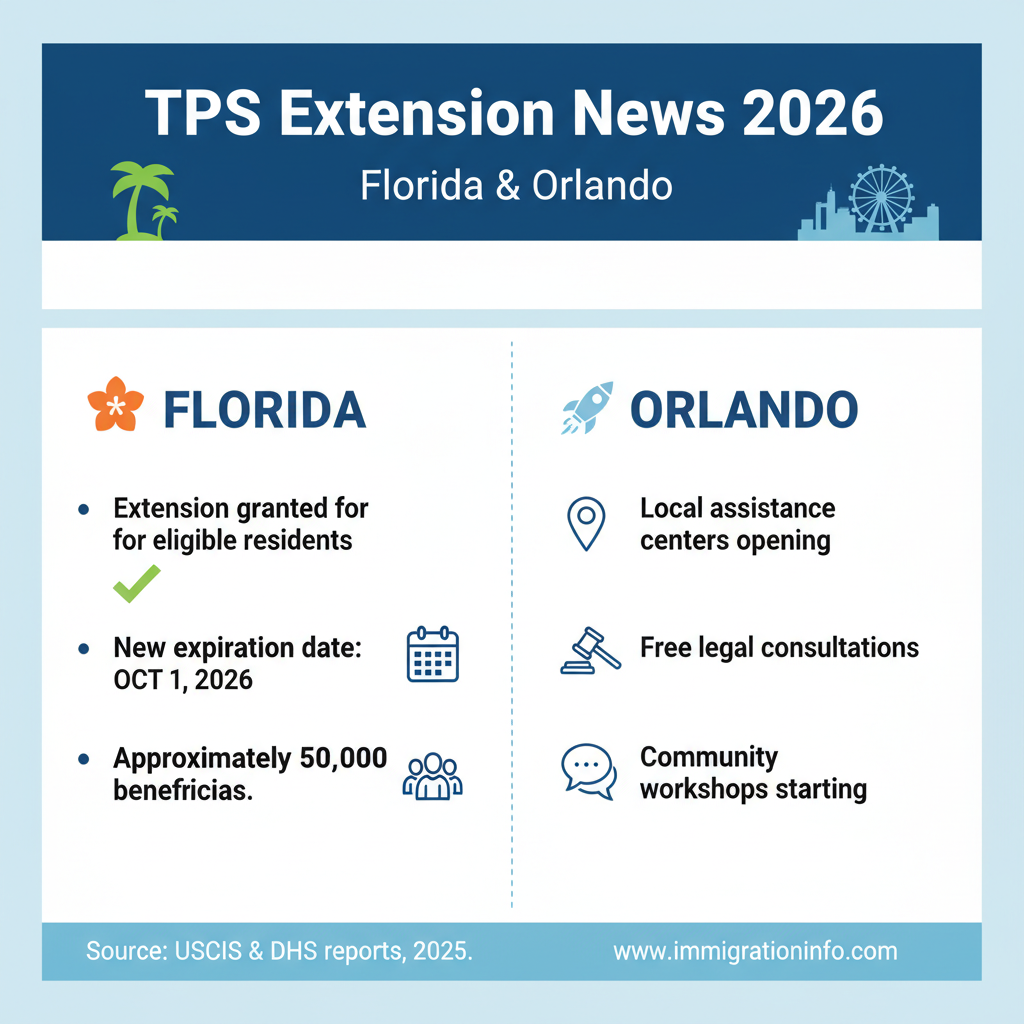
The ongoing discussions and announcements regarding Temporary Protected Status (TPS) extensions for various designated countries have been a significant focus in recent legal news. These updates are crucial for hundreds of thousands of individuals and families across the United States, including a substantial population right here in Florida. Staying informed about these developments is not just about legal compliance; it's about securing futures and keeping families together.
TPS (Temporary Protected Status) Extension News (Legal News)
Need Help Navigating TPS Extensions? Our Orlando immigration team at Imigrar is ready to assist. We understand the complexities of TPS and are committed to helping you understand your options and complete your application accurately. Call +1 786-791-3106 for a free, confidential consultation, or message us online. Se Habla Español.
What This News Means for Immigrants in Orlando and Across Florida
Recent announcements from the Department of Homeland Security (DHS) regarding the extension and, in some cases, redesignation of Temporary Protected Status (TPS) for several countries have sent ripples of hope and concern through immigrant communities. These updates are not abstract legal concepts; they directly impact the daily lives, employment, and stability of hundreds of thousands of individuals and their families who have sought refuge in the United States.
Why this news is showing up now
The Immigration and Nationality Act (INA) grants the Secretary of Homeland Security the authority to designate a foreign country for TPS due to conditions that temporarily prevent the country's nationals from returning safely, or where the country is unable to handle the return of its nationals adequately. These conditions typically include ongoing armed conflict, environmental disaster, or other extraordinary and temporary conditions. When a country is initially designated, the status is granted for a period of 6 to 18 months. As that period approaches its end, the Secretary must review the conditions in the designated country to determine if they still meet the criteria for TPS. This review often leads to either an extension of the existing designation, a redesignation (allowing more nationals to apply), or, less commonly, a termination of TPS.
The news you're seeing now reflects the outcome of these ongoing reviews. As of April 2026, several countries have recently had their TPS designations extended, or in some instances, been redesignated to include a broader group of eligible nationals. These decisions are made based on the latest assessments of country conditions, often involving input from the U.S. Department of State and other agencies. For countries like Haiti, Venezuela, El Salvador, Honduras, Nicaragua, Nepal, Sudan, South Sudan, and others, these announcements are critical. Each extension or redesignation comes with specific registration periods and eligibility criteria, making it essential for individuals to stay informed about the status of their specific country.
These updates are not merely bureaucratic formalities; they represent a crucial lifeline for individuals who cannot safely return home. They allow beneficiaries to live and work legally in the U.S., contributing to our society and economy, while providing a measure of stability during times of crisis in their home countries.
How it can affect Florida residents
Florida, and particularly Central Florida, is home to vibrant and diverse immigrant communities, many of whom are nationals of countries currently designated for TPS. For instance, the large Venezuelan, Haitian, and Central American populations in our state mean that TPS extensions directly impact tens of thousands of families here in Orlando, Miami, Tampa, and other cities along the I-4 corridor and beyond.
- Employment Authorization: For current TPS holders, an extension means continued eligibility for work permits (Employment Authorization Documents - EADs), allowing them to maintain their jobs and support their families without interruption. This is vital for the economic stability of many households in Orange County and surrounding areas.
- Protection from Deportation: TPS provides temporary protection from removal from the United States. An extension ensures that beneficiaries can continue to live without fear of deportation, allowing them to focus on their lives and contributions to the community.
- Travel Authorization: With an approved Form I-131, Application for Travel Document, TPS holders may be able to travel outside the U.S. and return, which is crucial for maintaining family ties or addressing urgent matters abroad, though careful planning and legal advice are always recommended.
- Community Stability: The continuity of TPS for designated countries contributes significantly to the stability of local communities. Families can plan for their children's education, individuals can invest in their careers, and the overall social fabric remains stronger when residents have a secure legal status.
- New Opportunities for Some: In cases of redesignation, individuals from the newly included period of continuous residence may become eligible for TPS for the first time. This can open doors to legal status and work authorization for many who previously did not qualify, offering a beacon of hope for those in Orlando and across Florida who have long sought protection.
For Central Florida residents, understanding these updates is paramount. The Orlando USCIS Field Office serves a significant immigrant population, and knowledge of TPS requirements, deadlines, and re-registration procedures is essential to avoid lapses in status. Imigrar is deeply embedded in this community, and we are committed to providing the most current and accurate information to help our neighbors navigate these critical immigration pathways.
Confused by Recent TPS Updates? Don't risk your status. Our knowledgeable legal team at Imigrar, based in Orlando, is here to clarify the latest TPS news and guide you through the re-registration or application process. Call us at +1 786-791-3106 for a free consultation. Se Habla Español.
What Temporary Protected Status (TPS) Is (and Why It Matters)
Temporary Protected Status (TPS) is a humanitarian immigration benefit provided by the United States to eligible nationals of designated countries. It is a temporary status, meaning it does not lead directly to permanent residency (a Green Card), but it offers crucial protections and benefits for a defined period.
A plain-English definition
Imagine your home country is experiencing an emergency – a devastating earthquake, a civil war, or another severe crisis that makes it unsafe for you to return. If you are already in the United States when this happens, TPS is a way for the U.S. government to say, "We understand it's not safe for you to go back right now. So, for a temporary period, you can stay here legally."
During this temporary period, you are protected from deportation and are allowed to work legally in the U.S. and, in some cases, travel internationally. This status is not permanent, and it's tied to the conditions in your home country. If those conditions improve significantly, your country's TPS designation might eventually be terminated, meaning you would need to find another immigration pathway or prepare to return home.
Key terms you need to know
- Designation: This is the official act by the Secretary of Homeland Security to grant TPS to a specific country. A country is designated when it meets statutory criteria, such as ongoing armed conflict, environmental disaster, or other extraordinary and temporary conditions. Each designation specifies an effective date and a duration (typically 6 to 18 months).
- Extension: When the conditions in a designated country have not improved sufficiently by the end of its TPS period, the Secretary of Homeland Security can extend the designation. This allows current TPS beneficiaries to maintain their status and work authorization for an additional period. Extensions require re-registration by current beneficiaries.
- Redesignation: Sometimes, the Secretary of Homeland Security may not only extend TPS for a country but also "redesignate" it. A redesignation means that a new, later date is set as the eligibility cut-off for continuous residence in the U.S. This allows individuals who arrived in the U.S. after the original eligibility date, but before the new redesignation date, to apply for TPS for the first time, provided they meet all other eligibility criteria. This is a significant development as it expands the pool of eligible applicants.
-
Eligibility Criteria: To be eligible for TPS, an individual must typically:
- Be a national of a country designated for TPS (or a person without nationality who last habitually resided in that country).
- Have been continuously physically present (CPP) in the U.S. since the effective date of the most recent designation or redesignation.
- Have continuously resided (CR) in the U.S. since the date specified for their country's designation or redesignation.
- Meet other general immigration eligibility requirements (e.g., pass security checks, not have certain criminal convictions).
- Employment Authorization Document (EAD): Often referred to as a "work permit," the EAD is a card issued by USCIS that proves you are authorized to work in the United States. TPS beneficiaries are eligible to apply for an EAD by filing Form I-765. Extensions of TPS usually come with automatic extensions of EADs for a certain period, but re-registration is still necessary to secure a new EAD card.
- Travel Authorization: While TPS provides protection from deportation, it does not automatically allow you to travel outside the U.S. and return. To travel internationally, TPS beneficiaries must apply for a travel document (Advance Parole Document) by filing Form I-131. Traveling without this document can lead to denial of re-entry and even loss of TPS.
Understanding these terms is critical for anyone considering applying for or re-registering for TPS. The temporary nature of TPS means that vigilance regarding deadlines and country-specific announcements is essential. It provides a vital safety net, but it requires active management from beneficiaries.
Current Immigration Law: The Foundation of TPS
Temporary Protected Status (TPS) is a statutory benefit authorized by Congress through the Immigration and Nationality Act (INA). Specifically, Section 244 of the INA (8 U.S.C. § 1254a) outlines the legal framework for TPS, granting the Secretary of Homeland Security the authority to designate countries for this status.
Federal requirements for TPS designation and individual eligibility
The INA sets forth clear criteria for both the designation of a country for TPS and the eligibility of individual applicants. These criteria are strictly adhered to by the Department of Homeland Security (DHS) when making decisions that impact thousands of lives.
Country Designation Requirements:
The Secretary of Homeland Security may designate a country for TPS if it determines that conditions in that country fall into one of three categories:
- Ongoing Armed Conflict: There is an ongoing armed conflict within the state, and requiring nationals of that state to return would pose a serious threat to their personal safety. Examples include civil wars or widespread violence.
- Environmental Disaster: The country has experienced an environmental disaster (such as an earthquake, hurricane, or tsunami), or an epidemic, and the foreign state is unable, temporarily, to handle adequately the return of its nationals.
- Extraordinary and Temporary Conditions: There exist other extraordinary and temporary conditions in the foreign state that prevent nationals from returning safely. This category is broader and allows for flexibility in response to various unforeseen crises.
The Secretary must publish a notice in the Federal Register announcing the designation, its effective date, and the estimated number of nationals eligible. Designations are made for periods of 6, 12, or 18 months and are subject to review and potential extension or redesignation.
Individual Eligibility Requirements:
To be granted TPS, an individual must meet several federal requirements:
- Nationality: Be a national of a country designated for TPS, or a person without nationality who last habitually resided in that designated country.
- Continuous Physical Presence (CPP): Have been continuously physically present in the United States since the effective date of the most recent designation or redesignation for their country. Brief, casual, and innocent absences do not break CPP.
- Continuous Residence (CR): Have continuously resided in the United States since the date specified for their country's designation or redesignation. This is often an earlier date than the CPP requirement.
- Timely Application: Apply for TPS during the initial registration period or during any subsequent re-registration period. There are limited exceptions for late initial registration.
- Admissibility: Be admissible to the United States as an immigrant, or be eligible for a waiver of inadmissibility. Certain criminal convictions (e.g., two misdemeanors or one felony) and other grounds of inadmissibility can bar an applicant from TPS.
- Security Checks: Pass all required security and background checks.
Applicants typically file Form I-821, Application for Temporary Protected Status, and often concurrently file Form I-765, Application for Employment Authorization, and Form I-601, Application for Waiver of Grounds of Inadmissibility, if necessary. All forms and instructions are available on the USCIS official website.
Florida-specific considerations
While TPS is a federal program and its requirements are uniform across the United States, its impact and practical considerations can vary by state due to demographic factors and local resources.
- Large Beneficiary Populations: Florida is home to a significant number of individuals from TPS-designated countries, especially from Latin America and the Caribbean. This means that extensions or redesignations for countries like Venezuela, Haiti, El Salvador, Honduras, and Nicaragua have a profound and immediate effect on a large segment of Florida's immigrant population.
- Access to Legal Services: Due to the high demand, access to knowledgeable immigration legal services is crucial. Firms like Imigrar in Orlando specialize in assisting these communities, providing guidance on complex TPS applications and re-registrations.
- Local USCIS Offices: The Orlando USCIS Field Office and other offices across Florida process thousands of TPS-related applications annually. Understanding local processing times and procedures can be beneficial, though most applications are filed at designated USCIS Service Centers. You can check general processing times at USCIS Processing Times.
- Community Resources: Various non-profit organizations and community centers in Central Florida offer support, language assistance, and sometimes legal clinics to help TPS beneficiaries. Imigrar often collaborates with or refers clients to these valuable local resources.
It's important for Florida residents to remember that state residency does not alter federal TPS eligibility. However, local resources and the prevalence of certain immigrant communities can shape the experience of applying for or maintaining TPS.
How to Apply or Re-register for TPS: A Complete Step-by-Step Guide
Applying for or re-registering for Temporary Protected Status can seem daunting, but breaking it down into manageable steps can simplify the process. This guide provides a detailed walkthrough for individuals in Orlando and across Florida.
1) Determine Your Eligibility and Country Designation
Action: Before anything else, confirm that your country is currently designated for TPS and that you meet the specific eligibility criteria for that designation or redesignation.
- Check Your Country's Status: Visit the USCIS TPS webpage to find the latest announcements for your country. Pay close attention to the designation/redesignation dates, continuous residence (CR) date, and continuous physical presence (CPP) date.
- Review Individual Eligibility: Ensure you meet the nationality, CR, CPP, and admissibility requirements. Consider any criminal history or previous immigration violations that might affect your eligibility.
- Important: Each country's designation comes with specific dates. Do not assume you are eligible based on general news; always verify the exact dates for your country.
2) Gather Required Documents
Action: Collect all necessary supporting documents. This is a critical step, as incomplete applications are often delayed or denied.
-
Proof of Identity and Nationality:
- Passport from your designated country.
- Birth certificate with photo identification.
- National identity card from your designated country with your photo and/or fingerprint.
- Any other official document that proves your nationality.
-
Proof of Entry into the U.S. (if applicable for initial registration):
- Entry stamp in passport.
- Form I-94, Arrival/Departure Record.
-
Proof of Continuous Residence (CR) in the U.S. since the specified date: (Provide as many as possible)
- Rental agreements, mortgage statements, utility bills (electricity, water, gas, phone).
- Employment records (pay stubs, W-2 forms, letters from employers).
- School records (transcripts, report cards, attendance records) for yourself or your children.
- Medical records (hospital bills, doctor's notes, vaccination records).
- Bank statements.
- Affidavits from credible witnesses (e.g., religious leaders, community members) who can attest to your presence.
- Any dated receipts, money order receipts, or dated correspondence.
- Florida driver's license or state ID card.
- Photos: Two identical passport-style photos (2x2 inches) taken within 30 days of filing.
- Previous TPS/EAD Cards: If re-registering, include copies of your most recent TPS approval notice and EAD.
- Proof of Any Prior Immigration Status/Benefits: If applicable.
3) Complete and File Forms I-821 and I-765
Action: Accurately complete the required forms and prepare them for submission.
-
Form I-821, Application for Temporary Protected Status:
- Complete all sections truthfully and accurately.
- If you are re-registering, clearly indicate this on the form.
- Sign the form. An unsigned form will be rejected.
-
Form I-765, Application for Employment Authorization:
- File this form if you wish to obtain an EAD or renew an existing one.
- Ensure the category code for TPS (usually (c)(19)) is correctly entered.
- Sign the form.
- Fee Waivers: If you cannot afford the filing fees, you may be eligible for a fee waiver by filing Form I-912, Request for Fee Waiver. Provide strong evidence of your inability to pay.
- Filing Location: Mail your application package to the specific USCIS Lockbox Facility designated for your country's TPS application, as listed in the Federal Register notice for your country or on the USCIS website. Do NOT send it to the Orlando USCIS Field Office directly.
- Warning: Keep a complete copy of your entire application package, including all forms, supporting documents, and proof of mailing.
4) Attend Biometrics Appointment
Action: After USCIS accepts your application, you will receive an appointment notice for biometrics.
- Receive Appointment Notice: USCIS will send you Form I-797C, Notice of Action, with the date, time, and location of your biometrics appointment, typically at an Application Support Center (ASC). For Central Florida residents, this might be in Orlando or a nearby city.
- Attend Appointment: Arrive on time with your appointment notice and a valid photo ID (e.g., passport, Florida driver's license). Your fingerprints, photograph, and signature will be collected. This data is used for background and security checks.
- Reminder: Missing your biometrics appointment without rescheduling can lead to delays or denial of your application.
5) Respond to Requests for Evidence (RFEs)
Action: If USCIS determines your application is incomplete or lacks sufficient evidence, they will send you an RFE.
- Review the RFE Carefully: Understand exactly what additional information or documents USCIS is requesting.
- Gather Requested Evidence: Collect the specific documents or information. If you're unsure, consult with an immigration attorney.
- Submit Timely: Respond to the RFE by the deadline specified in the notice. Failure to respond on time will likely result in a denial.
- Important: Always include a copy of the RFE notice with your response, and keep a copy of your response for your records.
6) Monitor Your Case Status and Receive Decision
Action: Track the progress of your application and await a decision.
- Online Case Status: Use the receipt number provided on your Form I-797C to check your case status online on the USCIS website.
- Receive Decision: USCIS will mail you a written decision. If approved, you will receive an approval notice and, if requested, your new EAD.
- Note: Processing times can vary significantly. You can check estimated processing times for your specific form and service center at USCIS Processing Times.
7) Re-register for Continued TPS Benefits
Action: If your country's TPS designation is extended, you must re-register during the specified window to maintain your status.
- Stay Informed: Regularly check USCIS announcements for your country's TPS status. Do not miss re-registration deadlines.
- File Timely: Re-registration periods are typically 60 days. File Form I-821 and Form I-765 (if you need a new EAD) within this window.
- Automatic EAD Extensions: Often, USCIS will announce an automatic extension of existing EADs for a certain period during a TPS extension. While this provides continuity, you must still re-register to secure a new EAD card.
- Warning: Failure to re-register on time can lead to loss of TPS and potential removal proceedings.

Practical Steps You Can Take Today to Secure Your TPS
Proactive engagement is key to successfully navigating the TPS process, whether you're applying for the first time or re-registering. Here are practical steps you can take today:
Actionable Checklist
- Verify Your Country's Latest TPS Status: Don't rely on hearsay. Immediately check the official USCIS website (www.uscis.gov/tps) for the most current information regarding your country's TPS designation, extension, or redesignation, including all critical dates (CR, CPP, and registration deadlines).
- Locate and Organize Existing Documents: If you are a current TPS holder, gather your previous TPS approval notices, EADs, and any travel documents. For new applicants, start compiling all proof of identity, nationality, and continuous residence in the U.S.
- Create a Filing System: Dedicate a physical or digital folder specifically for your TPS application. Keep all original documents, copies of submitted forms, USCIS notices, and proof of mailing in this folder.
- Consult with an Immigration Attorney: This is arguably the most crucial step. Even if you think your case is straightforward, an expert can identify potential issues, ensure all forms are correctly filled, and advise on the best strategy. Imigrar offers free consultations for this very purpose.
- Understand Deadlines: Mark all relevant deadlines (initial registration, re-registration, RFE responses, biometrics appointments) on your calendar. Set multiple reminders. Missing a deadline can have severe consequences.
- Review Financials for Fees: Determine the current USCIS filing fees for Form I-821 and Form I-765. If you anticipate needing a fee waiver, start gathering documentation for Form I-912 immediately.
Document Preparation Guidance
- Originals vs. Copies: Generally, USCIS requires copies of supporting documents. However, always be prepared to present originals if requested. Never send original irreplaceable documents unless specifically instructed.
- Translations: Any document not in English must be accompanied by a complete English translation certified by a competent translator. The translator must attest that they are proficient in both languages and that the translation is accurate.
- Multiple Proofs: For continuous residence, provide as many different types of evidence as possible for the entire period. USCIS prefers multiple, varied documents over a single piece of evidence.
- Organize Your Submission: Use fasteners (not staples) to group related documents. Include a cover letter listing all contents of your application package.
Timeline Expectations
- Registration/Re-registration Window: These are typically 60-day windows following a designation or extension announcement.


