


The landscape of U.S. immigration law is constantly evolving, with frequent updates that can significantly impact the lives of immigrants and their families. At Imigrar, we understand that staying informed is crucial, which is why we meticulously track legal news and official announcements to provide you with timely, accurate, and actionable information. Today, we delve into a critical development concerning Temporary Protected Status (TPS) – specifically, recent extensions for designated countries.
Need Clarity on TPS Extensions? Don't navigate complex immigration law alone. Our Orlando immigration team is ready to assist. Call +1 786-791-3106 for a free consultation, or message us online. Se Habla Español.
The reporting that sparked this guide:
This comprehensive guide is prompted by ongoing legal news regarding TPS (Temporary Protected Status) Extension News (Legal News). As the U.S. Department of Homeland Security (DHS) continues to review and announce extensions for various TPS-designated countries, it creates both relief and new responsibilities for thousands of individuals currently benefiting from this status. Keeping track of these announcements is vital, as they directly affect eligibility, re-registration periods, and the validity of work permits and travel documents.
What This News Means for Immigrants in Orlando and Across Florida
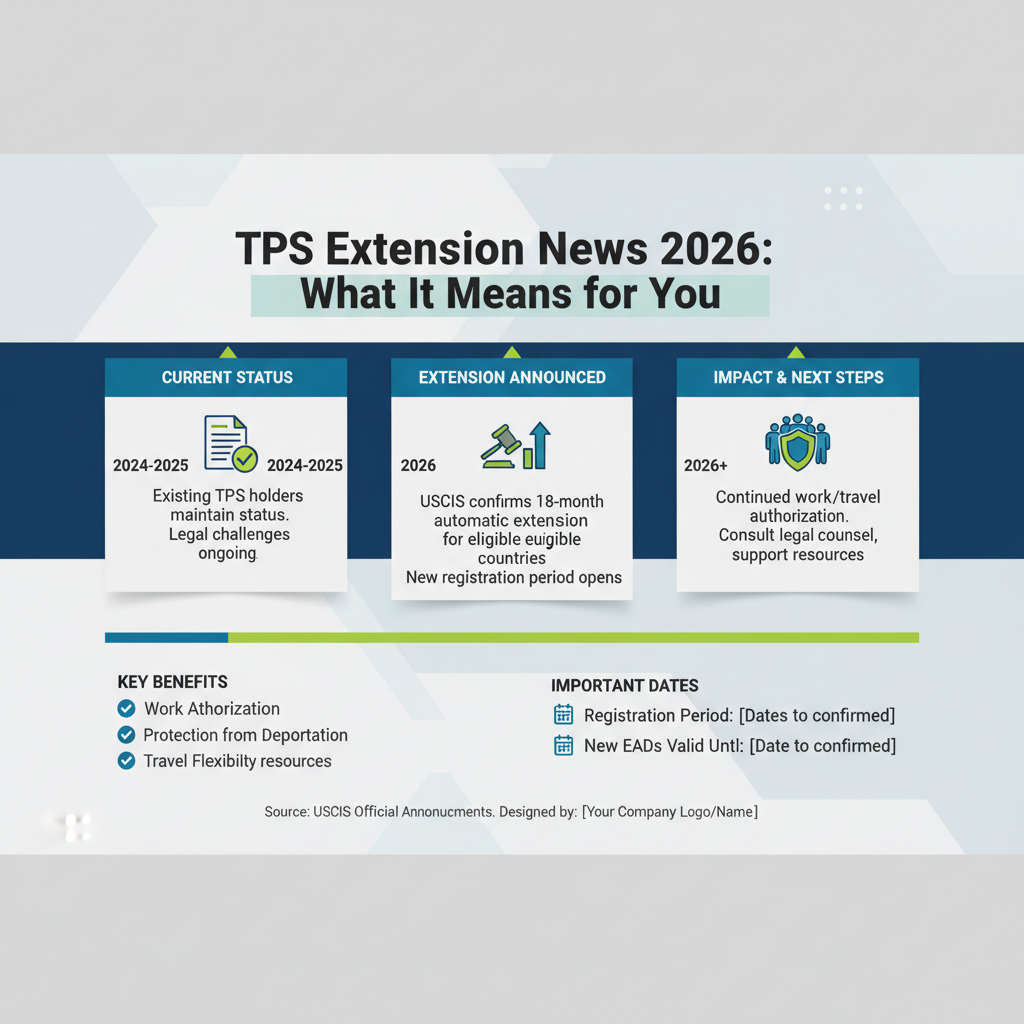
For many immigrants living in the United States, especially those who have found refuge and built lives in communities like Orlando, Florida, news regarding Temporary Protected Status (TPS) extensions is not just a headline – it’s a lifeline. These announcements determine whether they can continue to live and work legally in the U.S. without fear of deportation, allowing them to provide for their families and contribute to our local economy.
Why this news is showing up now
The U.S. government, specifically the Secretary of Homeland Security, has the authority under the Immigration and Nationality Act (INA) to designate a country for TPS if conditions within that country prevent its nationals from returning safely. These conditions typically include ongoing armed conflict, environmental disasters (such as earthquakes or hurricanes), or other extraordinary and temporary conditions. When a country is initially designated for TPS, that status is granted for a specific period, usually 6, 12, or 18 months.
As that initial period, or any subsequent extension, approaches its expiration, the Secretary of Homeland Security must review the country’s conditions. This review process is thorough and considers input from various government agencies, non-governmental organizations, and even foreign governments. Based on this assessment, the Secretary decides whether to extend, redesignate, or terminate TPS for that country. The news you're seeing now reflects these periodic reviews and the subsequent decisions to extend TPS for certain nations, providing continued relief to eligible nationals and residents of those countries.
Important: These decisions are often made a few months before the current designation is set to expire, allowing beneficiaries adequate time to prepare for re-registration and for USCIS to process applications. This proactive approach helps minimize gaps in employment authorization and protection from removal.
How it can affect Florida residents
Florida, particularly Central Florida and the Orlando metropolitan area, is home to a vibrant and diverse immigrant population. Many individuals from countries currently designated for TPS have established deep roots here, contributing significantly to our communities, businesses, and culture. Therefore, TPS extension news has a profound and direct impact on thousands of Florida residents. For those already holding TPS from a country that has received an extension:
- Continued Legal Presence: An extension means they can continue to live and work in the U.S. legally, protected from deportation. This provides immense stability for families, many of whom have U.S. citizen children.
- Work Authorization: Along with TPS extension, USCIS typically issues an automatic extension of Employment Authorization Documents (EADs) for a certain period, or allows beneficiaries to apply for new EADs. This ensures they can continue to earn a living and support their families without interruption. For many, this means maintaining their jobs in sectors critical to Florida's economy, from hospitality along the I-4 corridor to agriculture and healthcare.
- Travel Authorization: While TPS does not directly lead to a green card, beneficiaries can apply for travel authorization (Advance Parole) to leave and re-enter the U.S. An extension ensures this option remains available, allowing them to visit family abroad if necessary, though careful legal advice is always recommended before traveling.
- Planning and Stability: Knowing that their status is extended allows individuals and families to plan for their future, whether it's continuing their education, saving for a home in Orange County, or simply enjoying the peace of mind that comes with temporary legal stability.
- Impact on Local Economy: These extensions help maintain a stable workforce in Florida. When TPS holders can work legally, they pay taxes, spend money locally, and contribute to the economic vitality of cities like Orlando, Kissimmee, and Sanford.
For individuals in Central Florida whose home countries might be under consideration for TPS designation or re-designation, these announcements serve as a critical reminder to stay informed and seek legal counsel. The Orlando USCIS Field Office and surrounding immigration services are often impacted by the volume of re-registration applications during these periods.
Have Questions About Your TPS Status in Florida? Imigrar provides expert legal guidance to help you understand and navigate TPS extensions. Call us today at +1 786-791-3106 for a free consultation. Se Habla Español.
What Temporary Protected Status (TPS) Is (and Why It Matters)
Temporary Protected Status (TPS) is a humanitarian immigration benefit provided by the United States government. It offers temporary relief from deportation and the ability to work legally in the U.S. for eligible foreign nationals from certain countries experiencing extreme conditions.
A plain-English definition
Imagine your home country is hit by a massive natural disaster, like a devastating earthquake or a prolonged civil war, making it unsafe for you to return. The U.S. government can decide to offer "Temporary Protected Status" to people from that country who are already in the U.S. This means that for a set period, you are allowed to stay here, work legally, and you won't be deported. It's a temporary haven, not a path to a green card, but it provides crucial stability until conditions in your home country improve enough for you to return safely.
The Secretary of Homeland Security designates a country for TPS based on specific statutory criteria. These criteria include:
- Ongoing armed conflict: This means a civil war or other armed conflict that poses a serious threat to the personal safety of nationals if they were to return.
- Environmental disaster: Such as an earthquake, hurricane, flood, or epidemic, resulting in a substantial, but temporary, disruption of living conditions. The foreign country must be unable to handle the return of its nationals adequately.
- Other extraordinary and temporary conditions: Any other exceptional circumstances that prevent nationals from returning safely.
Once a country is designated, nationals of that country who meet specific eligibility requirements and were present in the U.S. by a certain date can apply for TPS. This protection is temporary and is regularly reviewed for extension, redesignation, or termination.
Key terms you need to know
Navigating TPS requires understanding specific terminology. Here are some key terms:
- Designated Country: A foreign state whose nationals are eligible for TPS due to specific, temporary conditions making return unsafe. The Secretary of Homeland Security makes this designation.
- Beneficiary: An individual who has been granted TPS.
- Re-registration Period: A specific window of time, typically 60 days, during which current TPS beneficiaries must apply to extend their status. Missing this deadline can lead to loss of TPS.
- Initial Registration: The first time an eligible individual applies for TPS after their country is designated.
- Extension: When the Secretary of Homeland Security determines that the conditions for a country's designation continue to exist, and therefore extends the TPS period for that country.
- Redesignation: When the Secretary of Homeland Security determines that new conditions in a country warrant a new TPS designation. This often allows individuals who arrived in the U.S. after the initial designation date to become eligible.
- Termination: When the Secretary of Homeland Security determines that the conditions for a country's designation no longer exist, and TPS for that country will end.
- Employment Authorization Document (EAD): Also known as a work permit, this document (Form I-766) allows TPS beneficiaries to work legally in the U.S.
- Travel Authorization (Advance Parole): A document (Form I-512 or Form I-512L) that allows a TPS beneficiary to travel outside the U.S. and return without jeopardizing their TPS status. This is obtained by filing Form I-131.
- Date of Continuous Residence (CDR): The date by which an applicant must have continuously resided in the U.S. to be eligible for TPS.
- Date of Continuous Physical Presence (CPP): The date by which an applicant must have been continuously physically present in the U.S. to be eligible for TPS.
- Inadmissibility: Conditions that would prevent an individual from being lawfully admitted to the U.S. TPS applicants may be eligible for waivers for certain grounds of inadmissibility.
Understanding these terms is fundamental to comprehending the nuances of TPS and ensuring compliance with all requirements, especially during re-registration periods.
Current Immigration Law: The Foundation of TPS
Temporary Protected Status is rooted in U.S. federal immigration law, primarily outlined in Section 244 of the Immigration and Nationality Act (INA), codified at 8 U.S.C. § 1254a. This statute grants the Secretary of Homeland Security (or formerly the Attorney General) the authority to designate countries for TPS based on specific humanitarian criteria.
Federal requirements
The INA specifies the conditions under which a country may be designated for TPS. As mentioned, these include ongoing armed conflict, environmental disaster, or other extraordinary and temporary conditions. For an individual to be eligible for TPS, they must meet several federal requirements:
- Nationality: Be a national of a country designated for TPS, or a person without nationality who last habitually resided in that country.
- Continuous Physical Presence (CPP): Have been continuously physically present in the U.S. since the effective date of the most recent designation for their country.
- Continuous Residence (CR): Have been continuously residing in the U.S. since a date specified by the Secretary of Homeland Security for their country's designation.
- Timely Application: Apply for TPS during the initial registration period or, for extensions, during the re-registration period. There are limited exceptions for late initial filings under specific circumstances.
- Admissibility: Not be inadmissible under certain grounds, such as those related to criminal offenses, national security, or persecution. Certain grounds of inadmissibility can be waived.
- Eligibility: Not have been convicted of any felony or two or more misdemeanors committed in the U.S. Not be subject to certain mandatory bars to asylum.
The federal government, through USCIS official website (U.S. Citizenship and Immigration Services), is responsible for processing all TPS applications, including initial registrations, re-registrations, and associated applications for Employment Authorization Documents (EADs) and Travel Documents. Each designation or extension for a country comes with a Federal Register notice, which is the official publication outlining the specific dates, requirements, and procedures for that particular country.
Reminder: It is critical to refer to the most recent Federal Register notice for your specific country's TPS designation, as dates and requirements can vary.
Florida-specific considerations
While TPS is a federal program, its impact and practical considerations extend to the state level. For Florida residents:
- Driver's Licenses: TPS beneficiaries in Florida are generally eligible to apply for a Florida driver's license or state identification card, provided they present their valid EAD (Form I-766) and other required identification documents. The validity period of the license will typically align with the expiration date of their EAD.
- Local Services: TPS status can impact access to certain state and local services, although eligibility varies by program. It's important to understand that TPS is not an immigrant visa and does not automatically grant access to all public benefits.
- Community Support: Florida, especially metropolitan areas like Orlando, Tampa, and Miami, has strong community organizations that support immigrant populations. These organizations can be valuable resources for information, language assistance, and sometimes even help with application preparation, though they cannot provide legal advice.
- Educational Opportunities: TPS beneficiaries are generally eligible to enroll in public schools and, in some cases, may qualify for in-state tuition at public colleges and universities in Florida, depending on specific state residency requirements.
- Economic Contributions: The ability of TPS holders to work legally means they contribute significantly to Florida's economy through taxes and consumer spending. This is particularly noticeable in sectors like tourism, construction, and agriculture, which are vital to the state.
For those living in Orlando and Central Florida, understanding these local implications alongside the federal requirements is key to fully leveraging the benefits of TPS. The Orlando USCIS Field Office serves a vast area, and it's not uncommon for local TPS beneficiaries to attend biometrics appointments or interviews there.
How to Re-register for TPS: A Complete Step-by-Step Guide
If your country’s TPS designation has been extended, re-registration is crucial to maintain your protected status and employment authorization. Missing the re-registration deadline can lead to significant complications, including loss of status and potential for removal. This guide assumes you are already a TPS beneficiary and are applying for an extension through re-registration. The process for initial registration for a newly designated country or redesignation may have slightly different requirements and deadlines.
Warning: Always consult the latest Federal Register notice for your specific country and the USCIS Forms page for the most current versions of forms and filing instructions.
1) Understand the Official Announcement and Re-registration Period
The first and most critical step is to be aware of the official announcement from DHS/USCIS regarding your country’s TPS extension. This announcement will be published in the Federal Register and will specify:
- The new expiration date for TPS for your country.
- The specific re-registration period (usually a 60-day window) during which you must submit your application.
- Any automatic extensions of EADs and other documents.
- The eligibility requirements for the extension.
Actionable Advice:
- Regularly check the USCIS TPS webpage or subscribe to USCIS email updates.
- Consult with an immigration attorney immediately upon hearing news of an extension to ensure you understand the specific deadlines applicable to your case.
2) Gather Required Documents for Re-registration
Even for re-registration, you will need to submit supporting documentation. While less extensive than initial registration, accuracy and completeness are paramount. You will generally need:
- Proof of Identity and Nationality:
- Copy of your passport (biographic page).
- Copy of your birth certificate with photo identification.
- Any national identity document from your country of origin with a photograph and/or fingerprint.
- Copies of previous TPS approval notices (Form I-797).
- Proof of Continuous Residence (CR) and Continuous Physical Presence (CPP):
- Documents proving your continuous residence in the U.S. since the specified date for your country’s designation. Examples include:
- Rent receipts, utility bills, or mortgage statements.
- Employment records (pay stubs, W-2s, employment letters).
- School records (transcripts, report cards).
- Medical records (hospital or doctor bills).
- Bank statements.
- Affidavits from friends, family, or employers.
- For re-registration, you typically only need to demonstrate you maintained CR/CPP since your last TPS grant, or since the most recent cutoff date if there was a redesignation.
- Documents proving your continuous residence in the U.S. since the specified date for your country’s designation. Examples include:
- Previous TPS-related Documents:
- Copy of your most recent Employment Authorization Document (EAD) (Form I-766).
- Copy of your previous TPS approval notice (Form I-797).
- Any criminal records: If you have any arrests or convictions since your last TPS application, you must provide certified copies of court dispositions.
Important: All documents not in English must be accompanied by a certified English translation.
3) Complete and File Form I-821, Application for Temporary Protected Status
This is the primary application form for TPS. For re-registration, you will indicate that you are applying for an extension.
- Accuracy: Fill out the form completely and accurately. Any missing information or inconsistencies can cause delays or even denial.
- Signatures: Ensure you sign the form in blue or black ink. Unsigned forms will be rejected.
- Fees:
- There is typically no fee for filing Form I-821 for re-registration if you are only requesting TPS and not an EAD.
- However, there is a biometrics services fee (currently $85) for all applicants aged 14 and older.
- You may be eligible for a fee waiver (Form I-912, Request for Fee Waiver) if you meet specific income requirements.
4) File Form I-765, Application for Employment Authorization (EAD)
If you wish to continue working legally in the U.S., you must file Form I-765 to renew your EAD.
- Concurrent Filing: It is highly recommended to file Form I-765 concurrently with Form I-821.
- Fees: There is a fee for filing Form I-765 (currently $410). This fee can also be waived if you qualify for a fee waiver.
- Automatic EAD Extension: Often, USCIS will automatically extend the validity of existing EADs for TPS beneficiaries from certain countries through a Federal Register notice. This allows continued employment while the new EAD application is processed. Check the latest notice for details regarding your country.
5) Consider Filing Form I-131, Application for Travel Document (Advance Parole)
If you anticipate needing to travel outside the U.S. during your extended TPS period, you must apply for Advance Parole by filing Form I-131.
- Separate Application: This is a separate application and is not mandatory for re-registration.
- Fees: There is a fee for Form I-131 (currently $575), which can also be waived if you qualify for a fee waiver.
- Caution: Traveling outside the U.S. without Advance Parole can lead to serious immigration consequences, including denial of re-entry and loss of TPS. Always consult an attorney before making travel plans.
6) Attend Biometrics Appointment and Respond to RFEs
After filing, USCIS will send you a receipt notice (Form I-797C) and, for most applicants aged 14 and older, an appointment notice for biometrics (fingerprints and photograph).
- Do Not Miss: It is critical to attend your biometrics appointment as scheduled. If you cannot attend, follow the instructions on the notice to reschedule.
- RFEs: USCIS may also issue a Request for Evidence (RFE) if they need additional information or clarification. Respond to RFEs promptly and thoroughly within the specified deadline.
7) Monitor Your Case Status
After filing, you can monitor the status of your application online using the receipt number provided on your Form I-797C.
- Online Tools: Use the USCIS Processing Times tool and the "Check My Case Status" feature on the USCIS website.
- Keep Records: Retain copies of all submitted forms, documents, and USCIS notices.
- Consult Attorney: If you notice unusual delays or receive unexpected notices, consult with your immigration attorney.
Need Assistance with Your TPS Re-registration? The intricate details of immigration paperwork can be overwhelming. Let Imigrar's experienced team in Orlando guide you. Call +1 786-791-3106 for a free consultation. Se Habla Español.
Practical Steps You Can Take Today
Staying organized and proactive is key to a successful TPS re-registration. Here’s a checklist of practical steps you can start taking right now, especially if you reside in Central Florida or elsewhere in the state:
Actionable Checklist:
- Verify Your Country's Status: Confirm if your country’s TPS designation has been extended. Check the USCIS TPS webpage and relevant Federal Register notices.
- Identify Your Re-registration Window: Note the exact start and end dates of the re-registration period. Mark these dates prominently on your calendar. Missing this window is a common and critical mistake.
- Review Your Previous Application: Gather all documents from your previous TPS application, including your approval notice (Form I-797) and EAD (Form I-766). This will serve as a guide for what you previously submitted.
- Collect Updated Personal Documents: Ensure you have valid copies of your passport, birth certificate, and any other national identification. If any of these have expired or changed, begin the process of updating them.
- Update Proof of Continuous Residence/Physical Presence: Gather recent utility bills, bank statements, pay stubs, lease agreements, or other documents demonstrating your continuous residence in Florida since your last TPS application. For those in the Orlando area, this might include Orange County property tax statements or local school records.
- Check for New Criminal History: If you have had any encounters with law enforcement (arrests, charges, convictions) since your last TPS application, immediately obtain certified court dispositions for each incident. This is crucial for your re-registration.
- Assess Fee Waiver Eligibility: Determine if you qualify for a fee waiver (Form I-912) for the biometrics fee and/or EAD fee. Start gathering the necessary financial documentation (e.g., tax returns, proof of public benefits, income statements).
- Consult an Immigration Attorney: This is arguably the most important step. An experienced attorney, especially one familiar with the Orlando USCIS Field Office procedures, can help you understand the specific requirements for your case, identify potential issues, and ensure your application is submitted correctly and on time. At Imigrar, we offer free consultations to help you get started.
- Organize Your Documents: Create a well-organized file for your TPS application. Make copies of everything you plan to submit and keep the originals in a safe place.
Document Preparation Guidance:
- Copies Only (Generally): Unless specifically requested by USCIS, send copies of your supporting documents, not originals. Keep your original documents safe.
- Translations: Any document not in English must be accompanied by a complete and accurate English translation, certified by the translator. The certification must state that the translator is competent to translate from the foreign language into English and that the translation is complete and accurate.
- Clarity and Legibility: Ensure all copies are clear and legible. If a document is difficult to read, try to obtain a better copy.
- Labeling: It can be helpful to lightly label the back of each document with your name and A-number (Alien Registration Number) to avoid mix-ups.
Timeline Expectations:
While USCIS strives for efficiency, processing times for TPS re-registration can vary. Here’s what you can generally expect:
- Re-registration Window: A 60-day window from the date of the Federal Register notice. It is vital to file within this period.
- Receipt Notice: You should receive a Form I-797C receipt notice within 2-4 weeks of filing your application. This notice confirms USCIS has received your application.
- Biometrics Appointment: An appointment notice for biometrics typically arrives within 4-8 weeks after filing. The appointment itself is usually scheduled within 2-4 weeks of receiving the notice. The Orlando Application Support Center (ASC) handles biometrics for many Central Florida residents.
- EAD Processing: Processing times for EADs can fluctuate significantly, ranging from a few months to over a year. Check the USCIS Processing Times page for the latest estimates for Form I-765 at your service center.


