


The landscape of U.S. immigration law is constantly evolving, with regular updates that can have profound impacts on individuals and families. For those holding or seeking Temporary Protected Status (TPS), recent developments regarding extensions for several designated countries are particularly significant. At Imigrar, your trusted immigration law firm in Orlando, Florida, we understand the critical need for timely, accurate, and actionable information.
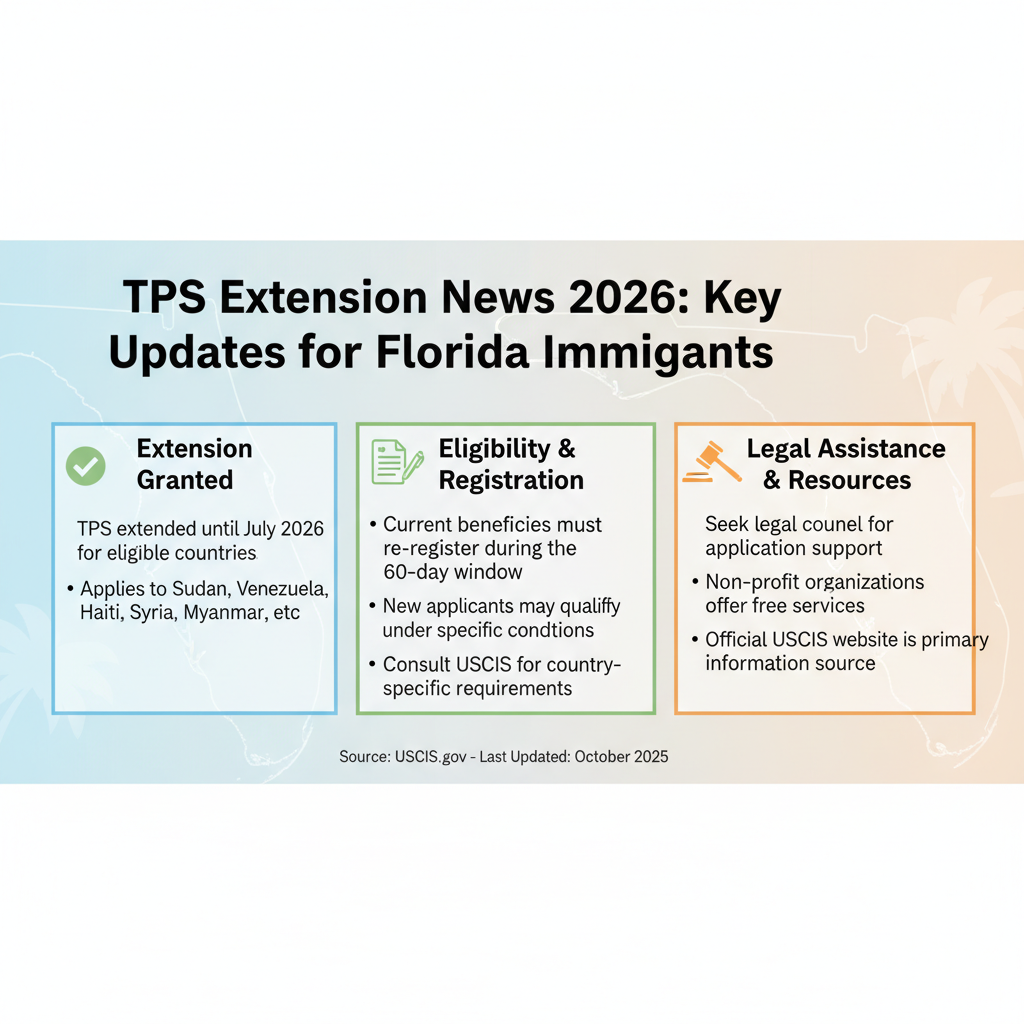
What This News Means for Immigrants in Orlando and Across Florida
The recent announcements concerning the extension of Temporary Protected Status for various countries represent a crucial lifeline for thousands of individuals and families living in the United States, including a significant population right here in Florida. These extensions provide continued protection from deportation and the ability to legally work, offering a much-needed sense of stability amidst ongoing global challenges. For beneficiaries from countries like El Salvador, Honduras, Nicaragua, Haiti, Venezuela, Ukraine, and Afghanistan, who often have large communities in Florida, this news is not just a policy update—it's a renewed opportunity to build their lives and contribute to their communities without fear.
Why this news is showing up now
Temporary Protected Status is not a permanent solution, but rather a temporary humanitarian relief granted by the Secretary of Homeland Security. This status is designated for foreign countries experiencing conditions that make it unsafe for their nationals to return. These conditions typically include ongoing armed conflict, environmental disasters (like earthquakes or hurricanes), or other extraordinary and temporary conditions. The law requires the U.S. government to regularly review these country designations. When the Secretary of Homeland Security determines that the unsafe conditions persist, they can extend the TPS designation for a period, usually 18 months, and open a new re-registration period for current beneficiaries. The recent news in early 2026 reflects these periodic reviews and determinations, acknowledging that conditions in certain designated countries have not yet improved sufficiently to allow for the safe return of their nationals.
These extensions are often the result of comprehensive assessments of current geopolitical situations, human rights conditions, and environmental stability within the designated countries. Advocacy from human rights organizations, international bodies, and community groups also plays a vital role in bringing these conditions to the attention of U.S. policymakers. Therefore, when you see news about TPS extensions, it signals a recognition by the U.S. government that the need for humanitarian protection for these communities remains urgent.
How it can affect Florida residents
Florida is home to one of the largest and most diverse immigrant populations in the United States. Our state, particularly Central Florida and cities along the I-4 corridor like Orlando, has vibrant communities comprised of individuals from many of the countries currently designated for TPS. For these Florida residents, an extension of TPS means:
- Continued Protection: Beneficiaries are protected from deportation and can remain lawfully in the U.S. for the duration of the extension. This is the cornerstone of TPS, ensuring that individuals are not forced to return to dangerous circumstances.
- Work Authorization: With an approved TPS and a valid Employment Authorization Document (EAD), individuals can continue to work legally in Florida. This is crucial for supporting families, paying bills, and contributing to the local economy. Many businesses in Orlando and surrounding Orange County rely on the stable workforce that TPS beneficiaries provide.
- Travel Authorization: While not automatic, TPS beneficiaries can apply for a travel document (Advance Parole) to travel outside the U.S. and return legally. This can be vital for family emergencies or other essential travel, though it’s always advised to consult with an attorney before international travel.
- Family Stability: The ability to live and work without the constant threat of deportation allows families to plan for the future, send their children to school, and build stable lives in their Florida communities. Imigrar’s tagline, "Keep Families Together," resonates deeply with the impact of these extensions.
- Access to State-Level Benefits: With a valid EAD and proof of lawful presence, TPS beneficiaries can often obtain Florida driver's licenses or state identification cards, which are essential for daily life and mobility in our spread-out state.
However, it's not just about the benefits. The extensions also bring a critical need for prompt and accurate re-registration. Missing deadlines or submitting incomplete applications can lead to a loss of status, putting individuals at risk. This is why understanding the specific requirements and timelines, especially for those in Orlando and the wider Florida community, is paramount.
Need Help? Navigating TPS re-registration can be complex. Our Orlando immigration team is ready to assist you in understanding the latest extensions and preparing your application. Call +1 786-791-3106 for a free consultation, or message us online. Se Habla Español.
What Temporary Protected Status (TPS) Is (and Why It Matters)
Understanding Temporary Protected Status is fundamental for anyone impacted by these extensions. It’s a unique provision in U.S. immigration law that serves a critical humanitarian purpose, offering temporary relief to foreign nationals who cannot safely return to their home countries due to specific, dire conditions.
A plain-English definition
Imagine your home country suddenly becomes a very dangerous place to live – perhaps due to a massive natural disaster, a widespread epidemic, or a violent conflict. The U.S. government, recognizing these severe conditions, can decide to offer a temporary safe haven to people from that country who are already in the United States. This safe haven is called Temporary Protected Status (TPS).
Essentially, TPS allows eligible individuals from designated countries to live and work legally in the U.S. for a specific period, without fear of deportation. It's "temporary" because the designation is reviewed periodically, and it can be extended, re-designated, or terminated depending on whether the conditions in the home country have improved or worsened. It does not automatically lead to a Green Card or U.S. citizenship, but it provides crucial protection and work authorization while it lasts.
For many, TPS is more than just a legal status; it’s a chance to rebuild lives, support families, and contribute to their communities in Florida and nationwide, all while their home country recovers from crisis. It embodies the principle of humanitarian protection, ensuring that people are not forced back into harm's way.
Key terms you need to know
To navigate the world of TPS, it’s helpful to understand some specific terminology:
- Designated Country: This refers to a foreign country whose nationals are eligible for TPS. The Secretary of Homeland Security makes these designations based on specific statutory criteria, such as ongoing armed conflict, environmental disaster, or other extraordinary and temporary conditions. Countries like El Salvador, Honduras, Haiti, Nicaragua, Venezuela, Ukraine, and Afghanistan are examples of countries that have held TPS designations.
- Eligibility Criteria: These are the requirements an individual must meet to be granted TPS. They typically include continuous physical presence (CPP) in the U.S. since a specific date, continuous residence (CR) in the U.S. since a specific date, and passing certain security and criminal background checks. Individuals with certain felony convictions or multiple misdemeanor convictions are generally ineligible.
- Re-registration: When a TPS designation is extended, current beneficiaries must apply to renew their status. This process is called re-registration. It usually involves filing Form I-821 (Application for Temporary Protected Status) and potentially Form I-765 (Application for Employment Authorization) within a specific re-registration window.
- Employment Authorization Document (EAD): Often referred to as a "work permit," this document (Form I-766) allows TPS beneficiaries to work legally in the United States. It is usually issued for the duration of the TPS period. Obtaining a new EAD is a key reason for timely re-registration.
- Travel Document (Advance Parole): This document (Form I-512), obtained by filing Form I-131, allows a TPS beneficiary to travel outside the U.S. and return lawfully. Traveling without Advance Parole can result in the loss of TPS status and may lead to inadmissibility issues.
- Termination: If the Secretary of Homeland Security determines that the conditions in a designated country have improved sufficiently, the TPS designation can be terminated. This means beneficiaries would lose their TPS status at the end of the termination period and would revert to their previous immigration status (if any) or potentially face removal proceedings.
- Continuous Physical Presence (CPP) & Continuous Residence (CR): These are crucial requirements. CPP means you have been physically present in the U.S. for the entire required period. CR means you have maintained residence in the U.S. for the required period, with brief, casual, and innocent absences permitted.
Understanding these terms will empower you to better comprehend the legal processes and requirements associated with TPS and its extensions. It’s also important to remember that TPS is distinct from other forms of immigration relief and does not, on its own, provide a direct pathway to U.S. permanent residency (Green Card).
Current Immigration Law: The Foundation of TPS
Temporary Protected Status is not an arbitrary program; it is firmly rooted in U.S. immigration law, specifically within the Immigration and Nationality Act (INA). Understanding this legal framework is essential to grasping the program's purpose, limitations, and the authority behind its designations and extensions.
The authority for TPS stems from Section 244 of the Immigration and Nationality Act (INA), codified at 8 U.S.C. § 1254a. This section grants the Secretary of Homeland Security (formerly the Attorney General) the power to designate a foreign country for TPS. The designation can occur if the country is experiencing:
- An ongoing armed conflict that poses a serious threat to the personal safety of its nationals if they were to return.
- An environmental disaster resulting in a substantial, but temporary, disruption of living conditions, and the foreign state is unable to handle the return of its nationals adequately.
- Extraordinary and temporary conditions in the foreign state that prevent its nationals from returning safely, unless the Secretary finds that allowing them to remain in the U.S. would be contrary to the national interest of the United States.
Once a country is designated, specific eligibility criteria are established for its nationals. The Secretary must review the conditions in designated countries at least 60 days before the expiration of each 6- or 18-month period. Based on this review, the Secretary can extend, re-designate, or terminate TPS for that country. The recent announcements in early 2026 are a direct result of this statutory review process, indicating that the Secretary of Homeland Security has determined that the extraordinary conditions in several countries continue to warrant protection for their nationals.
Federal requirements
To be eligible for TPS, an individual must meet several federal requirements set forth by the INA and further detailed by U.S. Citizenship and Immigration Services (USCIS):
- Nationality: Be a national of a country designated for TPS, or a person without nationality who last habitually resided in that designated country.
- Continuous Physical Presence (CPP): Have been continuously physically present in the U.S. since the effective date of the most recent TPS designation or re-designation for their country. Brief, casual, and innocent absences are generally permitted.
- Continuous Residence (CR): Have been continuously residing in the U.S. since the date specified for their country's initial TPS designation.
- Admissibility: Meet admissibility requirements, unless certain grounds of inadmissibility are waived.
- Criminal Background: Not have been convicted of any felony or two or more misdemeanors committed in the U.S.
- Other Disqualifiers: Not be found inadmissible under certain criminal, national security, or terrorism-related grounds, or be subject to any of the mandatory bars to asylum (e.g., persecution of others).
- Timely Application: File their application during the initial registration period for their country, or during any subsequent re-registration period for extensions.
The primary form for applying for TPS is Form I-821, Application for Temporary Protected Status. If you also wish to obtain an Employment Authorization Document (EAD), you must file Form I-765, Application for Employment Authorization. For travel authorization, Form I-131, Application for Travel Document, is required. It is crucial to use the most current versions of these forms, available on the official USCIS website.
Reminder: The specific dates for CPP and CR, as well as the re-registration window, vary by country designation. Always refer to the official USCIS official website for the latest details pertaining to your country.
Florida-specific considerations
While TPS is a federal program, its implementation has practical implications for residents in Florida. Our state has a significant number of individuals from TPS-designated countries, and understanding how TPS interacts with Florida state laws and services is vital:
- Driver's Licenses and State IDs: With a valid Employment Authorization Document (EAD) that explicitly states "Valid for TPS," beneficiaries can generally apply for a Florida driver's license or state identification card. This is essential for navigating Central Florida, where public transportation options can be limited, especially for those commuting along the I-4 corridor. The Florida Department of Highway Safety and Motor Vehicles (FLHSMV) will verify your lawful presence through federal databases.
- Community Resources: Various non-profit organizations, community centers, and faith-based groups in Orlando, Orange County, and other parts of Florida offer support services to immigrant communities, including assistance with understanding TPS updates, language services, and access to other resources.
- Legal Support: The Orlando USCIS Field Office processes various immigration applications, and while TPS applications are typically sent to a USCIS Lockbox, local legal counsel from firms like Imigrar is invaluable for Florida residents navigating the re-registration process, responding to Requests for Evidence (RFEs), or addressing any issues that arise.
It is important for TPS beneficiaries in Florida to stay informed about both federal immigration policies and any relevant state-level requirements that might affect them. The stability offered by TPS allows individuals to integrate more fully into Florida's economy and society, contributing to the rich cultural tapestry of our state.
Confused about TPS requirements? Don't risk your status. Imigrar offers expert guidance for immigrants in Orlando and nationwide. Call +1 786-791-3106 for a free consultation. Se Habla Español.

How to Re-register for TPS: A Complete Step-by-Step Guide
With TPS extensions being announced, the most critical next step for current beneficiaries is to re-register within the designated window. This process can seem daunting, but by following a clear, step-by-step approach, you can ensure your application is submitted correctly and on time. This guide focuses on re-registration, as most individuals affected by extensions are already TPS beneficiaries.
1) Determine Your Eligibility and Re-registration Window
Before you do anything else, confirm that your country’s TPS designation has indeed been extended and identify your specific re-registration period. USCIS will publish a Federal Register notice for each country detailing these dates. Missing this window is a common and serious mistake.
- Confirm Extension: Check the official USCIS official website for the latest announcements regarding your country. Look for the Federal Register notice.
- Identify Re-registration Window: This is a specific timeframe, typically 60 days, during which you must submit your re-registration application. Mark these dates clearly on your calendar.
- Review Individual Eligibility: Ensure you continue to meet all individual eligibility requirements, such as continuous physical presence and residence, and that you haven't incurred any new disqualifying criminal convictions since your last registration.
- Gather Proof of Previous TPS: You will need your previous TPS approval notice (Form I-797) and your current Employment Authorization Document (EAD).
2) Gather Required Documents
Thorough document preparation is key to a successful re-registration. Organize everything meticulously.
- Primary Application Forms:
- Form I-821, Application for Temporary Protected Status: This is the main form for re-registration.
- Form I-765, Application for Employment Authorization: File this if you want to receive a new EAD.
- Form I-131, Application for Travel Document: File this if you intend to travel outside the U.S. and return during the extended TPS period (Advance Parole).
- Identity and Nationality Documents (Copies Only, unless otherwise specified):
- Copy of your passport from your designated country (if available).
- Copy of your birth certificate with photo identification.
- Copy of any national identity document from your country with a photo and/or fingerprint.
- Copy of your previous TPS approval notice (Form I-797).
- Copy of your most recent EAD (front and back).
- Copy of your Form I-94 (Arrival/Departure Record), if available.
- Proof of Continuous Residence and Physical Presence (if requested or if there were significant absences):
- Utility bills, rent receipts, or mortgage statements.
- Employment records (pay stubs, W-2s, employment letters).
- School records (transcripts, enrollment letters).
- Medical records.
- Bank statements.
- Affidavits from friends, family, or employers.
- Two Passport-Style Photos: Ensure they meet USCIS specifications (2x2 inches, white background, taken within 30 days of filing).
- Fee Waiver Application (if applicable): Form I-912, Request for Fee Waiver, along with supporting documentation proving inability to pay.
3) Complete and File Forms I-821, I-765, and I-131 (If Applicable)
Accuracy and completeness are paramount. Any errors or omissions can lead to delays or denials.
- Fill Out Forms Carefully: Use black ink if filling out by hand, or type the information. Read all instructions thoroughly. Ensure all questions are answered truthfully and completely. If a question doesn't apply, write "N/A" (Not Applicable).
- Sign All Forms: Important: Do not forget to sign and date each form in the designated signature boxes. An unsigned form will be rejected.
- Re-registration Specifics for Form I-821: When re-registering, make sure to indicate that you are applying for "re-registration" in Part 1, Item 1.b. on Form I-821.
- EAD Application (Form I-765): If you are applying for a new EAD, ensure you select the correct eligibility category, which is typically (c)(10) for TPS beneficiaries.
- Travel Document Application (Form I-131): If applying for Advance Parole, clearly state the reason for travel and the dates you expect to be outside the U.S.
4) Pay Filing Fees or Apply for a Fee Waiver
There are specific fees associated with each form, though some may be waived.
- Form I-821 Fee: There is no fee for Form I-821 when re-registering for TPS.
- Biometrics Services Fee: All TPS re-registrants (unless specified otherwise in the Federal Register notice) are required to pay a biometrics services fee. Check the current fee schedule on USCIS Forms page.
- Form I-765 Fee: There is a fee for filing Form I-765 for an EAD.
- Form I-131 Fee: There is a fee for filing Form I-131 for Advance Parole.
- Total Fees: Sum up all applicable fees. Check the most current USCIS fee schedule on their website, as fees can change.
- Payment Method: You can pay by money order, personal check, cashier's check, or credit card using Form G-1450, Authorization for Credit Card Transactions. Make checks payable to "U.S. Department of Homeland Security."
- Fee Waiver: If you cannot afford the fees


