


The landscape of U.S. immigration law is constantly evolving, with policy changes and updates frequently impacting the lives of countless individuals and families. For those living under Temporary Protected Status (TPS), news regarding extensions, redesignations, or terminations can bring a mix of anticipation and anxiety. Today, we delve into the latest TPS extension news, breaking down what it means for you and offering a comprehensive guide to navigate these critical updates.
At Imigrar, an Orlando-based immigration law firm serving clients nationwide, our mission is to "Keep Families Together." We understand the profound importance of stability and legal status for our clients. This guide is designed to provide professional, accurate, and actionable information, helping you understand the implications of recent TPS developments and empowering you to take the necessary steps. Se Habla Español.
TPS (Temporary Protected Status) Extension News (Legal News)
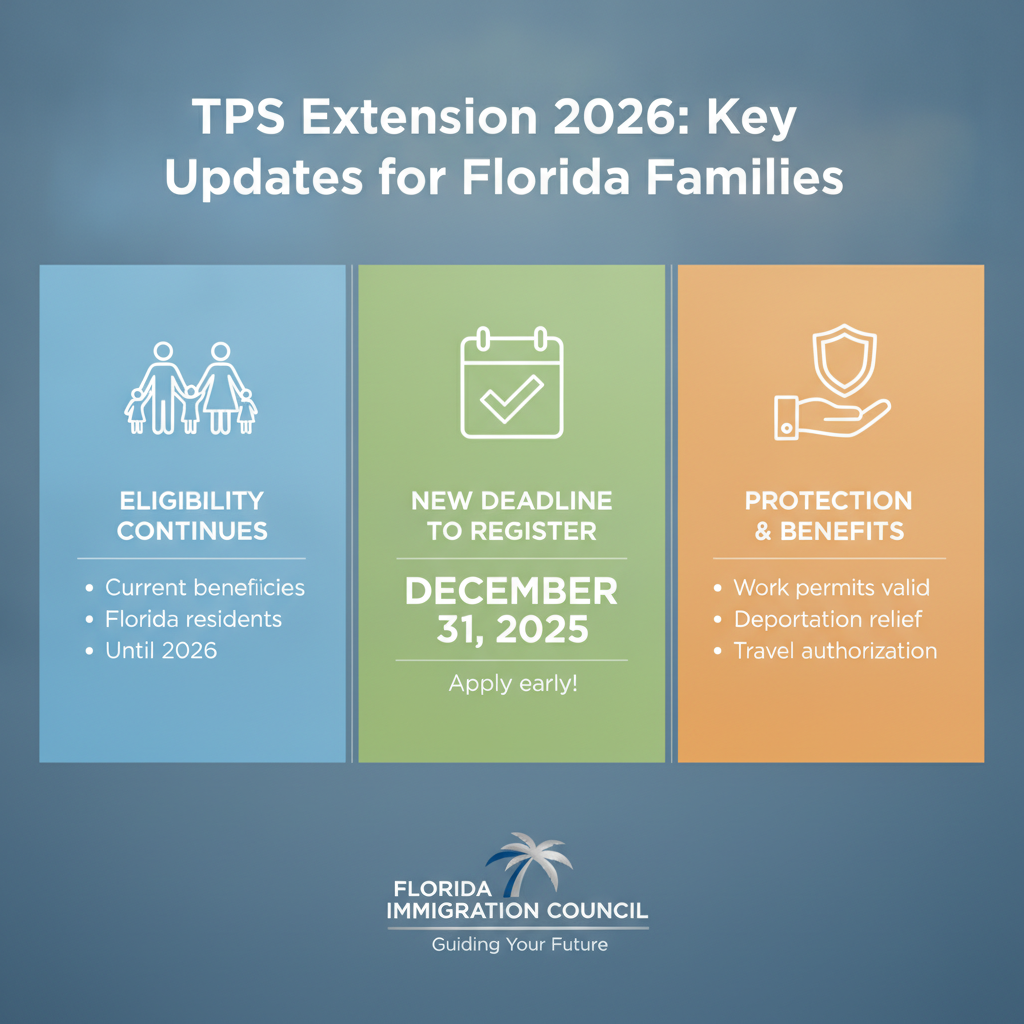
The reporting that sparked this guide highlights ongoing discussions and announcements regarding the future of Temporary Protected Status for various designated countries. While specific country designations may vary, the general trend of extensions reflects a continued recognition by the U.S. government of unsafe conditions in these nations, preventing the safe return of their citizens. These extensions are not just bureaucratic decisions; they are lifelines that allow hundreds of thousands of individuals to continue living and working legally in the United States, providing a measure of stability for them and their families.
What This News Means for Immigrants in Orlando and Across Florida
For the vibrant immigrant communities throughout Florida, and particularly in Orlando, news of TPS extensions is a significant development. Florida is home to a substantial population of individuals from countries currently designated for TPS, including Haiti, Venezuela, Nicaragua, El Salvador, Honduras, and others. These extensions directly impact their ability to live without fear of deportation, maintain employment, and contribute to the local economy and social fabric.
Why this news is showing up now
Temporary Protected Status is, by its very nature, temporary. Designations are made for specific periods, typically 6, 12, or 18 months, based on ongoing conditions in a country. As these periods approach their expiration, the Secretary of Homeland Security (DHS) is mandated by the Immigration and Nationality Act (INA) to review the country's conditions. This review determines whether the extraordinary and temporary conditions (such as armed conflict, environmental disaster, or other extraordinary and temporary conditions) that led to the initial designation persist. If they do, DHS may decide to:
- Extend the current TPS designation for another period.
- Redesignate the country, which can open a new registration period for individuals who arrived after the initial designation date but before the redesignation date.
- Terminate the designation, if conditions are deemed safe for return.
The news you're seeing now reflects these ongoing reviews and subsequent announcements. These decisions are often made public well in advance of the expiration date to allow affected individuals ample time to prepare for re-registration. Given that today is 2026-07-26, several countries' TPS designations are likely nearing their review periods, making news about extensions particularly relevant.
How it can affect Florida residents
Florida, especially Central Florida, has a large and diverse immigrant population. For TPS holders in Orlando, Kissimmee, Sanford, and surrounding areas, an extension means:
- Continued Legal Presence: You can continue to live and work in the U.S. legally, protected from deportation. This is paramount for maintaining family unity and personal safety.
- Employment Authorization: Your Employment Authorization Document (EAD), often referred to as a work permit, will likely be extended, or you will be able to apply for a new one. This ensures you can maintain your job and financial stability.
- Travel Authorization: With proper authorization (Form I-131, Application for Travel Document), TPS holders can often travel internationally and return to the U.S. This is crucial for visiting family or addressing urgent matters abroad.
- Economic Stability: The ability to work legally allows TPS holders to contribute significantly to Florida's economy, supporting their families and local businesses. Many TPS holders own homes, pay taxes, and are integral parts of their communities in Orange County and beyond.
- Planning for the Future: An extension provides a temporary respite, allowing individuals and families to continue pursuing long-term immigration solutions, such as Adjustment of Status through family petitions, if eligible.
Important: Even with an extension, it is crucial to understand that TPS is a temporary benefit. It does not lead directly to permanent residency or U.S. citizenship. However, it can provide a vital bridge to other immigration pathways.
Need Help? Our Orlando immigration team is ready to assist. Navigating TPS re-registration or initial applications can be complex. Call +1 786-791-3106 for a free consultation, or message us online. Se Habla Español.
What Temporary Protected Status (TPS) Is (and Why It Matters)
Temporary Protected Status (TPS) is a humanitarian immigration benefit provided by the U.S. government to eligible foreign nationals from certain countries who are unable to return safely to their home country due to extraordinary circumstances. It's a critical safety net that embodies the principle of protecting vulnerable populations.
A plain-English definition
Think of TPS as a temporary shield. If your home country is experiencing severe problems like a major war, a devastating natural disaster (like an earthquake or hurricane), or other unusually dangerous conditions, the U.S. government might decide it's unsafe for its citizens to return. In such cases, citizens of that country who are already in the U.S. can apply for TPS. This status allows them to live and work legally in the U.S. for a specific period, typically 6 to 18 months, and protects them from deportation. When that period is almost over, the government reviews the situation in the home country to decide if the TPS should be extended, redesignated, or ended.
Key terms you need to know
- Designation: The initial act by the Secretary of Homeland Security to grant TPS to a specific country due to ongoing armed conflict, environmental disaster, or other extraordinary and temporary conditions. A designation specifies an effective date and an expiration date.
- Extension: When the Secretary of Homeland Security determines that the conditions supporting a country's TPS designation continue to exist, they can extend the status for an additional period (e.g., 18 months). This is the focus of the current news.
- Redesignation: If conditions worsen or change significantly, the Secretary may "redesignate" a country for TPS. This opens a new registration period for individuals who arrived after the initial designation date but before the redesignation date, making more people eligible.
- Termination: If the Secretary determines that the conditions supporting a country's TPS designation no longer exist, the designation can be terminated. This means TPS holders from that country would lose their status and protection from deportation, requiring them to seek other immigration relief or depart the U.S.
- Re-registration: The process by which current TPS beneficiaries apply to maintain their status when a country's designation is extended. This usually involves filing Form I-821 and Form I-765 within a specific window.
- Employment Authorization Document (EAD): Also known as a work permit, this document allows TPS holders to work legally in the U.S. It is typically issued for the duration of the TPS designation or extension.
- Prima Facie Eligibility: This means that based on the initial evidence provided, an applicant appears to meet the basic eligibility requirements for TPS.
Current Immigration Law: The Foundation of TPS
Temporary Protected Status is authorized by Section 244 of the Immigration and Nationality Act (INA), found at 8 U.S.C. § 1254a. This federal statute outlines the conditions under which the Secretary of Homeland Security may designate a foreign country for TPS.
Federal requirements for TPS eligibility
To be eligible for TPS, an individual must meet several federal requirements:
- Be a national of a country designated for TPS, or a person without nationality who last habitually resided in that country.
- Have been continuously physically present in the U.S. since the effective date of the most recent designation for their country.
- Have been continuously residing in the U.S. since the date specified by the Secretary of Homeland Security for their country's designation.
- Apply for TPS within the initial registration period or during any extension of that period (for re-registration).
- Not be inadmissible under specific grounds, including certain criminal and security-related offenses.
- Not have been convicted of any felony or two or more misdemeanors committed in the U.S.
- Not be subject to any of the mandatory bars to asylum.
The Secretary of Homeland Security (DHS) can designate a country for TPS if:
- There is an ongoing armed conflict within the state, posing a serious threat to personal safety.
- There has been an earthquake, flood, drought, epidemic, or other environmental disaster resulting in a substantial, but temporary, disruption of living conditions, and the foreign state is unable to handle the return of its nationals adequately.
- There are other extraordinary and temporary conditions in the foreign state that prevent nationals from returning safely.
For more detailed information on TPS eligibility and current designations, always refer to the USCIS official website on TPS.
Florida-specific considerations for TPS applicants
While TPS is a federal program, certain practical considerations are specific to Florida residents:
- Local USCIS Field Office: If your case is in Orlando, your biometrics appointment will likely be scheduled at the Orlando USCIS Field Office, located at 5449 South Semoran Boulevard, Orlando, FL 32822.
- Community Resources: Central Florida is rich in community organizations that provide support, language services, and sometimes legal aid referrals for immigrant populations.
- Identification: Having a valid form of identification, such as a Florida Driver's License or State ID, can be facilitated by your TPS status and EAD. This is crucial for daily life in Orange County and navigating the I-4 corridor.
- Legal Expertise: Due to the high volume of immigration cases in Florida, it is essential to work with an experienced immigration law firm like Imigrar, which understands both federal regulations and local implications.
When applying for TPS or re-registering, you will typically need to file Form I-821, Application for Temporary Protected Status. If you wish to work in the U.S., you will also need to file Form I-765, Application for Employment Authorization. For international travel, Form I-131, Application for Travel Document, is required. Always download the latest versions of these forms directly from the USCIS Forms page.
Don't risk your status. TPS applications require meticulous attention to detail. Our Orlando immigration lawyers are experts in TPS law and can guide you through every step. Call +1 786-791-3106 today for a free, confidential consultation. Se Habla Español.
How to Re-register for TPS or Apply for Initial TPS: A Complete Step-by-Step Guide
Whether you're re-registering for an extension or applying for initial TPS under a new designation or redesignation, the process requires careful attention to detail. Here’s a comprehensive guide:
1) Determine Your Eligibility and Country Designation
Before you begin, verify that your country has been designated or extended for TPS and that you meet the eligibility criteria. USCIS will publish a Federal Register notice announcing the extension or redesignation, which includes specific eligibility dates (Continuous Physical Presence - CPP and Continuous Residence - CR) and the re-registration or initial registration window.
- Check USCIS Website: Visit the USCIS official TPS page to find the latest information on country designations, extensions, and registration periods.
- Review Eligibility Dates: Ensure you meet the CPP and CR dates specified in the Federal Register notice for your country.
- Consult an Attorney: If you have any doubts about your eligibility, especially if you have past criminal history or immigration violations, seek legal advice immediately.
2) Gather Required Documents
Collecting all necessary documents early can streamline your application process. Organize them carefully.
- Proof of Identity and Nationality:
- Passport (copy of biographical page)
- Birth certificate with photo identification
- National identity document from your country of origin with photo and/or fingerprint
- Proof of Entry into the U.S.:
- Copy of I-94 Arrival/Departure Record
- Entry stamps in your passport
- Airline tickets or boarding passes
- Proof of Continuous Residence in the U.S. (CR): Documents proving you have been living in the U.S. since the specified date for your country’s TPS designation. You'll need documents for each year. Examples include:
- Leases or rent receipts
- Utility bills (electric, water, gas)
- Employment records (pay stubs, W-2 forms, letters from employers)
- School records (transcripts, report cards)
- Medical records or hospital bills
- Bank statements
- Affidavits from friends, family, or employers (with supporting evidence)
- Money transfer receipts (sending or receiving)
- Vehicle registration or insurance documents
- Tax returns (federal or state)
- Proof of Continuous Physical Presence in the U.S. (CPP): Documents proving you have been physically present in the U.S. since the specified date. These often overlap with CR documents but should specifically attest to physical presence.
- Prior TPS Documentation (for Re-registration):
- Copy of your previous Form I-797, Approval Notice for TPS
- Copy of your previous EAD
- Photographs: Two identical, color passport-style photographs taken within 30 days of filing.
3) Complete Forms I-821 and I-765 (if applicable)
These are the primary forms for TPS. Ensure you download the latest version from the USCIS website.
- Form I-821, Application for Temporary Protected Status:
- Fill out all sections accurately and completely. Do not leave any sections blank; if a question doesn't apply, write "N/A."
- Be truthful and consistent with any previous immigration applications.
- For re-registration, indicate that you are applying for an extension of TPS.
- Form I-765, Application for Employment Authorization (Optional but Recommended):
- If you wish to work legally in the U.S., you must file this form.
- Ensure the category for TPS is correctly marked (e.g., (c)(19) for TPS).
- If you are re-registering, you will apply for a new EAD based on the extension.
- Form I-912, Request for Fee Waiver (Optional): If you cannot afford the filing fees, you may apply for a fee waiver. Provide strong evidence of your inability to pay.
4) Prepare Supporting Evidence
Organize your documents clearly. Make copies of everything you send to USCIS and keep the originals (unless specifically requested otherwise). For any documents not in English, you must include a complete English translation certified by the translator.
- Translations: Each translated document must be accompanied by a certification from the translator stating that they are competent to translate from the foreign language into English and that the translation is complete and accurate.
- Photocopies: Submit clear, legible photocopies of all supporting documents. Do not send original documents unless specifically instructed by USCIS.
- Organize: Use tabs or separators to clearly label different categories of evidence (e.g., "Proof of Nationality," "Proof of Continuous Residence," "Prior TPS Approval").
5) Pay Fees or Request a Fee Waiver
There are filing fees for Form I-821 and Form I-765, as well as a biometrics fee. Check the USCIS website for the most current fee schedule.
- Filing Fees: As of 2026-07-26, fees can change. Always verify the current amounts on the USCIS Forms & Fees page.
- Biometrics Fee: A separate fee is required for biometrics (fingerprints and photograph).
- Fee Waiver: If you are unable to pay, you may submit Form I-912, Request for Fee Waiver. You must provide documentation demonstrating your financial hardship, such as proof of public benefits, income below federal poverty guidelines, or significant medical debt.
- Payment Method: Pay with a money order, personal check, cashier's check, or by credit card using Form G-1450, Authorization for Credit Card Transactions.
6) Mail Your Application Package
Send your completed application to the correct USCIS lockbox facility. The address depends on your mailing method (USPS vs. courier service) and your state of residence.
- Check Filing Address: Refer to the specific Federal Register notice for your country’s TPS designation or the "Where to File" section on the Form I-821 page on USCIS.gov.
- Mailing Method:
- USPS: Use certified mail with return receipt requested to track delivery.
- Courier Service (FedEx, UPS, DHL): Use a service that provides tracking.
- Cover Letter: Consider including a cover letter listing all the forms and supporting documents included in your package.
7) Attend Biometrics Appointment & Await Decision
After filing, USCIS will send you a receipt notice (Form I-797C) and a biometrics appointment notice.
- Receipt Notice: Keep this safe. It confirms USCIS received your application.
- Biometrics Appointment: You will receive a notice (Form I-797C) with the date, time, and location (e.g., Orlando USCIS Field Office or an Application Support Center) for your biometrics appointment. It is mandatory to attend. Bring the appointment notice, a valid photo ID, and any other requested documents.
- Processing Times: TPS applications and EADs can take several months to process. You can check current processing times on the USCIS Processing Times page.
- EAD Automatic Extension: Often, when TPS is extended, USCIS will automatically extend the validity of existing EADs for a specific period (e.g., 180 days or more) for those who re-register on time. Check the Federal Register notice for details.
- Decision: USCIS will send you a written decision. If approved, you will receive an approval notice and, if requested, your new EAD.
Practical Steps You Can Take Today
Don't wait until the last minute. Proactive preparation is key to a smooth TPS application or re-registration process.
Actionable Checklist:
- Verify Your Country’s Status: Immediately check the USCIS TPS webpage to confirm if your country’s TPS designation has been extended or redesignated, and note the specific re-registration or initial registration window.
- Gather Core Documents: Start collecting your proof of identity, nationality, entry, and continuous residence/physical presence. Create a dedicated folder for these documents.
- Review Your Previous Application (if re-registering): Pull out copies of your last TPS application and approval notices. This will help ensure consistency in your current filing.
- Check Your EAD Expiration: Note the expiration date of your current Employment Authorization Document. Understand any automatic extension periods announced by USCIS.
- Assess Financial Ability: Determine if you will need to apply for a fee waiver (Form I-912). If so, start gathering financial documentation.
- Consult with Imigrar: Schedule a free consultation with our experienced immigration attorneys in Orlando. We can help you understand the latest updates, confirm your eligibility, and prepare your application correctly.
Document Preparation Guidance:
- Digital Copies: Scan all your important documents and save them digitally. This creates a backup and makes it easier to share with your attorney.
- Chronological Order: Organize documents proving continuous residence in chronological order for easy review.
- Translations: If you have any foreign language documents, arrange for certified translations now.
- Avoid Gaps: Ensure your proof of continuous residence does not have significant gaps. If there are gaps, be prepared to explain them and provide alternative evidence.
Timeline Expectations:
- Re-registration Window: Typically, USCIS provides a 60-day window for re-registration. It is crucial to file within this period. Late filings are generally not accepted unless there are exceptional circumstances.
- EAD Processing: Processing times for EADs can vary significantly. While some may be processed within a few months, others can take longer. Always refer to the USCIS Processing Times page for the most up-to-date information.
- Biometrics Appointment: Expect to receive your biometrics appointment notice within a few weeks to a few months after filing.
Worried about deadlines or complex forms? Let Imigrar handle the details. Our compassionate team is here to guide you. Call +1 786-791-3106 for a free consultation. Se Habla Español.

How Imigrar Helps Immigrants in Orlando and Beyond
At Imigrar, our commitment to keeping families together is at the heart of everything we do. We understand the unique challenges faced by immigrants in Orlando, across Florida, and nationwide. When it comes to complex immigration matters like TPS, our expertise and personalized approach make a significant difference.
- Our Experience and Expertise: Our legal team possesses deep knowledge of immigration law, including the intricacies of Temporary Protected Status. We stay abreast of the latest policy changes, Federal Register notices, and USCIS guidance to provide the most current and accurate advice. We have successfully represented countless clients from various TPS-designated countries, helping them secure and maintain their status.
- Personalized Guidance: We don't believe in one-size-fits-all solutions. We take the time to understand your unique situation, assess your eligibility, and identify any potential challenges. From the initial consultation to the final decision, we provide step-by-step guidance, ensuring you understand every aspect of your case.
- Comprehensive Application Preparation: Our team meticulously prepares all necessary forms, including Form I-821 and Form I-765. We assist in gathering and organizing supporting documentation, ensuring completeness and accuracy to minimize the risk of delays or denials. We also prepare persuasive arguments for any complex issues that may arise.
- Representation at Biometrics Appointments: While typically not required, we can provide advice and preparation for your biometrics appointment at the Orlando USCIS Field Office or other Application Support Centers.
- Addressing Complexities: If you have a criminal history, previous immigration violations, or


