


The landscape of U.S. immigration law is constantly evolving, and for hundreds of thousands of individuals and families, staying informed is not just important – it's critical to their futures. At Imigrar, your trusted immigration law firm in Orlando, Florida, we are dedicated to providing timely, accurate, and actionable information that empowers our community.
Today, we're addressing significant developments concerning Temporary Protected Status (TPS), a vital humanitarian program that offers a lifeline to many.
Need Help Navigating TPS? Our Orlando immigration team is ready to assist. Call +1 786-791-3106 for a free consultation, or message us online. Se Habla Español.
The reporting that sparked this guide
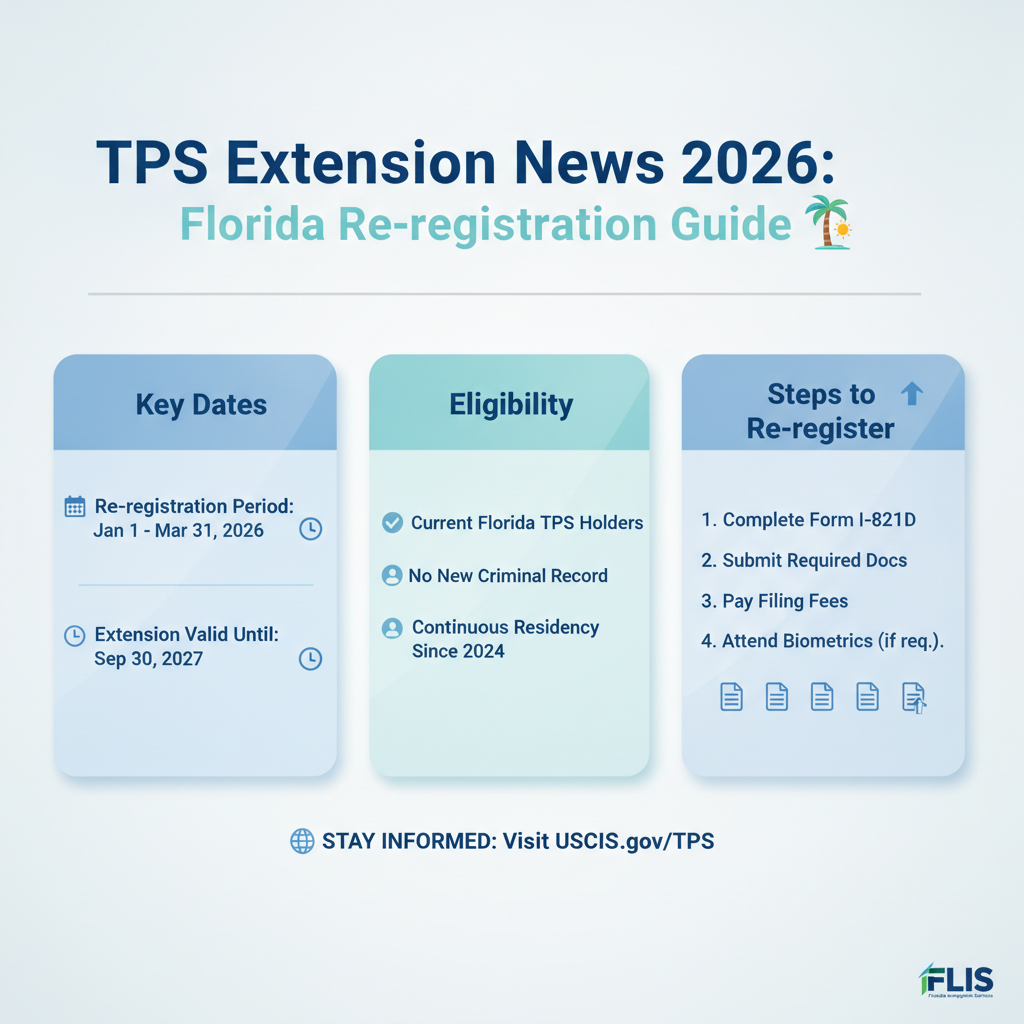
Recent TPS (Temporary Protected Status) Extension News (Legal News) has brought renewed attention to this critical immigration program. These updates, often announced by the Department of Homeland Security (DHS) via the U.S. Citizenship and Immigration Services (USCIS), directly impact the lives and livelihoods of non-citizens from designated countries.
What This News Means for Immigrants in Orlando and Across Florida
For many, Temporary Protected Status (TPS) represents stability in uncertain times. The recent news regarding extensions for various designated countries is a beacon of hope, but also a call to action. It underscores the ongoing need for vigilance and timely legal compliance for TPS beneficiaries.
Why this news is showing up now
The Department of Homeland Security (DHS) periodically reviews the conditions in countries currently designated for TPS. These reviews assess whether the extraordinary and temporary conditions that led to the initial designation (such as armed conflict, environmental disaster, or other extraordinary and temporary conditions) continue to exist. Based on these assessments, DHS makes a determination to either extend, redesignate, or terminate a country's TPS status.
The current news cycle reflects these ongoing reviews and subsequent announcements. Each extension provides a temporary reprieve, allowing eligible individuals to continue living and working legally in the U.S. without fear of deportation for a specified period. These decisions are crucial because they directly affect the legal status, employment authorization, and travel eligibility for thousands of individuals, enabling them to maintain their lives, contribute to their communities, and uphold their family responsibilities.
Important: These extensions are not permanent solutions but rather temporary grants of protection, emphasizing the need for beneficiaries to understand their obligations and rights during each re-registration period.
How it can affect Florida residents
Florida, particularly Central Florida and cities like Orlando, is home to a vibrant and diverse immigrant population. Many residents from countries like Venezuela, Haiti, Nicaragua, El Salvador, Honduras, and others have been granted TPS. Therefore, any news regarding TPS extensions has a profound and immediate impact on these communities.
- Continued Stability: For eligible Floridians, an extension means continued permission to remain in the U.S., work legally with an Employment Authorization Document (EAD), and potentially travel abroad with appropriate authorization. This stability allows families to remain together, children to continue their education without disruption, and individuals to maintain their jobs and contribute to the local economy.
- Re-registration Deadlines: The most significant impact is the activation of new re-registration windows. Missing these deadlines can lead to a loss of TPS status, making timely action paramount. For Central Florida residents, understanding these specific dates and requirements is crucial.
- Community Impact: The continuation of TPS status contributes to the social and economic fabric of Orlando and surrounding areas. It supports local businesses, schools, and healthcare systems by ensuring stability for a significant portion of the population. Without TPS, many families would face immense hardship, potentially leading to widespread disruption.
- Legal Guidance: The complexity of the re-registration process often necessitates legal guidance. Immigration law firms in Orlando, like Imigrar, experience an increased demand for assistance during these periods, helping beneficiaries navigate the paperwork and ensure compliance with USCIS requirements.
Reminder: While TPS offers significant benefits, it does not lead directly to permanent residency or a Green Card. Beneficiaries often explore other immigration pathways concurrently or as future options.
What Temporary Protected Status (TPS) Is (and Why It Matters)
Temporary Protected Status (TPS) is a temporary immigration benefit granted by the United States to eligible nationals of certain countries (or parts thereof) who are already in the United States. It's a humanitarian program designed to protect individuals from having to return to their home countries where conditions are deemed unsafe or unstable.
A plain-English definition
Imagine your home country is experiencing a major disaster – perhaps a devastating earthquake, a widespread epidemic, or a violent civil war. If you are already in the U.S. when this happens, the U.S. government might decide it's too dangerous for you to return. In such a scenario, they can grant you "Temporary Protected Status." This means, for a specific period, you are allowed to stay in the U.S., you can apply for permission to work legally (an Employment Authorization Document, or EAD), and you are protected from deportation. It’s temporary because the U.S. government hopes conditions in your home country will improve, allowing you to eventually return safely. It doesn't lead directly to a Green Card, but it provides crucial relief and stability.
Key terms you need to know
Understanding these terms is vital for anyone involved with TPS:
- Designated Country: A country (or a specific area within a country) that the Secretary of Homeland Security has determined meets the legal criteria for TPS due to ongoing armed conflict, environmental disaster, or other extraordinary and temporary conditions. Examples include Haiti, Venezuela, El Salvador, Honduras, Nicaragua, and others.
- Initial Registration Period: The specific timeframe during which eligible individuals from a newly designated country can apply for TPS for the first time.
- Re-registration Period: A designated timeframe during which current TPS beneficiaries must apply to extend their status. Missing this deadline can result in the loss of TPS. This is the period most relevant to recent extension news.
- Employment Authorization Document (EAD): Also known as a work permit, this document allows TPS beneficiaries to legally work in the United States. It is typically issued with a validity period matching the TPS designation.
- Travel Authorization (Advance Parole): A document that allows individuals with TPS to travel outside the U.S. and return legally. This is applied for using Form I-131. Traveling without Advance Parole can lead to serious immigration consequences.
- Unlawful Presence: The period of time an individual is in the United States without being admitted or paroled, or after their nonimmigrant visa or authorized period of stay has expired. TPS protects beneficiaries from accruing unlawful presence during the validity of their status.
- USCIS (U.S. Citizenship and Immigration Services): The government agency responsible for administering immigration and naturalization benefits, including TPS applications. You will interact with USCIS for all forms and decisions related to your TPS.
- DHS (Department of Homeland Security): The federal department that oversees USCIS and is responsible for designating or extending TPS for countries.
Confused by Immigration Jargon? Our team at Imigrar speaks your language – literally. We provide clear, understandable legal advice in English and Spanish. Call us for a free consultation at +1 786-791-3106.
Current Immigration Law: The Foundation of TPS
The authority for Temporary Protected Status (TPS) is found in Section 244 of the Immigration and Nationality Act (INA), specifically 8 U.S.C. § 1254a. This federal statute outlines the conditions under which the Secretary of Homeland Security may designate a foreign country for TPS. It's a critical piece of legislation that allows the U.S. to offer humanitarian protection to foreign nationals already present in the country when their homeland faces severe crises.
Federal requirements
Under INA Section 244(b), the Secretary of Homeland Security can designate a country for TPS if he or she finds that:
- Ongoing Armed Conflict: There is an ongoing armed conflict within the state, and requiring the return of nationals to that state would pose a serious threat to their personal safety.
- Environmental Disaster: There has been an earthquake, flood, drought, epidemic, or other environmental disaster in the state resulting in a substantial, but temporary, disruption of living conditions, and the foreign state is unable, at least temporarily, to handle the return of its nationals. The foreign state must officially request the designation.
- Extraordinary and Temporary Conditions: There exist extraordinary and temporary conditions in the foreign state that prevent nationals of the state from returning in safety, unless the Secretary finds that permitting the aliens to remain temporarily in the United States is contrary to the national interest of the United States.
Once a country is designated, individual eligibility for TPS requires applicants to:
- Be a national of a designated country.
- Have been continuously physically present in the U.S. since a specific date (the "Continuous Physical Presence" date).
- Have been continuously residing in the U.S. since a specific date (the "Continuous Residence" date).
- Not be inadmissible under certain grounds (e.g., certain criminal offenses, national security threats).
- Register during the initial registration period or any subsequent re-registration period.
Warning: Certain criminal convictions or other immigration violations can make an individual ineligible for TPS, even if they meet other criteria. It's crucial to disclose all relevant information when applying.
Florida-specific considerations
While TPS is a federal program, and there are no Florida-specific state laws governing its requirements, the large immigrant population in Florida means that TPS designations and extensions have a significant practical impact on the state. For Central Florida residents, particularly those in Orange County and along the I-4 corridor, the Orlando USCIS Field Office plays a key role in processing immigration benefits, though most TPS filings are processed by service centers.
Florida is home to many communities directly impacted by TPS decisions, including large populations from Haiti, Venezuela, El Salvador, and Honduras. These communities rely heavily on accurate and timely information, as well as accessible legal assistance, to navigate the complexities of TPS re-registration and other immigration pathways.
For applicants in Florida, it's essential to:
- Be aware of the specific filing deadlines for your country's designation.
- Understand where to send your application (usually a USCIS Lockbox facility, not the Orlando Field Office).
- Know that if a biometrics appointment is required, you may be scheduled at an Application Support Center (ASC) in Florida.
USCIS Forms relevant to TPS:
- Form I-821, Application for Temporary Protected Status: This is the primary form for applying for or re-registering for TPS.
- Form I-765, Application for Employment Authorization: Filed concurrently with Form I-821 to obtain an EAD, allowing you to work legally.
- Form I-131, Application for Travel Document: Used to request Advance Parole, which grants permission to travel outside the U.S. and return without jeopardizing your TPS status.
Always download the latest versions of these forms directly from the USCIS Forms page on the USCIS official website.
How to Re-register for TPS: A Complete Step-by-Step Guide
If your country's TPS designation has been extended, timely re-registration is crucial to maintain your status. This guide outlines the essential steps for current TPS beneficiaries.
1) Determine Your Eligibility and Re-registration Window
Before you begin, confirm that you are eligible for re-registration. Eligibility typically requires that you were granted TPS during a previous designation and have maintained continuous physical presence and residence in the U.S. since the specified dates for your country. Most importantly, identify the precise re-registration window for your country's extension. This window is usually announced in a Federal Register notice published by DHS.
- Required Documents for this step:
- Your previous TPS approval notice (Form I-797).
- Your current EAD.
- Official Federal Register notice announcing the extension and re-registration period for your country (found on the USCIS official website).
Important: Missing the re-registration deadline can lead to the termination of your TPS status. While late re-registration may be possible in exceptional circumstances, it is not guaranteed.
2) Gather All Necessary Documents
Thorough document preparation is key to a smooth re-registration process. You will need to prove your identity, nationality, continuous residence, and continuous physical presence. Even if you submitted these documents previously, it's wise to have them ready.
- Required Documents for this step (prepare copies, do NOT send originals unless specifically requested):
- Proof of identity and nationality (e.g., passport, birth certificate with photo identification).
- Proof of entry into the U.S. (e.g., Form I-94, passport entry stamp).
- Proof of continuous residence in the U.S. since the specified date for your country (e.g., utility bills, rent receipts, school records, employment records, medical records, bank statements with dates, and your name/address).
- Proof of continuous physical presence in the U.S. since the specified date (often covered by the same documents as continuous residence).
- Two passport-style photos.
- Previous TPS approval notices (Form I-797).
- Previous EADs.
- Any court dispositions for arrests or convictions (even minor ones).
Reminder: Any documents not in English must be accompanied by a certified English translation.
3) Complete and File Forms I-821 and I-765 (and I-131 if needed)
You must file Form I-821, Application for Temporary Protected Status. If you want to continue working legally, you should also file Form I-765, Application for Employment Authorization, concurrently with your I-821. If you wish to travel outside the U.S., you must file Form I-131, Application for Travel Document, also concurrently or separately.
- Required Forms and Fees:
- Form I-821: Complete accurately and truthfully.
- Form I-765: Complete accurately.
- Form I-131: If applying for travel authorization.
- Filing fees: Check the USCIS Filing Fees page for current amounts. You may be eligible for a fee waiver for Form I-821 and the biometrics fee if you can demonstrate inability to pay using Form I-912, Request for Fee Waiver. The Form I-765 fee generally cannot be waived for re-registrants, but always check the latest guidance.
- Mail your application package to the correct USCIS Lockbox facility for your country (check USCIS Designated Countries for specific filing addresses).
Warning: Always use the latest version of the forms available on the USCIS website. Outdated forms will be rejected.
4) Attend Biometrics Appointment (if required)
After filing, USCIS will send you a notice to attend a biometrics appointment at an Application Support Center (ASC) near you. This appointment is mandatory for most applicants. During this appointment, your fingerprints, photograph, and signature will be collected. These biometrics are used for background checks.
- Required for this step:
- Your biometrics appointment notice (Form I-797C).
- A valid photo identification (e.g., driver's license, passport).
Reminder: If you are in Orlando or Central Florida, your appointment will likely be at a local ASC. Do not miss this appointment without rescheduling in advance.
5) Monitor Your Application Status
Once you file your application, USCIS will send you a receipt notice (Form I-797C). You can use the receipt number provided on this notice to check the status of your case online through the USCIS Case Status Online tool. It's crucial to regularly check for updates and respond promptly to any Requests for Evidence (RFEs) or other notices from USCIS.
- Tools for this step:
- Form I-797C (Receipt Notice).
- Access to the USCIS Processing Times page for general timelines.
- A reliable email address and mailing address to receive notifications.
6) Receive Your Decision and New EAD
If your re-registration is approved, you will receive an approval notice (Form I-797) and, if you applied for it, a new Employment Authorization Document (EAD). The new EAD will reflect the extended validity period of your TPS. This document is essential for continued legal employment in the U.S.
- Expected items:
- TPS approval notice (Form I-797).
- New EAD card.
Important: Keep all approval notices and your EAD in a safe place. These documents are proof of your legal status and work authorization.
Don't Risk Your TPS Status! The re-registration process can be complex. Let Imigrar's experienced team guide you. Call +1 786-791-3106 for your free consultation today. Se Habla Español.

Practical Steps You Can Take Today for Your TPS Application
Proactive preparation is your best defense against errors and delays. Here are actionable steps you can take right now to secure your TPS re-registration:
- Verify Your Country's Status: Immediately check the USCIS TPS page to confirm the latest extension dates and re-registration windows for your specific country. Do not rely solely on news reports; always verify with the official source.
- Locate Previous TPS Documents: Gather all past TPS approval notices, EADs, and any correspondence from USCIS. These will serve as a foundation for your re-registration.
- Update Your Address with USCIS: If you've moved since your last TPS application, file Form AR-11, Alien's Change of Address Card, online or by mail. Failure to do so could result in missed important notices.
- Start Gathering Proof of Continuous Residence: Begin collecting documents that prove your continuous residence in the U.S. since your last TPS application or the initial designation date, whichever is applicable. Aim for documents from various points in time.
- Review Your Criminal History: If you have any arrests or convictions, even minor ones, gather all certified court dispositions. It's better to disclose this information upfront and discuss it with an attorney.
- Organize Your Financials for Fee Waivers: If you anticipate needing a fee waiver, start collecting documentation of your income, expenses, and any public benefits received to support Form I-912.
- Consult with an Immigration Attorney: This is perhaps the most critical step. An experienced attorney can review your eligibility, help you prepare your application accurately, and identify any potential issues that could complicate your case.
Document preparation guidance
- Keep Originals Safe: Always send copies of your supporting documents, not originals, unless USCIS specifically requests them.
- Organize Clearly: Arrange your documents logically. Use cover sheets, tabs, and a table of contents for complex applications.
- Certified Translations: Any document not in English must be accompanied by a complete and accurate English translation, certified by the translator as competent to translate and that the translation is accurate.
- Make Copies for Yourself: Before mailing, make a complete copy of your entire application package for your records.
Timeline expectations
- Re-registration Window: This is typically a 60-day period following the Federal Register notice. It is essential to file within this window.
- Biometrics Appointment: Expect to receive a notice for your biometrics appointment within a few weeks to a few months after filing your application.
- EAD Processing: Processing times for the EAD can vary significantly. Check the USCIS Processing Times page for current estimates. Many extensions include an automatic extension of existing EADs for a certain period to prevent gaps in work authorization. Be


