


The landscape of immigration law is constantly shifting, and staying informed is paramount for individuals and families building a life in the United States. Today, we're diving into a critical development that impacts thousands: the recent news surrounding Temporary Protected Status (TPS) extensions. This guide from Imigrar, your trusted immigration law firm in Orlando, Florida, is designed to provide clarity, actionable steps, and peace of mind during these important times.
Navigating TPS extensions can be complex. Don't face it alone. Our Orlando immigration team is ready to assist. Call +1 786-791-3106 for a free consultation, or message us online. Se Habla Español.
The reporting that sparked this guide
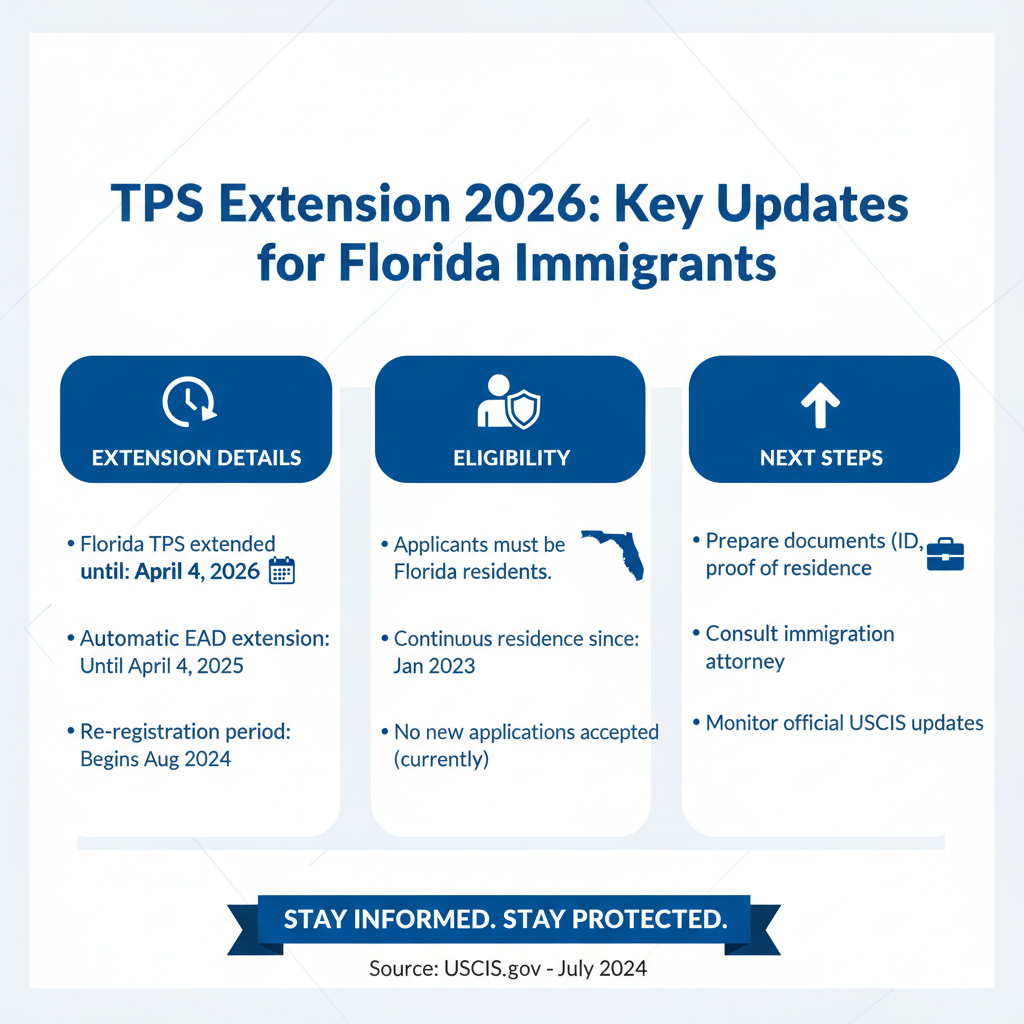
This comprehensive guide is inspired by recent legal news regarding the extensions of Temporary Protected Status (TPS) for various designated countries. These extensions are critical for countless individuals and families who rely on TPS for their safety and stability in the U.S.
TPS (Temporary Protected Status) Extension News (Legal News)
What This News Means for Immigrants in Orlando and Across Florida
For the vibrant immigrant communities in Orlando, Central Florida, and throughout the state, news of TPS extensions carries significant weight. Florida is home to a substantial population of individuals from countries often designated for TPS, including Haiti, Venezuela, Honduras, Nicaragua, El Salvador, and others. Any update, especially an extension, offers a renewed sense of security and an opportunity to continue their lives and contributions without immediate fear of deportation.
Why this news is showing up now
Temporary Protected Status is, by its very nature, a temporary designation. The Secretary of Homeland Security (DHS) is mandated to review the conditions in a designated country periodically – typically 60 days before the expiration of the current designation or extension. Based on this review, DHS determines whether the extraordinary conditions that led to the initial designation (such as armed conflict, environmental disaster, or other extraordinary and temporary conditions) continue to exist. If these conditions persist, DHS may decide to extend TPS for an additional period, usually 6, 12, or 18 months. The news surfacing now, in April 2026, indicates that DHS has recently concluded or is in the process of concluding these reviews for several countries, announcing either extensions or re-designations. This process is crucial for providing continued stability to current TPS beneficiaries and ensuring they have ample time to prepare for re-registration.
How it can affect Florida residents
Florida, with its diverse population and strong ties to many TPS-designated countries, is particularly affected by these announcements. For thousands of Florida residents currently holding TPS, an extension means they can continue to live and work legally in the U.S. without fear of removal. This stability allows them to maintain employment, support their families, pursue educational opportunities, and contribute to Florida’s economy and society. Specifically:
- Continued Work Authorization: TPS beneficiaries are eligible for an Employment Authorization Document (EAD), which allows them to work legally. Extensions often come with automatic EAD extensions, preventing gaps in employment.
- Protection from Deportation: The primary benefit of TPS is protection from removal from the U.S. This provides immense relief for families who might otherwise face separation.
- Opportunity for Travel: With an approved Advance Parole document (Form I-131), TPS holders can travel outside the U.S. and return legally, which is vital for maintaining family ties or addressing urgent matters abroad.
- Planning for the Future: While TPS is temporary, extensions provide critical time for individuals to explore other potential avenues for permanent residency, if eligible, or to continue building stable lives in Florida.
For those in Orlando and the wider Central Florida region, understanding the specific details of these extensions – including the new validity dates and re-registration deadlines – is essential. Failure to re-register within the specified window can lead to a loss of TPS benefits, including work authorization and protection from deportation. Imigrar is here to help you navigate these critical updates and ensure your status remains secure.
What Temporary Protected Status (TPS) Is (and Why It Matters)
Temporary Protected Status (TPS) is a humanitarian immigration program established by the U.S. Congress under the Immigration and Nationality Act (INA). It offers a temporary safe haven to foreign nationals from countries experiencing extreme conditions that make it unsafe for their citizens to return. This status is truly a lifeline for many, allowing them to live and work legally in the United States for a designated period, free from the constant threat of deportation.
A plain-English definition
Imagine your home country becomes incredibly dangerous due to a massive natural disaster, an ongoing war, or other severe, temporary events. The U.S. government recognizes that sending people back to such conditions would be inhumane. So, through TPS, it grants eligible individuals from those specific countries temporary permission to stay in the United States. This protection lasts for a set period, typically 6, 12, or 18 months, and can be extended if the dangerous conditions in the home country persist. It's not a path to a Green Card directly, but it provides crucial relief and stability while the situation abroad hopefully improves.
Key terms you need to know
Understanding the terminology associated with TPS is vital for anyone considering or currently holding this status:
- Designated Country: This refers to a foreign country whose conditions meet the statutory requirements for TPS. The Secretary of Homeland Security makes this designation. Examples of countries that have been designated for TPS include El Salvador, Haiti, Honduras, Nepal, Nicaragua, Somalia, Sudan, South Sudan, Syria, Ukraine, Venezuela, Yemen, and Afghanistan, among others. Each designation specifies an effective date and period.
- Eligibility Criteria: To qualify for TPS, individuals must generally be nationals of a designated country (or stateless individuals who last habitually resided in that country), have been continuously physically present (CPP) and continuously residing (CR) in the U.S. since a specific date, and meet certain admissibility requirements (e.g., no felony convictions, certain misdemeanor convictions, or grounds of inadmissibility).
- Work Authorization (EAD): An Employment Authorization Document (EAD), also known as a work permit, is granted to TPS beneficiaries, allowing them to legally work in the U.S. This is applied for using Form I-765. For many, this is one of the most critical benefits, providing financial stability.
- Travel Authorization (Advance Parole): While holding TPS, individuals generally cannot travel outside the U.S. without risking their status. However, they can apply for Advance Parole using Form I-131, which allows them to travel abroad and lawfully return to the U.S. It’s crucial to obtain this *before* departing.
- Re-registration: When a country's TPS designation is extended, current beneficiaries must re-register during a specific window to maintain their status. This involves filing Form I-821 again, often along with Form I-765. Missing this window can lead to termination of status.
- Termination/Extension: TPS is not permanent. DHS periodically reviews country conditions. If conditions improve, TPS can be terminated. If they persist, it can be extended. Sometimes, a country's TPS can be re-designated, which might open eligibility to new applicants who arrived after the initial designation date but before the re-designation date.
- Dual Status: It is possible to hold TPS while simultaneously pursuing other immigration benefits, such as a Green Card through family petitions or asylum. TPS provides protection while these other, often lengthier, processes unfold.
For immigrants in Florida, understanding these terms is the first step toward securing or maintaining their TPS. The temporary nature of TPS means that vigilance and timely action are always necessary, and Imigrar is here to guide you through every update and requirement.
Concerned about your TPS eligibility or re-registration? Get expert legal advice from Imigrar. Call +1 786-791-3106 for a free consultation, or message us online. Se Habla Español.
Current Immigration Law: The Foundation
Temporary Protected Status (TPS) is firmly rooted in federal immigration law, specifically **Section 244 of the Immigration and Nationality Act (INA)** (8 U.S.C. § 1254a). This statute grants the Secretary of Homeland Security (DHS) the authority to designate a foreign country for TPS if certain conditions exist. Understanding this legal framework is crucial for anyone seeking or holding TPS.
Federal requirements
The INA outlines the precise conditions under which a country can be designated for TPS, as well as the eligibility requirements for individuals. The three primary statutory grounds for designation are:
- Ongoing Armed Conflict: The country is experiencing ongoing armed conflict, making return unsafe.
- Environmental Disaster: The country has suffered an earthquake, flood, drought, epidemic, or other environmental disaster resulting in a substantial, but temporary, disruption of living conditions, and the country is unable to handle the return of its nationals adequately.
- Extraordinary and Temporary Conditions: There exist extraordinary and temporary conditions in the foreign state that prevent nationals from returning safely, and granting TPS is consistent with U.S. national interests.
Once a country is designated, individual applicants must meet specific federal requirements to be eligible:
- Be a national of a designated country (or a person without nationality who last habitually resided in that country).
- Have been continuously physically present (CPP) in the U.S. since the effective date of the most recent designation.
- Have been continuously residing (CR) in the U.S. since the date specified by the Secretary of Homeland Security for the country's designation.
- File their application (Form I-821) within the initial registration period or any subsequent re-registration period.
- Meet general admissibility requirements, meaning they must not be inadmissible under certain grounds, such as serious criminal offenses. Specifically, individuals are ineligible if they have been convicted of any felony or two or more misdemeanors committed in the U.S., or if they are found inadmissible under certain non-waivable grounds applicable to all immigrants.
All applications for TPS are processed by U.S. Citizenship and Immigration Services (USCIS), a component of DHS. The forms involved are primarily Form I-821 (Application for Temporary Protected Status), Form I-765 (Application for Employment Authorization), and Form I-131 (Application for Travel Document). It is essential to refer to the official USCIS website for the most current forms, instructions, and fee information: USCIS official website.
Florida-specific considerations
While TPS is a federal program, its implementation and impact are deeply felt at the state and local levels. Florida, particularly major metropolitan areas like Orlando, Miami, and Tampa, has a large and diverse immigrant population. For Central Florida residents, the Orlando USCIS Field Office plays a significant role in processing biometrics appointments and interviews related to various immigration benefits, including TPS. Although there are no specific Florida state laws governing TPS eligibility or benefits, federal immigration policies directly shape the lives of thousands of Floridians. The economic contributions of TPS holders, their integration into local communities, and the stability TPS provides to families are all vital aspects of Florida's social and economic fabric. Therefore, staying informed about federal TPS extensions is critical for the well-being of many families living and working in Orange County and along the I-4 corridor.
How to Re-Register for TPS: A Complete Step-by-Step Guide
If your country's TPS designation has been extended, re-registration is a critical process to maintain your protected status, work authorization, and protection from deportation. Missing the re-registration window can have severe consequences. Here’s a detailed, step-by-step guide to help you navigate the process.
1) Determine Your Eligibility and Re-registration Window
The very first step is to confirm that your country's TPS status has indeed been extended and to identify the specific re-registration period. USCIS publishes Federal Register notices for all TPS designations, extensions, and re-designations. These notices are your authoritative source for deadlines and eligibility criteria. You must be a national of the designated country (or a stateless person who last habitually resided there), and you must have continuously resided (CR) and been continuously physically present (CPP) in the U.S. since the dates specified in the initial designation or subsequent re-designation. Additionally, you must not have any disqualifying criminal convictions or other ineligibility factors. Always check the official USCIS website or the Federal Register for the most current information regarding your specific country.
- Required Documents for this step:
- Your current or most recent TPS approval notice (Form I-797).
- Your passport or national identity document from the designated country.
- Proof of your continuous residence in the U.S. since the specified date (e.g., utility bills, rental agreements, employment records, school records).
2) Gather Required Documents
A complete and accurate application package is key to a smooth re-registration process. Start gathering all necessary supporting documents well in advance. This includes proof of identity, nationality, date of entry, continuous residence, and continuous physical presence in the U.S. since the specified dates. If you have any criminal history, even minor offenses, you must gather all certified court dispositions. It's crucial to submit copies, not originals, unless USCIS specifically requests them. All documents not in English must be accompanied by a certified English translation.
- Required Documents for this step (examples):
- Copy of your passport or birth certificate from the designated country.
- Copy of your national identity document (if applicable).
- Copy of your Form I-94 (Arrival/Departure Record).
- Evidence of continuous residence (CR) and continuous physical presence (CPP) (e.g., pay stubs, bank statements, school records, medical records, utility bills, rental agreements, sworn affidavits).
- Any previous USCIS notices related to your TPS, EAD, or Advance Parole.
- Two identical, passport-style photographs (for Form I-765 and Form I-131, if filing).
- Certified copies of any court dispositions for arrests or convictions (even if charges were dismissed).
3) Complete and File Form I-821, Application for Temporary Protected Status
This is the core form for re-registration. It must be filled out completely and accurately. Pay close attention to all questions, especially those related to your continuous residence and any interactions with law enforcement. Sign the form in blue ink. For re-registrants, the Form I-821 filing fee is often waived, but you will typically need to pay a biometric services fee unless you qualify for a fee waiver. If you are requesting a fee waiver, you must submit Form I-912, Request for Fee Waiver, along with supporting documentation. Always check the current fee schedule on the USCIS website.
- Required Documents for this step:
- Completed and signed Form I-821.
- Supporting documents confirming eligibility (from step 2).
- Check or money order for the biometric services fee (or approved Form I-912).
4) File Form I-765, Application for Employment Authorization (Optional but Recommended)
If you wish to continue working legally in the U.S., you must apply for a new Employment Authorization Document (EAD) or an extension of your current one. You can file Form I-765 concurrently with your Form I-821 or at a later date. Remember to include two passport-style photos and the required filing fee, unless you are filing for a fee waiver (Form I-912). Often, the Federal Register notice announcing the TPS extension will include an automatic extension of existing EADs for a certain period, which can provide continued work authorization while your new EAD application is processed. It is critical to understand the terms of any automatic extension.
- Required Documents for this step:
- Completed and signed Form I-765.
- Two identical, passport-style photographs.
- Copy of your most recent EAD (front and back), if applicable.
- Copy of your Form I-94.
- Copy of your passport biographical page.
- Check or money order for the Form I-765 filing fee (or approved Form I-912).
5) File Form I-131, Application for Travel Document (Optional)
If you anticipate needing to travel outside the United States while your TPS is valid, you must apply for Advance Parole using Form I-131. Traveling abroad without an approved Advance Parole document can lead to serious immigration consequences, including denial of re-entry and potential termination of your TPS. You will need to provide two passport-style photos and the filing fee, or an approved fee waiver. Clearly state the reason for your travel in the application. It is advisable to file this well in advance of any planned travel, as processing times can vary significantly.
- Required Documents for this step:
- Completed and signed Form I-131.
- Two identical, passport-style photographs.
- Copy of your most recent TPS approval notice (Form I-797).
- Copy of your Form I-94.
- Copy of your passport biographical page.
- Detailed explanation for your travel (e.g., family emergency, funeral).
- Check or money order for the Form I-131 filing fee (or approved Form I-912).
6) Attend Biometrics Appointment
After filing your applications, USCIS will send you an appointment notice for biometrics. This appointment, typically held at a local Application Support Center (ASC), is for collecting your fingerprints, photograph, and signature. It is a mandatory step. Be sure to bring your appointment notice and a valid photo ID. Missing this appointment without rescheduling can delay your application or even lead to denial. For Central Florida residents, your appointment will likely be at the Orlando USCIS Field Office or another ASC in the region.
- Required Documents for this step:
- USCIS Biometrics Appointment Notice (Form I-797C).
- Valid government-issued photo identification (e.g., passport, state ID).
7) Monitor Your Case and Respond to RFEs
Once you've submitted your application and attended biometrics, it's crucial to monitor the status of your case. You can do this using the Case Status Online tool on the USCIS website with your receipt number. Be prepared to respond promptly to any Requests for Evidence (RFEs) from USCIS. An RFE means USCIS needs more information or clarification to make a decision on your case. Failing to respond by the deadline or providing insufficient evidence can lead to a denial. Keep copies of everything you submit to USCIS, and consider using certified mail with a return receipt for all correspondence. You can check typical processing times here: USCIS Processing Times. For additional forms and information, visit USCIS Forms.
Overwhelmed by the TPS re-registration process? Let Imigrar simplify it for you. Our Orlando team offers expert guidance and support. Call +1 786-791-3106 for a free consultation, or message us online. Se Habla Español.

Practical Steps You Can Take Today
Given the recent TPS extension news, proactive steps are essential to ensure you maintain your legal status and avoid any disruptions. Here’s an actionable checklist and guidance to help you prepare:
Actionable Checklist:
- Confirm Your Country's Status: Immediately verify the specific details of your country’s TPS extension, including the new expiration date and the re-registration window. This information is published in the Federal Register and on the USCIS website.
- Gather All Personal Documents: Start compiling all necessary documents now.


