

The reporting that sparked this guide: TPS (Temporary Protected Status) Extension News (Legal News)
What This News Means for Immigrants in Orlando and Across Florida
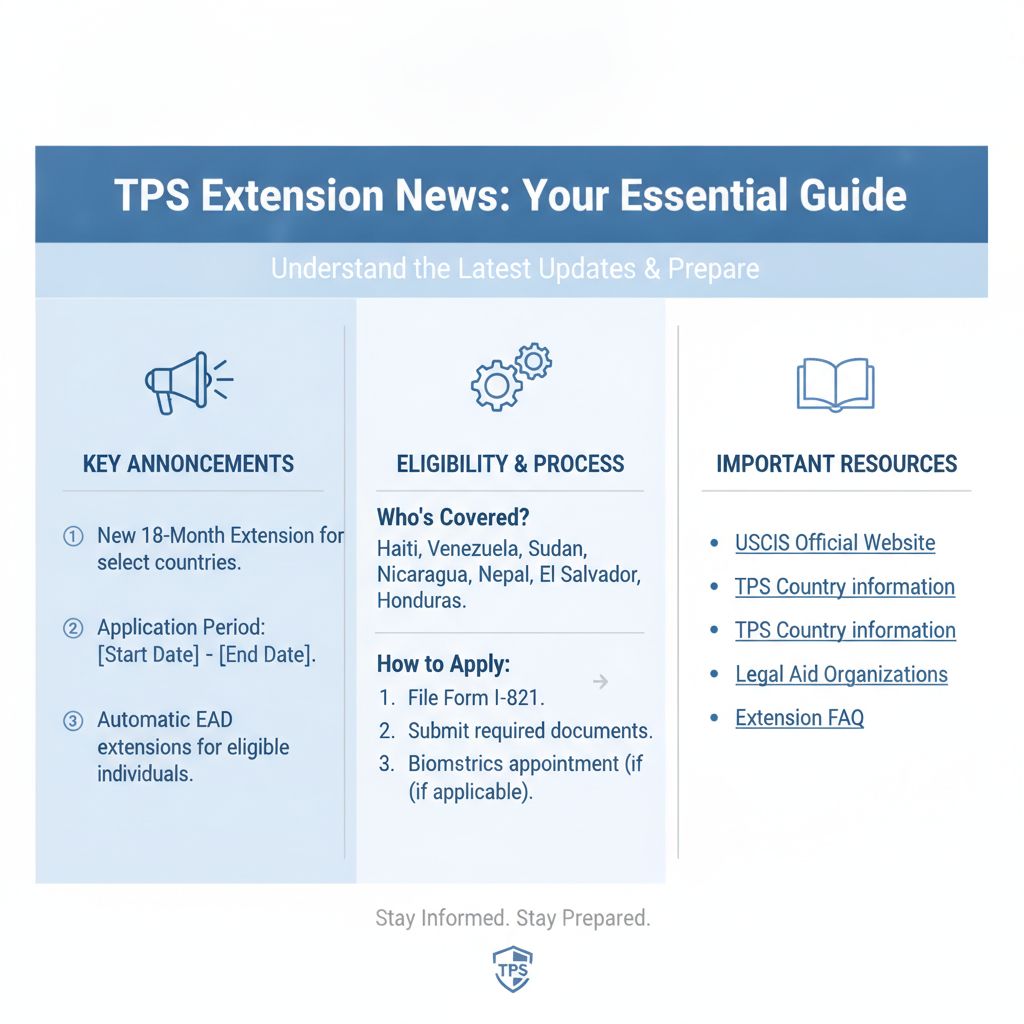
Recent developments regarding Temporary Protected Status (TPS) have been a significant topic in immigration circles, bringing both relief and renewed questions for thousands of individuals and families. For those living in Orlando, Central Florida, and across the nation, these updates can directly impact your ability to live, work, and plan for your future in the United States.
Why this news is showing up now
The landscape of TPS is constantly evolving, driven by ongoing humanitarian crises, natural disasters, and political instability in various countries around the world. Nations like Venezuela, Haiti, El Salvador, Honduras, Nicaragua, Nepal, Sudan, Afghanistan, and Ukraine have seen their citizens granted or extended TPS due to conditions preventing their safe return. The U.S. government, through the Department of Homeland Security (DHS), regularly reviews conditions in designated countries. These reviews lead to decisions to extend existing TPS designations, redesignate countries, or, in some cases, terminate the status. What we are seeing now are the results of these critical reviews, often influenced by current geopolitical events, court challenges, and advocacy efforts by immigrant rights organizations.
For example, several countries have recently received extensions or redesignations for TPS, allowing current beneficiaries to maintain their protected status and providing new eligibility for others who arrived during specific windows. These announcements are critical because they dictate the deadlines for re-registration and initial applications, and they reaffirm the government's recognition of the unsafe conditions in these countries. It’s a dynamic situation, and staying informed is paramount.
How it can affect Florida residents
Florida, particularly the Orlando area, is home to vibrant communities from many TPS-designated countries. For example, Central Florida has a significant population from Haiti, Venezuela, Nicaragua, El Salvador, and Honduras. Therefore, any news concerning TPS extensions, redesignations, or their potential termination directly impacts thousands of our neighbors, friends, and family members. An extension of TPS means continued protection from removal, continued eligibility for work authorization (Employment Authorization Document - EAD), and the ability to maintain a sense of stability for families who have built their lives here.
Conversely, the termination of TPS for a country can plunge beneficiaries into uncertainty, potentially leading to loss of work authorization and vulnerability to deportation. The stakes are incredibly high. For Central Florida residents, understanding these updates is not just about legal compliance; it's about securing your livelihood, your children's education, and your family's future. The Orlando USCIS Field Office and local community organizations are often at the forefront of assisting these populations, making local knowledge and legal guidance invaluable.
Need Help? Our Orlando immigration team is ready to assist. Call +1 786-791-3106 for a free consultation, or message us online. Se Habla Español.
What Temporary Protected Status (TPS) Is (and Why It Matters)
Temporary Protected Status (TPS) is a humanitarian immigration benefit provided by the United States government. It offers temporary relief from deportation and work authorization to eligible foreign nationals from designated countries facing extraordinary and temporary conditions that prevent their safe return.
A plain-English definition
Imagine your home country becomes unsafe due to a war, a massive natural disaster like an earthquake or hurricane, or an epidemic that devastates the infrastructure. The U.S. government recognizes that it would be dangerous for you to return. In such cases, the Secretary of Homeland Security can designate that country for Temporary Protected Status. This means that citizens of that country who are already in the U.S. (or arrive during a specific window) can apply to legally stay and work here for a temporary period, without fear of being sent back to an unsafe environment. It's a temporary haven, not a path to a Green Card, but it provides crucial stability and protection.
The designation period typically lasts for 6, 12, or 18 months and can be extended if the unsafe conditions persist. While under TPS, individuals cannot be deported, can obtain an Employment Authorization Document (EAD) to work legally, and may be granted travel authorization.
Key terms you need to know
- Designation: When the Secretary of Homeland Security officially identifies a country for TPS due to ongoing armed conflict, environmental disaster, or other extraordinary and temporary conditions. This sets the initial period for which citizens of that country can apply.
- Redesignation: This occurs when a country that already has TPS is designated again, often due to new or worsening conditions since the initial designation. A redesignation typically changes the eligibility criteria, allowing individuals who arrived in the U.S. after the initial designation date, but before the redesignation date, to apply.
- Extension: When the Secretary of Homeland Security determines that the conditions supporting a country's TPS designation continue to exist, the existing designation period is extended. This allows current TPS beneficiaries to re-register and maintain their status.
- Eligibility Period: This refers to the specific timeframe during which individuals must have continuously resided in the U.S. to be eligible for TPS for a particular country. It is crucial to meet this residency requirement.
- Employment Authorization Document (EAD): Also known as a work permit, this card allows TPS beneficiaries to legally work in the United States. Applying for an EAD is usually done concurrently with the TPS application (Form I-765).
- Prima Facie Eligibility: This means that based on the initial evidence presented, an applicant appears to meet all the basic eligibility requirements for TPS.
- Inadmissibility: Certain factors, such as criminal convictions, national security concerns, or prior immigration violations, can make an individual inadmissible to the U.S. and therefore ineligible for TPS, unless waivers are available and granted.
- Waivers of Grounds of Inadmissibility: In some cases, if an applicant has certain inadmissibility grounds, they may be able to apply for a waiver (using Form I-601 or Form I-212) to overcome these issues and still be granted TPS.
- Continuous Physical Presence (CPP): The requirement that an applicant must have been physically present in the U.S. since a specific date set for their country's TPS designation.
- Continuous Residence (CR): The requirement that an applicant must have maintained residence in the U.S. since a specific date set for their country's TPS designation. Brief, casual, and innocent departures from the U.S. do not break continuous residence.
Understanding these terms is fundamental to navigating the TPS process successfully and ensuring you meet all the necessary criteria.
Current Immigration Law: The Foundation
Temporary Protected Status is established under Section 244 of the Immigration and Nationality Act (INA), found at 8 U.S.C. § 1254a. This section of the law outlines the authority of the Secretary of Homeland Security to designate a foreign country for TPS due to specific, temporary conditions.
The law specifies three broad statutory bases for TPS designation:
- Ongoing armed conflict: Requiring nationals to return would pose a serious threat to their personal safety.
- Environmental disaster: Such as an earthquake, hurricane, flood, or epidemic, resulting in substantial, but temporary, disruption of living conditions, and the foreign country is unable to handle the return of its nationals adequately.
- Extraordinary and temporary conditions: The country is experiencing conditions that prevent nationals from returning safely, and granting TPS is consistent with U.S. foreign policy interests.
Once a country is designated, eligible individuals from that country who are already in the U.S. can apply for TPS. The law also dictates requirements for continuous physical presence and continuous residence in the U.S. since a specified date, as well as criteria for good moral character and other admissibility standards.
Federal requirements
To be eligible for TPS, an individual must meet several federal requirements:
- Be a national of a country designated for TPS, or a person without nationality who last habitually resided in that designated country.
- File Form I-821, Application for Temporary Protected Status, during the initial registration or re-registration period.
- Have been continuously physically present (CPP) in the U.S. since the effective date of the most recent designation or redesignation for their country.
- Have been continuously residing (CR) in the U.S. since the date specified for their country's designation. Brief, casual, and innocent absences generally do not disrupt CR.
- Meet all other eligibility requirements, including admissibility criteria. Certain criminal offenses (e.g., two misdemeanors or one felony), persecution of others, or national security grounds can make an applicant ineligible.
- Individuals must also pass security background checks.
It is important to note that even if you meet the country-specific and residency requirements, certain bars to eligibility can prevent you from obtaining TPS. These include conviction for certain crimes, or participation in the persecution of others. However, waivers for some grounds of inadmissibility may be available.
For more detailed information and specific country designations, always refer to the USCIS official TPS website.
Florida-specific considerations
While TPS is a federal program, its implementation and impact often have state-specific nuances, especially in a state like Florida with a large immigrant population. For Central Florida residents, understanding these local considerations can be crucial:
- Local USCIS Field Office: If your case is in Orlando, your biometrics appointment will likely be scheduled at the Orlando USCIS Field Office. Familiarity with local office procedures and wait times can be beneficial.
- State ID and Driver's Licenses: With an approved EAD and TPS status, you are generally eligible to obtain a Florida driver's license or state identification card. This is vital for daily life, including commuting along the I-4 corridor or securing employment.
- Community Resources: Florida has numerous non-profit organizations and legal aid groups that offer assistance to immigrant communities, particularly those from TPS-designated countries. These resources can provide support beyond legal representation, such as language services or social support.
- Notario Fraud Awareness: Unfortunately, Florida, like many states, sees cases of "notario" fraud, where unauthorized individuals pose as immigration lawyers. Warning: Always ensure you are dealing with a licensed attorney or accredited representative. Imigrar is a licensed and experienced law firm.
Understanding the interplay between federal immigration law and local realities in Florida is key to a smooth TPS application process.
Need Assistance with Your TPS Application or Re-registration? Don't navigate complex immigration laws alone. Contact Imigrar in Orlando for expert guidance. Call +1 786-791-3106 for a free consultation. Se Habla Español.
How to Apply for TPS (or Re-register): A Complete Step-by-Step Guide
Applying for Temporary Protected Status, or re-registering for it, involves careful preparation and adherence to specific USCIS procedures. This guide outlines the essential steps. Reminder: Deadlines are critical, so act swiftly once an extension or redesignation is announced.
1) Determine Your Eligibility
Before gathering documents, confirm that you meet the core eligibility criteria for your country's TPS designation:
- Country of Nationality: Are you a national of a country currently designated for TPS, or a person without nationality who last habitually resided in that country?
- Residency Dates: Did you continuously reside (CR) in the U.S. since the specified date for your country's designation? Did you continuously physically present (CPP) in the U.S. since the specified date?
- Admissibility: Do you have any criminal convictions (especially felonies or two or more misdemeanors), immigration violations, or other issues that might make you inadmissible? If so, discuss potential waivers with an attorney.
- Application Period: Are you applying during the initial registration period or the re-registration window? Missing these deadlines can lead to denial.
Important: Check the USCIS TPS page frequently for the latest country-specific announcements and deadlines. For example, recent extensions for countries like Venezuela and Haiti have specific re-registration windows that must be met.
2) Gather Required Documents
This is a crucial step. Organize all original documents and make copies. Ensure all foreign language documents are accompanied by a certified English translation.
- Proof of Identity and Nationality:
- Passport (copy of biographical page)
- Birth certificate with photo identification (if no passport)
- National identity card from your country of origin
- Proof of Entry into the U.S. (if applicable):
- Copy of Form I-94, Arrival/Departure Record
- Entry stamp in your passport
- Proof of Continuous Residence (CR) in the U.S.: (documents from the specified date until now)
- Rental agreements, utility bills (electricity, water, gas, internet)
- Employment records (pay stubs, W-2s, employment verification letters)
- School records (transcripts, enrollment letters for yourself or children)
- Medical records (clinic visits, hospital bills)
- Bank statements
- Affidavits from individuals who have known you and can attest to your residence (with their contact info)
- Receipts for money transfers
- Any dated documents showing your presence in the U.S.
- Photographs: Two identical passport-style photos.
- Criminal History Records (if applicable):
- Certified copies of court dispositions for any arrests or convictions, even if expunged or dismissed.
- Proof of completion of probation or parole.
- Previous Immigration Filings (if applicable): Copies of any prior applications or petitions filed with USCIS or EOIR.
3) Complete Required Forms
Accuracy is key. Fill out all forms completely and truthfully. Do not leave any sections blank; write "N/A" if a question does not apply to you.
- Form I-821, Application for Temporary Protected Status: This is the primary application form for TPS. Read the instructions carefully.
- Form I-765, Application for Employment Authorization: If you want to work legally in the U.S., you must file this form along with your Form I-821.
- Form I-601, Application for Waiver of Grounds of Inadmissibility: If you have certain inadmissibility issues, you may need to file this form. This is complex and requires legal guidance.
- Form I-212, Application for Permission to Reapply for Admission into the United States After Deportation or Removal: If you have a prior removal order, you might need this waiver. Consult an attorney.
- Form I-912, Request for Fee Waiver: If you cannot afford the filing fees, you may apply for a fee waiver.
You can find all official forms and instructions on the USCIS Forms page. Important: Always use the most recent version of the forms.
4) Pay Fees or Request a Fee Waiver
There are typically two main fees:
- Form I-821 Filing Fee: This fee varies based on your age.
- Form I-765 Filing Fee: This fee is required for the employment authorization document.
- Biometrics Services Fee: This fee is for fingerprinting and background checks.
Check the USCIS Fees page for current amounts. You can pay by money order, personal check, cashier's check, or by credit card using Form G-1450, Authorization for Credit Card Transactions. If paying by check or money order, make it payable to "U.S. Department of Homeland Security."
If you cannot afford the fees, you may apply for a fee waiver using Form I-912, Request for Fee Waiver. You will need to provide documentation of your financial hardship.
5) Mail Your Application
Once all forms are completed, signed, fees are paid (or fee waiver requested), and all supporting documents are compiled, assemble your application package. Reminder: Make a complete copy of everything you send to USCIS for your records.
- Assembly: Organize your documents in the order specified in the form instructions, or logically (e.g., forms first, then identity, then residency proof, etc.). Use tabs for easy navigation.
- Mailing Address: Send your application to the correct USCIS lockbox facility. The address depends on the country you are applying for TPS from and whether you are using regular mail or courier service. Refer to the specific instructions for Form I-821 for the correct address.
- Proof of Mailing: Use a service that provides tracking and delivery confirmation (e.g., USPS Certified Mail with Return Receipt, FedEx, UPS). This is your proof that you submitted the application on time.
Warning: Sending your application to the wrong address can cause significant delays or even rejection.
6) Attend Biometrics Appointment
After USCIS receives your application, they will send you a receipt notice (Form I-797C, Notice of Action). Later, you will receive another notice scheduling your biometrics appointment at an Application Support Center (ASC), typically the one closest to your residence, such as the Orlando ASC if you reside in Central Florida.
- What to Bring: Bring the appointment notice, a valid photo ID (e.g., passport, driver's license), and any other documents specified in the notice.
- What Happens: At the appointment, your fingerprints, photograph, and signature will be collected. This information is used for background and security checks.
- Important: Do not miss this appointment. If you have an unavoidable conflict, follow the instructions on the notice to request a reschedule immediately.
7) Respond to Requests for Evidence (RFEs) or Notices
After your biometrics, USCIS may send you a Request for Evidence (RFE) if they need more information or clarification on your application. They might also send a Notice of Intent to Deny (NOID).
- Timely Response: It is critical to respond to an RFE or NOID by the deadline provided in the notice. Failure to do so will likely result in a denial.
- Complete Response: Provide all requested documents and information thoroughly.
- Seek Legal Help: If you receive an RFE or NOID, it is highly advisable to consult with an immigration attorney to ensure your response is complete and addresses all concerns.
8) Receive a Decision
Eventually, USCIS will make a decision on your TPS application. You will receive a written notice of their decision.
- Approval: If approved, you will receive an approval notice for your Form I-821. If you also applied for an EAD, you will receive a separate approval notice for Form I-765 and your Employment Authorization Document card will be mailed to you.
- Denial: If your application is denied, the notice will explain the reasons. You may have options to appeal or refile, depending on the grounds for denial. This is where legal counsel is essential to understand your next steps.
Remember, the process can take time. You can check the status of your case online using the receipt number provided on your Form I-797C at the USCIS Case Status Online tool.
Practical Steps You Can Take Today
Navigating TPS extensions or initial applications requires proactive steps. Here's what you can do right now to prepare and protect your status:
Actionable Checklist:
- Stay Informed: Regularly check the USCIS official website and reputable immigration news sources for updates on your country's TPS status. Subscribe to email alerts if available.
- Gather Documents Early: Even if your country's TPS has just been extended or redesignated, start compiling all necessary documents now. Don't wait until the re-registration window opens. This includes proof of identity, nationality, and continuous residence.
- Consult an Immigration Attorney: This is perhaps the most important step. An expert legal opinion can clarify eligibility, identify potential issues, and ensure your application is submitted correctly and completely.
- Make Copies of Everything: Before sending anything to USCIS, make a complete, organized copy of your entire application package. This includes forms, supporting documents, and proof of mailing.
- Update Your Address with USCIS: If you move, even within Orlando or to another city along the I-4 corridor, you must update your address with USCIS within 10 days of moving using Form AR-11, Alien's Change of Address Card, and update any pending applications online. Failing to do so can result in missed notices and critical deadlines.
- Monitor USCIS Processing Times: While waiting, you can track general processing times for Form I-821 and Form I-765 at the USCIS Processing Times page. This helps manage expectations, though individual cases may vary.
Document Preparation Guidance
- Originals vs. Copies: Generally, USCIS prefers copies of supporting documents. Keep your original documents safe. Only send originals if specifically requested.
- Certified Translations: Any document not in English must be accompanied by a complete and accurate English translation, certified by the translator as competent to translate from the foreign language into English and that the translation is true and accurate.
- Organization: Use fasteners, clips, or tabs to organize your application package. Avoid staples unless specifically instructed. A cover letter listing all included documents can be helpful.
- Notarization: Most immigration documents do not require notarization, unless specifically requested (e.g., certain affidavits).
Timeline Expectations
The TPS process involves several stages, and each can have varying timelines:
- Application Submission Window: Typically, there's a 60-day window for initial registration or re-registration once a country's TPS is designated, extended, or redesignated. Missing this deadline can make you ineligible.
- Receipt Notice: You should receive a receipt notice (Form I-797C) from USCIS within a few weeks of mailing your application.
- Biometrics Appointment: This usually happens within 1-3 months after your application is received.
- Processing Time for I-821: Varies significantly by USCIS service center and the volume of applications. It can range from several months to over a year.
- Processing Time for EAD (Form I-765): Often processed concurrently with Form I-821. However, there can be delays. USCIS sometimes issues automatic extensions for expiring EADs for re-registrants, so check for official announcements.
- Decision: The final decision on your TPS application could take many months, sometimes over a year, from the date of submission.
Warning: These timelines are estimates and can change without notice. Always check the official USCIS processing times and do not rely on anecdotal evidence.
Overwhelmed by TPS Deadlines or Documentation? Let Imigrar's experienced immigration lawyers guide you. We serve clients nationwide from our Orlando office. Call +1 786-791-3106 for a free consultation. Se Habla Español.

How Imigrar Helps Immigrants in Orlando
At Imigrar, we understand the profound impact that immigration decisions have on individuals and families. Our mission, "Keep Families Together," drives our dedicated approach to every case. Based in Orlando, Florida, we proudly serve clients not only across the Sunshine State but nationwide, offering expert legal assistance in a wide range of immigration matters, including Temporary Protected Status (TPS).
Our team of experienced immigration attorneys possesses in-depth knowledge of current immigration laws, policies, and procedures. We stay up-to-date on the latest announcements from USCIS, DHS, and the Executive Office for Immigration Review (EOIR) to provide accurate and timely advice. Whether you are applying for TPS for the first time, re-registering for an extension, or facing complex eligibility issues, we are here to simplify the process and advocate on your behalf.
We assist clients with:
- Determining TPS eligibility for initial applications and re-registrations.
- Comprehensive preparation and submission of Form I-821 and Form I-765.
- Guidance on gathering and organizing supporting documentation, including proof of continuous residence and physical presence.
- Preparing and filing fee waiver requests (Form I-912).
- Addressing potential inadmissibility issues and preparing waiver applications (e.g., Form I-601).
- Responding to Requests for Evidence (RFEs) from USCIS.
- Representing clients at USCIS interviews or biometrics appointments, if needed.
- Strategic advice on


