


The landscape of U.S. immigration law is constantly evolving, bringing both challenges and opportunities for individuals and families seeking safety and stability. For many, Temporary Protected Status (TPS) has been a vital lifeline, offering protection from deportation and the ability to work legally in the United States. As of early 2026, the Department of Homeland Security (DHS) has once again made significant announcements regarding TPS designations and extensions for several countries, impacting thousands of individuals nationwide, particularly here in Florida.
Need Clarity on TPS Extensions? The complexities of immigration law can be overwhelming. Our Orlando immigration team at Imigrar is ready to assist you in understanding the latest TPS updates and navigating the re-registration process. Call us today at +1 786-791-3106 for a free, confidential consultation, or message us online. Se Habla Español.
NEWS SOURCE REFERENCE SECTION
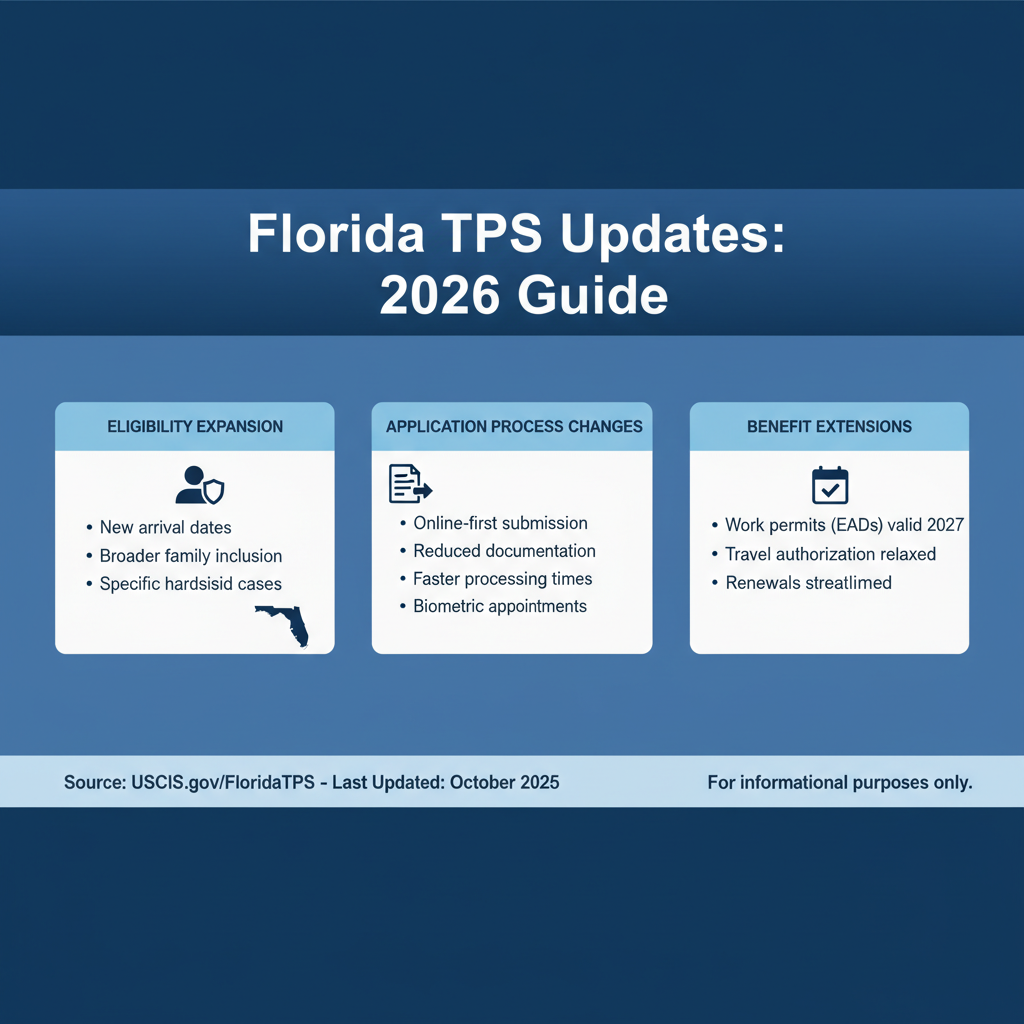
The reporting that sparked this guide: TPS (Temporary Protected Status) Extension News (Legal News)
What This News Means for Immigrants in Orlando and Across Florida
Recent announcements regarding the extension of Temporary Protected Status for several designated countries are a beacon of hope for many immigrants currently residing in the United States. These extensions mean that eligible individuals from these countries can continue to live and work legally in the U.S. without fear of deportation for a specified period, typically an additional 18 months. For families across Orlando and the entire state of Florida, this news directly translates into continued stability, security, and the ability to contribute to their communities.
Why this news is showing up now
Temporary Protected Status is a humanitarian immigration program established by the U.S. Congress under Section 244 of the Immigration and Nationality Act (INA). It is granted by the Secretary of Homeland Security to eligible nationals of certain countries who are unable to return safely to their homeland due to ongoing armed conflict, environmental disaster (such as an earthquake or hurricane), or other extraordinary and temporary conditions. The decision to extend or redesignate TPS for a country is not made lightly. It involves a thorough review by the Secretary of Homeland Security, in consultation with interagency partners, of the country conditions that led to the initial designation. This review assesses whether the conditions that warranted the original designation still persist or have worsened. Given the dynamic geopolitical landscape and environmental challenges globally, it is common for DHS to periodically review and often extend TPS for countries where conditions have not sufficiently improved to permit safe return. The current wave of extensions in early 2026 reflects ongoing assessments of such conditions in various designated nations, ensuring that those who cannot safely return are not forced to do so.
These reviews are mandated by law, and the Secretary of Homeland Security must publish a notice in the Federal Register explaining the decision to extend, redesignate, or terminate TPS for a specific country. This ensures transparency and provides the public with official guidance on filing periods and eligibility requirements. The recent news reflects the outcome of these statutory reviews, providing renewed hope and stability for many.
How it can affect Florida residents
Florida, with its diverse population and significant immigrant communities, is profoundly impacted by TPS extensions. Our state is home to a large number of individuals from countries frequently designated for TPS, including but not limited to nations in the Caribbean, Central America, Africa, and the Middle East. For many Central Florida residents, particularly those in Orange County and along the I-4 corridor, these extensions are critical. The Orlando area has vibrant communities of immigrants from various TPS-designated countries, and these individuals form an integral part of our local economy and social fabric.
The immediate effects for eligible Florida residents include:
- Continued Protection from Deportation: TPS holders are legally protected from removal from the United States. This means they can remain in the country without fear of being returned to dangerous conditions.
- Work Authorization: An extension of TPS typically comes with an automatic extension or eligibility to renew an Employment Authorization Document (EAD), also known as a work permit. This allows individuals to continue working legally, supporting themselves and their families, and contributing to Florida's economy. This is often an automatic extension of your existing Form I-765 EAD.
- Travel Authorization: With an approved Form I-131, Application for Travel Document (Advance Parole), TPS holders may be able to travel outside the U.S. and return legally. This is vital for family emergencies or humanitarian trips, though it always carries some risk and should be discussed with an attorney.
- Stability for Families: The ability to plan for the future without the constant threat of deportation provides immense relief for families, allowing children to continue their education and parents to maintain stable employment and housing. This aligns perfectly with Imigrar's mission to "Keep Families Together."
For those in Orlando and the surrounding areas, these extensions solidify their place in the community, empowering them to pursue educational opportunities, establish businesses, and invest in their futures. It allows them to maintain their lives here, without the disruption and trauma of being forced to return to unsafe conditions.
Questions About Your TPS Status in Florida? Don't navigate these complex updates alone. Imigrar offers expert legal guidance for TPS holders and their families across Florida. Contact us at +1 786-791-3106 for a free consultation. We are proud to serve our diverse communities. Se Habla Español.
What Temporary Protected Status (TPS) Is (and Why It Matters)
Temporary Protected Status (TPS) is a critical humanitarian program that offers a temporary haven to foreign nationals in the United States whose home countries are experiencing severe crises. It is a lifeline that allows individuals to remain in the U.S. for a designated period, providing protection from deportation and the ability to work legally.
A plain-English definition
Imagine your home country is suddenly hit by a massive earthquake, a devastating hurricane, or plunged into a civil war, making it unsafe for you to return. The U.S. government, recognizing these dire circumstances, can offer you "Temporary Protected Status." This means you can stay in the U.S. legally for a set period (usually 6-18 months), get a work permit, and not be deported. It's a temporary status, not a path to a green card, but it provides crucial safety and stability until conditions in your home country improve, or until you can find another way to adjust your immigration status.
It's important to understand that TPS does not lead directly to permanent residency or U.S. citizenship. It is, as the name suggests, temporary. However, it can provide a critical bridge, allowing individuals to live lawfully in the U.S. while they explore other potential avenues for long-term immigration relief, or until their home country stabilizes.
Key terms you need to know
Understanding the terminology associated with TPS is crucial for navigating the process effectively:
- Temporary Protected Status (TPS): The immigration status itself, granting temporary relief from deportation and work authorization.
- Designation: The act by the Secretary of Homeland Security (DHS) of identifying a country whose nationals are eligible for TPS due to ongoing armed conflict, environmental disaster, or extraordinary and temporary conditions.
- Extension: When the Secretary of DHS determines that the conditions in a designated country continue to meet the statutory criteria for TPS, the existing designation period is extended, allowing current beneficiaries to re-register.
- Redesignation: When the Secretary of DHS determines that a country continues to meet the statutory criteria for TPS, but there are new or worsened conditions, or a need to include additional individuals who arrived later. Redesignation allows individuals who were not eligible under the original designation to apply.
- Re-registration: The process by which current TPS beneficiaries apply to extend their TPS status and associated benefits (like work authorization) during an extension period. This is the primary action required following an extension announcement.
- Employment Authorization Document (EAD): Also known as a work permit, this document (Form I-766) allows TPS beneficiaries to work legally in the United States.
- Travel Authorization (Advance Parole): A document (Form I-512) granted by USCIS that allows certain non-citizens, including TPS holders, to travel outside the U.S. and return lawfully without jeopardizing their immigration status. This is applied for using Form I-131.
- Prima Facie Eligibility: Meeting the basic, initial requirements for TPS without needing to delve into deeper scrutiny.
- USCIS (U.S. Citizenship and Immigration Services): The government agency responsible for adjudicating immigration benefits, including TPS applications. You can find official information and forms on the USCIS official website.
- DHS (Department of Homeland Security): The federal department that oversees USCIS and makes decisions regarding TPS designations.
- Continuous Physical Presence (CPP): The requirement that an applicant has been physically present in the U.S. since a specific date set by the TPS designation.
- Continuous Residence (CR): The requirement that an applicant has continually resided in the U.S. since a specific date set by the TPS designation.
Understanding these terms is your first step toward confidently navigating the TPS process and ensuring your continued protection.
Current Immigration Law: The Foundation of TPS
Temporary Protected Status is rooted in federal immigration law, specifically within the Immigration and Nationality Act (INA). It is a discretionary humanitarian relief, allowing the U.S. government to respond to crises abroad by offering temporary refuge.
Federal requirements
The authority for TPS is found in Section 244 of the Immigration and Nationality Act (INA), 8 U.S.C. § 1254a. This section outlines the conditions under which the Secretary of Homeland Security may designate a country for TPS, as well as the eligibility criteria for individuals seeking or re-registering for this status. The law mandates that the Secretary must find that conditions in a foreign country meet one or more of the following criteria:
- Ongoing Armed Conflict: There is an ongoing armed conflict within the state, and requiring the return of nationals to that state would pose a serious threat to their personal safety.
- Environmental Disaster: There has been an earthquake, flood, drought, epidemic, or other environmental disaster in the state resulting in a substantial, but temporary, disruption of living conditions, and the foreign state is unable, at least temporarily, to handle the return of its nationals.
- Extraordinary and Temporary Conditions: There exist extraordinary and temporary conditions in the foreign state that prevent nationals from returning safely, and it is not contrary to the national interest of the United States to permit the nationals to remain temporarily.
For an individual to be eligible for TPS, they must meet several federal requirements:
- Be a national of a country designated for TPS (or a person without nationality who last habitually resided in that country).
- Have been continuously physically present (CPP) in the U.S. since the effective date of the most recent designation or extension.
- Have been continuously residing (CR) in the U.S. since the date specified by the Secretary of Homeland Security for the country's designation.
- Apply for TPS within the registration period announced for their country (or during any extension period for re-registration).
- Not be inadmissible under certain grounds, including felony convictions, two or more misdemeanor convictions, or certain immigration-related crimes.
- Not be found to be a persecutor of others.
- Not be subject to certain bars to asylum.
Applicants must file Form I-821, Application for Temporary Protected Status. Most applicants also file Form I-765, Application for Employment Authorization, to receive a work permit. If travel outside the U.S. is anticipated, Form I-131, Application for Travel Document, must also be filed and approved before departure. All these forms, along with detailed instructions and filing fees, are available on the USCIS Forms page.
Important: Even if you are prima facie eligible, USCIS conducts background checks and reviews all information to ensure you meet all statutory and regulatory requirements. Any criminal history or previous immigration violations can impact eligibility.
Florida-specific considerations
While TPS is a federal program and its requirements are uniform across the United States, there are practical considerations for Florida residents. Florida does not have its own specific laws regarding TPS; federal law governs this status entirely. However, the application of these federal laws impacts Florida's large immigrant population significantly.
- Access to Legal Services: Given the substantial immigrant communities in Orlando, Miami, Tampa, and other major Florida cities, there are numerous legal aid organizations and private law firms, like Imigrar, specializing in immigration law. This means Florida residents often have good access to experienced legal counsel to help navigate TPS applications and re-registrations.
- Local USCIS Field Office: While initial TPS applications (Form I-821) and work permits (Form I-765) are generally sent to specific USCIS Lockbox facilities (which handle mail and initial processing), Florida residents may interact with the Orlando USCIS Field Office for certain related immigration matters, such as interviews for other applications (e.g., Adjustment of Status if pursuing a green card through a different path) or naturalization. However, TPS re-registration itself typically does not involve an interview.
- State ID and Driver's Licenses: With an approved EAD and TPS status, Florida residents can apply for a Florida driver's license or state identification card, providing essential mobility and identification for daily life.
- Community Support: Florida's diverse communities, particularly in Central Florida, often have strong support networks and community organizations that can offer resources, language assistance, and guidance to TPS beneficiaries, complementing legal advice.
For individuals in Orlando and across Florida, staying informed about federal TPS announcements and deadlines is paramount. Relying on accurate, official information from USCIS official website and consulting with a knowledgeable immigration attorney are the best ways to ensure continued compliance and protection.

How to Re-register for TPS: A Complete Step-by-Step Guide
The recent TPS extension announcements mean that many current beneficiaries will need to re-register to maintain their status and work authorization. Missing the re-registration deadline can lead to serious consequences, including loss of protection and potential placement in removal proceedings. This step-by-step guide will walk you through the process.
1) Determine Your Eligibility and Re-registration Window
The first and most crucial step is to confirm your eligibility for re-registration and identify the specific re-registration period for your country. Each TPS extension notice published in the Federal Register will clearly state the open re-registration window, usually a 60-day period. You must file your application within this timeframe unless you have a good cause for late filing, which is rarely granted.
- Check Official Announcements: Refer to the official USCIS official website for the latest Federal Register notices pertaining to your country's TPS designation. These notices will provide the exact start and end dates for re-registration.
- Confirm Prior TPS Grant: Ensure you were previously granted TPS. You will typically have an I-797 approval notice and a valid EAD (work permit) from your previous TPS grant.
- Maintain Eligibility: Confirm that you continue to meet the basic eligibility criteria for TPS, including continuous physical presence and continuous residence since your last grant, and that you have not committed any disqualifying crimes or acts.
Reminder: Automatic EAD extensions are often part of a TPS extension announcement. Your current EAD, combined with the Federal Register notice, may serve as proof of continued work authorization for a specified period beyond its expiration date, even while your re-registration application is pending. Always carry a copy of the Federal Register notice with your expired EAD.
2) Gather Required Documents for Your Application
Thorough documentation is key to a successful re-registration. Organize your documents meticulously before you begin filling out forms. You will need to submit copies, not originals, unless specifically requested by USCIS.
- Proof of Identity and Nationality:
- Copy of your passport from your designated country.
- Copy of your birth certificate with photo identification.
- Any national identity document from your country of origin with your photograph and/or fingerprint.
- Proof of Continuous Physical Presence (CPP) and Continuous Residence (CR): Documents demonstrating your presence in the U.S. since the required date for your country's TPS designation. This is often the most challenging part.
- Employment records (pay stubs, W-2 forms, letters from employers).
- Rent receipts, utility bills (electricity, water, gas, phone).
- School records (transcripts, report cards, enrollment letters).
- Medical records (hospital bills, doctor's notes, vaccination records).
- Bank statements.
- Affidavits from individuals who have knowledge of your residence and physical presence (with their contact information and identification).
- Receipts for any money sent or received.
- Any other dated documents that show you were in the U.S.
- Proof of Previous TPS Grant:
- Copy of your most recent Form I-797, Approval Notice for TPS.
- Copy of your most recent Form I-766, Employment Authorization Document (EAD).
- Photographs: Two identical passport-style photographs taken within 30 days of filing your application.
Warning: The more evidence you can provide for CPP and CR, the stronger your application. USCIS will scrutinize these dates carefully.
3) Complete and File Form I-821 (Application for Temporary Protected Status)
This is the primary form for re-registering for TPS. Fill it out completely and accurately. Any omissions or errors can cause delays or even a denial.
- Download the Latest Form: Always download the most current version of Form I-821 from the USCIS Forms page.
- Read Instructions Carefully: Follow the form instructions precisely. If a question does not apply to you, write "N/A" (not applicable). If a numerical answer is zero, write "None."
- Fees: There may be a filing fee for Form I-821, though for re-registrants, it is often waived. Check the fee chart on the USCIS website or in the form instructions. If you cannot afford the fee, you may be eligible to apply for a fee waiver using Form I-912, Request for Fee Waiver.
- Sign the Form: Do not forget to sign the form in blue ink. An unsigned form will be rejected.
- Assemble and Mail: Organize your application packet as instructed by USCIS (typically I-821, then supporting documents, then fees/fee waiver request). Send your application to the correct USCIS Lockbox facility for your country's designation. The address will be in the Federal Register notice or on the USCIS website. We strongly recommend sending it with a tracking number.
4) File Form I-765 (Application for Employment Authorization) (Optional but Recommended)
Even if your EAD is automatically extended, filing Form I-765 is necessary to receive a new physical EAD card with an updated expiration date. This is crucial for employment and identification purposes.
- Download the Latest Form: Use the most current version of Form I-765 from the USCIS Forms page.
- Complete Accurately: Fill out the form. For question 27, the eligibility category for TPS is typically (c)(10).
- Fees: There is a filing fee for Form I-765. Check the USCIS fee chart. You may also be eligible for a fee waiver (Form I-912) if you are concurrently applying for a fee waiver for Form I-821.
- Supporting Documents: Include copies of your previous EAD, Form I-797 approval notice for TPS, and two passport-style photos.
- Concurrent Filing: It is generally recommended to file Form I-765 concurrently with your Form I-821 to ensure timely processing of your work authorization.
5) Consider Filing Form I-131 (Application for Travel Document) (If Needed)
If you anticipate needing to travel outside the United States for any reason, you must apply for and receive an Advance Parole document (travel authorization) before you depart. Traveling without Advance Parole can result in the termination of your TPS and prevent your re-entry into the U.S.
- Download the Latest Form: Obtain the current Form I-131 from the USCIS Forms page.
- Purpose of Travel: You must state the specific reason for your travel (e.g., humanitarian, educational, employment). Provide supporting documents for your reason.


