


The reporting that sparked this guide
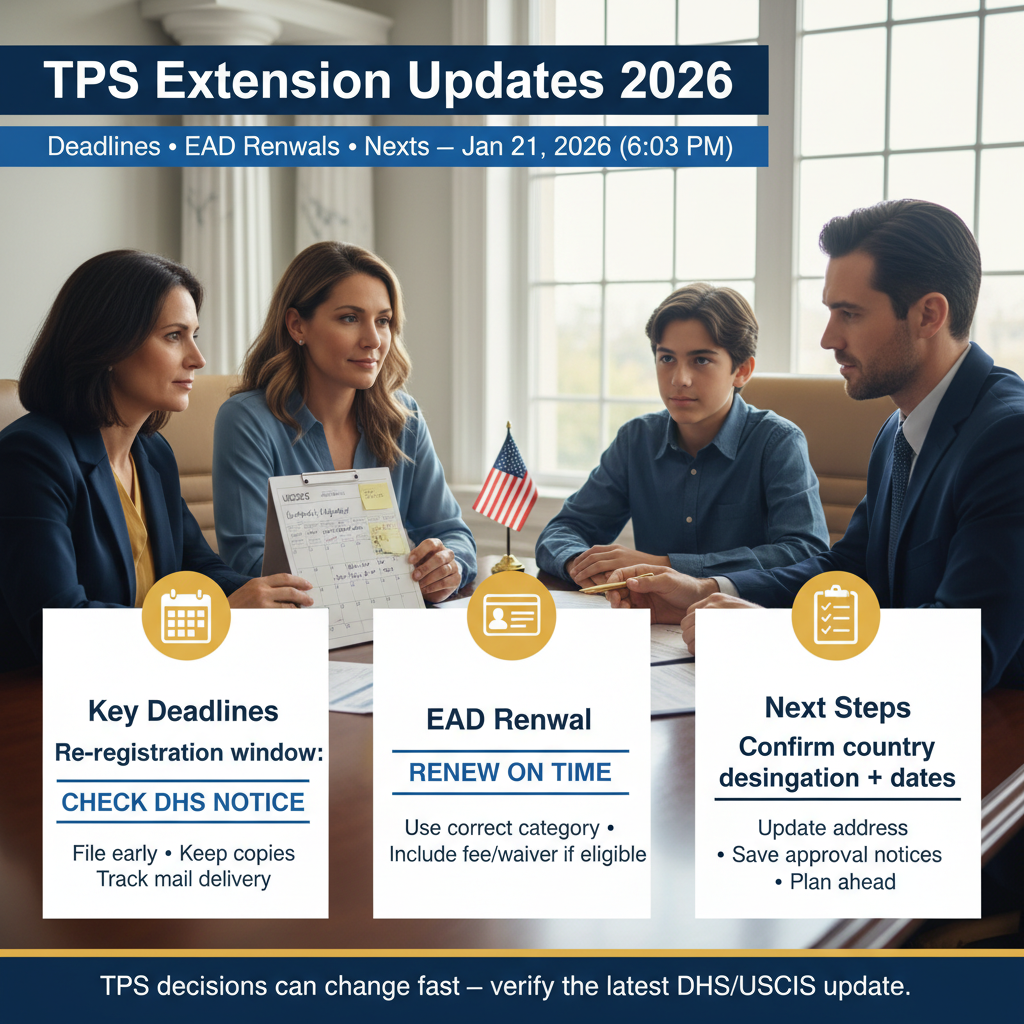
This article is based on trending coverage and ongoing updates in immigration reporting, including:
TPS (Temporary Protected Status) Extension News (Legal News)
Reminder: News headlines move fast. TPS decisions (extensions, redesignations, terminations, and related work permit rules) are made through official DHS/USCIS announcements and Federal Register notices. Always confirm your country’s current TPS designation and dates directly through the USCIS official website.
Need Help? Our Orlando immigration team is ready to assist. Call +1 786-791-3106 for a free consultation, or message us online. Se Habla Español.
What This News Means for Immigrants in Orlando and Across Florida
Why this news is showing up now
TPS is frequently in the news because it is time-limited by design. DHS must periodically decide whether conditions in a country still prevent safe return—such as armed conflict, environmental disaster, or extraordinary temporary conditions. When DHS announces a TPS extension (or a redesignation), it often triggers:
- New registration or re-registration periods (sometimes called a 90-day window in public-facing summaries, though the exact dates vary by country and are published in the Federal Register).
- Automatic extensions of certain Employment Authorization Documents (EADs), depending on the notice.
- Updated filing guidance for Form I-821 (TPS application) and Form I-765 (work permit).
- Questions about travel permission (Advance Parole) and future options like Adjustment of Status.
Important: TPS is country-specific and date-specific. Two people from the same country may have different eligibility depending on when they arrived, whether they continuously resided in the U.S., and whether they meet criminal and other bars.
How it can affect Florida residents
Florida is home to large communities from TPS-designated countries. For Central Florida residents—especially along the I-4 corridor (Orlando, Kissimmee, Sanford, and surrounding areas)—TPS extension news can impact:
- Work authorization: whether you can keep working lawfully and when to renew your EAD.
- Driver’s license and ID: Florida DHSMV often relies on lawful status documents and EAD validity dates.
- Family stability: TPS can reduce the immediate risk of removal and help families plan.
- Immigration court strategy: if you are in removal proceedings, TPS may affect continuances and case posture with the Executive Office for Immigration Review.
If your case is in Orlando, TPS updates may also influence timing and document planning for related filings handled through the Orlando area, including biometrics appointments and downstream applications.
What TPS (Temporary Protected Status) Extension News Is (and Why It Matters)
A plain-English definition
Temporary Protected Status (TPS) is a humanitarian immigration benefit that allows eligible nationals of certain countries (or people who last habitually resided there) to remain in the United States temporarily when returning home would be unsafe due to specific conditions recognized by the U.S. government.
When you hear “TPS extension news,” it usually means DHS has decided to keep TPS in place for a designated country for an additional period (for example, 6, 12, or 18 months). An extension can also come with instructions to re-register so you can keep TPS and maintain work authorization.
Warning: An extension is not automatic for every person. Many extensions require timely re-registration, and missing deadlines can put your TPS at risk.
Key terms you need to know
- Designation: When DHS first adds a country to the TPS list.
- Extension: DHS continues TPS for an already-designated country.
- Redesignation: DHS may reset certain eligibility dates (like continuous residence) so more recent arrivals may qualify. Not every extension includes redesignation.
- Re-registration: A required filing during a specific period so current TPS holders keep TPS.
- Initial registration: The first-time TPS filing for those newly eligible (often tied to redesignation).
- EAD (Employment Authorization Document): Your work permit, typically requested using Form I-765.
- Continuous residence / continuous physical presence: Rules requiring you to have been living in the U.S. since certain dates and not leaving in a way that breaks eligibility.
- Advance Parole: Travel authorization requested through Form I-131. TPS travel rules can be complex and have changed in recent years.
- Priority Date: A key date in many family and employment immigration processes. TPS does not itself create a Priority Date, but TPS holders often pursue family-based options where the Priority Date matters.
- Adjustment of Status: The process of applying for a green card from inside the U.S., often using Form I-485. TPS can intersect with eligibility but does not guarantee it.
Current Immigration Law: The Foundation
TPS is governed primarily by federal statute and regulations, and implemented through DHS/USCIS policy and Federal Register notices for each country.
Federal requirements
TPS is authorized under section 244 of the Immigration and Nationality Act (INA), codified at 8 U.S.C. § 1254a, with implementing regulations at 8 C.F.R. § 244. Key legal requirements typically include:
- You must be a national of a TPS-designated country (or a person without nationality who last habitually resided there).
- You must meet the country-specific dates for:
- Continuous residence in the U.S. since a specified date; and
- Continuous physical presence in the U.S. since a specified date.
- You must timely file during the registration/re-registration period (unless an exception applies).
- You must not be barred due to certain criminal convictions or other inadmissibility/security-related grounds.
Common USCIS forms used in TPS-related filings include:
- Form I-821 (Application for Temporary Protected Status)
- Form I-765 (Application for Employment Authorization)
- Form I-131 (Application for Travel Document)
Always verify filing instructions and current editions at the USCIS Forms page and country-specific TPS page on the USCIS official website.
Reminder: If you are also pursuing family-based immigration, you may see forms like Form I-130 (Petition for Alien Relative) and Form I-485 (Application to Register Permanent Residence or Adjust Status). TPS does not replace these processes, but it can sometimes help you maintain lawful presence while they are pending.
Florida-specific considerations
Immigration law is federal, but Florida residents often face state-level practical issues:
- Driver’s license renewals: EAD expiration dates matter. If USCIS announces an automatic EAD extension for TPS, bring the Federal Register notice and USCIS guidance when renewing.
- Employment verification: Employers must complete Form I-9. Automatic extensions can be used for I-9 purposes if the notice allows it—documentation must match the specific TPS country and category.
- Local processing realities: For Central Florida residents, biometrics and certain appointments may route through USCIS Application Support Centers serving the Orlando area. The Orlando USCIS Field Office may be involved for other benefits (like Adjustment of Status interviews), depending on your case type.
To monitor timing, check USCIS Processing Times—but note that TPS processing can vary by country and workload.
How to Maintain TPS After an Extension: A Complete Step-by-Step Guide
This step-by-step guide focuses on what most TPS holders need to do after extension announcements: confirm eligibility, re-register on time, and keep work authorization valid.
1) Confirm your country’s TPS dates and whether you must re-register
Start by locating the official TPS page for your country on the USCIS official website and reading the most recent Federal Register notice referenced there.
Important: Do not rely on social media summaries. Each country’s notice lists the exact re-registration period, EAD auto-extension rules (if any), and eligibility cut-off dates.
Documents to gather:
- Your current or most recent EAD (front and back)
- Your prior TPS approval notices (I-797)
- Your prior Form I-821 and Form I-765 receipts (if available)
- Any USCIS correspondence requesting evidence (RFEs) from prior filings
- A copy (PDF/print) of the latest country-specific TPS USCIS page and/or Federal Register notice
2) Identify whether you are re-registering or filing an initial TPS application
Many people already have TPS and must re-register. Others may be eligible for the first time if DHS announced a redesignation (which can change required residence dates).
Warning: Filing the wrong type of case—or filing outside the correct window—can cause delays or denial.
Documents to gather (re-registration):
- Prior TPS approval notice(s)
- Evidence you have remained in the U.S. (as needed)
- Certified court dispositions for any arrests/charges (even if dismissed)
Documents to gather (initial registration, if eligible):
- Proof of nationality (passport, birth certificate with photo ID, national ID, etc.)
- Proof of entry and residence in the U.S. (I-94, visa, stamps, travel records)
- Proof of continuous residence and physical presence since the required dates (leases, bills, school/medical records, pay stubs)
- Certified court dispositions for any criminal history
3) Prepare and file Form I-821 (TPS) correctly
Form I-821 is the core TPS filing. Even if you do not need a new EAD, you may still need to re-register with Form I-821 to keep TPS.
Tips: Use the current form edition from USCIS Forms and follow the country-specific filing instructions (addresses and fees can change).
Documents to include:
- Completed and signed Form I-821
- Copy of government-issued photo ID
- Proof of TPS eligibility (initial) or prior TPS approval (re-registration)
- Proof of continuous residence/physical presence if required by your case posture
- Fee waiver request (if applicable) using Form I-912 (with supporting evidence)
- Certified dispositions for arrests/charges (if any)
4) File Form I-765 to renew or obtain your work permit (EAD)
Most TPS holders file Form I-765 to request an EAD. Even when DHS grants an automatic EAD extension, many people still file to obtain a new card with a later expiration date.
Important: Your eligibility category on Form I-765 must match TPS rules for your country (often category (a)(12) or (c)(19), depending on circumstances). Choosing the wrong category is a common delay trigger.
Documents to include:
- Completed and signed Form I-765
- Copy of prior EAD(s) (front and back)
- Two passport-style photos (if required by filing method)
- Copy of TPS receipt/approval (if available)
- Fee waiver request (if eligible) using Form I-912
- Any supporting documents referenced in the country-specific notice
5) Track your receipts, biometrics, and requests for evidence (RFEs)
After filing, USCIS will issue receipt notices and may schedule biometrics. Some TPS re-registrations reuse biometrics, while others require a new appointment.
If your case is in Orlando or you live in Orange County, your biometrics appointment may be scheduled at a nearby Application Support Center. Keep every notice and attend appointments on time.
Documents to keep organized:
- I-797 receipt notices for Form I-821 and Form I-765
- Biometrics appointment notice and photo ID
- Copies of everything filed (full packet)
- Any RFE notice and your response proof (delivery confirmation)
6) Protect your ability to work and travel while TPS is pending
Work: If your EAD is expiring, determine whether your country’s notice provides an automatic extension and for how long. Use that notice for I-9 reverification and, if needed, driver’s license renewal.
Travel: Do not leave the U.S. without proper authorization. Consider Form I-131 (Advance Parole), but travel rules and risk factors vary by immigration history.
Documents to gather for work/travel planning:
- Most recent EAD and category code
- Federal Register notice showing any automatic extension language
- Your passport (validity check)
- Any prior removal order or immigration court documents (if applicable)
- Advance Parole application materials (if filing Form I-131)
7) Evaluate longer-term options beyond TPS (family, employment, humanitarian)
TPS is temporary. Many families use the stability TPS provides to pursue longer-term solutions, where eligible—such as family-based petitions (Form I-130), Adjustment of Status with Form I-485, consular processing through the U.S. Department of State, asylum, or other relief.
Warning: Not every TPS holder can adjust status in the U.S. Eligibility depends on lawful entry, admissibility, prior immigration history, and the category you qualify under. A legal screening is critical.
Documents to gather for a strategy review:
- Passport, birth certificate, marriage certificate (with certified translations if needed)
- All I-94s, visas, entry stamps, and travel history
- Immigration court paperwork (NTA, hearing notices) if any, including EOIR case info
- Family member proof of U.S. citizenship or permanent residence
- Any prior USCIS decisions, denials, or removal orders
Need Help? Our Orlando immigration team is ready to assist. Call +1 786-791-3106 for a free consultation, or message us online. Se Habla Español.
Practical Steps You Can Take Today
TPS extension news is only helpful if you act on it correctly and on time. Here’s a practical checklist you can start today.
Actionable checklist (do these now)
- 1) Confirm your country’s TPS notice on the USCIS official website and write down the re-registration dates and any automatic EAD extension dates.
- 2) Calendar your deadline and set reminders at 30, 14, and 7 days before the end of the re-registration period.
- 3) Order certified court dispositions if you have ever been arrested or cited—do not assume a dismissal means “no record.”
- 4) Make a document timeline showing where you lived and worked since the required continuous residence date.
- 5) Renew your passport through your consulate if it will expire soon (this can also help with EAD/ID renewals).
- 6) Check processing times at USCIS Processing Times and plan for delays.
- 7) If you are in immigration court, coordinate TPS filings with your EOIR schedule and talk to counsel about continuances or administrative closure where appropriate (see EOIR resources).
Document preparation guidance
Build a TPS “master file” (digital + paper). Include:
- All prior TPS receipts/approvals and copies of every TPS packet filed
- All EADs (front/back) and Social Security card copy (if you have one)
- Proof of residence (leases, utility bills) and proof of presence (pay stubs, school records)
- Certified translations for any non-English documents
Reminder: If you moved, update your address with USCIS promptly (typically via AR-11 online). Missed notices can lead to denials.
Timeline expectations
TPS timelines vary by country and workload. In many cases:
- Receipts may arrive within 2–6 weeks after filing (sometimes faster).
- Biometrics may be scheduled within 3–10 weeks, if required.
- EAD approvals can take several months depending on volume; check USCIS Processing Times.
Important: If your EAD is expiring soon, do not wait. Some TPS notices provide automatic extensions, but not all do—and automatic extensions have specific end dates.
How Imigrar Helps Immigrants in Orlando
At Imigrar, our mission is to Keep Families Together. TPS extension periods are high-stakes because a missed re-registration window or a preventable filing error can put your work authorization and protection from removal at risk.
We help TPS clients in Orlando, throughout Orange County, and nationwide with:
- TPS re-registration and initial TPS filings (Form I-821)
- EAD renewals and category review (Form I-765)
- Travel planning and Advance Parole requests (Form I-131)
- Long-term strategies beyond TPS, including family petitions (Form I-130) and Adjustment of Status (Form I-485) where eligible
- Coordination for clients in removal proceedings with EOIR (see Executive Office for Immigration Review)
If your case is in Orlando, we can help you prepare for the practical realities of local processing, including organizing evidence, responding to RFEs, and planning around appointments that may be scheduled in the Central Florida region.
Se Habla Español. We offer a free consultation to help you understand what the TPS extension means for your specific situation and what to do next.
Need Help? Our Orlando immigration team is ready to assist. Call +1 786-791-3106 for a free consultation, or message us online. Se Habla Español.
Frequently Asked Questions
Q: How do I know if my country’s TPS was extended (and for how long)?
A: Confirm on the country-specific TPS page at the USCIS official website. USCIS will reference the Federal Register notice with the exact extension dates, re-registration window, and any automatic EAD extension language. Save a copy for your records and for your employer/DMV if needed.
Q: Am I still eligible if I have an arrest or criminal charge in Florida?
A: Maybe, but you must get a legal screening. TPS has criminal bars, and USCIS will evaluate convictions and sometimes dispositions. Important: Bring certified court dispositions for every arrest/charge (including dismissed cases). For Central Florida residents, this often means requesting certified records from Orange County or the county where the incident occurred.
Q: Does TPS give me lawful status or a path to a green card?
A: TPS is a temporary protection and does not automatically lead to permanent residence. However, many TPS holders may qualify for other immigration benefits (family or employment-based). For example, a U.S. citizen spouse may file Form I-130, and you may be able to file Form I-485 for Adjustment of Status depending on lawful entry and other factors. A strategy consult is essential because eligibility is highly fact-specific.
Q: How long does it take to renew my TPS work permit?
A: Timelines vary widely. Check USCIS Processing Times for the most current estimates. Some TPS extension notices provide automatic EAD extensions for a limited period, which can protect your ability to work while a renewal is pending. Reminder: Automatic extensions only apply if the notice says they do and if your EAD category/country match.
Q: What documents do I need for TPS re-registration?
A: Typically: (1) prior TPS approval/receipt notices, (2) your current EAD (front/back), (3) identity documents, and (4) certified court dispositions if you have any criminal history. USCIS may not require extensive residence evidence for every re-registration, but you should keep proof of continuous residence/physical presence in case USCIS requests it.
Q: How much does it cost to file TPS and renew my EAD?
A: Costs depend on whether you are filing Form I-821, Form I-765, whether biometrics fees apply, and your age and case type. USCIS fees change periodically, so verify current fees on the USCIS Forms pages for each form. If you cannot afford the fees, you may be able to request a fee waiver with Form I-912 if eligible.
Q: What happens if my TPS re-registration is denied?
A: A denial can put you at risk of losing work authorization and protection from removal. Next steps depend on the reason for denial (late filing, missing evidence, criminal bar, or ineligibility). In some cases, you may file a motion to reopen/reconsider or refile if allowed. If you are in removal proceedings, the denial may also affect your posture in immigration court. Review the denial notice carefully and consult counsel immediately—especially if you have an upcoming EOIR hearing (see EOIR).
Q: Can I travel outside the U.S. with TPS after an extension?
A: Do not travel without permission. Many TPS holders need Advance Parole via Form I-131 before departing. Travel can carry serious risks if you have prior unlawful presence, removal orders, or pending applications. Speak with an attorney before booking any travel.
Common Mistakes (and How to Avoid Them)
Mistake #1: Missing the re-registration deadline
TPS often requires re-registration during a specific period. Missing it can lead to denial and loss of benefits. How to avoid it: calendar the deadline immediately and aim to file early in the re-registration window, not at the end. Keep proof of delivery.
Mistake #2: Filing the wrong form edition, fee, or I-765 category
USCIS rejects or delays cases for incorrect editions, missing signatures, wrong fees, or incorrect eligibility categories. How to avoid it: download current forms from USCIS Forms, double-check signatures, and confirm the correct Form I-765 category for TPS per your country’s instructions.
Mistake #3: Traveling without Advance Parole (or without a legal risk review)
Leaving the U.S. without proper authorization can jeopardize TPS and other pending immigration options. How to avoid it: consult counsel, consider Form I-131, and review your full immigration history before travel.
TPS Extensions and Long-Term Planning for Florida Families
TPS extension news is a relief for many families—but it is also a planning moment. TPS can be renewed, but it can also be terminated or changed by future government action. If you live in Central Florida, especially in Orange County and along the I-4 corridor, consider using the stability of TPS to build a longer-term immigration plan.
That plan may include:
- Family-based immigration through a U.S. citizen or permanent resident relative (Form I-130)
- Exploring whether you qualify for Adjustment of Status with Form I-485 (eligibility varies and can be complex)
- Consular processing steps and document readiness through the U.S. Department of State
- Understanding court posture if you have an EOIR case (see Executive Office for Immigration Review)
Important: Even if you are not ready to file for a green card today, you can prepare: collect civil documents, fix name/date inconsistencies, address old warrants or unresolved cases, and keep a clean record.
If your case is in Orlando, the Orlando USCIS Field Office may handle certain interview-based filings (like marriage-based Adjustment of Status). A well-organized file and consistent documentation can reduce delays and stress.
Need Help? Our Orlando immigration team is ready to assist. Call +1 786-791-3106 for a free consultation, or message us online. Se Habla Español.

Closing: Get Help With Your TPS Extension, EAD, and Next Steps
TPS extension updates can protect your family, your job, and your future—but only if you follow the official rules, file on time, and avoid common mistakes. If you’re unsure whether you must re-register, whether your EAD is automatically extended, or whether you have a pathway beyond TPS, we can help you build a clear plan.
Need legal guidance now? Call Imigrar at +1 786-791-3106 for a free consultation or message us online at https://www.imigrar.com/contact. Se Habla Español. We’re based in Orlando and serve clients nationwide—because we believe in one mission: Keep Families Together.


