


The reporting that sparked this guide
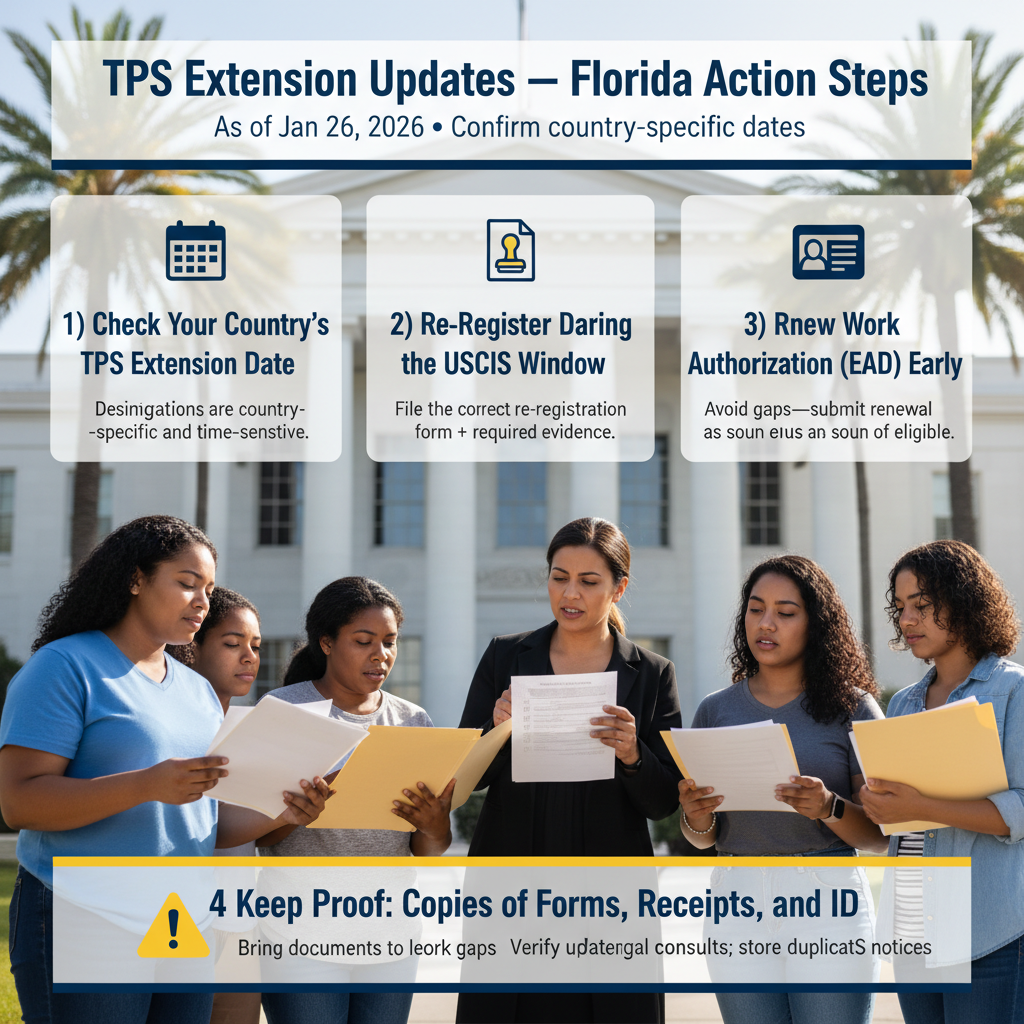
This article is informed by trending TPS headlines and updates tracked in legal news coverage, including: TPS (Temporary Protected Status) Extension News (Legal News).
Important: TPS announcements are country-specific and time-sensitive. Always confirm the latest designation, extension dates, and re-registration window directly through the USCIS official website.
Need Help? Our Orlando immigration team is ready to assist. Call +1 786-791-3106 for a free consultation, or message us online. Se Habla Español.
What This News Means for Immigrants in Orlando and Across Florida
Why this news is showing up now
TPS is one of the most “headline-driven” immigration benefits because it depends on current conditions in a country—such as armed conflict, natural disasters, epidemics, or other extraordinary and temporary conditions. When the U.S. government decides to extend TPS for a designated country (or redesignate it), the decision triggers urgent, practical steps for people already in the U.S., including:
- Re-registration deadlines (often a limited 90-day window or similar USCIS-announced period)
- Work permit (EAD) renewal planning under Form I-765
- Potential automatic EAD extensions published in the Federal Register (which employers must understand)
- Travel planning and risks (including whether to request advance permission to travel)
- Screening for longer-term options like Adjustment of Status, family petitions, or asylum
Reminder: TPS is not permanent residence and does not automatically lead to a green card. However, it can be a critical bridge to stability—especially for families trying to “buy time” to pursue a more permanent pathway.
How it can affect Florida residents
Florida has large TPS-eligible communities, including families and workers throughout Orlando, Orange County, and the I-4 corridor (Kissimmee, Davenport, Lakeland, Tampa). TPS extension news matters here because it often impacts:
- Employment continuity (keeping your job legally with a valid EAD)
- Driver’s license and ID renewals (often tied to immigration documentation validity)
- Housing stability (leases and income verification)
- Family planning (marriage-based cases, Form I-130 filings, and timing)
- Removal defense strategy if you are in immigration court under EOIR
If your case is in Orlando, you may also need to coordinate between USCIS filings and any pending proceedings before the immigration court system (EOIR). For court-related context, see the Executive Office for Immigration Review.
Need Help? Our Orlando immigration team is ready to assist. Call +1 786-791-3106 for a free consultation, or message us online. Se Habla Español.
What TPS Extension News Is (and Why It Matters)
A plain-English definition
Temporary Protected Status (TPS) is a humanitarian immigration status the U.S. government can grant to eligible nationals of certain designated countries (and sometimes people without nationality who last habitually lived in that country) who are already in the United States. When TPS is granted, it generally provides:
- Protection from removal (deportation) during the TPS period
- Eligibility to apply for work authorization (an EAD) using Form I-765
- Potential permission to travel if you request and obtain advance authorization (rules vary and are risk-sensitive)
A “TPS extension” means the government has decided that conditions in the designated country still meet the legal standard for TPS, so the TPS period is continued for a new length of time (often 6, 12, or 18 months). Extensions typically come with a USCIS re-registration requirement for people who already have TPS.
Key terms you need to know
- Designation: The initial decision to grant TPS to nationals of a specific country.
- Extension: Continuation of TPS for an already designated country.
- Redesignation: A new designation date that can allow additional people (who arrived later) to apply—depending on the announcement.
- Re-registration: The process for current TPS holders to keep TPS during an extension (usually via Form I-821).
- EAD: Employment Authorization Document, typically requested via Form I-765.
- Continuous residence / continuous physical presence: Requirements that you have been living in and/or present in the U.S. since specific dates listed in the TPS notice.
- Automatic EAD extension: Sometimes USCIS extends certain EADs automatically for a set period. Employers must follow I-9 rules carefully.
- Removal proceedings: Immigration court cases handled under EOIR (not USCIS).
Warning: TPS does not erase prior immigration violations, does not automatically cure unlawful entry, and does not automatically create eligibility for a green card. But TPS can be a powerful protective status while you explore longer-term options like family-based petitions (Form I-130) and, if eligible, Adjustment of Status via Form I-485.
Current Immigration Law: The Foundation
TPS is governed by federal statute and implemented through regulations and country-specific notices. While news coverage may summarize changes, your legal obligations come from the official government publications and instructions.
Federal requirements
The legal authority for TPS is primarily found in the Immigration and Nationality Act (INA) at INA § 244 (codified at 8 U.S.C. § 1254a). TPS-related regulations and procedures are implemented through federal rules and USCIS guidance.
In practice, TPS compliance usually involves these USCIS filings and concepts:
- Form I-821 (Application for Temporary Protected Status) for initial registration and re-registration when required
- Form I-765 (Application for Employment Authorization) to request or renew your EAD
- Form I-131 (Application for Travel Document) if you are seeking advance authorization to travel (highly case-specific)
- Form AR-11 (Change of Address) if you move—missing USCIS mail can be devastating
You can verify forms and filing instructions through the USCIS Forms page and the USCIS official website.
Important: TPS extensions are typically announced through a Federal Register notice and mirrored on USCIS’s TPS country pages. Those notices specify:
- The extension dates
- The re-registration period (often a limited 90-day window)
- Whether certain EAD categories are automatically extended and for how long
- Eligibility dates for continuous residence/physical presence
For planning purposes, also monitor USCIS Processing Times (note that TPS and EAD processing can vary widely by workload).
Florida-specific considerations
TPS is federal immigration law, so eligibility rules are the same in Florida as in any other state. However, Florida residents often face state-level practical issues tied to TPS documentation:
- Driver’s license/ID timing: Florida DHSMV typically requires proof of lawful status and valid dates. If your EAD is expiring but covered by an automatic extension, you may need to bring the Federal Register notice and USCIS guidance.
- Employment verification (Form I-9): Florida employers may be unfamiliar with automatic EAD extensions. You may need to provide the notice and ensure the employer uses correct I-9 rules.
- Orlando logistics: The Orlando USCIS Field Office may be relevant for certain in-person appointments, while many TPS filings are mailed to USCIS lockboxes and processed at service centers. Your receipt notice will control where the case is handled.
For Central Florida residents, planning ahead is key—especially if you need your renewed EAD for work, a professional license, or a pending job offer along the I-4 corridor.
Need Help? Our Orlando immigration team is ready to assist. Call +1 786-791-3106 for a free consultation, or message us online. Se Habla Español.
How to Maintain TPS After an Extension: A Complete Step-by-Step Guide
Below is a practical roadmap for people who already have TPS and are responding to extension news. Exact dates, categories, and instructions depend on your country’s TPS notice—so always cross-check your country’s page on the USCIS official website.
1) Confirm your country’s TPS extension and your re-registration window
Start by locating the official TPS extension announcement for your designated country. Look for:
- The new TPS validity period (start and end dates)
- The re-registration dates (often a limited 90-day window)
- EAD category codes and whether an automatic extension applies
- Any special instructions (fees, biometrics, mailing addresses)
Documents to gather for this step:
- Your prior TPS approval notice(s) (I-797)
- Your current/most recent EAD (front and back)
- A copy (PDF/print) of the USCIS TPS country page or Federal Register summary for your file
Reminder: Do not rely only on social media posts. TPS rules change country-by-country and sometimes include narrow filing windows.
2) Check eligibility for re-registration and screen for red flags
Most current TPS holders can re-register, but certain issues can create risk. Before you file, screen for:
- Criminal arrests/charges/convictions (even old cases)
- Prior immigration fraud findings or misrepresentation concerns
- Missed prior re-registration deadlines
- Travel outside the U.S. that may affect continuous physical presence
Warning: A criminal case that seems “minor” under state law can still have serious immigration consequences. If you have any record at all, it’s wise to consult an immigration attorney before filing.
Documents to gather for this step:
- Certified court dispositions for any criminal case (all counts)
- Arrest reports (if available) and final outcomes
- All prior USCIS notices (RFEs, NOIDs, approvals, denials)
- Travel history and entry documents (passport stamps, I-94 if any)
3) Prepare and file Form I-821 (TPS re-registration)
Re-registration generally requires filing Form I-821 during the required window. Even if USCIS announces fee changes or fee waivers for certain filings, follow the exact instructions for your country’s extension notice.
Documents to gather for this step:
- Completed and signed Form I-821
- Copy of a government-issued photo ID (passport, national ID, or current EAD)
- Evidence of your nationality (passport, birth certificate with photo ID, consular ID—varies)
- Copies of your prior TPS approval notices
- Two passport-style photos (if required by the filing method/instructions)
Important: Keep proof of timely filing—USCIS receipt notices are critical if you need to show ongoing eligibility to an employer, a state agency, or in immigration court.
4) File Form I-765 to renew your work permit (EAD)
TPS itself can protect you from removal, but your ability to work legally depends on having a valid EAD (or being covered by an automatic extension, if applicable). Many TPS holders file Form I-765 at the same time as Form I-821.
If the extension notice includes an automatic EAD extension, you may still choose to file for a new card because automatic extensions end, and some employers or agencies require the updated card.
Documents to gather for this step:
- Completed and signed Form I-765
- Copy of your current/expired EAD (front and back)
- Copy of your passport biographic page (if available)
- Two passport-style photos (if required)
- Filing fee or fee waiver request (if eligible and permitted)
Timeline note: EAD processing can be unpredictable. Check USCIS Processing Times and plan well before your card expires.
5) Attend biometrics (if scheduled) and respond to any USCIS notices
USCIS may schedule a biometrics appointment at an Application Support Center (ASC). Missing biometrics can cause delays or denial. USCIS may also issue:
- Requests for Evidence (RFE)
- Notices of Intent to Deny (NOID)
- Interview notices (rare for TPS, but possible in certain contexts)
Documents to gather for this step:
- Biometrics appointment notice (I-797C)
- Photo ID (passport, EAD, state ID)
- Any documents requested in an RFE/NOID (submit exactly what USCIS asks for)
Reminder: If you move, file a change of address immediately (typically Form AR-11) and update each pending case to avoid missing time-sensitive letters.
6) Consider travel carefully: Form I-131 and risk review
TPS holders sometimes ask whether they can travel internationally. Travel rules are sensitive and fact-specific. You generally should not depart the U.S. without proper advance authorization, and even with authorization, travel can create risks depending on your history.
Documents to gather for this step:
- Completed Form I-131 (if pursuing advance travel authorization)
- Explanation of the reason for travel (humanitarian, family emergency, etc.)
- Evidence supporting the reason (medical letters, death certificates, affidavits)
- Copies of TPS approval and EAD
For general travel document context, see the U.S. Department of State (and always follow USCIS-specific instructions for TPS travel authorization).
7) Use the extension period to explore long-term options (family, employment, asylum)
TPS is temporary by design. A TPS extension is a chance to stabilize your life and pursue a permanent solution if you qualify. Common pathways include:
- Family-based petition through a U.S. citizen or permanent resident using Form I-130
- Employment-based options (varies widely by category and history)
- Asylum or related relief (must be carefully evaluated; deadlines and exceptions apply)
- Defense strategies if you are in removal proceedings before EOIR
Important: If you are eligible for Adjustment of Status, you may file Form I-485 when a visa is available and you meet all requirements. Family-based cases also involve timing concepts like a Priority Date (especially for preference categories).
Documents to gather for this step:
- Marriage certificate, divorce decrees, birth certificates (for family cases)
- Proof of bona fide relationship (photos, leases, joint accounts)
- Immigration history documents (I-94, prior approvals/denials, court notices)
- Proof of continuous presence and residence in the U.S.
Practical Steps You Can Take Today
TPS extension news can feel overwhelming, but most successful TPS renewals come down to organization, timing, and careful documentation.
- 1) Print and save your country’s TPS notice: Keep a “TPS folder” (digital and paper) with the extension dates, your re-registration window, and any automatic EAD extension language.
- 2) Calendar your deadlines immediately: Mark the re-registration window and aim to file early. Don’t wait until the last week of the 90-day window.
- 3) Verify your mailing address with USCIS: If you moved in Orange County or anywhere along the I-4 corridor, update your address. Missing a biometrics notice can derail your case.
- 4) Order certified court records if you have any history: This can take time. Start now—even if the case was “dismissed.”
- 5) Prepare employment continuity: If your EAD is expiring, talk to HR early. If an automatic extension applies, provide the notice and keep copies for your I-9 records.
- 6) Track processing times and plan for delays: Use USCIS Processing Times as a baseline, but assume delays are possible.
- 7) Use TPS time strategically: If you may qualify for a family petition (Form I-130) or Adjustment of Status (Form I-485), don’t postpone planning.
Timeline expectations: Many TPS-related filings are processed over months, not weeks. EAD renewals can vary significantly. Filing early and responding quickly to USCIS notices is the best way to avoid gaps.
Reminder: Some people may be eligible for an automatic EAD extension, but that does not mean every agency or employer will understand it. Documentation and clarity matter.
Need Help? Our Orlando immigration team is ready to assist. Call +1 786-791-3106 for a free consultation, or message us online. Se Habla Español.
How Imigrar Helps Immigrants in Orlando
At Imigrar, we help clients in Orlando, Central Florida, and nationwide navigate TPS updates with a clear plan—so you can protect your work authorization, remain compliant, and pursue longer-term options to keep your family together. Our tagline is “Keep Families Together”, and we bring that focus to every TPS case we handle.
- TPS re-registration strategy and filing support (Form I-821)
- EAD renewal planning and filing (Form I-765)
- RFE/NOID responses and case troubleshooting
- Travel risk review and travel document strategy (Form I-131)
- Screening for family-based options (Form I-130) and, when eligible, Adjustment of Status via Form I-485
- Coordination if you are in removal proceedings (EOIR) and need a unified plan
If your case is in Orlando, we can help you prepare a clean, well-documented filing package and a timeline strategy that accounts for real-world issues like work authorization gaps, state ID renewals, and USCIS scheduling.
Se Habla Español. We offer a free consultation to help you understand your next steps.
Frequently Asked Questions
Q: Am I automatically covered when TPS is extended, or do I have to file something?
A: Many TPS extensions require re-registration using Form I-821 during the USCIS-announced filing period (often a 90-day window). Even if USCIS announces an automatic EAD extension for certain card categories, you may still need to re-register to maintain TPS. Always confirm your country’s specific instructions on the USCIS official website.
Q: What if I live in Florida—does that change TPS eligibility?
A: No. TPS eligibility is federal and does not change based on living in Orlando, Orange County, or elsewhere in Florida. What does change are practical issues like employer I-9 practices and Florida driver’s license renewals tied to document validity. For Central Florida residents, it’s smart to keep printed copies of the extension notice and your USCIS receipts in case an employer or agency needs proof.
Q: Does TPS affect my ability to get a green card through my U.S. citizen spouse?
A: TPS can be helpful as a “stability bridge,” but it does not automatically grant permanent residence. Many people pursue a family case through Form I-130 and, if eligible, Adjustment of Status using Form I-485. Whether you can adjust depends on several factors (including how you entered the U.S., any prior immigration violations, and admissibility). A consultation is recommended to map the safest path and timeline.
Q: How long does it take to get my TPS work permit renewed?
A: Processing times vary. Some applicants receive EADs in a few months; others wait longer depending on USCIS workload. Check the baseline estimates on USCIS Processing Times. If your EAD is expiring soon, file as early as permitted, and keep proof of filing. If an automatic extension applies, use the notice plus your expiring EAD for I-9 purposes.
Q: What documents do I need for TPS re-registration and EAD renewal?
A: Typical filings include Form I-821 (re-registration) and Form I-765 (EAD). Common supporting documents include your prior TPS approval notices (I-797), your current EAD (front/back), proof of identity and nationality, and any documents requested by the country-specific notice. If you have any criminal history, obtain certified dispositions before filing.
Q: How much does it cost to renew TPS and the work permit?
A: Costs depend on which forms you file, your age, biometrics requirements, and the current USCIS fee schedule. Some applicants may qualify for a fee waiver in certain circumstances, depending on USCIS rules. Always confirm current fees and instructions on the USCIS Forms page before filing, because fees and policies can change.
Q: What happens if my TPS re-registration is denied?
A: A denial can put you at risk of losing protection from removal and losing work authorization. Next steps depend on why USCIS denied the case (missing deadline, insufficient evidence, criminal inadmissibility issues, or other factors). In some situations you may be able to file a motion or a new application, but timing is critical. If you are in removal proceedings, coordinate immediately with your court strategy via EOIR resources at Executive Office for Immigration Review and consult counsel right away.
Q: Can I travel internationally during a TPS extension?
A: Travel is risky and should be reviewed case-by-case. You generally should not depart without advance authorization (often requested via Form I-131). Even with authorization, prior removal orders, unlawful presence, or other issues can create re-entry risks. If you must travel, consult an attorney before booking. For general travel information, see U.S. Department of State.
Common Mistakes (and How to Avoid Them)
Mistake #1: Waiting until the last minute to re-register
TPS re-registration windows can be strict. Filing late can lead to denial or requests for evidence. Avoid this by filing early in the re-registration period and keeping proof of delivery and your receipt notice.
Mistake #2: Assuming an automatic EAD extension means you do not need to file
Automatic EAD extensions (when they apply) typically help with short-term work authorization continuity, but they do not always replace the requirement to re-register TPS. Avoid this by reading the country-specific notice carefully and filing Form I-821 and Form I-765 as instructed.
Mistake #3: Not disclosing or documenting criminal history
USCIS will review background checks. If you omit arrests or fail to provide certified dispositions when requested, you can trigger delays or denial. Avoid this by collecting certified court records early and getting legal guidance if anything appears on your record.
Important: Another common issue is missing USCIS mail after moving. If you relocate within Orlando, Orange County, or elsewhere in Florida, update your address promptly and keep screenshots/confirmations.
Putting TPS Extension News Into a Clear Orlando Action Plan
TPS extension announcements can bring relief—but relief only lasts if you take the required steps on time. For many families in Central Florida, the immediate priorities are:
- Confirm your country’s extension dates and re-registration rules
- File Form I-821 during the required window
- Renew your EAD with Form I-765 and plan for processing delays
- Prepare for biometrics and respond quickly to any USCIS notices
- Use the TPS period to pursue permanent solutions like Form I-130 and, if eligible, Adjustment of Status with Form I-485
If your case is in Orlando, we can also discuss how the Orlando USCIS Field Office may fit into your broader immigration strategy (even though many TPS filings are handled through service centers).
Need Help? Our Orlando immigration team is ready to assist. Call +1 786-791-3106 for a free consultation, or message us online. Se Habla Español.
Official Resources to Bookmark (TPS, Work Permits, and Court Cases)
- USCIS official website
- USCIS Forms (for Form I-821, Form I-765, Form I-131, Form I-130, Form I-485)
- USCIS Processing Times
- U.S. Department of State (travel and passport guidance)
- Executive Office for Immigration Review (immigration court information)
Reminder: TPS details are country-specific. Always confirm your country’s current TPS page and the Federal Register notice referenced there.
Closing: Protect Your TPS, Your Job, and Your Family
TPS extension news is an opportunity—an opportunity to keep working legally, remain protected from removal, and plan for a more permanent future. But it only helps if you act within the deadlines and file correctly.
Contact Imigrar in Orlando for a free consultation. We serve clients across Florida and nationwide, and we focus on practical, family-centered solutions.
Need help now? Call +1 786-791-3106 or message us online. Se Habla Español.


