


The reporting that sparked this guide
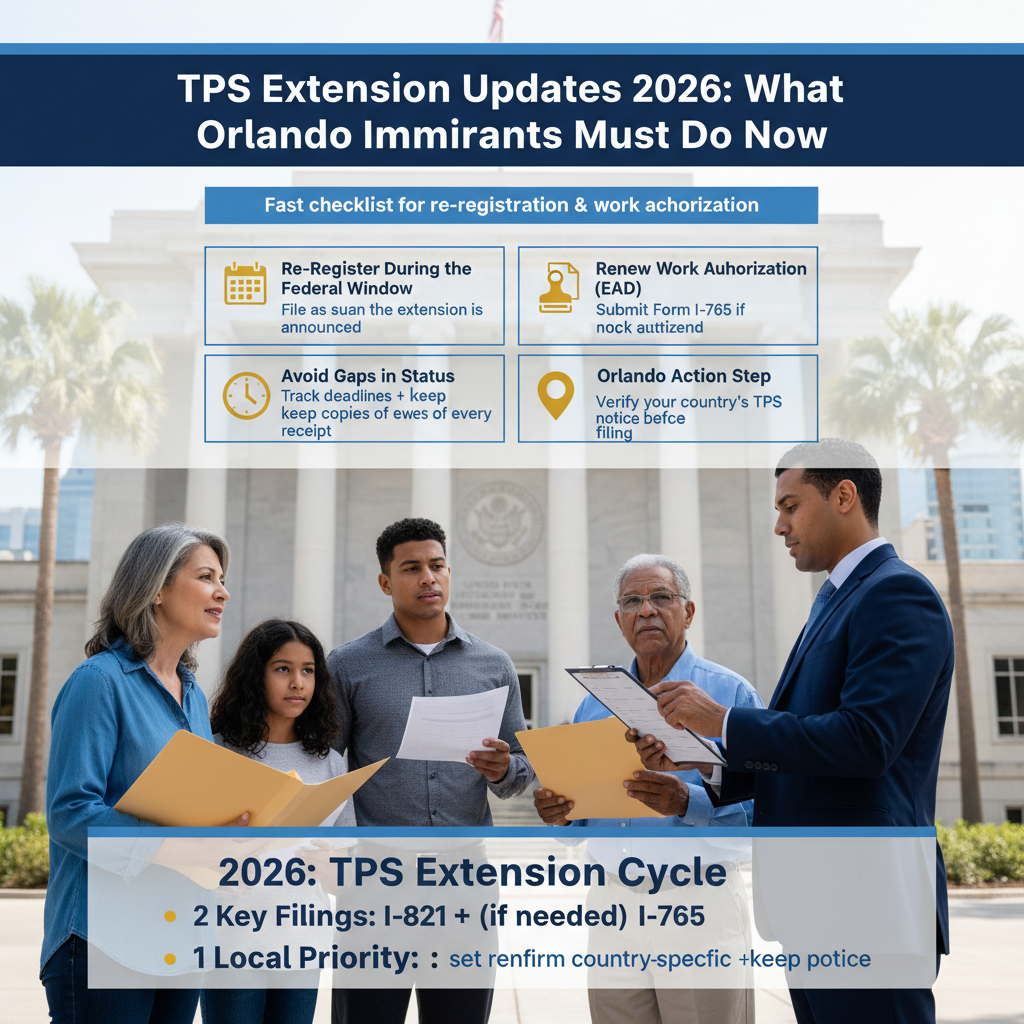
This article is based on trending coverage and ongoing updates about TPS redesignations, extensions, and related work authorization announcements.
TPS (Temporary Protected Status) Extension News (Legal News)
Reminder: TPS announcements can change quickly. Always verify the latest country-specific dates and instructions on the USCIS official website.
Need Help? Our Orlando immigration team is ready to assist. Call +1 786-791-3106 for a free consultation, or message us online. Se Habla Español.
What This News Means for Immigrants in Orlando and Across Florida
Why this news is showing up now
TPS is a humanitarian immigration program that the U.S. government can extend, redesignate, or terminate for specific countries when conditions make it unsafe for nationals to return—such as armed conflict, environmental disaster, or other extraordinary and temporary conditions. TPS “extension news” tends to trend because:
- USCIS publishes Federal Register notices that set new validity dates and deadlines (including re-registration periods and work permit rules).
- Employment Authorization Documents (EADs) may be automatically extended for certain TPS categories, which affects employers, I-9 compliance, and your ability to keep working.
- Travel rules can change depending on whether you have (or need) advance permission to travel and return.
- Litigation and policy shifts can create uncertainty for families and employers—especially when a termination is challenged or paused.
Important: TPS is country-specific and date-specific. Two people from the same country can have different outcomes depending on when they arrived, whether they filed on time, and whether they are eligible under the latest rules.
How it can affect Florida residents
Florida is home to large communities from TPS-designated countries. For Central Florida residents—especially along the I-4 corridor (Orlando, Kissimmee, Sanford, and surrounding areas)—TPS extension updates can directly affect:
- Work authorization (keeping your job, renewing your EAD, or relying on an automatic extension).
- Driver’s license renewal and other ID issues that often depend on lawful presence and document validity.
- Family planning and long-term options like Adjustment of Status through a qualifying family petition (when available).
- Removal (deportation) risk if TPS expires or if you miss a re-registration deadline.
- Immigration court strategy if you are in proceedings with the Executive Office for Immigration Review (EOIR).
If your case is in Orlando, it’s especially important to track deadlines because missed TPS filings can create a chain reaction: EAD expiration, job loss, license problems, and increased vulnerability in any pending immigration matter.
What TPS (Temporary Protected Status) Extension News Is (and Why It Matters)
A plain-English definition
TPS is a temporary immigration status that allows eligible nationals of certain designated countries (and people who last habitually resided there) to:
- Remain in the United States for a limited period, and
- Apply for a work permit (EAD), and
- Request permission to travel outside the U.S. and return (with proper authorization).
“TPS extension news” usually means the U.S. government has decided to keep TPS in place longer for a country already designated, often adding a new re-registration window and updated EAD guidance.
Warning: TPS is not the same as a green card. It is temporary and does not automatically lead to permanent residence or citizenship.
Key terms you need to know
- Designation / Redesignation: The government identifies a country for TPS and sets eligibility rules, including key dates (like continuous residence and physical presence requirements).
- Extension: TPS continues for an already-designated country for a new period.
- Re-registration: Current TPS holders must usually re-register during a specific period to keep TPS (even if they do not need a new EAD).
- EAD (work permit): The card showing you are authorized to work. You typically request it through Form I-765.
- Automatic EAD extension: In some TPS extensions, USCIS automatically extends certain EAD categories for a period, allowing continued work while a renewal is pending.
- Late initial filing: Some people can file for TPS after the initial registration period if they meet strict requirements.
- Advance permission to travel: TPS travel authorization is requested through Form I-131. Traveling without authorization can have serious consequences.
- Inadmissibility / Bars: Criminal history, certain immigration violations, or other grounds may make someone ineligible.
- Removal proceedings: If you are in immigration court, TPS may still be possible, but timing and strategy matter.
Reminder: TPS rules are published by country in official notices and USCIS webpages. Always confirm your country’s dates and instructions directly with USCIS.
Need Help? Our Orlando immigration team is ready to assist. Call +1 786-791-3106 for a free consultation, or message us online. Se Habla Español.
Current Immigration Law: The Foundation
TPS is authorized by federal law and implemented through federal regulations and agency guidance. While this article is designed to be practical, it’s grounded in the legal framework that governs TPS and related benefits.
Federal requirements
TPS is created under INA § 244 (8 U.S.C. § 1254a). The rules are further implemented through regulations in 8 C.F.R. § 244. In general, TPS requires:
- Nationality (or last habitual residence) in a TPS-designated country;
- Meeting country-specific continuous residence and continuous physical presence dates;
- Timely registration or qualifying for late initial registration;
- Passing background checks and not being barred due to certain crimes or other disqualifying factors.
Common USCIS forms used in TPS-related filings include:
- Form I-821 (Application for Temporary Protected Status)
- Form I-765 (Application for Employment Authorization)
- Form I-131 (Application for Travel Document)
You can confirm instructions, filing addresses, and updates on the USCIS official website and find official PDFs at USCIS Forms.
Important: Many TPS holders also have (or may qualify for) other immigration options through family or employment. For example, a U.S. citizen spouse may file Form I-130, and the immigrant may file Form I-485 for Adjustment of Status if eligible. These are separate from TPS and require careful analysis (including entry history and any bars).
Florida-specific considerations
Immigration is federal, but Florida residents often face state-level practical issues tied to TPS validity:
- Driver’s license/ID: Florida’s DMV (DHSMV) typically requires proof of lawful status and unexpired immigration documents. TPS extensions and EAD automatic extensions can affect what you can present.
- Employment verification: Employers across Orange County and the I-4 corridor may request updated documents for I-9 compliance when EADs expire or are automatically extended.
- Local enforcement realities: If you have any contact with law enforcement, even minor charges can trigger immigration consequences. TPS has criminal bars; get legal advice before pleading to anything.
If your case is in Orlando, the Orlando-area USCIS facilities and the Orlando USCIS Field Office (for certain in-person services and interviews) may be part of your broader immigration journey—especially if you pursue a green card path alongside TPS.
Reminder: Processing times vary. Check USCIS Processing Times for related forms, but note that TPS timelines can also be affected by country-specific volume and policy changes.
How to Maintain TPS After an Extension: A Complete Step-by-Step Guide
This step-by-step guide focuses on what most TPS holders must do after an extension announcement: re-register, renew the EAD if needed, and protect their ability to work and remain in the U.S. Country-specific rules vary, so treat this as a framework and confirm details for your nationality on USCIS.
1) Confirm your country’s TPS extension dates and deadlines
Your first job is to identify the exact TPS extension period, the re-registration window, and any automatic EAD extension rules that apply to your country and EAD category.
- Go to the USCIS official website and search your country’s TPS page.
- Review the Federal Register notice linked on that page (USCIS typically summarizes it).
- Identify the 90-day window (or other stated period) for re-registration if one is published for your country.
Documents to gather for this step:
- Your current (or most recent) TPS approval notice(s)
- Front/back of your current EAD (if you have one)
- Any USCIS receipt notices for pending TPS/EAD filings
- Your passport and any U.S. entry documents you have
Warning: Do not assume your friend’s deadline is your deadline—TPS is country-specific and sometimes category-specific.
2) Decide whether you need to re-register, renew your EAD, or both
Many people must re-register to keep TPS, and separately decide whether to file for a new EAD. Some people re-register without requesting an EAD; others do both.
In general:
- Re-registration is done through Form I-821 (TPS application), following USCIS instructions for re-registration.
- EAD renewal is typically done through Form I-765.
- Some extensions provide an automatic EAD extension for a limited time—useful if you file your renewal but the new card hasn’t arrived.
Documents to gather for this step:
- Copy of your prior Form I-821 approval (if available)
- Copy of your prior Form I-765 approval/EAD
- Two passport-style photos (if required by current instructions)
- Any name change documents (marriage certificate, court order), if applicable
3) Prepare your filing packet carefully (Forms, fees, and fee waivers)
TPS filings can be rejected for avoidable reasons: wrong edition date, missing signature, incorrect fee, or missing evidence. Review the official instructions on USCIS Forms.
Key preparation points:
- Use the correct and current edition of Form I-821 and Form I-765.
- Sign in black ink (or follow online filing signature rules if eligible).
- Include correct fees or a proper fee waiver request if eligible (USCIS has specific standards).
- Include supporting evidence and copies (keep originals unless instructed otherwise).
Documents to gather for this step:
- Completed Form I-821 (re-registration)
- Completed Form I-765 (if requesting/renewing EAD)
- Completed Form I-912 (Request for Fee Waiver), if applicable
- Copy of government-issued photo ID
- Proof of TPS (prior approval/receipt notices)
- Payment (check/money order) if filing by mail, or payment method if filing online (where permitted)
Important: Filing fees and eligibility for fee waivers can change. Confirm current amounts and rules on USCIS before you mail anything.
4) File on time and track delivery/receipts
Once your packet is ready, file it using the correct USCIS address or online method (if available for your form and situation). Then track your case.
- Mail using a trackable service (USPS Priority/Certified, FedEx, UPS) and keep proof of delivery.
- After USCIS accepts the filing, you should receive receipt notice(s) with case numbers.
- Create or log into your USCIS online account to track updates.
Documents to gather for this step:
- Copy of the full packet you mailed (every page)
- Shipping label and delivery confirmation
- USCIS receipt notices once received
Reminder: If you move, file a change of address promptly to avoid missing biometrics or RFE notices.
5) Complete biometrics and respond to any USCIS requests (RFEs)
USCIS may require biometrics (fingerprints/photo) and may issue a Request for Evidence (RFE) if something is missing or unclear.
- Attend your biometrics appointment on the scheduled date (or reschedule properly if you must).
- Respond to RFEs by the deadline with organized, complete evidence.
- If you have arrests or charges, get certified dispositions and consult an attorney before filing—TPS has criminal-related bars.
Documents to gather for this step:
- Biometrics appointment notice
- Passport or government ID to enter the biometrics facility
- Any RFE notice and your response packet (copies)
- Certified court dispositions for any criminal matters (if applicable)
Warning: Missing biometrics or ignoring an RFE can lead to denial—sometimes without a second chance.
6) Protect your work authorization and I-9 compliance while your case is pending
TPS holders often face the most stress around employment. If your EAD is expiring, you may need to rely on:
- An EAD renewal filing (receipt notice), and/or
- An automatic extension announced in the Federal Register for your country and EAD category.
Employers may ask for updated documents. Provide only what’s required for Form I-9 and avoid over-documenting.
Documents to gather for this step:
- Your expiring EAD (front/back copy)
- USCIS receipt notice for Form I-765 (if filed)
- Printed USCIS/Federal Register automatic extension language (if applicable)
- Unexpired state ID/driver’s license (if available)
Important: If you are unsure whether the automatic extension applies to you, get legal guidance before advising your employer.
7) Consider your long-term plan beyond TPS (family, asylum, employer options)
Because TPS is temporary, it’s wise to evaluate whether you qualify for a more permanent status. Depending on your history, you may have options such as:
- Family sponsorship via Form I-130 (spouse, parent, adult child, etc.), potentially leading to Form I-485 Adjustment of Status if eligible.
- Employment-based pathways (varies widely by case).
- Asylum or other humanitarian relief (time limits and eligibility rules apply).
- Defense in removal proceedings if you are in immigration court (EOIR), including continuances based on TPS or pending petitions.
Key term: If you pursue a family-based green card, your Priority Date (the date USCIS receives certain petitions) can matter for visa availability in some categories.
Documents to gather for this step:
- Marriage certificate, birth certificates, and proof of relationship (for Form I-130)
- Proof of lawful entry or records of entry/inspection (I-94, passport stamps)
- Prior immigration filings/decisions
- Any immigration court documents (NTA, hearing notices) if applicable
Need Help? Our Orlando immigration team is ready to assist. Call +1 786-791-3106 for a free consultation, or message us online. Se Habla Español.
Practical Steps You Can Take Today
If TPS extension news affects your country, here is a practical, Florida-focused action plan you can start today—even before you sit down with a lawyer.
Actionable checklist (do these now)
- 1) Print or save your country’s USCIS TPS page and the Federal Register notice for your records.
- 2) Create a TPS folder (paper + digital) with every approval notice, receipt notice, EAD copy, and passport page.
- 3) Calendar your deadlines for the re-registration period and EAD expiration. Set reminders 60/30/14 days ahead.
- 4) Request certified court dispositions for any arrest/charge—even if it was dismissed—before you file anything.
- 5) Talk to your employer early if your EAD will expire soon. Bring receipts and official extension language if applicable.
- 6) Avoid international travel unless you have proper authorization through Form I-131 and legal advice on risks.
- 7) If you move, update USCIS promptly so you don’t miss biometrics or RFEs.
Document preparation guidance
For most TPS extension/re-registration filings, USCIS expects clean, readable copies and consistent biographic information. Tips:
- Make sure your name and date of birth match across your passport, prior USCIS filings, and new forms.
- If you have multiple last names or spelling variations, document the reason and be consistent.
- Translate any non-English documents with a proper translator certification.
- Keep proof of continuous residence/physical presence if your country’s notice requires it (leases, bills, pay stubs, school records).
Timeline expectations
TPS-related timelines vary by country and USCIS workload. As a general planning guide:
- Receipt notices: often within a few weeks after USCIS accepts the filing.
- Biometrics: sometimes scheduled within weeks to a few months (varies).
- EAD renewals: can take months; check USCIS Processing Times for Form I-765 trends.
Important: Because processing can be slow, filing early in the re-registration period is usually safer than waiting until the last week.
How Imigrar Helps Immigrants in Orlando
At Imigrar, we help TPS holders and their families protect lawful presence, work authorization, and long-term immigration options. Our team is based in Orlando, Florida and serves clients nationwide.
- We confirm country-specific TPS rules and deadlines and help you build a correct filing strategy.
- We prepare and file TPS re-registration and EAD renewals using Form I-821 and Form I-765, and help with TPS travel requests through Form I-131.
- We assess risks that can lead to denial, including criminal issues, prior orders, and missed deadlines.
- We explore long-term options beyond TPS, including family-based cases like Form I-130 and Form I-485 Adjustment of Status when eligible.
Se Habla Español. Our mission reflects our tagline: Keep Families Together.
Need a plan? We offer a free consultation to help you understand your next steps and reduce risk.
Frequently Asked Questions
Q: Am I automatically eligible when TPS is extended for my country?
A: Not always. You generally must already have TPS (or qualify for late initial filing under strict rules) and must meet the country-specific requirements like continuous residence and physical presence. You also must not be barred due to certain criminal convictions or other disqualifying factors. Check the country’s TPS page on the USCIS official website and consider a legal screening if you have any arrests, prior orders, or missed deadlines.
Q: Does TPS extension news affect my current immigration status or a pending green card case?
A: It can. TPS is a separate status, but it interacts with other cases. For example, you may have a pending family petition (Form I-130) or be preparing Form I-485 for Adjustment of Status. TPS can provide stability and work authorization while other matters are pending, but it does not automatically fix issues like unlawful entry or inadmissibility. Your Priority Date may matter in some family categories. If you are in removal proceedings, TPS may also be relevant to your court strategy with EOIR (Executive Office for Immigration Review).
Q: How long does it take to get a renewed TPS work permit (EAD)?
A: Processing varies. Some applicants receive EADs in a few months; others wait longer depending on USCIS workload and country volume. Use USCIS Processing Times to review current trends for Form I-765. Important: Some TPS extensions include an automatic EAD extension for certain categories—this can help you keep working while your renewal is pending, but it must apply specifically to your situation.
Q: What documents do I need to re-register for TPS?
A: Common documents include your prior TPS approval/receipt notices, identity documents (passport/ID), copies of your current EAD (if any), and completed Form I-821. If you are renewing work authorization, you’ll typically file Form I-765 and include supporting documents per the instructions on USCIS Forms. If you have any criminal history, obtain certified dispositions—USCIS may deny TPS if you are barred.
Q: How much does it cost to re-register for TPS and renew my EAD?
A: Fees can change and depend on whether you are filing only Form I-821, also filing Form I-765, and whether biometrics fees apply. Some applicants may qualify for a fee waiver using Form I-912. Always confirm current fee amounts and instructions on the USCIS official website before filing.
Q: What happens if my TPS re-registration or EAD renewal is denied?
A: A denial can end TPS protection and may expose you to removal risk, especially if you have no other lawful status. Next steps depend on why USCIS denied the case—late filing, missing evidence, criminal bars, or other issues. If your case is in Orlando and you are placed in proceedings, your case may be handled through EOIR (Executive Office for Immigration Review). You should speak with an immigration attorney immediately to evaluate motions, refiling options (if allowed), or alternative relief.
Q: Can I travel outside the U.S. while I have TPS or while my TPS is pending?
A: Travel can be risky. TPS holders generally must request travel authorization through Form I-131 before departing. Leaving without authorization may cause you to lose TPS or face problems returning. Also, travel can affect other immigration strategies, including Adjustment of Status. For travel rules and consular information, review the U.S. Department of State site and consult counsel before making plans.
Common Mistakes (and How to Avoid Them)
Mistake #1: Missing the re-registration deadline
TPS extensions often come with a defined re-registration period (sometimes described as a 90-day window). Missing it can lead to denial or loss of TPS.
- How to avoid it: Calendar the opening and closing dates, file early, and keep proof of delivery and receipts.
Mistake #2: Assuming an automatic EAD extension applies to everyone
Automatic extensions usually apply only to certain EAD categories and only for specific dates, and you often must present the right combination of documents to your employer.
- How to avoid it: Confirm your EAD category code and match it to the Federal Register notice language for your country.
Mistake #3: Filing without addressing arrests, charges, or prior immigration orders
Even old or dismissed cases can create complications. TPS has criminal-related ineligibilities, and prior removal orders can change your risk profile.
- How to avoid it: Obtain certified dispositions and get legal advice before filing. Do not guess or omit information.
Need Help? Our Orlando immigration team is ready to assist. Call +1 786-791-3106 for a free consultation, or message us online. Se Habla Español.
Additional official resources to follow TPS updates
Because TPS is updated through official notices, these resources help you verify information and plan next steps:
- USCIS official website (country pages, alerts, and filing guidance)
- USCIS Forms (download the correct form editions and instructions)
- USCIS Processing Times (track timelines for Form I-765 and other filings)
- U.S. Department of State (travel and consular information)
- Executive Office for Immigration Review (information for people in immigration court)
Orlando-focused guidance for TPS holders
For Central Florida residents, TPS issues often show up first as practical problems: an employer asking for updated documents, a driver’s license renewal issue, or confusion about whether an EAD is automatically extended.
If your case is in Orlando, consider these local realities:
- The Orlando USCIS Field Office may be relevant if you later pursue a green card through Form I-130 and Form I-485 Adjustment of Status, which can involve an interview.
- Orange County employers frequently run strict I-9 compliance programs; bring clear documentation and official extension proof when needed.
- Along the I-4 corridor, many families commute for work—plan ahead so an expired EAD doesn’t disrupt employment and stability.
Important: If you are considering a permanent option beyond TPS, don’t wait until the last month of your TPS period. Some strategies take time to prepare (relationship evidence, certified records, medical exams, and more).

Closing: Protect your TPS, your work, and your family
TPS extension news can be a relief—but it also creates deadlines and decisions. The safest approach is to confirm your country’s rules, file correctly and on time, and use the extension period to evaluate longer-term options for you and your family.
Need help with TPS re-registration, EAD renewal, or a long-term plan? Call Imigrar at +1 786-791-3106 for a free consultation, or message us online. Se Habla Español. We’re here to Keep Families Together.
Need Help? Our Orlando immigration team is ready to assist. Call +1 786-791-3106 for a free consultation, or message us online. Se Habla Español.


