


The reporting that sparked this guide
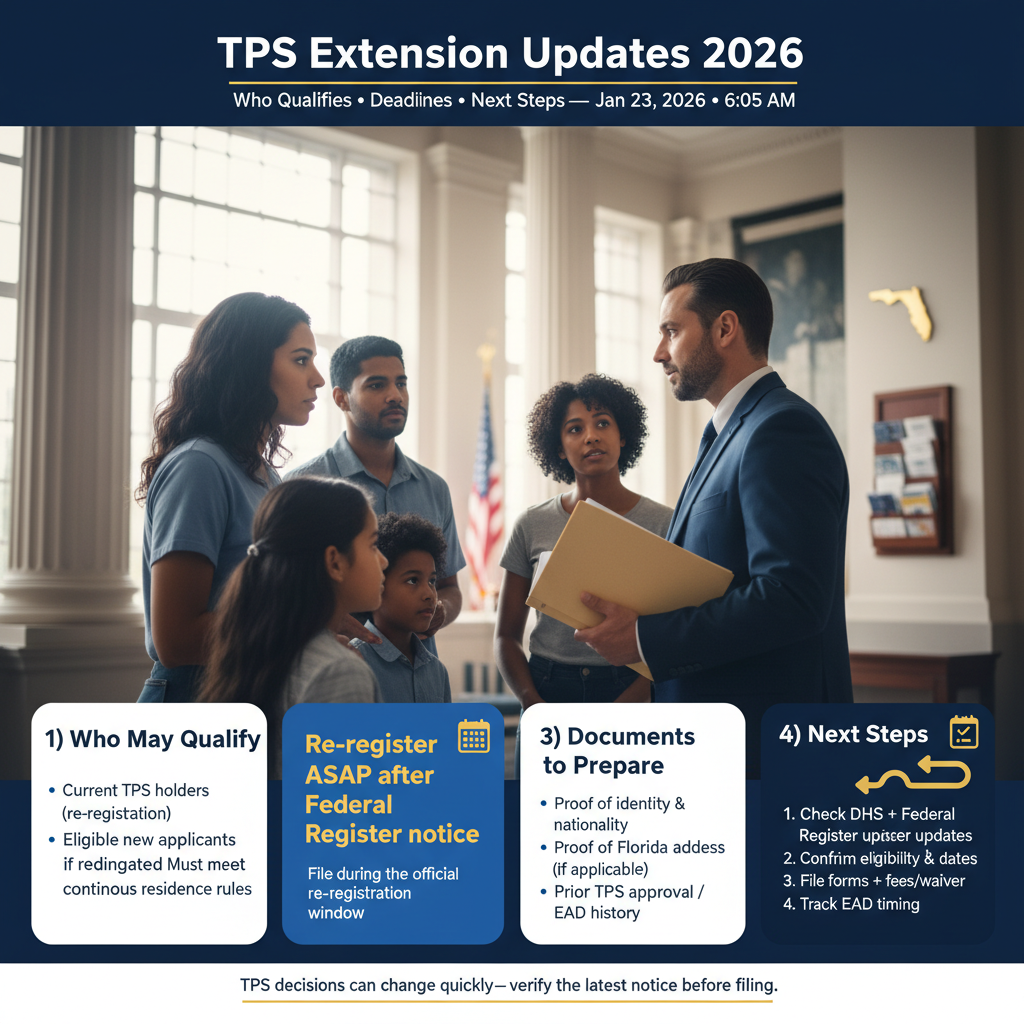
This article is a practical, Florida-focused guide based on ongoing national coverage and updates about TPS redesignations and extensions, including:
TPS (Temporary Protected Status) Extension News (Legal News)
Important: TPS decisions can change quickly through Federal Register notices, DHS announcements, and litigation. Always confirm your country’s current designation, extension dates, and re-registration window on the USCIS official website and the Federal Register before filing.
Need Help? Our Orlando immigration team is ready to assist. Call +1 786-791-3106 for a free consultation, or message us online. Se Habla Español.
What This News Means for Immigrants in Orlando and Across Florida
Why this news is showing up now
TPS is a humanitarian program that depends on time-limited government designations. That means TPS is frequently “in the news” because DHS must periodically decide whether to extend, redesignate, or terminate TPS for each country. When conditions in a country remain unsafe—due to armed conflict, environmental disasters, or extraordinary temporary conditions—DHS may announce an extension and open a re-registration period.
TPS also trends because employment authorization documents (EADs) are tied to TPS timelines. When DHS extends TPS, it often also provides automatic EAD extensions for certain categories while applicants re-register. These automatic extensions can be critical for keeping a job, renewing a driver’s license, and maintaining day-to-day stability—especially for families along the I-4 corridor (Orlando, Kissimmee, Sanford, and surrounding Central Florida communities).
Reminder: TPS changes are country-specific. “TPS extended” in the headlines does not automatically apply to everyone with TPS—only to the designated country (and only if you meet the eligibility requirements and file correctly).
How it can affect Florida residents
Florida has large communities from TPS-designated countries and mixed-status households. A TPS extension can impact:
- Work authorization (keeping your job, onboarding with a new employer, or passing E-Verify checks)
- Driver’s license renewals and Real ID documentation (requirements vary, but valid proof of lawful presence is often necessary)
- Family planning and long-term options (for example, whether you may qualify for Adjustment of Status through a family petition like Form I-130)
- Immigration court strategy if you have removal proceedings (TPS may be relevant to continuances or prosecutorial discretion; court is managed under Executive Office for Immigration Review)
- Travel decisions (TPS holders who travel without proper permission can create serious immigration consequences)
If your case is in Orlando, timing matters: missing a re-registration window can lead to losing TPS and work authorization. For Central Florida residents, a well-organized re-registration packet and careful tracking of receipts can make the difference between a smooth renewal and months of avoidable stress.
What TPS (Temporary Protected Status) Extension News Is (and Why It Matters)
A plain-English definition
Temporary Protected Status (TPS) is a temporary immigration protection the U.S. government may grant to eligible nationals of certain countries (or people without nationality who last habitually lived in that country) when returning home is unsafe. TPS can provide:
- Protection from removal (deportation) while TPS is in effect
- Eligibility to apply for a work permit (EAD) using Form I-765
- Eligibility to request travel permission (advance parole) using Form I-131
TPS is not a green card and does not automatically lead to U.S. permanent residence or citizenship. However, TPS can be a bridge that allows families to stay stable while exploring other options—like family-based petitions (Form I-130), employment-based sponsorship, asylum, or other forms of relief.
Key terms you need to know
- Designation: DHS places a country on the TPS list for a set time period.
- Extension: DHS continues TPS for a country already designated, usually with a re-registration requirement.
- Redesignation: DHS may reset certain dates and allow additional people (who arrived later) to apply for TPS.
- Re-registration: If you already have TPS, you must usually re-register during a specific window to keep it.
- EAD (Employment Authorization Document): Your work permit card, typically requested via Form I-765.
- Continuous residence / continuous physical presence: Date-based requirements that vary by country notice.
- Inadmissibility / criminal bars: Certain criminal convictions or other issues can block TPS.
- Removal proceedings: If you are in immigration court, TPS can still be available, but strategy and timing matter.
- Priority Date: Relevant for some family/employment paths, not a TPS concept—but important when planning longer-term options beyond TPS.
- Adjustment of Status: The process (often through Form I-485) to apply for a green card from inside the U.S., if eligible.
Warning: TPS rules are technical. Small mistakes—wrong fees, missing signatures, filing outside the window, or sending outdated evidence—can lead to delays or denials.
Current Immigration Law: The Foundation
TPS is authorized by federal statute and implemented through regulations and country-specific notices. The key legal foundation includes:
- Immigration and Nationality Act (INA) § 244 (TPS authority)
- 8 U.S.C. § 1254a (Temporary Protected Status)
- 8 C.F.R. § 244 (TPS regulations and procedures)
- Country-specific DHS notices published in the Federal Register (control the exact dates and requirements)
USCIS administers TPS applications and renewals. Always cross-check filing instructions and current filing addresses on the USCIS official website and the USCIS Forms page before you mail anything.
Federal requirements
To qualify for TPS (initially or through re-registration), you generally must:
- Be a national of a TPS-designated country (or meet the “no nationality” habitual residence rule)
- Meet the country’s continuous residence and continuous physical presence dates
- File during the designated window (or qualify for late filing in limited circumstances)
- Not be barred due to certain criminal convictions, security grounds, or other statutory bars
Common USCIS forms used in TPS cases include:
- Form I-821 (Application for Temporary Protected Status)
- Form I-765 (Application for Employment Authorization)
- Form I-131 (Application for Travel Document), when travel is requested
TPS holders may also pursue other immigration strategies, depending on eligibility, including:
- Form I-130 (family petition)
- Form I-485 (green card application through Adjustment of Status, if eligible)
Important: Filing a family petition (Form I-130) does not automatically give lawful status or a work permit. Many people need a separate strategy to stay protected while waiting for a Priority Date to become current or to qualify to file Form I-485.
Florida-specific considerations
TPS is federal immigration law, so eligibility does not change because you live in Florida. However, Florida residents often face practical, state-level issues where TPS documentation matters:
- Driver’s licenses and state ID: Many Florida applicants must show valid immigration documentation and unexpired EAD/notice details.
- Employment verification: Employers may rely on USCIS automatic EAD extension language and Federal Register notices to complete Form I-9.
- Address stability: If you move along the I-4 corridor (Orange County, Osceola County, Seminole County), updating USCIS addresses can prevent missed biometrics or RFE notices.
- Local processing logistics: The Orlando area is served by the Orlando USCIS Field Office for many interview-based benefits (not always TPS), while TPS filings are typically handled by USCIS lockboxes and service centers. Still, your local realities—mail delivery, biometrics appointments, and document access—affect success.
For official instructions, start at USCIS official website and check USCIS Processing Times to set expectations.
How to Re-Register for TPS (and Renew Your Work Permit): A Complete Step-by-Step Guide
This step-by-step guide focuses on the most common scenario in TPS extension news: you already have TPS and must re-register (and often renew your EAD). If you are applying for TPS for the first time due to a redesignation, the framework is similar but evidence requirements can be heavier.
1) Confirm your country’s TPS extension dates and your re-registration window
Your first task is to find the exact Federal Register notice or USCIS TPS country page for your country. The notice controls:
- The TPS validity period (start/end dates)
- The re-registration dates (your filing window)
- Whether DHS granted an automatic EAD extension and for how long
- Which EAD category codes are covered (often “A12” or “C19” for TPS-related EADs)
Reminder: Many TPS extensions include a limited re-registration period (often around 60 days). Missing it can create major risk.
Documents to gather (start a TPS folder):
- Copy of your current (or most recent) EAD (front/back)
- Copy of your TPS approval notice(s) (Form I-797)
- Your passport biographic page (if available)
- Any prior Form I-821 and Form I-765 receipts
- Proof of current address in Florida (lease, utility bill)
2) Decide what you are filing: TPS re-registration, EAD renewal, and/or travel permission
Most people file:
- Form I-821 (re-registration)
- Form I-765 (EAD renewal) — even if the filing fee is $0 for TPS, check whether you must pay for the EAD or whether a fee waiver is needed
Some people also file:
- Form I-131 to request advance parole for travel
Warning: Traveling without approved advance parole (or other proper authorization) can trigger severe consequences, including being unable to return or creating issues for future Adjustment of Status via Form I-485.
Documents to gather for this step:
- Reason for travel (if filing Form I-131): employer letter, medical documentation, family emergency evidence
- Two passport-style photos (if required by form instructions)
- Any name-change documents (marriage certificate, court order), if applicable
3) Prepare your forms carefully (and use the current USCIS edition dates)
Download forms only from the USCIS Forms page to avoid outdated editions. Pay close attention to:
- Exact spelling of your name (match your identity documents)
- All A-number/USCIS number fields
- Country of citizenship and country of birth entries
- Addresses for the last 5 years (avoid gaps)
- Criminal history questions (answer truthfully; consult counsel if unsure)
Important: If you have ever been arrested—even if charges were dismissed—talk to an attorney before filing. Some outcomes can still create immigration problems or require certified dispositions.
Documents to gather for this step:
- Government ID (passport, national ID, or prior immigration ID)
- Certified court dispositions for any arrests/citations (if any)
- Certified translations for non-English documents
- Prior immigration documents (notices, approvals, denials)
4) Build a clean filing package (evidence, fees, and a cover letter)
A well-organized package reduces the chance of Requests for Evidence (RFEs) and delays. Typically include:
- Cover letter listing everything included
- Form I-821 (signed)
- Form I-765 (signed)
- Form I-131 (signed), if applicable
- Copy of your EAD (front/back)
- Copy of TPS approval notice (I-797)
- Fees or fee waiver request, if applicable
Fee rules can change and can differ between the TPS application and the EAD request. Confirm current requirements on USCIS official website.
Documents to gather for this step:
- Money order/check details (if paying by mail) or online filing confirmation (if filing online where available)
- Fee waiver evidence (if requesting): proof of income, public benefits documentation, hardship statement
- Two-sided copies of documents (keep originals safe)
5) File on time and track your case (receipts, biometrics, and RFEs)
After filing, USCIS will issue receipt notices (Form I-797). You may receive:
- A receipt for Form I-821
- A receipt for Form I-765
- A biometrics appointment notice (ASC appointment), depending on current policy
- An RFE if anything is missing or unclear
Use your receipt numbers to track cases and set expectations using USCIS Processing Times.
Timeline expectations (general): EAD renewals can take months depending on USCIS workload. Many TPS extensions include automatic EAD extensions precisely because processing can be slow. Still, do not rely on last-minute filings—file as early in the window as possible.
Documents to gather for this step:
- All USCIS receipts (scan and save)
- USCIS online account screenshots (if applicable)
- Biometrics notice and photo ID for the appointment
- RFE response packet materials (if requested)
Need Help? Our Orlando immigration team is ready to assist. Call +1 786-791-3106 for a free consultation, or message us online. Se Habla Español.
Practical Steps You Can Take Today
If TPS extension news affects your country, the best outcomes usually go to people who act early and stay organized. Here’s a practical checklist you can start today.
Actionable checklist (do this now)
- Confirm your country’s notice and write down the re-registration start and end dates. Treat the end date like a hard deadline.
- Create a “TPS binder” (physical and digital): EAD copies, approvals, receipts, passports, birth certificates, translations.
- Check your EAD category (often A12 or C19) and see if an automatic extension applies to you.
- Update your address with USCIS if you moved. Missed mail is one of the top reasons people miss biometrics or RFEs.
- Ask your employer’s HR what they need for I-9 re-verification. Provide the Federal Register notice and USCIS guidance when automatic extensions apply.
- Screen for red flags: any arrest history, prior immigration denials, prior removal orders, or travel without permission—get legal advice before filing.
Document preparation guidance
- Use clear, single-sided copies unless USCIS requests otherwise.
- Translate non-English documents with a proper translator certification.
- Keep proof of delivery if you mail your package (USPS/UPS/FedEx tracking).
- Save a complete copy of what you send—forms, checks, evidence, cover letter.
Timeline expectations (realistic planning)
While every case is different, plan for these realities:
- Receipts: often within 2–6 weeks after filing (varies by workload and filing method).
- Biometrics: may be scheduled or reused; if scheduled, typically within weeks to a few months.
- EAD processing: can take several months. Check USCIS Processing Times for current ranges.
Reminder: If your TPS notice provides an automatic EAD extension, it may keep you work-authorized during processing—but only if you qualify under the notice’s terms.
How Imigrar Helps Immigrants in Orlando
At Imigrar, we help TPS holders and their families protect work authorization, avoid filing mistakes, and plan beyond TPS when possible—because our mission is to Keep Families Together.
We assist with:
- TPS re-registration strategy and filing (Form I-821)
- EAD renewals and automatic extension guidance (Form I-765)
- Advance parole/travel planning (Form I-131)
- Risk screening for arrests, prior orders, or inadmissibility issues
- Long-term planning: family petitions (Form I-130), possible Adjustment of Status (Form I-485), and coordinating with court proceedings when needed
If your case is in Orlando or you live anywhere in Florida, we can help you understand how the latest TPS extension news affects your specific situation—and what to do next.
Free consultation available. Se Habla Español.
Need Help? Our Orlando immigration team is ready to assist. Call +1 786-791-3106 for a free consultation, or message us online. Se Habla Español.
Frequently Asked Questions
Q: Am I automatically covered when TPS is “extended” for my country?
A: Not automatically. An extension means DHS continued TPS for the country, but you usually must re-register during the designated window and remain eligible. Also, automatic EAD extensions apply only if your EAD category and dates match the notice. Verify details on the USCIS official website.
Q: Does TPS give me a green card or a path to citizenship?
A: TPS by itself does not grant permanent residence or citizenship. However, TPS can allow you to remain in the U.S. lawfully for a period and may help you maintain stability while pursuing other options—like a family petition via Form I-130 or, if eligible, Adjustment of Status through Form I-485. Whether you can adjust often depends on how you entered the U.S., your immigration history, and any inadmissibility issues.
Q: How long does TPS re-registration and an EAD renewal take?
A: Processing times vary by workload and service center. Receipt notices often arrive within weeks, while EAD approvals can take months. Check USCIS Processing Times for current estimates. Important: If DHS provides an automatic EAD extension in the country notice, that may keep you work-authorized while your renewal is pending—if you meet the notice requirements.
Q: What documents do I need to re-register for TPS?
A: Common documents include your prior TPS approval notice (I-797), your current/expired EAD copy (front/back), identity documents (passport/national ID), and any documents USCIS requests in the country notice. If you have any arrests, you should obtain certified court dispositions. Use current forms from the USCIS Forms page and follow instructions exactly.
Q: How much does it cost to renew TPS and my work permit?
A: Costs depend on what you file and current USCIS fee rules. TPS re-registration and EAD requests can have different fee requirements, and some applicants may qualify for a fee waiver in limited situations. Because fees change, confirm the latest amounts and waiver rules directly on USCIS official website before filing. If you’re unsure, speak with counsel to avoid a rejection for incorrect fees.
Q: What happens if my TPS re-registration is denied?
A: A denial can lead to loss of TPS protection and work authorization, and it may increase the risk of being placed in removal proceedings depending on your broader immigration history. Denials can happen due to late filing, missing evidence, criminal bars, or ineligibility. If you receive a denial, talk to an attorney immediately to evaluate options—such as a motion, refiling (if allowed), or alternate relief. If you are in immigration court, coordination with Executive Office for Immigration Review procedures may be necessary.
Q: Can I travel internationally while I have TPS?
A: You should not travel internationally without proper authorization. Many TPS holders apply for advance parole using Form I-131. Travel without authorization can lead to being denied re-entry and may harm future immigration options, including Adjustment of Status (Form I-485). If travel is urgent, get legal advice first and review official guidance on USCIS official website and general travel documentation information from the U.S. Department of State.
Common Mistakes (and How to Avoid Them)
Mistake #1: Missing the re-registration deadline
Many people assume an extension means “nothing to do.” In reality, re-registration windows can be short. Missing the window may require proving late-filing eligibility—often difficult.
How to avoid it: As soon as the extension is announced, write down the dates, set reminders, and file early. Aim to file within the first half of the window, not the last week.
Mistake #2: Filing outdated forms or incorrect fees
USCIS frequently updates form editions and fee rules. Using an old form or wrong fee can cause rejection, delaying your case and risking gaps.
How to avoid it: Download forms only from USCIS Forms and verify fee instructions on USCIS official website the same day you file.
Mistake #3: Underestimating arrest history or immigration “red flags”
Even minor charges can create complications. Also, prior removal orders, misrepresentation issues, or prior denials can affect TPS eligibility and future strategies.
How to avoid it: Get certified court dispositions and consult an immigration attorney before filing if you have any criminal or complex immigration history.
Official Resources to Follow (Don’t Rely on Social Media Alone)
TPS extension news moves fast, and misinformation spreads even faster. Use these official and high-authority resources:
- USCIS official website (TPS pages, filing guidance, alerts)
- USCIS Forms (download current editions and instructions)
- USCIS Processing Times (realistic timing expectations)
- Executive Office for Immigration Review (if you are in immigration court)
- U.S. Department of State (travel documentation and general travel guidance)
Important: If you are considering a longer-term plan beyond TPS—such as consular processing or immigrant visa steps—official State Department guidance is essential.
Need Help? Our Orlando immigration team is ready to assist. Call +1 786-791-3106 for a free consultation, or message us online. Se Habla Español.
Orlando & Central Florida Notes: What to Watch Locally
For Central Florida residents, TPS issues often show up in practical ways:
- Employment and I-9 reverification: If HR is unfamiliar with automatic EAD extensions, bring the relevant DHS/USCIS guidance and ask them to review the Federal Register notice carefully.
- DMV timing: Try to renew state IDs early if your EAD is nearing expiration—even if an automatic extension applies—because some offices may request additional verification time.
- Mail reliability: If you move within Orange County or along the I-4 corridor, update USCIS promptly to avoid missing biometrics or RFEs.
- The Orlando USCIS Field Office: While many TPS filings are not handled locally, Orlando-based applicants may still interact with USCIS locally for other benefits (like Form I-485 interviews). A coordinated strategy matters when TPS and family-based plans overlap.
Reminder: TPS can protect you temporarily, but it’s wise to explore durable options—especially if you have U.S. citizen immediate relatives, or if you may qualify for other relief.
Conclusion: Use TPS Extension News to Protect Your Future
TPS extension announcements can be a lifeline—protecting families, jobs, and stability. But the benefits usually depend on doing the basics correctly: confirming your country’s dates, filing within the window, renewing your EAD properly, and avoiding preventable mistakes.
Important: If you have any criminal history, prior removal issues, or plans to travel, get legal advice before filing. And if you’re hoping to move beyond TPS into a green card path, a careful review of eligibility for Form I-130 and Form I-485 (including entry history and admissibility) is essential.

Closing: Talk to an Orlando TPS Lawyer at Imigrar
TPS rules are technical, deadlines are strict, and small errors can lead to big consequences. If you want help re-registering, renewing your work permit, or building a longer-term plan to keep your family together, we’re here.
Call Imigrar today at +1 786-791-3106 for a free consultation, or message us online. Se Habla Español. Serving Orlando, Orange County, and clients nationwide.


