

The reporting that sparked this guide: TPS (Temporary Protected Status) Extension News (Legal News)
What This News Means for Immigrants in Orlando and Across Florida
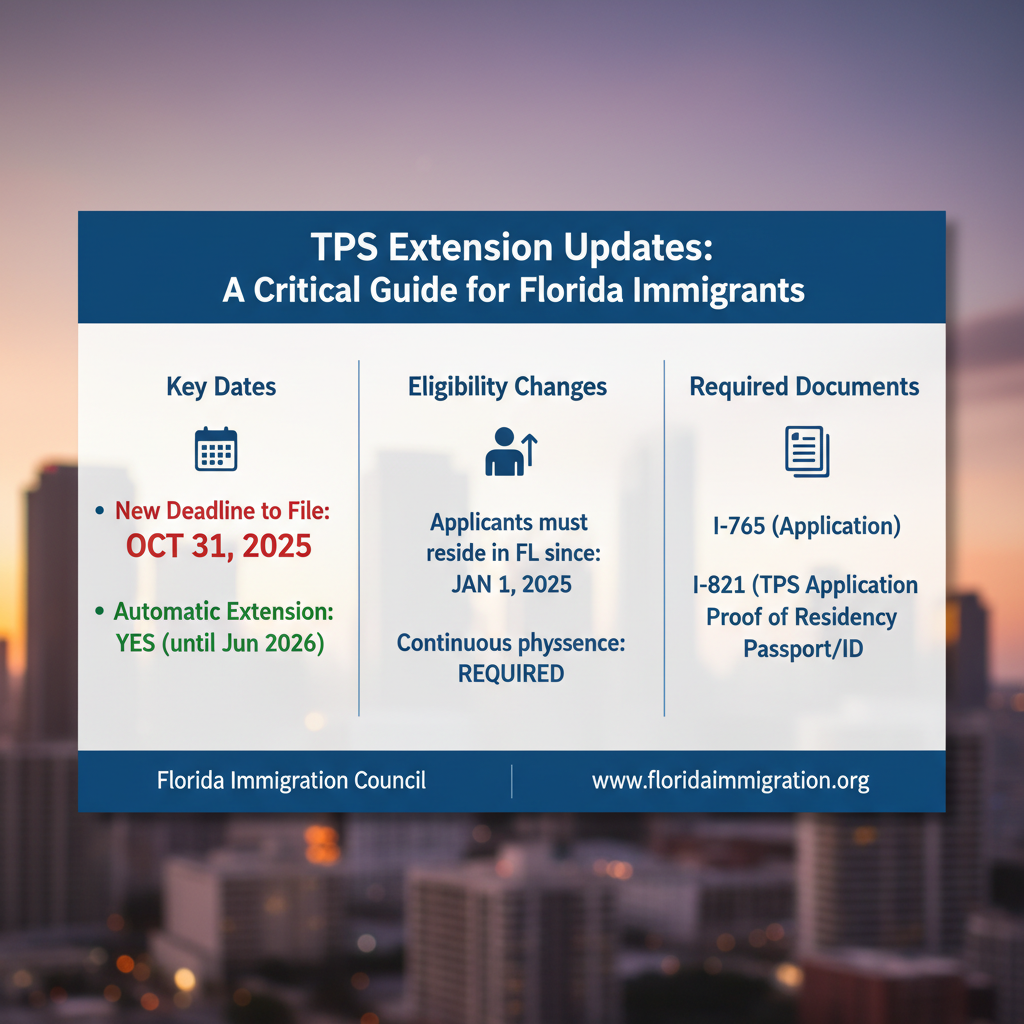
The landscape of U.S. immigration law is constantly shifting, and few areas reflect this more dynamically than Temporary Protected Status (TPS). Recent reports regarding TPS extensions for various designated countries have sent ripples through immigrant communities nationwide, especially here in Florida, a state home to a vibrant and diverse population of foreign nationals.
Why this news is showing up now
TPS is, by its very nature, a temporary designation. The Secretary of Homeland Security (DHS) grants TPS to eligible nationals of certain countries (or parts of countries) who are already in the United States. This designation is based on conditions in the country that temporarily prevent its nationals from returning safely, or, in certain circumstances, where the country is unable to handle the return of its nationals adequately. These conditions often include ongoing armed conflict, environmental disaster, or other extraordinary and temporary conditions.
Because TPS is temporary, it requires periodic review by the DHS Secretary. Typically, every 6, 12, or 18 months, the Secretary must evaluate whether the conditions in a designated country still meet the criteria for TPS. This ongoing evaluation leads to announcements of extensions, re-designations, or terminations of TPS for specific countries. The current news cycle reflects these regular reviews and the resulting decisions to extend TPS for certain nations, providing a lifeline for thousands of individuals and families who cannot safely return home. These extensions are not automatic; they require eligible individuals to re-register within a specific window.
Reminder: The specific countries subject to these extensions are announced by USCIS official website and the Federal Register. It is crucial to check these official sources for the most up-to-date information regarding your country's status.
How it can affect Florida residents
Florida, particularly Central Florida with its significant immigrant populations, is profoundly impacted by TPS decisions. Orlando and its surrounding areas, including Orange County and along the I-4 corridor, are home to many individuals from countries currently designated for TPS. These extensions provide critical relief, allowing beneficiaries to continue living and working legally in the U.S. without fear of deportation, while also providing a pathway to renew their employment authorization documents (EADs).
- Continued Stability: For those already holding TPS, an extension means continued permission to stay and work in the U.S., offering stability for families, jobs, and community ties built over years.
- Work Authorization: Beneficiaries can apply for or renew their Employment Authorization Documents (EADs), commonly known as work permits, allowing them to maintain lawful employment and support themselves and their families. This is vital for the economic well-being of many households in Orlando and beyond.
- Protection from Deportation: TPS provides protection from removal (deportation) from the United States, giving individuals peace of mind during periods of instability in their home countries.
- Travel Authorization: In some cases, TPS beneficiaries may be able to apply for travel authorization (Form I-131) to travel outside the U.S. and return, though this must be done carefully and with expert legal guidance.
- Impact on Families: For many, TPS is a cornerstone of family unity. An extension helps keep families together, allowing parents to continue raising their children in a safe environment and contributing to their communities in Florida. Our firm, Imigrar, lives by the tagline "Keep Families Together," and these TPS extensions directly align with our mission.
If you are a Florida resident and believe you may be eligible for TPS or need to re-register due to an extension, understanding the nuances of these announcements and the application process is paramount. The Orlando USCIS Field Office and local legal resources are crucial for navigating these updates.
Need Help? Our Orlando immigration team is ready to assist. Call +1 786-791-3106 for a free consultation, or message us online. Se Habla Español.
What Temporary Protected Status (TPS) Is (and Why It Matters)
Temporary Protected Status, or TPS, is a humanitarian immigration benefit provided by the United States government. It’s a temporary status granted to eligible nationals of certain countries who are already in the U.S. when their home country experiences severe conditions that make it unsafe for them to return. The "temporary" aspect is key, as it's not a path to permanent residency or citizenship unless other immigration avenues are pursued.
A plain-English definition
Imagine your home country is experiencing a major crisis—maybe a devastating earthquake, a civil war, or a widespread epidemic. If you're already in the United States when this happens, the U.S. government might decide it's not safe for you to go back. That's where TPS comes in. It allows you to legally live and work in the U.S. for a specific period, usually 6, 12, or 18 months, until conditions in your home country improve. This status can be extended repeatedly if the unsafe conditions persist. While you have TPS, you are protected from deportation and can obtain a work permit.
Key terms you need to know
- Designated Country: A country (or a part of a country) that the Secretary of Homeland Security has identified as having conditions that qualify its nationals for TPS. Examples include Haiti, Venezuela, El Salvador, Honduras, Nicaragua, Nepal, and others, though the list changes.
- Re-registration: The process by which current TPS beneficiaries apply to extend their status when the DHS Secretary extends the TPS designation for their country. This is not automatic and requires submitting new forms and potentially fees.
- Employment Authorization Document (EAD): Also known as a work permit, this card allows TPS beneficiaries to legally work in the United States. It is typically applied for using Form I-765.
- Travel Authorization: A document, often called an Advance Parole document, issued by USCIS (using Form I-131) that allows a foreign national to travel abroad and return to the U.S. without jeopardizing their immigration application or status. TPS beneficiaries may be eligible, but it requires careful consideration.
- DHS (Department of Homeland Security): The federal department responsible for U.S. immigration and border security, including USCIS.
- USCIS (U.S. Citizenship and Immigration Services): The agency within DHS that administers the country’s naturalization and immigration system, including processing TPS applications.
- Federal Register Notice: The official daily publication for rules, proposed rules, and notices of federal agencies and organizations, including specific deadlines and instructions for TPS designations and extensions.
Understanding these terms is crucial for anyone navigating the TPS process, especially when news of extensions breaks. It empowers you to better comprehend official announcements and take appropriate action to protect your status.
Current Immigration Law: The Foundation of TPS
The legal basis for Temporary Protected Status is found in Section 244 of the Immigration and Nationality Act (INA), 8 U.S.C. § 1254a. This section grants the Secretary of Homeland Security the authority to designate a foreign country for TPS. The designation can be made if the Secretary finds that conditions in the country fall into one or more of three statutory bases:
- Ongoing armed conflict within the state, posing a serious threat to the personal safety of nationals if they were returned.
- An environmental disaster resulting in a substantial, but temporary, disruption of living conditions, and the foreign state is unable to handle the return of its nationals adequately.
- Other extraordinary and temporary conditions in the foreign state that prevent nationals from returning safely.
Once a country is designated, the Secretary must also determine the effective date of the designation and the period for which it will remain in effect, typically 6, 12, or 18 months. The Secretary may extend or terminate a TPS designation based on a review of the country conditions. Each decision to extend or terminate is published in the Federal Register, which provides the official dates and instructions.
Federal requirements
To be eligible for TPS, individuals must meet several federal requirements:
- Nationality: Be a national of a country designated for TPS, or a person without nationality who last habitually resided in that designated country.
- Continuous Physical Presence (CPP): Have been continuously physically present in the U.S. since the effective date of the most recent TPS designation for their country.
- Continuous Residence (CR): Have been continuously residing in the U.S. since the date specified for their country's TPS designation. Brief, casual, and innocent departures do not break continuous residence or physical presence.
- Timely Application: Apply for TPS within the initial registration period or during any extension/re-registration period announced in the Federal Register.
- Admissibility: Meet general admissibility requirements for immigration, though certain grounds of inadmissibility can be waived.
- No Disqualifying Factors: Not have been convicted of any felony or two or more misdemeanors committed in the U.S., or be subject to certain bars related to persecution, national security, or participation in persecution.
When TPS is extended, current beneficiaries must re-register within the specified re-registration period to maintain their status and receive a new EAD. Failure to re-register on time can lead to loss of TPS and potential removal proceedings. For detailed information on TPS, always refer to the USCIS TPS page.
Florida-specific considerations
While TPS is a federal program and does not have specific "Florida laws," the implications for residents of the Sunshine State are significant. Florida has one of the largest immigrant populations in the U.S., including many individuals from TPS-designated countries like Haiti, Venezuela, El Salvador, and Honduras. These communities are concentrated in areas such as Miami, Fort Lauderdale, and Orlando.
- Local USCIS Field Offices: For Central Florida residents, the Orlando USCIS Field Office plays a role in processing certain aspects of immigration cases, including potential interviews or biometrics appointments related to TPS. While TPS applications are generally mailed to specific service centers, local offices handle biometrics.
- Community Resources: Florida's extensive network of non-profit organizations and legal aid services often provides assistance to TPS beneficiaries. However, the demand for services is high, making private legal counsel essential for timely and accurate applications.
- Economic Impact: Continued work authorization through TPS extensions is critical for Florida's economy. TPS beneficiaries contribute to various sectors, from hospitality and agriculture to healthcare and construction, particularly along the I-4 corridor and in major metropolitan areas.
The forms typically involved in TPS applications and re-registrations are:
- Form I-821, Application for Temporary Protected Status
- Form I-765, Application for Employment Authorization (EAD)
- Form I-131, Application for Travel Document (if you need to travel outside the U.S.)
It is vital that these forms are completed accurately and submitted with all required supporting documentation. Mistakes or omissions can lead to delays or even denial. You can find all official forms and instructions on the USCIS Forms page.
How to Re-register for TPS: A Complete Step-by-Step Guide
If your country’s TPS designation has been extended, you must re-register within the specified window to maintain your status. This is not an automatic process. Below is a comprehensive, step-by-step guide for re-registration.
1) Determine Your Eligibility and Re-registration Window
Before doing anything else, confirm that your country’s TPS designation has indeed been extended and note the exact re-registration period. This information is published in the Federal Register and on the USCIS official website. Pay close attention to the start and end dates of the re-registration period. Missing this window can result in the loss of your TPS.
- Check Federal Register Notice: Look for the specific notice for your country.
- Verify Continuous Physical Presence (CPP) & Continuous Residence (CR): Ensure you have maintained these requirements since your initial designation.
- Review Disqualifying Factors: Reconfirm you have not committed any disqualifying crimes or actions since your last TPS application.
Important: Even if you have an initial TPS application pending, you generally still need to re-register if your country's designation is extended. Consult with an attorney to confirm your specific situation.
2) Gather All Required Documents
Accurate and complete documentation is crucial for a smooth re-registration process. While you may have submitted many of these before, some documents may need to be updated or re-submitted.
- Proof of Identity and Nationality:
- Copy of your birth certificate with photo identification.
- Copy of your passport identity pages (if available).
- Copy of national identity document from your country of origin.
- Copy of your previous Form I-821 approval notice.
- Copy of your previous EAD card (front and back).
- Proof of Continuous Residence (CR) and Continuous Physical Presence (CPP): Documents showing you have lived in the U.S. since the initial designation date for your country and have not left for extended periods without authorization.
- Rent receipts, utility bills, mortgage statements.
- Employment records, pay stubs, W-2 forms.
- School records (for children or students).
- Medical records, hospital bills.
- Bank statements.
- Affidavits from friends, family, or employers.
- Any Form I-131 (Advance Parole) documents if you traveled.
- Two Passport-Style Photos: Taken within 30 days of filing.
Warning: Always keep original documents and submit only copies unless USCIS specifically requests originals. If documents are not in English, they must be accompanied by a certified English translation.
3) Complete and File Required Forms
For re-registration, you will primarily need to submit Form I-821. If you also wish to renew your work authorization, you must file Form I-765. If you need to travel internationally, you will also file Form I-131.
- Form I-821, Application for Temporary Protected Status:
- Complete all sections accurately.
- For re-registration, check the "re-registration" box.
- Ensure all biographical information matches your previous applications.
- Form I-765, Application for Employment Authorization:
- If you want a new EAD, you must file this form.
- Check the box for "renewal of my permission to work."
- The eligibility category for TPS is typically (c)(10).
- Form I-131, Application for Travel Document (Optional):
- If you anticipate needing to travel outside the U.S. during the TPS extension period, you must apply for an Advance Parole Document.
- Traveling without Advance Parole can lead to serious immigration consequences, including denial of re-entry or loss of TPS.
All forms must be signed and dated. Do not leave any fields blank; if a question does not apply, write "N/A."
4) Prepare Supporting Evidence and Affidavits
Beyond the primary documents, you may need additional evidence to support your application, especially if there are gaps in your residence history or changes in your personal information.
- Marriage Certificates / Divorce Decrees: If your marital status has changed.
- Birth Certificates: For any children born in the U.S.
- Police Clearances: While not always required for re-registration, USCIS may request them if there are new arrests or convictions since your last application.
- Affidavits: Sworn statements from individuals who can attest to your continuous residence and good moral character.
5) Pay Required Fees (or Apply for a Fee Waiver)
There are fees associated with filing Form I-821 and Form I-765. However, for re-registration, the Form I-821 fee is often waived. The fee for Form I-765 (EAD) and the biometrics fee (if required) typically apply.
- Biometrics Fee: Required for applicants 14 years of age or older.
- Form I-765 Fee: Generally required unless you qualify for a fee waiver.
- Form I-131 Fee: Required if you apply for Advance Parole.
- Fee Waivers: If you cannot afford the fees, you may apply for a fee waiver using Form I-912, Request for Fee Waiver. You must provide evidence of your inability to pay, such as proof of public benefits, household income below 150% of the poverty line, or financial hardship.
Reminder: Check the USCIS Fee Schedule for the most current fees. Fees are subject to change.
6) Submit Your Application Packet
Once all forms are completed, signed, and all supporting documents are gathered, assemble your application packet carefully. USCIS provides specific mailing addresses for TPS applications, which vary depending on your country of designation and the service center processing your case.
- Check Filing Address: Always use the address specified in the Federal Register notice or on the USCIS website for your country's TPS.
- Organize Packet: Use fasteners or paper clips. Do not staple entire packets. Include a cover letter listing all contents.
- Mail with Tracking: Send your application via certified mail with a return receipt or a courier service that provides tracking. This is your proof of timely submission.
For Central Florida residents, while your local Orlando USCIS Field Office cannot accept TPS applications directly, they will be involved in any necessary biometrics appointments.
7) Attend Your Biometrics Appointment (if required)
After USCIS receives your application, you will typically receive an appointment notice (Form I-797C, Notice of Action) for a biometrics appointment at an Application Support Center (ASC). This appointment is for collecting your fingerprints, photograph, and signature.
- Do Not Miss It: Attend your appointment as scheduled. If you cannot attend, you must request to reschedule, providing a valid reason, but this can cause significant delays.
- Bring Required Documents: Bring your appointment notice and a valid photo ID (e.g., passport, driver's license).
This appointment is a standard part of the process and helps USCIS conduct necessary background checks.
Confused by the forms or deadlines? Don't risk your status. Contact Imigrar's experienced immigration lawyers in Orlando today for personalized assistance with your TPS re-registration. Call +1 786-791-3106. Se Habla Español.
Practical Steps You Can Take Today
Navigating TPS extensions requires proactive engagement. Here are practical steps you can take right now to prepare and protect your status, especially if you reside in Orlando or elsewhere in Florida.
- Verify Your Country's Status: Immediately check the USCIS TPS page or the Federal Register for the latest announcements regarding your country of origin. Confirm the re-registration window dates.
- Review Your Existing Documents: Go through your immigration file. Do you have copies of your previous TPS approval notices, EADs, and all supporting evidence? Are your identification documents current?
- Gather Proof of Continuous Residence: Start collecting documents that prove your continuous physical presence and residence in the U.S. since your initial TPS designation. This includes utility bills, bank statements, pay stubs, leases, school records, and medical bills from different periods.
- Organize Your Records: Create a dedicated folder for your TPS documents. Keep originals safe and make copies for your application packet. Consider digital backups.
- Consult with an Immigration Attorney: This is perhaps the most crucial step. An experienced attorney can confirm your eligibility, help you gather and organize documents, accurately complete forms, apply for fee waivers if needed, and represent you if any issues arise.
- Plan for Fees: Determine which fees you will need to pay. If you plan to request a fee waiver (Form I-912), start gathering documentation to support your request.
- Update Contact Information: Ensure USCIS has your current mailing address. If you've moved since your last application, file Form AR-11, Alien's Change of Address Card, online or by mail.
Document preparation guidance
- Copies, Not Originals: Unless specifically requested, never send original documents to USCIS. Always keep your originals.
- Certified Translations: Any document not in English must be accompanied by a complete and accurate English translation, along with a certification by the translator that they are competent to translate from the foreign language to English and that the translation is accurate.
- Clarity and Legibility: Ensure all copies are clear and easy to read. If a document is difficult to read, consider getting a certified copy from the issuing authority.
Timeline expectations
Understanding processing times can help manage expectations, though these can vary significantly.
- Re-registration Window: Typically, the re-registration window is 60 days, but it can vary. It’s critical to file within this period.
- Receipt Notice: You should receive a receipt notice (Form I-797C) from USCIS within 2-4 weeks after filing.
- Biometrics Appointment: A biometrics appointment notice usually arrives within 3-8 weeks after filing, with the appointment itself scheduled for a few weeks later. For Central Florida residents, this will likely be at the Orlando USCIS Application Support Center.
- EAD Processing: Renewal of Employment Authorization Documents (EADs) can take several months, sometimes 6 months or more. USCIS often issues automatic EAD extensions for TPS beneficiaries who re-register on time, as announced in the Federal Register. Always check the official notice for your country to confirm if an automatic extension applies to your EAD. You can check current processing times on the USCIS Processing Times page.
- TPS Approval Notice: Final approval for your TPS re-registration can also take several months.
Important: These timelines are estimates. Processing times can fluctuate based on USCIS workload, policy changes, and the complexity of your individual case. Consulting with Imigrar can help you navigate these timelines effectively.
How Imigrar Helps Immigrants in Orlando and Nationwide
At Imigrar, our mission is to "Keep Families Together." We understand the complexities, anxieties, and hopes that come with navigating the U.S. immigration system. For immigrants in Orlando, across Florida, and nationwide, especially concerning critical updates like TPS extensions, having knowledgeable and compassionate legal representation is invaluable.
Our experience and expertise
Our team of dedicated immigration attorneys possesses extensive experience in all facets of immigration law, including Temporary Protected Status. We regularly assist clients from TPS-designated countries with their initial applications, re-registrations, and related matters such as employment authorization and travel documents. We stay abreast of the latest legal developments, Federal Register notices, and USCIS policy changes to provide the most accurate and up-to-date advice.
We pride ourselves on:
- Deep Knowledge of TPS: Understanding the specific requirements for each designated country, the nuances of continuous residence and physical presence, and the grounds for inadmissibility and waivers.
- Comprehensive Case Management: From gathering documents and completing complex forms like Form I-821, Form I-765, and Form I-131, to preparing fee waiver requests (Form I-912) and responding to Requests for Evidence (RFEs).
- Strategic Planning: Advising clients not just on TPS, but also on how it fits into their broader immigration goals, exploring potential pathways to permanent residency or other forms of relief.
- Local Insight: While we serve clients nationwide, our Orlando location gives us specific insight into the needs and challenges of Central Florida's immigrant communities, including interactions with the Orlando USCIS Field Office.
Free consultation offer
We believe everyone deserves access to quality legal advice, especially when their status and future are on the line. That's why Imigrar offers a free consultation to discuss your TPS situation. During this initial meeting, we can:
- Evaluate your eligibility for TPS re-registration or initial application.
- Explain the specific requirements and deadlines for your country.
- Outline the necessary forms and documents.
- Answer your pressing questions and address your concerns.
- Provide a clear roadmap for your next steps.
Don't face the immigration process alone. Our team is here to guide you with clarity and confidence.
Se Habla Español. We are proud to serve our Spanish-speaking community, ensuring that language is never a barrier to understanding your rights and options.
Your future matters. Secure your TPS status with expert legal support from Imigrar. Call us at +1 786-791-3106 for your free consultation today. Our Orlando team is ready to help, serving clients nationwide. Se Habla Español.

Frequently Asked Questions About TPS Extensions
Q: Who is eligible for a TPS extension?
A: Eligibility for a TPS extension is generally limited to individuals who already have TPS from a designated country and have maintained their continuous physical presence (CPP)


