

The landscape of U.S. immigration law is constantly evolving, with policy updates frequently impacting the lives of thousands of individuals and families. For those holding or seeking Temporary Protected Status (TPS), staying informed is not just important—it’s critical to maintaining their legal standing and future in the United States.
At Imigrar, an immigration law firm based in Orlando, Florida, we understand the anxieties and uncertainties that come with these changes. Our mission is to "Keep Families Together" by providing clear, accurate, and actionable legal guidance. With today's news regarding TPS extensions, we want to ensure you have all the information you need to navigate this crucial period.
Concerned about your TPS status or an upcoming deadline? Don't wait. Our Orlando immigration team is ready to assist. Call +1 786-791-3106 for a free consultation, or message us online. Se Habla Español.
The reporting that sparked this guide: TPS (Temporary Protected Status) Extension News (Legal News)
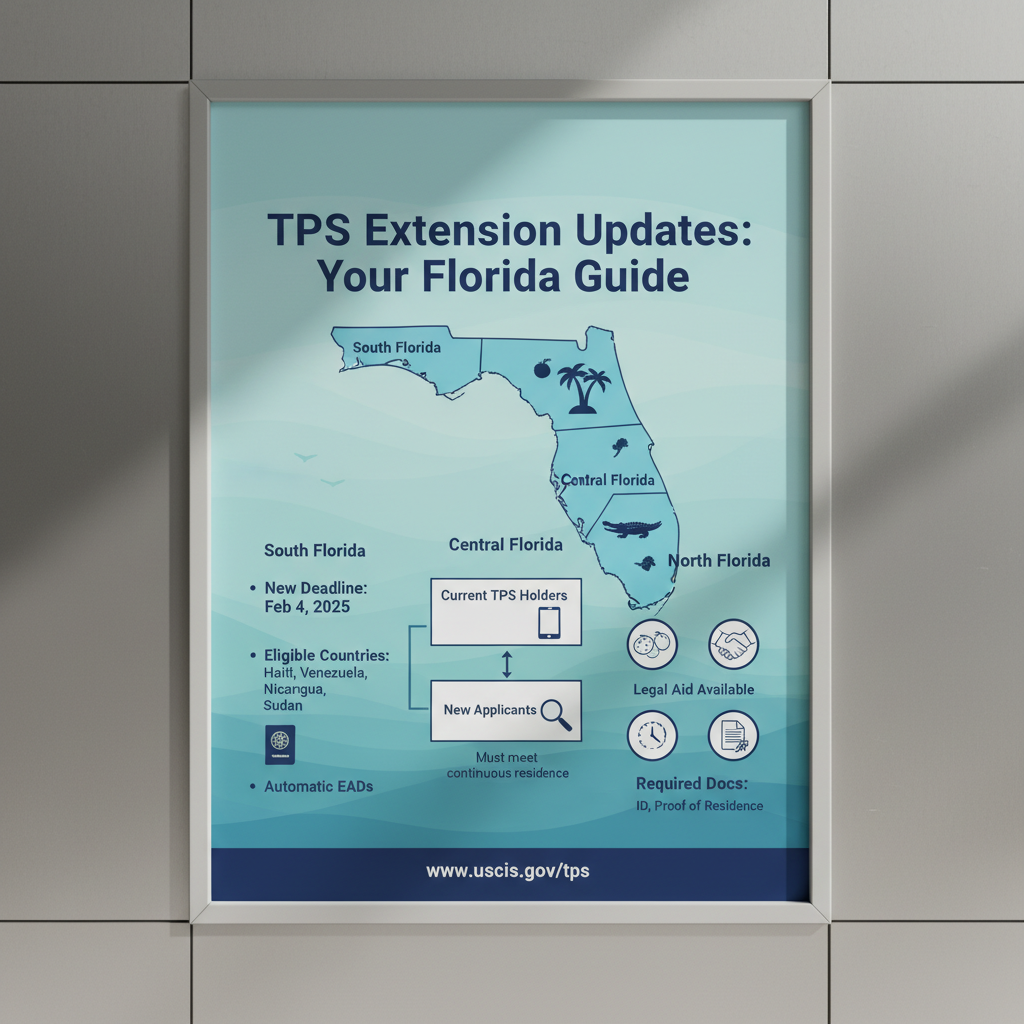
What This News Means for Immigrants in Orlando and Across Florida
Recent developments in immigration law, particularly regarding Temporary Protected Status (TPS), are generating significant discussion within legal circles and immigrant communities nationwide. These updates, often stemming from federal court decisions, administrative announcements by the Department of Homeland Security (DHS), or legislative actions, can profoundly affect the lives of many individuals who have sought refuge and built lives in the U.S.
Why this news is showing up now
Temporary Protected Status (TPS) is a temporary immigration benefit granted by the Secretary of Homeland Security to eligible nationals of certain countries designated by the U.S. government. These designations occur when conditions in the country prevent its nationals from returning safely, or when the country is unable to handle the return of its nationals adequately. Such conditions typically include ongoing armed conflict, environmental disaster, or other extraordinary and temporary conditions.
The "news" often revolves around several key events:
- Extensions of Existing Designations: When the Secretary of Homeland Security determines that the conditions supporting a country’s TPS designation still exist, they can extend the designation for a period, typically 6, 12, or 18 months. This allows current TPS holders to re-register and maintain their status.
- New Country Designations: In response to new crises abroad, the U.S. may designate additional countries for TPS, allowing eligible individuals from those nations to apply for the first time.
- Re-designations: Sometimes, a country's TPS status might be terminated, but then later re-designated due to a deterioration of conditions.
- Court Challenges and Settlements: Many TPS designations and terminations have been subject to complex legal challenges. Court rulings or settlement agreements can lead to extensions or special provisions for certain groups of TPS holders, often requiring USCIS to issue specific guidance or automatic extensions of work permits. These legal battles are a primary driver of the "news" you're seeing now, as their outcomes directly impact the validity periods for current beneficiaries.
- Legislative Efforts: While less common, Congress can also pass legislation that impacts TPS, such as pathways to permanent residency for long-term TPS holders.
The current news cycle is largely influenced by the ongoing legal landscape surrounding the previous administration's attempts to terminate TPS for several countries. Court injunctions have often paused these terminations, leading to subsequent extensions and re-registration periods for beneficiaries from countries like El Salvador, Honduras, Nicaragua, Nepal, and Sudan, among others. These extensions are not always straightforward and often come with specific, sometimes complex, instructions from USCIS.
How it can affect Florida residents
Florida is home to a significant population of immigrants, including a substantial number of individuals from TPS-designated countries. For residents in Orlando, Central Florida, and across the state, these TPS extensions carry immense weight:
- Continued Legal Presence: For current TPS holders, an extension means they can continue to live and work legally in the U.S., without fear of deportation, for the duration of the extension. This stability is vital for families, employment, and community integration.
- Employment Authorization: Most importantly, an extension of TPS typically comes with an automatic extension of their Employment Authorization Document (EAD), often referred to as a work permit. This allows individuals to continue working and supporting their families, contributing to Florida’s economy. Businesses in Orlando and Orange County rely on a stable workforce, and these extensions help provide that.
- Travel Authorization: With TPS, individuals may also be eligible to apply for Travel Authorization (Advance Parole), allowing them to travel outside the U.S. and lawfully return. This can be critical for family emergencies or other essential international travel.
- Planning for the Future: The extensions provide a critical window for individuals and families to explore other potential avenues for long-term immigration relief, such as marriage-based petitions, employment-based visas, or other forms of relief that may become available. For many in Orlando, this means continued stability while they pursue more permanent solutions.
- Economic Impact: TPS beneficiaries contribute significantly to Florida's economy through their labor, taxes, and consumption. Maintaining their status helps sustain local businesses and communities, from the I-4 corridor to coastal towns.
- Community Stability: Families with TPS status can maintain their homes, send their children to local schools in Orlando, and participate fully in community life, fostering stability and growth.
Important: Even with automatic extensions of EADs, it is crucial to understand the specific dates and requirements. Employers in Florida must be informed about these automatic extensions to avoid issues with employment verification (Form I-9).
What Temporary Protected Status (TPS) Is (and Why It Matters)
Temporary Protected Status (TPS) is a humanitarian immigration program designed to protect foreign nationals already in the United States from returning to countries experiencing severe crises. It is a critical lifeline for hundreds of thousands of individuals and families, allowing them to live and work legally in the U.S. when their home country is deemed unsafe for return.
A plain-English definition
Imagine your home country suddenly faces a devastating earthquake, a civil war, or a widespread epidemic, making it extremely dangerous or impossible for you to return. If you are already in the United States when such a crisis occurs, the U.S. government might designate your country for Temporary Protected Status (TPS). This designation means that, for a specific period, you can legally remain in the U.S., obtain a work permit (Employment Authorization Document - EAD), and potentially travel with special permission (Advance Parole). It's "temporary" because it's tied to the conditions in your home country; if those conditions improve, the designation might end.
TPS is not a path to a green card or permanent residency on its own, but it offers crucial protection from deportation and the ability to work, providing a temporary safe haven and stability. It allows individuals to contribute to the U.S. economy and society without fear of being sent back to dangerous circumstances.
Key terms you need to know
Understanding the following terms is essential when discussing Temporary Protected Status:
- Temporary Protected Status (TPS): The immigration status itself, granting temporary relief from deportation and eligibility for work authorization.
- Designated Country: A foreign country whose nationals are eligible for TPS due to specific, severe conditions (e.g., armed conflict, environmental disaster, or other extraordinary and temporary conditions).
- Initial Registration Period: The specific timeframe during which eligible individuals from a newly designated country can first apply for TPS.
- Re-registration Period: The specific timeframe during which current TPS holders must apply to extend their status when their country's designation is extended. Missing this deadline can lead to loss of status.
- Employment Authorization Document (EAD): Also known as a work permit, this document (Form I-766) allows TPS beneficiaries to legally work in the United States. Often automatically extended during TPS extensions.
- Travel Authorization (Advance Parole): A document (Form I-512 or Form I-797C for Form I-131 approval) that allows a TPS holder to travel outside the U.S. and return lawfully without jeopardizing their TPS status. Applying for this requires Form I-131.
- USCIS (U.S. Citizenship and Immigration Services): The government agency responsible for administering TPS applications and other immigration benefits.
- DHS (Department of Homeland Security): The federal department whose Secretary is responsible for designating or terminating countries for TPS.
- INA Section 244: The section of the Immigration and Nationality Act that establishes the legal framework for Temporary Protected Status.
Navigating TPS re-registration or initial application can be complex. Get expert guidance from Imigrar. Call +1 786-791-3106 today for a free consultation. Se Habla Español.
Current Immigration Law: The Foundation of TPS
Temporary Protected Status (TPS) is rooted in federal law, specifically Section 244 of the Immigration and Nationality Act (INA). This section outlines the conditions under which a foreign country may be designated for TPS and the eligibility requirements for individuals seeking this status. Understanding these legal underpinnings is crucial for anyone considering applying or re-registering for TPS.
Federal requirements
The Secretary of Homeland Security may designate a country for TPS if:
- There is an ongoing armed conflict in the country, posing a serious threat to the personal safety of its nationals if they were to return.
- The country has been affected by an earthquake, flood, drought, epidemic, or other environmental disaster resulting in a substantial, but temporary, disruption of living conditions, and the country is unable to handle the return of its nationals adequately.
- There are other extraordinary and temporary conditions in the country that prevent nationals from returning safely.
For an individual to be eligible for TPS, they must meet several federal requirements:
- Be a national of a country designated for TPS, or a person without nationality who last habitually resided in that country.
- Have been continuously physically present (CPP) in the U.S. since the effective date of the most recent designation for their country.
- Have been continuously residing (CR) in the U.S. since the date specified for their country’s designation.
- Apply for TPS during the initial registration period or any subsequent re-registration period.
- Not be inadmissible under certain grounds, including those related to criminal offenses, national security, or certain immigration violations. Generally, two or more misdemeanors or one felony can disqualify an applicant.
- Not have been firmly resettled in any third country prior to arriving in the U.S.
- Meet other specific eligibility criteria as outlined by USCIS for their country's designation.
Reminder: The continuous physical presence and continuous residence requirements are strict. Brief, casual, and innocent departures from the U.S. may not break continuous physical presence, but any significant travel can. It’s essential to consult with an attorney if you have left the U.S. since your country’s designation date.
The primary forms for TPS are:
- Form I-821, Application for Temporary Protected Status
- Form I-765, Application for Employment Authorization (often filed concurrently with Form I-821 to obtain a work permit)
- Form I-131, Application for Travel Document (if you wish to apply for Advance Parole for international travel)
- Form I-912, Request for Fee Waiver (if you cannot afford the application fees)
You can find these forms and detailed instructions on the USCIS Forms page and learn more about TPS on the USCIS official website.
Florida-specific considerations
While TPS is a federal program, its impact and application have some local considerations for Florida residents:
- Orlando USCIS Field Office: If your case requires an interview or biometrics appointment, it will typically be scheduled at the Orlando USCIS Field Office or a local Application Support Center (ASC). Knowing the location and specific procedures for these offices is important. For Central Florida residents, this means less travel burden for appointments.
- Local Legal Resources: Florida has a robust network of immigration legal service providers. Firms like Imigrar in Orlando specialize in assisting clients with TPS applications, re-registrations, and related immigration matters. This local expertise can be invaluable for navigating specific regional challenges or questions.
- Community Outreach: Many community organizations in Orlando and across Florida actively engage in outreach to inform TPS-eligible individuals about deadlines and legal changes. These organizations often work closely with legal firms to provide assistance.
- Economic Landscape: Florida's diverse economy, particularly in sectors like hospitality, agriculture, and construction, relies heavily on immigrant labor. TPS holders contribute significantly to these industries, and maintaining their status helps sustain the state’s economic vitality. For employers in Orlando, understanding the automatic EAD extensions is crucial for continued operations.
Warning: Be wary of unqualified "notarios" or individuals who claim to provide legal advice without being licensed attorneys. Only a qualified immigration attorney or an accredited representative can legally advise you on your immigration case. Improperly filed applications can lead to delays, denials, and even adverse immigration consequences.
How to Apply for TPS Re-registration (or Initial Application, if applicable): A Complete Step-by-Step Guide
Applying for Temporary Protected Status (TPS), whether it's an initial application or a re-registration, requires careful attention to detail and strict adherence to deadlines. Missing a step or a deadline can jeopardize your status. This guide outlines the typical process.
1) Determine Your Eligibility and the Correct Application Period
Before you begin, confirm that your country is currently designated for TPS and that you meet the eligibility criteria for either initial registration or re-registration.
- For Initial Applicants: You must be a national of a newly designated country (or a country that has been re-designated after a lapse, or for which the eligibility dates have been updated) and meet the Continuous Physical Presence (CPP) and Continuous Residence (CR) requirements from the specified dates. You must apply within the initial registration period.
- For Re-registrants: You must already have TPS and your country’s designation must have been extended. You must apply within the specified re-registration period, which is typically a 60-day window. USCIS often announces automatic extensions of work permits (EADs) and other documents for current beneficiaries, but you still must re-register to maintain your TPS.
Actionable Step: Visit the USCIS TPS webpage to find the most current information regarding designated countries, eligibility dates, and registration/re-registration deadlines. Pay close attention to any specific announcements for your country, as these can include automatic extensions of EADs.
2) Gather All Required Documents
This is a critical step. Missing documents are a common cause of delays or denials. Organize your documents carefully.
General Required Documents (for both initial and re-registration):
- Proof of Identity and Nationality:
- Copy of passport from your designated country.
- Copy of birth certificate with photo identification.
- Any national identity document from your country bearing your photo and/or fingerprint.
- If you do not have a passport, explain why and provide other evidence.
- Proof of Date of Entry into the U.S.:
- Copy of passport entry stamp.
- Form I-94, Arrival/Departure Record (can be obtained from CBP website).
- Airline or ship tickets, boarding passes.
- Proof of Continuous Residence (CR) and Continuous Physical Presence (CPP) in the U.S. from the specified date: This is crucial and requires comprehensive documentation. Provide as much as possible.
- Employment records (pay stubs, W-2 forms, letters from employers).
- Rent receipts, utility bills, mortgage statements.
- School records (transcripts, report cards, letters from schools).
- Medical records (hospital or doctor bills, vaccination records).
- Bank statements.
- Affidavits from friends, relatives, or employers attesting to your presence.
- Birth certificates of children born in the U.S.
- Any official document showing your name and a U.S. address over the required period.
- Photographs: Two identical passport-style photos (2x2 inches) taken within 30 days of filing. Write your A-number (Alien Registration Number) lightly in pencil on the back of each photo.
- Previous TPS Approval Notice (for re-registrants): Copy of your most recent Form I-797C, Notice of Action, showing approval of your previous TPS application.
- Previous EAD (for re-registrants): Copy of the front and back of your most recent Employment Authorization Document (EAD).
Important: All documents not in English must be accompanied by a complete and certified English translation. The translator must certify that they are competent to translate and that the translation is accurate.
3) Complete the Required Forms
Fill out the forms accurately and completely. Do not leave any fields blank; if a question doesn't apply, write "N/A" (not applicable).
- Form I-821, Application for Temporary Protected Status: This is the main application for TPS. Fill it out carefully, ensuring all personal details, eligibility questions, and criminal history questions are answered truthfully.
- Form I-765, Application for Employment Authorization: If you wish to receive an Employment Authorization Document (EAD), you must file this form. For TPS applicants, the eligibility category is typically (c)(19).
- Form I-131, Application for Travel Document (Optional): If you plan to travel outside the U.S. and return, you must apply for Advance Parole by filing this form. Do NOT travel internationally without an approved Advance Parole document, or you may jeopardize your TPS status and ability to re-enter.
- Form I-912, Request for Fee Waiver (Optional): If you cannot afford the filing fees for Form I-821 and Form I-765, you may apply for a fee waiver. You must provide evidence of your inability to pay, such as proof of means-tested benefits, household income below 150% of the poverty level, or financial hardship.
4) Pay the Filing Fees or Request a Fee Waiver
Each form has a specific filing fee. Check the USCIS website for current fees. Fees can change, so always verify the latest amounts.
- Form I-821 Fee: The fee for Form I-821 is typically $50.
- Biometrics Fee: There is an additional biometrics services fee, currently $85, for applicants 14 years of age or older.
- Form I-765 Fee: The fee for Form I-765 is typically $410.
- Form I-131 Fee: The fee for Form I-131 is typically $575.
You can pay by money order, personal check, cashier’s check, or by credit card using Form G-1450, Authorization for Credit Card Transactions. Make checks payable to "U.S. Department of Homeland Security."
If you are filing Form I-912, you do not need to submit payment for the forms included in your waiver request. USCIS will review your fee waiver request first. If denied, they will send you a notice to submit the fees.
5) Submit Your Application Package
Once all forms are completed, signed, and all required documents and fees are ready, assemble your package. Make a complete copy of everything you send to USCIS for your records. This is a critical step for your own protection.
- Mailing Address: Send your application to the correct USCIS lockbox facility. The mailing address depends on your mailing service (USPS vs. private courier) and the state you live in. Check the USCIS Direct Filing Addresses for Form I-821 page for the most current address.
- Organization: It's recommended to organize your application with cover letters, tabs, and a clear table of contents to help the USCIS officer review your submission.
Reminder: Ensure your forms are signed. Unsigned forms will be rejected.
6) Attend Your Biometrics Appointment
After USCIS receives your application, they will send you a receipt notice (Form I-797C) and, typically, a separate appointment notice for biometrics. This appointment will take place at an Application Support Center (ASC), such as the one serving the Orlando area.
- What to bring: Your appointment notice, a valid photo ID (e.g., passport, state ID, EAD).
- What happens: At the ASC, your fingerprints, photograph, and signature will be collected. This data is used for background checks.
Warning: Missing your biometrics appointment without rescheduling can lead to your application being considered abandoned and denied.
7) Monitor Your Case Status and Respond to Requests
After your biometrics appointment, the waiting period begins. Processing times can vary significantly. You can monitor your case status online:
- USCIS Online Case Status Tool: Use the receipt number from your Form I-797C notice on the USCIS Case Status Online tool.
- Requests for Evidence (RFE): USCIS may send you a Request for Evidence (RFE) if they need additional documents or clarification. Respond promptly and thoroughly to all RFEs within the given deadline.
- Approval/Denial: You will receive a written notice of USCIS’s decision. If approved, you will receive a new Form I-797C and your new EAD (if applied for).
For current processing times, visit the USCIS Processing Times page. Remember that these are estimates and can fluctuate.
Practical Steps You Can Take Today
Don't wait until the last minute to address your TPS status. Proactive measures can save you stress and potential legal issues.
Here’s an actionable checklist:
- Verify Your Country's Status and Deadlines: Immediately check the official USCIS TPS webpage for the latest announcements regarding your country’s designation, extension, and the specific re-registration window. Note down all critical dates.
- Gather Essential Documents: Start collecting all necessary documents now. This includes proof of identity, nationality, date of entry, and continuous residence in the U.S. (utility bills, lease agreements, pay stubs, school records, etc.). If any documents are missing or expired, begin the process of obtaining replacements.
- Review Previous Applications: If you are re-registering, review your previous TPS application to ensure consistency in information. Make sure your address on file with USCIS is current.
- Consult with an Immigration Attorney: This is arguably the most crucial step. An experienced attorney can confirm your eligibility, help you gather and organize documents, accurately complete forms, and represent you in case of any issues. This is especially true if you have any criminal history, prior immigration violations, or have traveled outside the U.S.
- Update Your Contact Information: Ensure USCIS has your correct mailing address. If you've moved, file Form AR-11, Alien's Change of Address Card, online or by mail.
- Budget for Fees: If you do not qualify for a fee waiver, start saving for the filing fees for Form I-821, Form I-765, and biometrics.
- Make Copies of Everything: Before sending anything to USCIS, make a complete copy of your entire application package for your records.
Document preparation guidance
- Originals vs. Copies: Generally, USCIS requires copies of supporting documents, not originals, unless specifically requested. However, always have your originals readily available for potential interviews or requests.
- Organization: Use tabs, dividers, and a cover letter to clearly label and organize your documents. A well-organized packet can help USCIS process your application more efficiently.
- Translations: For any document not in English, provide a certified English translation. The translation must be accompanied by a certification from the translator stating that they are competent to translate from the foreign language into English and that the translation is complete and accurate.
- Affidavits: If you lack official documents for continuous residence, affidavits from credible individuals (notary public is not required for affidavits, but signatures should be clear) who can attest to your presence in the U.S. can be helpful. These should include the affiant's full name, address, date of birth, and how they know you.
Timeline expectations
- Re-registration Window: This is typically a 60-day period. It is vital to file within this window.
- Automatic EAD Extensions: USCIS often grants automatic extensions of EADs for specific periods (e.g., 18 months) for current TPS beneficiaries while their re-registration application is pending. Check the Federal Register notice for your country for precise dates.
- Processing Times: After filing, it can take several months for USCIS to process your application, schedule biometrics, and issue a new EAD. You can check estimated processing times on the USCIS website.
- Biometrics Appointment: Usually scheduled 3-8 weeks after filing.
- Decision Notification: Once your application is processed, USCIS will mail you a decision notice.
Important: Do not assume that because your EAD has been automatically extended, you do not need to re-register. Re-registration is mandatory to maintain your Temporary Protected Status.
Feeling overwhelmed by TPS requirements or deadlines? Imigrar is here to simplify the process. Contact us in Orlando for a free consultation at +1 786-791-3106. Se Habla Español.
How Imigrar Helps Immigrants in Orlando and Beyond
At Imigrar, we understand that navigating the complexities of immigration


