


At Imigrar, we understand that news about immigration policy can be confusing and often stressful, particularly when it impacts your family’s stability and future in the United States. Our commitment is to keep families together by providing clear, accurate, and actionable legal guidance. With today’s significant updates regarding Temporary Protected Status (TPS) extensions, we want to ensure you have all the information you need.
The reporting that sparked this guide: TPS (Temporary Protected Status) Extension News (Legal News)
What This News Means for Immigrants in Orlando and Across Florida
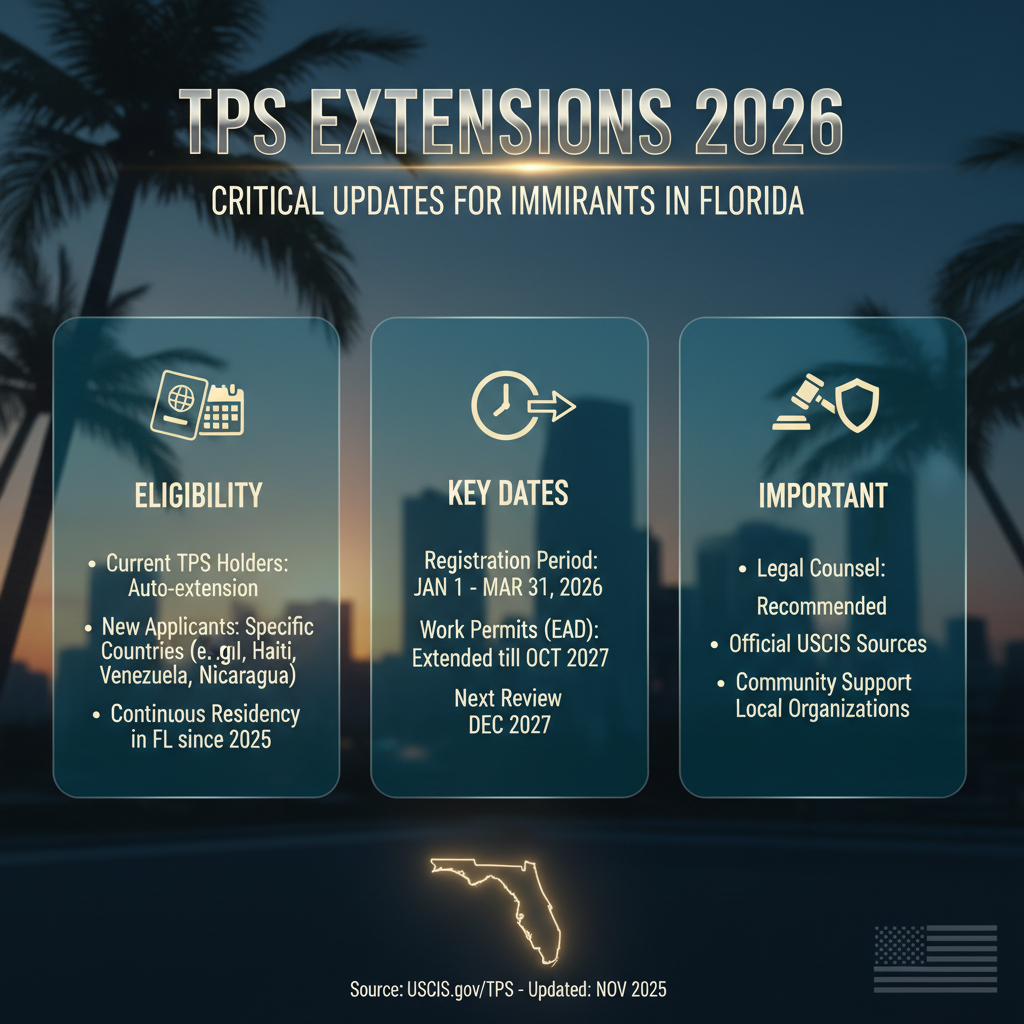
Recent announcements regarding extensions of Temporary Protected Status for several designated countries are a beacon of hope and a call to action for thousands of individuals and families. For those living in Orlando, Central Florida, and across the state, these updates directly impact your ability to live and work legally in the U.S. without fear of deportation.
Why this news is showing up now
Temporary Protected Status is a temporary immigration benefit granted by the Secretary of Homeland Security to eligible nationals of certain countries. This designation is made when conditions in the country prevent its nationals from returning safely, or when the country is unable to handle the return of its nationals adequately. These conditions often include ongoing armed conflict, environmental disaster, or other extraordinary and temporary conditions.
The "news showing up now" reflects the periodic review process mandated by the Immigration and Nationality Act (INA). The Department of Homeland Security (DHS) regularly assesses whether the conditions that led to a country's initial TPS designation, or subsequent extensions, continue to exist. If conditions have not sufficiently improved, or if new crises have emerged, the Secretary may decide to extend TPS for an additional period, typically 18 months, or even redesignate the country for TPS. Given the fluid geopolitical landscape and persistent challenges in various nations, these extensions are a frequent and critical part of immigration discourse and policy.
For example, countries previously designated for TPS often face continued instability, natural disasters, or political turmoil. These ongoing challenges necessitate that DHS reviews and, in many cases, extends the protection offered by TPS. This continuous evaluation ensures that individuals are not forced to return to unsafe environments. The current news cycle reflects the outcomes of these latest evaluations for specific countries.
How it can affect Florida residents
Florida, and particularly the Orlando metropolitan area, is home to a significant number of immigrants from TPS-designated countries. These extensions are not just bureaucratic announcements; they are lifelines. For Florida residents, especially those in Orange County and along the I-4 corridor, these updates mean:
- Continued Legal Presence: Eligible individuals can maintain their lawful status in the U.S., protecting them from deportation.
- Work Authorization: TPS beneficiaries are eligible to apply for an Employment Authorization Document (EAD), allowing them to work legally in Florida and contribute to our economy. This is crucial for supporting families and building stable lives.
- Travel Authorization: In some cases, TPS beneficiaries may be able to apply for travel authorization (advance parole), allowing them to travel outside the U.S. and return legally.
- Planning and Stability: These extensions provide a renewed sense of security, enabling families to plan for their future, pursue educational opportunities, and invest in their communities without the immediate threat of displacement.
- Community Impact: A stable immigrant population benefits Florida's diverse economy and cultural fabric. TPS beneficiaries are often integral parts of our workforce, from agriculture to tourism and healthcare.
Important: It is crucial for all eligible individuals, whether initially applying or re-registering, to understand the specific deadlines and requirements for their country's designation. Missing a deadline can have severe consequences, potentially leading to loss of status and eligibility.
Need Help? Our Orlando immigration team is ready to assist. Call +1 786-791-3106 for a free consultation, or message us online. Se Habla Español.
What Temporary Protected Status (TPS) Is (and Why It Matters)
Temporary Protected Status, or TPS, is a humanitarian immigration program offering temporary relief to nationals of certain countries who are already present in the United States. It's a critical safety net for individuals unable to return to their home country due to extraordinary circumstances.
A plain-English definition
Imagine your home country suddenly becomes unsafe – perhaps due to a massive earthquake, a devastating hurricane, or an ongoing war. If you are already in the U.S. when this happens, TPS allows you to stay here legally for a temporary period. It prevents you from being forced to return to dangerous conditions. While you have TPS, you can live and work legally in the U.S. and cannot be deported. It's not a path to permanent residency or citizenship on its own, but it offers crucial stability and protection for as long as the designation for your country remains in effect.
The Secretary of Homeland Security has the authority to grant TPS to eligible foreign countries. This decision is based on specific criteria outlined in U.S. immigration law, primarily focusing on the safety and well-being of the nationals from the designated country. The status is "temporary" because it's tied to the conditions in the home country; if those conditions improve sufficiently, TPS can be terminated.
Key terms you need to know
- Designation: When the Secretary of Homeland Security identifies a country as eligible for TPS due to qualifying conditions (e.g., armed conflict, natural disaster, extraordinary conditions).
- Extension: When the Secretary decides that the conditions justifying a country's TPS designation continue to exist, extending the period of protection, usually for 6, 12, or 18 months. This is the focus of the current news.
- Redesignation: When a country's TPS designation is renewed, but with a new eligibility date, allowing people who arrived in the U.S. after the original cutoff date to apply for TPS. This often happens if conditions worsen significantly or new crises emerge.
- Re-registration: The process by which current TPS beneficiaries apply to extend their TPS and work authorization during an extension period. This is mandatory to maintain status.
- Employment Authorization Document (EAD): Also known as a work permit, this document (Form I-766) allows TPS beneficiaries to legally work in the U.S.
- Advance Parole: A document (Form I-512L or included on Form I-131) that allows certain non-citizens to travel outside the U.S. and return legally without jeopardizing their immigration status. TPS beneficiaries may be eligible.
- Prima Facie Eligible: Means that based on the evidence provided in your application, you appear to meet the basic eligibility requirements for TPS.
Understanding these terms is vital for anyone considering applying for TPS or re-registering for an extension. The process involves specific forms, deadlines, and documentation, and a clear grasp of the terminology will help you navigate it more effectively.
Current Immigration Law: The Foundation of TPS
Temporary Protected Status is a specific provision within U.S. immigration law, designed to offer humanitarian relief. It is authorized under Section 244 of the Immigration and Nationality Act (INA), found at 8 U.S.C. § 1254a. This section grants the Secretary of Homeland Security the authority to designate a foreign country for TPS if certain conditions are met.
Federal requirements
To be eligible for TPS, an individual must meet several federal requirements:
- Nationality: Be a national of a country designated for TPS, or a person without nationality who last habitually resided in that designated country.
- Continuous Physical Presence (CPP): Have been continuously physically present in the U.S. since the effective date of the most recent designation for your country.
- Continuous Residence (CR): Have been continuously residing in the U.S. since the date specified for your country's designation. Brief, casual, and innocent departures do not break continuous residence.
- Admissibility: Meet the general admissibility requirements for immigration, though some grounds of inadmissibility can be waived. Certain criminal offenses or national security grounds will disqualify an applicant.
- Timely Application: Apply for TPS within the registration period established by USCIS for your country's designation or extension.
Warning: Individuals with certain criminal convictions (e.g., two misdemeanors or one felony) or who are found to be inadmissible on specific grounds (such as national security or terrorism) are generally ineligible for TPS. Consulting with an experienced immigration attorney is crucial to assess your eligibility, especially if you have any criminal history or past immigration violations.
For more detailed information on specific requirements and current designations, always refer to the USCIS official website.
Florida-specific considerations
While TPS is a federal program and its legal requirements are uniform across the U.S., there are practical considerations for Florida residents:
- USCIS Field Offices: If your case requires an interview or biometric services, you will likely interact with the Orlando USCIS Field Office or another office in Florida, such as the one in Miami. Understanding their local procedures can be beneficial.
- Legal Support: Florida has a large and diverse immigrant population, meaning there are many reputable immigration law firms, like Imigrar, with extensive experience in TPS applications and re-registrations.
- Community Resources: Various non-profit organizations and community groups in Central Florida offer support, language assistance, and referrals for immigrants, including those seeking TPS.
- Economic Impact: TPS beneficiaries contribute significantly to Florida's economy, particularly in sectors like hospitality, construction, and agriculture. Their continued legal status supports local businesses and families in Orlando and beyond.
The process of applying for or re-registering for TPS primarily involves submitting forms to U.S. Citizenship and Immigration Services (USCIS). The main forms are:
- Form I-821, Application for Temporary Protected Status: This is the primary application form for TPS.
- Form I-765, Application for Employment Authorization: If you wish to work legally in the U.S., you must file this form along with or after your Form I-821.
- Form I-601, Application for Waiver of Grounds of Inadmissibility: If you have certain grounds of inadmissibility, you might need to file this form. This is a complex area where legal counsel is highly recommended.
All forms and their respective instructions can be found on the USCIS Forms page. It is vital to use the most current version of each form and follow all instructions precisely.
How to Apply for TPS or Re-register: A Complete Step-by-Step Guide
Whether you are applying for TPS for the first time under a new designation or re-registering during an extension period, the process requires careful attention to detail and strict adherence to deadlines. This guide outlines the general steps; remember that specific requirements may vary slightly depending on your country's designation and the particular announcement.
1) Determine Your Eligibility and Gather Initial Information
Before you even touch a form, confirm that you meet the fundamental eligibility criteria for TPS for your specific country. This includes:
- Being a national of a country designated for TPS (or a person without nationality who last habitually resided in that country).
- Having been continuously physically present (CPP) in the U.S. since the date specified for your country.
- Having been continuously residing (CR) in the U.S. since the date specified for your country.
- Not being inadmissible due to certain criminal convictions or other grounds.
Required Documents (Initial Assessment):
- Proof of nationality (e.g., passport, birth certificate with photo ID).
- Documents proving continuous residence and physical presence (e.g., utility bills, leases, employment records, school records, medical records, bank statements, tax returns).
- Any documents related to previous immigration history in the U.S.
Reminder: The specific dates for CPP and CR are crucial and are announced by USCIS for each country's designation or redesignation. Always check the latest Federal Register notice or USCIS website for these exact dates.
2) Complete and File Form I-821, Application for Temporary Protected Status
This is the cornerstone of your TPS application. Fill out Form I-821 accurately and completely. Read all instructions carefully. Any errors or omissions can lead to delays or denial. If you are re-registering, you will still file Form I-821.
Required Documents (Form I-821):
- Completed and signed Form I-821.
- Evidence of your identity and nationality (e.g., a copy of your passport, birth certificate with photo identification, national identity card).
- Evidence of your date of entry into the U.S. and your continuous physical presence (CPP) and continuous residence (CR) from the specified dates (e.g., flight tickets, I-94 arrival/departure record, utility bills, rent receipts, school records, employment records, medical records).
- Two passport-style photos.
- Any applicable fees or a fee waiver request (Form I-912, Request for Fee Waiver).
Important: Ensure all documents are translated into English by a certified translator if they are in another language. Each translation must include the translator's certification that they are competent to translate and that the translation is accurate.
3) Complete and File Form I-765, Application for Employment Authorization (Optional but Recommended)
If you wish to work legally in the U.S. while you have TPS, you must file Form I-765. This can be filed concurrently with your Form I-821 or later. For re-registrants, filing this form within the specified window is essential to maintain work authorization.
Required Documents (Form I-765):
- Completed and signed Form I-765, with eligibility category (c)(19) for TPS.
- Two passport-style photos.
- Copy of your last EAD (if applying for renewal).
- Copy of the front and back of your Form I-94 (Arrival/Departure Record), if available.
- Copy of your last TPS approval notice (Form I-797, Notice of Action), if applicable.
- Copy of a government-issued identity document (e.g., passport, birth certificate with photo ID).
- Any applicable fees or a fee waiver request (Form I-912).
4) Attend Your Biometrics Appointment
After filing your applications, USCIS will send you a notice to attend a biometrics appointment at an Application Support Center (ASC). This appointment is mandatory. You will have your fingerprints, photograph, and signature taken. These are used for background checks and identity verification.
What to bring:
- Your appointment notice (Form I-797C).
- A valid photo identification (e.g., passport, driver's license).
Reminder: Do not miss this appointment. If you have a legitimate reason to reschedule, follow the instructions on your notice immediately.
5) Respond to Requests for Evidence (RFE) or Notices of Intent to Deny (NOID)
USCIS may determine that your application is missing information or requires further clarification. They will send you an RFE (Request for Evidence) or a NOID (Notice of Intent to Deny). It is critically important to respond to these requests fully and by the specified deadline. Failure to do so will likely result in a denial of your application.
What to do:
- Read the RFE/NOID carefully to understand exactly what USCIS is asking for.
- Gather all requested documents and information.
- Submit your response well before the deadline. Keep copies of everything you send.
6) Receive a Decision and Next Steps
Once USCIS has processed your application and completed all necessary checks, they will mail you a decision notice. If your TPS application is approved, you will receive an approval notice (Form I-797). If you also applied for an EAD, it will be mailed to you separately.
If Approved:
- Keep your approval notice and EAD in a safe place.
- Be aware of the validity dates of your TPS and EAD.
- Stay informed about future extensions or terminations of TPS for your country.
- Consider consulting an attorney about other potential immigration pathways.
If Denied:
- The denial notice will explain the reasons.
- Consult an immigration attorney immediately to discuss your options, which may include filing a motion to reconsider or reopen, or exploring other immigration relief.
You can check the general processing times for Form I-821 and Form I-765 on the USCIS Processing Times page. However, individual processing times can vary.
Navigating TPS extensions can be complex. Don't risk your status. Contact Imigrar for expert guidance on your application or re-registration. Call us at +1 786-791-3106 for a free consultation. Se Habla Español.
Practical Steps You Can Take Today to Secure Your TPS
Even if the official re-registration period for your country hasn't opened yet, or if you're awaiting a new designation, there are proactive steps you can take today to prepare. Being prepared is key to a smooth and successful application process.
Actionable Checklist (5+ items)
- Verify Your Country's Status: Regularly check the USCIS official website for announcements regarding TPS designations, extensions, or redesignations for your country. Pay close attention to the specific dates for continuous residence (CR) and continuous physical presence (CPP), as well as the filing window.
- Gather All Vital Documents: Start collecting all documents that prove your identity, nationality, date of entry, and continuous residence in the U.S. since the required date. This includes passports, birth certificates, I-94 records, utility bills, rent receipts, school transcripts, employment records, medical bills, bank statements, and tax returns. Ensure documents are current and accessible.
- Organize Your Records: Create a dedicated file (physical or digital) for all your immigration documents. Label everything clearly. This organization will save you significant time and stress when the filing period opens.
- Secure Financial Documentation: Determine if you will need to pay the application fees or apply for a fee waiver (Form I-912). If applying for a waiver, gather proof of your income, assets, and household expenses.
- Update Contact Information with USCIS: If you have moved, ensure USCIS has your current mailing address. You can update your address online through your USCIS account or by filing Form AR-11, Alien's Change of Address Card. Missing important notices due to an outdated address can be detrimental to your case.
- Consult an Immigration Attorney: This is perhaps the most crucial step. An experienced attorney can review your specific situation, confirm your eligibility, help you gather the correct documents, prepare your application, and represent you throughout the process. This is especially vital if you have any criminal history, prior immigration issues, or complex family situations.
Document Preparation Guidance
Accuracy and completeness are paramount when preparing your documents:
- Photocopies, Not Originals: Generally, USCIS requests photocopies of supporting documents. Keep your original documents safe. If USCIS needs an original, they will specifically request it.
- Translations: Any document not in English must be accompanied by a complete English translation. The translator must certify that the translation is accurate and that they are competent to translate from the foreign language into English. Include the translator's name, address, and signature.
- Chronological Order: When providing evidence of continuous residence, arrange documents in chronological order to clearly demonstrate your presence in the U.S. over the required period.
- Multiple Forms of Evidence: Don't rely on just one type of document. The more varied evidence you can provide (e.g., utility bills *and* school records *and* employment letters), the stronger your case for continuous residence.
Timeline Expectations
Understanding the typical timeline can help manage expectations:
- Filing Window: For TPS extensions or redesignations, USCIS announces a specific filing window, often a 60-day or 180-day window. It is critical to file your application within this period.
- Biometrics Appointment: After filing, expect to receive a biometrics appointment notice within 4-8 weeks.
- EAD Processing: Processing times for Employment Authorization Documents (Form I-765) can vary significantly, sometimes taking several months. USCIS often automatically extends existing EADs for TPS beneficiaries whose country has been extended, to bridge the gap while new EADs are processed. Always check the Federal Register notice for your country for specific EAD extension details.
- TPS Application Processing: The processing of Form I-821 can also take several months, depending on the volume of applications and the specific USCIS service center. You can monitor general processing times on the USCIS Processing Times page, but these are estimates.
Important: Do not wait until the last minute to file. Gather your documents and prepare your application well in advance of the deadline. This proactive approach helps avoid stress and potential errors.
How Imigrar Helps Immigrants in Orlando and Nationwide
At Imigrar, we understand the profound impact that immigration decisions have on individuals and families. Our mission is clear: "Keep Families Together." Based in Orlando, Florida, we proudly serve clients not only across Central Florida but also nationwide, providing expert legal counsel tailored to each unique situation.
Our experience and expertise
Our team of dedicated immigration attorneys possesses extensive knowledge and experience in all facets of immigration law, including the intricacies of Temporary Protected Status. We have successfully assisted countless clients with their initial TPS applications, re-registrations during extensions, and navigating the complexities that can arise.
We stay current with the ever-evolving immigration laws and policies, ensuring that our advice is always accurate and up-to-date. When you choose Imigrar, you gain a partner who understands the nuances of federal immigration regulations and how they apply to your specific case, whether you're dealing with the Orlando USCIS Field Office or communicating with national service centers.
We pride ourselves on a client-centered approach. We take the time to listen to your story, explain your options in clear, understandable language, and develop a strategic plan designed to achieve your immigration goals. Our expertise extends beyond TPS to family-based petitions, adjustment of status, naturalization, and defense against deportation, providing holistic support for your immigration journey.
Free consultation offer
We believe that everyone deserves access to quality legal advice, especially when their future is on the line. That's why Imigrar offers a free, no-obligation consultation for prospective clients. This initial meeting is an opportunity for you to discuss your situation with an experienced attorney, understand your options, and learn how we can assist you.
During your consultation, we will:
- Review your immigration history and current circumstances.
- Assess your eligibility for TPS or other immigration benefits.
- Explain the application process, required documentation, and potential timelines.
- Answer your questions and address any concerns you may have.
- Outline the legal services Imigrar can provide and our transparent fee structure.
Don't face the complex immigration system alone. Let our compassionate and knowledgeable team guide you through every step. We are here to simplify the process, minimize stress, and maximize your chances of success.
Se Habla Español: We are proud to serve our Spanish-speaking community. Our team is fully bilingual, ensuring that language is never a barrier to receiving the legal help you need. Feel comfortable discussing your case in the language you prefer.
For Central Florida residents or anyone across the nation seeking reliable immigration legal services, Imigrar is your trusted advocate. Call us today to schedule your free consultation and take the first step towards securing your future.

Frequently Asked Questions About TPS Extensions
Q: Who is eligible for a TPS extension?
A: Eligibility for a TPS extension generally applies to individuals who were granted TPS under a previous designation for their country and who continue to meet the eligibility requirements. This includes being a national of the designated country (or a person without nationality who last habitually resided there), having maintained continuous physical presence (CPP) and continuous residence (CR) in the U.S. since the specified dates, and not being inadmissible due to certain criminal offenses or other grounds. You must also re-register within the specified re-registration period announced by USCIS.
Q: How does a TPS extension impact my current immigration status and work authorization?
A: A TPS extension allows you to maintain your temporary protected status in the U.S. for the duration of the extension period, preventing deportation. If you also had an Employment Authorization Document (EAD) under your previous TPS designation, USCIS often automatically extends the validity of existing EADs for a specific period to cover the gap while new EADs are processed. This automatic extension typically ensures you can continue to work legally. Always check the specific Federal Register notice for your country to confirm the exact details of any EAD automatic extension.
Q: What is the timeline for applying for an extension, and how long does processing take?
A: USCIS will announce a specific re-registration period, typically 60 days or 180 days, during which current TPS beneficiaries must file their applications. It is crucial to file within this window. Processing times for Form I-821 (TPS application) and Form I-765 (EAD application) can vary. You can check estimated processing times on the USCIS Processing Times website, but be prepared for processing to take several months, sometimes longer. Filing early in the window is always advisable.
Q: What documents are required for re-registering for TPS?
A: For re-registration, you will typically


