


Navigating the ever-evolving landscape of U.S. immigration law can be challenging, especially when critical updates like Temporary Protected Status (TPS) extensions are announced. For thousands of individuals and families across the United States, including a significant population right here in Florida, these extensions are a lifeline, offering temporary protection from deportation and the ability to work legally.
At Imigrar, an immigration law firm based in Orlando, Florida, our mission is to Keep Families Together. We understand the profound impact that news about TPS extensions has on our communities. This comprehensive guide, updated for July 2026, aims to provide clear, actionable information regarding the latest TPS developments, ensuring you have the knowledge and resources to protect your status.
The reporting that sparked this guide
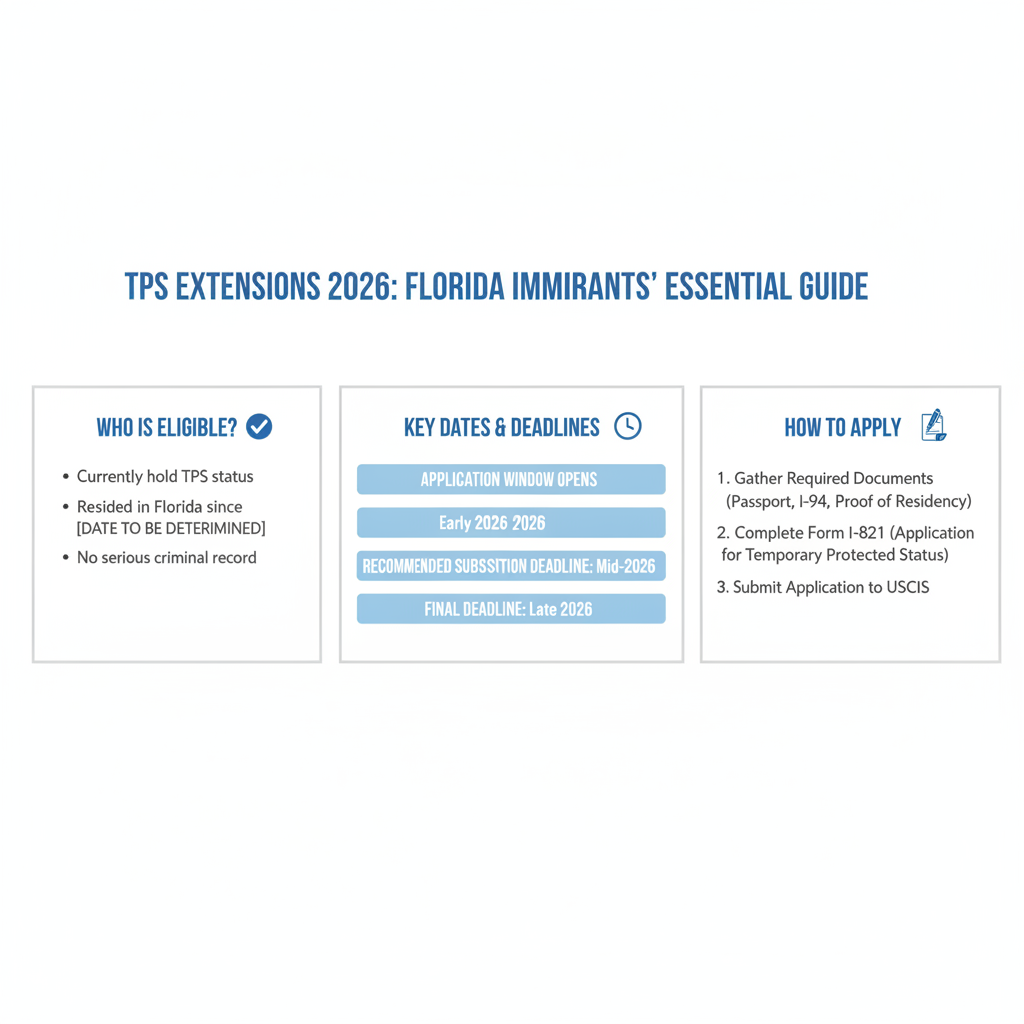
The information and advice provided in this article are informed by recent updates and discussions surrounding immigration policy and Temporary Protected Status, as highlighted by: TPS (Temporary Protected Status) Extension News (Legal News).
What This News Means for Immigrants in Orlando and Across Florida
Recent announcements regarding the extension of Temporary Protected Status for several designated countries are critical for thousands of individuals currently residing in the United States. For many, TPS offers a temporary haven from unsafe conditions in their home countries, providing stability and the opportunity to contribute to their new communities.
Why this news is showing up now
Temporary Protected Status is, by its very nature, a temporary designation. Section 244 of the Immigration and Nationality Act (INA), 8 U.S.C. § 1254a, grants the Secretary of Homeland Security the authority to designate a country for TPS if conditions there fall into one of three categories: ongoing armed conflict, environmental disaster, or other extraordinary and temporary conditions. These designations are typically for periods of 6, 12, or 18 months and are subject to regular review by the Department of Homeland Security (DHS).
The current wave of news surrounding TPS extensions in July 2026 stems from the DHS's ongoing process of reviewing the conditions in previously designated countries. Each designation or extension requires the Secretary to assess whether the statutory conditions for TPS continue to be met. Factors considered include the level of conflict, the extent of environmental recovery, political stability, and humanitarian concerns. These reviews often result in decisions to extend, re-designate, or terminate TPS for specific countries. The timing of these announcements is crucial, as they trigger specific re-registration periods for eligible individuals.
How it can affect Florida residents
Florida is home to a vibrant and diverse immigrant population, including a significant number of individuals from countries currently designated for TPS. For residents of Orlando, Kissimmee, Tampa, and other cities across Central and South Florida, these TPS extensions carry immense weight. The impact is multi-faceted:
- Protection from Deportation: The most immediate benefit is continued protection from removal from the United States. For individuals who might otherwise be subject to deportation, TPS provides a legal basis to remain in the country, fostering security and peace of mind for themselves and their families.
- Work Authorization: An extension of TPS also means that eligible individuals can continue to apply for or renew their Employment Authorization Documents (EADs), typically using Form I-765, Application for Employment Authorization. This allows them to work legally, support their families, and contribute to Florida's economy. Many businesses in Orange County and along the I-4 corridor rely on this workforce.
- Family Stability: For families where some members have TPS and others may have different immigration statuses (or none), the extension helps to Keep Families Together. It prevents the separation that could result from a TPS termination and subsequent deportation.
- Community Impact: Florida's communities, especially those with large immigrant populations, benefit from the stability that TPS provides. It allows individuals to invest in their homes, businesses, and local schools, strengthening the social and economic fabric of places like Orlando.
- Planning for the Future: While temporary, extensions allow individuals to plan for their immediate future, whether it's continuing their education, saving for a home, or exploring other potential pathways to permanent residency, if available.
For Central Florida residents, understanding these extensions is paramount. The Orlando USCIS Field Office often handles many of these cases, and knowing the specific requirements and deadlines is essential to maintaining status.
Need Help Navigating TPS Extensions? The complexities of immigration law can be overwhelming. Our Orlando immigration team at Imigrar is ready to assist you in understanding the latest TPS updates and ensuring your re-registration is handled correctly. Call +1 786-791-3106 for a free consultation, or message us online. Se Habla Español.
What Temporary Protected Status (TPS) Is (and Why It Matters)
Temporary Protected Status, or TPS, is a humanitarian immigration program administered by the U.S. Department of Homeland Security (DHS). It offers a temporary legal status to foreign nationals in the United States who are unable to return safely to their home countries due to extraordinary conditions.
A plain-English definition
Imagine your home country is experiencing a major crisis – perhaps a devastating earthquake, a widespread epidemic, or an armed conflict that makes it unsafe to live there. If you are already in the U.S. when this crisis occurs, the U.S. government might decide to grant your country "Temporary Protected Status." This means that for a specific period, you are protected from deportation and are allowed to live and work legally in the United States. It's a temporary measure, not a path to a Green Card, but it provides crucial relief and stability during uncertain times.
Key terms you need to know
- Designated Country: A foreign country (or part of a country) formally designated by the Secretary of Homeland Security as meeting the statutory criteria for TPS. This designation is what allows its nationals to apply for TPS.
- Re-registration Period: A specific, limited timeframe (typically 60 days) during which individuals who have previously been granted TPS for a designated country must apply to renew their status following an extension. Missing this deadline can lead to loss of TPS.
- Employment Authorization Document (EAD): Often referred to as a "work permit," this document (Form I-765) allows TPS beneficiaries to legally work in the United States. It must be renewed periodically.
- Form I-821, Application for Temporary Protected Status: The primary form used to apply for or re-register for TPS.
- Form I-765, Application for Employment Authorization: The form used to apply for or renew an EAD, often filed concurrently with Form I-821.
- DHS (Department of Homeland Security): The U.S. federal department responsible for public security, including immigration enforcement and the administration of TPS.
- USCIS (U.S. Citizenship and Immigration Services): An agency within the DHS responsible for administering the country's lawful immigration system, including processing TPS applications. You can find official forms and information on the USCIS official website.
- Continuous Physical Presence (CPP): A requirement that an applicant has been physically present in the U.S. for a specified period without leaving.
- Continuous Residence (CR): A requirement that an applicant has maintained residence in the U.S. for a specified period.
Important: TPS is not a permanent solution. It is a temporary status that can be extended, re-designated, or terminated depending on the conditions in the home country. While some TPS beneficiaries may qualify for other immigration pathways (like asylum or family-based petitions), TPS itself does not directly lead to permanent residency or U.S. citizenship.
Current Immigration Law: The Foundation of TPS
Temporary Protected Status is rooted in federal immigration law, specifically Section 244 of the Immigration and Nationality Act (INA), codified at 8 U.S.C. § 1254a. This statute outlines the criteria for country designations, individual eligibility, and the administrative processes involved.
Federal requirements
The INA empowers the Secretary of Homeland Security to designate a foreign country for TPS if certain conditions are met:
- Ongoing Armed Conflict: If there is an ongoing armed conflict within the state, and requiring nationals to return would pose a serious threat to their personal safety.
- Environmental Disaster: If there has been an earthquake, flood, drought, epidemic, or other environmental disaster resulting in a substantial, but temporary, disruption of living conditions, and the foreign state is unable to handle the return of its nationals adequately.
- Other Extraordinary and Temporary Conditions: If there are other extraordinary and temporary conditions in the foreign state that prevent nationals from returning safely, provided that the Secretary finds it would be contrary to U.S. national interests to deport them.
Once a country is designated, individual nationals seeking TPS must meet their own set of federal requirements:
- Be a national of a designated country (or a person without nationality who last habitually resided in that country).
- File their application within the initial registration period or any subsequent re-registration period.
- Have been continuously physically present (CPP) in the U.S. since the effective date of the most recent designation.
- Have been continuously residing (CR) in the U.S. since the date specified by the Secretary for their country's designation. Brief, casual, and innocent departures do not interrupt CR.
- Be admissible to the U.S. as an immigrant, or qualify for a waiver of inadmissibility.
- Not have been convicted of any felony or two or more misdemeanors committed in the U.S.
- Not be found to be subject to any of the mandatory bars to asylum, such as having persecuted others or having engaged in terrorist activity.
The primary forms involved in TPS applications are Form I-821, Application for Temporary Protected Status, and if employment authorization is desired, Form I-765, Application for Employment Authorization. It's crucial to obtain the latest versions of these forms directly from the USCIS Forms page.
Florida-specific considerations
While TPS is a federal program, its implementation and impact have local implications, particularly in states with large immigrant populations like Florida. For residents in Orlando, Tampa, Miami, and other parts of the state:
- Local Resources: Access to legal aid organizations, community centers, and immigration attorneys specializing in TPS can vary. Orlando, with its significant immigrant community and proximity to the Orlando USCIS Field Office, has several resources available.
- Economic Impact: TPS beneficiaries contribute significantly to Florida's economy. The ability to work legally under an EAD means they pay taxes, support local businesses, and fill essential roles in various industries, from hospitality to construction and healthcare.
- Family Dynamics: Many TPS families in Florida have mixed-status households, where children may be U.S. citizens while parents hold TPS. The extension of TPS helps maintain family unity and stability within these communities.
- Legal Support: Given the complexities of immigration law, finding an experienced immigration attorney in Central Florida is vital. An attorney can help navigate federal requirements, ensure proper documentation, and represent you in interactions with USCIS.
Reminder: Staying informed about federal notices published in the Federal Register and on the USCIS official website is essential for all TPS beneficiaries in Florida.
Confused by TPS Regulations? Don't risk your status. Imigrar's legal experts in Orlando understand the nuances of TPS law and can guide you through the re-registration process. Contact us at +1 786-791-3106 for a free consultation. Se Habla Español.
How to Re-register for TPS: A Complete Step-by-Step Guide
If your country's TPS designation has been extended, re-registration is a critical process to maintain your protected status and work authorization. Missing the re-registration window can have severe consequences, including the loss of your TPS. Follow these steps carefully:
1) Determine Your Eligibility and Re-registration Window
The first and most crucial step is to confirm that your country's TPS designation has indeed been extended and to identify the specific re-registration period. USCIS publishes this information on its website and in the Federal Register.
- Check Official Announcements: Regularly visit the USCIS official website and look for press releases or Federal Register notices specifically mentioning your country's TPS extension. These announcements will state the new expiration date and the precise start and end dates of the re-registration period.
- Confirm Individual Eligibility: Ensure you meet the criteria for re-registration, which generally means you were previously granted TPS for the designated country, have maintained continuous residence and continuous physical presence as required, and have not committed any disqualifying crimes.
- Note the Deadline: The re-registration window is typically 60 days. Mark this deadline clearly on your calendar. Warning: Late filing is rarely excused and can result in denial.
2) Gather Required Documents
Thorough document preparation is essential. You will need to provide evidence of your identity, nationality, and continuous residence in the U.S. since the initial designation date, as well as proof of your previous TPS grant.
- Proof of Identity and Nationality:
- Passport from your designated country (valid or expired).
- Birth certificate with photo identification.
- National identity document from your country with photo and/or fingerprint.
- Proof of Previous TPS Grant:
- Copy of your previous Form I-797, Approval Notice for TPS.
- Copy of your previous Employment Authorization Document (EAD) based on TPS.
- Proof of Continuous Residence (CR) in the U.S. since the specified date:
- Rent receipts, utility bills, mortgage statements.
- Employment records (pay stubs, W-2s, letters from employers).
- School records (transcripts, report cards).
- Medical records (hospital or doctor visits).
- Bank statements, credit card statements.
- Affidavits from friends, family, or employers attesting to your residence.
- Photographs: Two recent, identical passport-style color photographs.
Tip: Organize your documents chronologically in folders or binders. Make copies of everything you send to USCIS and keep the originals safely.
3) Complete and File Form I-821, Application for Temporary Protected Status
This is the primary form for re-registration. Ensure you use the latest version available on the USCIS website.
- Download the Latest Form: Visit USCIS Forms to download the current Form I-821.
- Fill Out Accurately: Complete all sections of the form truthfully and accurately. Pay close attention to questions about your criminal history, travel, and previous immigration applications.
- Sign the Form: An unsigned application will be rejected. If someone helped you prepare the form, they must also sign in the preparer's section.
- Fee: For re-registrants, there is typically no fee for Form I-821 itself, but you will likely need to pay the biometrics services fee. Always verify current fees on the USCIS website.
4) Consider Filing Form I-765, Application for Employment Authorization (EAD)
If you wish to continue working legally, you must apply for or renew your Employment Authorization Document (EAD). This is typically filed concurrently with Form I-821.
- Download the Latest Form: Obtain the current Form I-765 from the USCIS Forms page.
- Complete All Sections: Fill out the form completely, ensuring your information matches your Form I-821.
- Fee: There is a separate filing fee for Form I-765. Check the current fee schedule on USCIS.gov.
- Fee Waiver (Optional): If you cannot afford the fees, you may be eligible to apply for a fee waiver using Form I-912, Request for Fee Waiver. You must submit this form and supporting documentation with your application package.
5) Pay Required Fees or File for a Fee Waiver
Most TPS re-registrants will need to pay a biometrics services fee. If you are also filing Form I-765, that will incur an additional fee.
- Check Current Fees: Always refer to the USCIS Fee Schedule for the most up-to-date information.
- Payment Methods: Fees can usually be paid by money order, personal check, cashier's check, or by credit card using Form G-1450, Authorization for Credit Card Transactions.
- Fee Waiver Eligibility: If your household income is below 150% of the Federal Poverty Guidelines, you receive a means-tested benefit, or you are experiencing financial hardship, you may qualify for a fee waiver. Submit Form I-912 with evidence of your eligibility.
6) Mail Your Application Package
Once all forms are completed, signed, and fees/fee waiver requests are prepared, assemble your application package.
- Assemble Correctly: Follow any specific USCIS instructions for assembling your package (e.g., using clips instead of staples, placing forms in a certain order).
- USCIS Filing Address: The filing address for TPS applications depends on your mailing address and the country you are applying for. Always check the "Where to File" section on the USCIS webpage for Form I-821.
- Send with Tracking: Use a reputable mail service (e.g., USPS Certified Mail, FedEx, UPS) that provides a tracking number. This is your proof of timely submission.
7) Attend Biometrics Appointment (If Required)
After filing, USCIS will send you a receipt notice (Form I-797C) and, in most cases, an appointment notice for biometrics.
- Receive Appointment Notice: USCIS will mail you Form I-797C, Notice of Action, detailing the date, time, and location for your biometrics appointment. This will likely be at an Application Support Center (ASC) near Orlando or your Central Florida residence.
- Attend Appointment: Bring the appointment notice and a valid photo ID (e.g., passport, EAD). At the appointment, your fingerprints, photograph, and signature will be taken. This data is used for background and security checks.
8) Monitor Your Case Status
You can track the progress of your application online.
- Receipt Number: Use the 13-character receipt number from your Form I-797C.
- Online Tools: Go to the USCIS Case Status Online tool to check for updates.
- Processing Times: You can also check estimated processing times for your service center at USCIS Processing Times.
Important: If USCIS sends a Request for Evidence (RFE) or a Notice of Intent to Deny (NOID), respond promptly and thoroughly. Consulting with an attorney at this stage is highly recommended.

Practical Steps You Can Take Today for TPS Re-registration
Proactive preparation can significantly reduce stress and improve the success of your TPS re-registration. Here are actionable steps you can take starting today:
Actionable Checklist:
- Verify Your Country's Status: Immediately confirm if your country's TPS designation has been extended and note the exact re-registration deadline. Check the USCIS official website.
- Locate All Previous Immigration Documents: Gather your previous TPS approval notices, EADs, passports, birth certificates, and any other immigration-related documents.
- Update Your Address with USCIS: If you have moved since your last TPS application, file Form AR-11, Alien's Change of Address Card, online or by mail, within 10 days of moving. This ensures you receive all critical notices from USCIS. Failure to do so can lead to missed appointments or RFEs.
- Start Gathering Proof of Continuous Residence: Begin compiling documents that prove your continuous residence in the U.S. since your original TPS designation. This includes utility bills, bank statements, employment records, school records, and medical bills. Aim for at least one document per month for the entire period.
- Consult with an Immigration Attorney Promptly: The re-registration process can be complex. An experienced attorney can review your eligibility, help gather documents, prepare your application, and address any potential issues. This is especially important if you have had any arrests, convictions, or significant travel outside the U.S.
- Make Copies of Everything: Before submitting your application, make a complete set of copies for your records. This includes all forms, supporting documents, and the check/money order for fees.
- Set Reminders for Deadlines: Use digital calendars, phone alarms, or physical planners to ensure you do not miss the re-registration deadline.
- Review Your Criminal Record: If you have any arrests or convictions, even minor ones, discuss them fully with your attorney. Certain offenses can disqualify you from TPS. Obtain certified court dispositions for all incidents.
Document Preparation Guidance:
- Organize Systematically: Use folders, binders, or dividers to keep your documents organized. A chronological order for residence proof is often most effective.
- Highlight Key Information: For lengthy documents like bank statements, highlight the relevant dates and your name/address.
- Provide Translations: If any of your supporting documents


