


The landscape of U.S. immigration law is constantly evolving, with policy changes and updates frequently impacting the lives of individuals and families across the nation. Today, a significant development regarding Temporary Protected Status (TPS) extensions has emerged, bringing both relief and critical deadlines for many. For immigrants residing in Orlando, Central Florida, and throughout the Sunshine State, understanding these changes is not just important—it's essential for maintaining legal status and stability.
At Imigrar, an immigration law firm based in Orlando, Florida, our mission is to "Keep Families Together." We understand the profound impact that news like this has on our community. This comprehensive guide is designed to break down the latest TPS extension news, explain what TPS means, walk you through the application process, and provide actionable advice to protect your future.
Need Help? Navigating TPS extensions can be complex. Our Orlando immigration team is ready to assist. Call +1 786-791-3106 for a free consultation, or message us online. Se Habla Español.
NEWS SOURCE REFERENCE SECTION
The reporting that sparked this guide: TPS (Temporary Protected Status) Extension News (Legal News)
What This News Means for Immigrants in Orlando and Across Florida
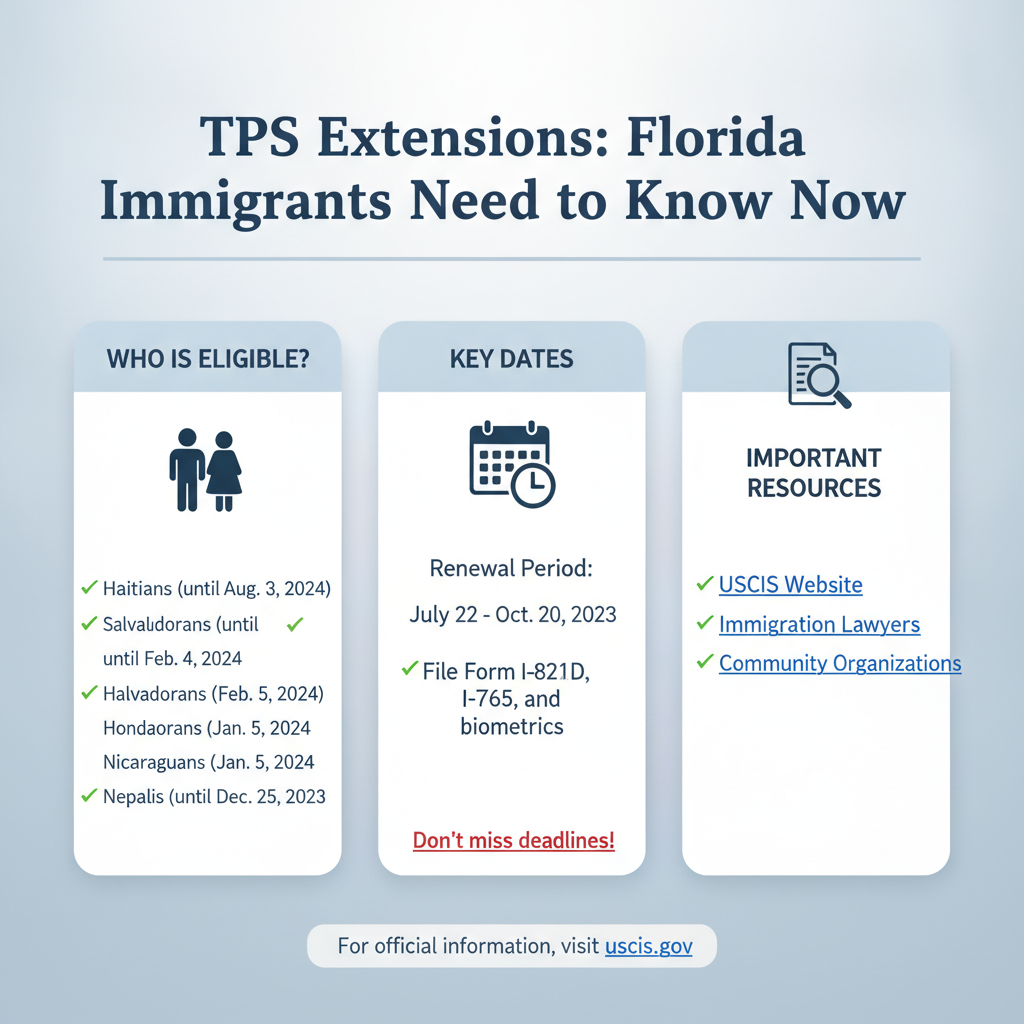
Recent announcements regarding Temporary Protected Status (TPS) extensions for several designated countries are making headlines and directly affecting hundreds of thousands of individuals. This news is a beacon of hope for many, offering continued protection from deportation and the ability to work legally in the United States. However, it also comes with urgent deadlines and specific requirements that must be met to avoid jeopardizing one's status.
Why this news is showing up now
The U.S. Secretary of Homeland Security has the authority, under the Immigration and Nationality Act (INA), to designate a country for TPS when conditions there prevent its nationals from returning safely. These conditions typically include armed conflict, environmental disaster (like earthquakes or hurricanes), or other extraordinary and temporary conditions. TPS designations are not permanent; they are granted for periods of 6, 12, or 18 months and must be periodically reviewed for extension, re-designation, or termination.
The current news cycle is driven by the Department of Homeland Security's (DHS) recent review of conditions in several designated countries. After careful assessment, DHS has determined that the extraordinary and temporary conditions justifying TPS for these nations persist. This decision often reflects ongoing instability, humanitarian crises, or the slow pace of recovery in the home countries, making it unsafe for nationals to return. Therefore, extensions are announced to provide continued relief to those already holding TPS and, in some cases, to allow new applicants from those countries to apply if re-designation has also occurred.
These announcements are crucial because they set new re-registration periods and automatically extend the validity of certain Employment Authorization Documents (EADs) and other immigration documents for current beneficiaries, preventing gaps in their legal work authorization and protection from removal. The U.S. government is bound by law to assess these conditions and make determinations, leading to these periodic news updates that are vital for the immigrant community.
How it can affect Florida residents
Florida is home to one of the largest and most diverse immigrant populations in the United States. Many residents of the Sunshine State hail from countries currently designated for TPS, including significant communities from Venezuela, Haiti, Nicaragua, El Salvador, Honduras, and others. For these individuals and their families, TPS extensions are profoundly impactful:
- Continued Stability: An extension means that thousands of families in Orlando, Tampa, Miami, and other Central and South Florida cities can continue to live and work without the immediate fear of deportation. This stability is critical for children attending schools, parents holding jobs, and families contributing to the local economy and community fabric.
- Work Authorization: For many TPS beneficiaries, their Employment Authorization Document (EAD) is their lifeline. The automatic extension of EAD validity, often accompanying a TPS extension announcement, ensures that individuals can maintain their jobs and financial security without interruption. This is particularly important in Florida's competitive job market, especially along the I-4 corridor and in major metropolitan areas like Orange County.
- Planning for the Future: While TPS is temporary, extensions offer a window of opportunity for beneficiaries to explore other potential avenues for permanent residency, if available. It buys time for legislative changes, personal circumstances to evolve, or for family petitions to process.
- Legal Clarity and Urgency: The news also brings a sense of urgency. TPS extensions come with specific re-registration deadlines. Missing these deadlines can lead to a loss of status, work authorization, and protection. For Central Florida residents, understanding these precise dates and requirements is paramount to avoid critical mistakes.
- Local Impact: The immigrant communities in Florida are vibrant and integral to the state's economy and culture. Continued TPS allows these communities to thrive, supporting local businesses, schools, and social services. Conversely, any uncertainty or confusion around TPS can cause widespread anxiety and disruption, making clear, actionable legal guidance from firms like Imigrar indispensable.
The Orlando USCIS Field Office and local immigration courts will experience increased activity during re-registration periods. Having local legal representation that understands the nuances of these processes and the specific needs of Florida's diverse immigrant population is a tremendous advantage.
What Temporary Protected Status (TPS) Is (and Why It Matters)
Temporary Protected Status (TPS) is a humanitarian immigration program established by the U.S. Congress. It offers a lifeline to individuals from certain countries who cannot safely return to their homelands due to specific, temporary, and extraordinary conditions. Understanding TPS is crucial for anyone whose country has been designated, as it provides vital protections and opportunities.
A plain-English definition
Imagine your home country becomes unsafe – perhaps due to a devastating natural disaster like an earthquake or hurricane, an ongoing civil war, or other severe and temporary problems. If the U.S. government determines that it's too dangerous for its citizens to return, it can grant them "Temporary Protected Status." This means you're allowed to stay and work in the United States legally for a specific period (usually 6, 12, or 18 months), protected from deportation. It's not a green card or a path to permanent residency on its own, but it's a temporary legal status that offers safety and stability until conditions in your home country improve.
The core purpose of TPS is humanitarian relief. It prevents the U.S. from sending people back to dangerous situations while also allowing them to contribute to the U.S. economy and society during their stay. It's a temporary solution to a temporary crisis.
Key terms you need to know
Navigating TPS requires familiarity with several important terms:
- Designated Country: A country officially identified by the Secretary of Homeland Security as meeting the criteria for TPS due to ongoing armed conflict, environmental disaster, or other extraordinary and temporary conditions. Nationals of these countries are eligible.
- Registration Period: The specific timeframe during which eligible individuals must apply for TPS (initial registration) or re-register for an extension. These periods are strict, and missing them can lead to loss of status.
- Re-registration: The process by which current TPS beneficiaries apply to extend their status when the designation for their country is extended. This typically involves submitting updated forms and fees.
- Initial Filing: The first-time application for TPS by someone who has never held it before, usually during a new country designation or re-designation that opens up eligibility for new applicants.
- Employment Authorization Document (EAD): Often referred to as a "work permit," this document (Form I-766) allows TPS beneficiaries to legally work in the United States. Obtaining an EAD is a key benefit of TPS.
- Travel Authorization (Advance Parole): This is permission granted by USCIS (Form I-131) for a TPS beneficiary to travel outside the U.S. and lawfully return. Traveling without Advance Parole can lead to serious immigration consequences, including the loss of TPS.
- Continuous Physical Presence (CPP): A requirement that an applicant has been physically present in the U.S. since a specific date set by the TPS designation for their country, with only brief, innocent, and casual departures permitted.
- Continuous Residence (CR): A requirement that an applicant has continuously maintained residence in the U.S. since a specific date set by the TPS designation for their country.
- DHS (Department of Homeland Security): The federal agency responsible for administering immigration laws, including making TPS designations and processing applications.
- USCIS (U.S. Citizenship and Immigration Services): A component of DHS, responsible for processing immigration benefits, including TPS applications.
- I-821 (Application for Temporary Protected Status): The primary form used to apply for or re-register for TPS.
- I-765 (Application for Employment Authorization): The form used to apply for an EAD.
- I-131 (Application for Travel Document): The form used to apply for Advance Parole.
Understanding these terms is fundamental to successfully navigating the TPS process and ensuring you maintain your legal status and benefits. It matters because it provides a temporary haven, allowing individuals to escape dangerous conditions and rebuild their lives, even if only for a limited time, contributing to the fabric of communities like those in Orlando.
Worried about deadlines or complex forms? Imigrar can help ensure your TPS application or re-registration is filed correctly and on time. Don't risk your status. Call +1 786-791-3106 for expert guidance. Se Habla Español.
Current Immigration Law: The Foundation of TPS
Temporary Protected Status is not a discretionary program; it is firmly rooted in U.S. immigration law, specifically the Immigration and Nationality Act (INA). Understanding the legal framework is key to appreciating the requirements and protections TPS offers.
TPS was established by Section 244 of the Immigration and Nationality Act (INA), found at 8 U.S.C. § 1254a. This statute grants the Secretary of Homeland Security (formerly the Attorney General) the authority to designate a foreign country for TPS. The designation can occur if the Secretary finds that conditions in that country fall into one of three statutory bases:
- There is an ongoing armed conflict within the state, and requiring the return of nationals would pose a serious threat to their personal safety.
- There has been an earthquake, flood, drought, epidemic, or other environmental disaster in the state resulting in a substantial, but temporary, disruption of living conditions, and the state is unable to handle the return of its nationals adequately.
- There exist extraordinary and temporary conditions in the foreign state that prevent nationals from returning safely, unless the Secretary finds that permitting the nationals to remain in the United States is contrary to the national interest.
Once a country is designated, eligible nationals of that country who are already present in the U.S. on the date of designation can apply for TPS. TPS status provides temporary lawful status, protection from removal (deportation), and eligibility for employment authorization and travel authorization.
Federal requirements for TPS
To be eligible for TPS, whether for initial registration or re-registration, individuals must meet several strict federal criteria:
- Nationality: Be a national of a country designated for TPS, or a person without nationality who last habitually resided in that designated country.
- Continuous Physical Presence (CPP): Have been continuously physically present in the United States since the effective date of the most recent designation for your country. Brief, casual, and innocent departures from the U.S. do not break CPP.
- Continuous Residence (CR): Have been continuously residing in the United States since the effective date of the most recent designation for your country.
- Timely Application: Apply for TPS during the initial registration period or any subsequent re-registration period. Late applications are generally only accepted under specific, limited circumstances.
- Admissibility: Meet certain admissibility requirements. Applicants must not have been convicted of any felony or two or more misdemeanors committed in the U.S. They must also not be subject to any of the mandatory bars to asylum (e.g., persecution of others, certain severe criminal offenses, or engaging in terrorist activity).
- Security Checks: Pass all required security and background checks.
It's important to note that even if a country's TPS designation is extended, individuals must still re-register within the specified window and continue to meet all eligibility requirements. Failure to do so can result in the loss of TPS.
Florida-specific considerations
While TPS is a federal program, its impact and the application process have specific considerations for residents of Florida:
- High Concentration of Beneficiaries: Florida has a particularly large population of immigrants from several TPS-designated countries, including Venezuela, Haiti, Nicaragua, El Salvador, and Honduras. This means that TPS extensions directly affect a significant portion of the state's immigrant communities, especially in major metropolitan areas like Orlando, Miami, and Tampa.
- Local USCIS Offices: For Central Florida residents, the Orlando USCIS Field Office (at 5449 Forbes Pl, Orlando, FL 32812) is the primary local point of contact for biometrics appointments and, in some cases, interviews. However, all TPS applications are filed with specific USCIS Lockbox facilities, not directly at the field office.
- Support Services: Florida's extensive network of community organizations and legal aid groups often provide assistance to TPS beneficiaries. However, due to the volume of cases, professional legal counsel from firms like Imigrar is often essential for accurate and timely filing.
- State Legislation: While Florida does not have its own TPS laws, state-level policies can sometimes indirectly impact immigrants. It is always wise for immigrants to stay informed about local and state regulations in addition to federal immigration law.
When applying for or re-registering for TPS, several USCIS forms are typically involved:
- Form I-821, Application for Temporary Protected Status: This is the primary form for TPS.
- Form I-765, Application for Employment Authorization: Used to request an EAD.
- Form I-131, Application for Travel Document: Used to request Advance Parole for international travel.
- Form I-912, Request for Fee Waiver: If you cannot afford the filing fees.
All these forms and detailed instructions can be found on the USCIS official website. It is crucial to use the most current version of each form.

How to Apply for TPS (or Re-register): A Complete Step-by-Step Guide
Whether you are applying for TPS for the first time (initial registration) or re-registering to extend your current status, the process requires careful attention to detail and strict adherence to deadlines. This step-by-step guide will walk you through the essential actions.
1) Determine Your Eligibility and Designation Status
Before you begin, confirm that your country is currently designated for TPS and that you meet the specific eligibility requirements for that designation. USCIS provides official notices (Federal Register notices) outlining the designation dates, continuous residence (CR) and continuous physical presence (CPP) dates, and the specific registration/re-registration period.
- Check Your Country's Status: Visit the USCIS TPS webpage to verify if your country is designated or has received an extension/re-designation. Pay close attention to the dates.
- Confirm Continuous Residence and Physical Presence: Ensure you have been living in the U.S. since the CR date and physically present since the CPP date. Gather documents that prove your presence here since those dates.
- Review Inadmissibility Grounds: Honestly assess if you have any criminal convictions (felonies or two or more misdemeanors) or other grounds of inadmissibility that could bar you from TPS. This is a critical step where legal counsel is highly recommended.
Required Documents (for this step):
- Proof of Nationality: Valid passport, birth certificate with photo ID, or national identity document from your designated country.
2) Prepare and File Form I-821, Application for Temporary Protected Status
This is the cornerstone of your TPS application. Complete Form I-821 accurately and thoroughly. USCIS scrutinizes every detail, and errors can lead to delays or denials.
- Download the Latest Form: Always download the most current version of Form I-821 from the USCIS Forms page.
- Provide Detailed Information: Fill out every section completely. If a question doesn't apply, write "N/A."
- Gather Supporting Documents: This is the most crucial part. You must provide evidence to prove your identity, nationality, continuous residence, and continuous physical presence in the U.S. since the specified dates.
Required Documents (bullet list for Form I-821):
- Copy of your birth certificate.
- Copy of your passport (valid or expired), national identity card, or other proof of nationality.
- Two passport-style photographs (taken within 30 days of filing).
- Proof of Continuous Residence (CR) since the designation date: Lease agreements, utility bills (electricity, water, gas, internet), bank statements, employment records (pay stubs, tax returns), school records (transcripts, enrollment letters), medical records, dated receipts, affidavits from family/friends.
- Proof of Continuous Physical Presence (CPP) since the designation date: Entry stamps, airline tickets, school records, employment records, medical records.
- For re-registration: Copy of your previous TPS approval notice (Form I-797) and previous EAD.
- Any evidence related to criminal history (even if expunged) – consult an attorney first.
3) File Form I-765, Application for Employment Authorization (Optional but Recommended)
If you wish to work legally in the U.S., you must apply for an Employment Authorization Document (EAD). You can file Form I-765 concurrently with your Form I-821.
- Complete Form I-765: Use the most recent version. Make sure the category code (e.g., (c)(19) for TPS) is correct.
- Include Supporting Documents:
Required Documents (bullet list for Form I-765):
- Two passport-style photographs.
- Copy of your last EAD (if renewing).
- Copy of the receipt notice for your pending Form I-821 (if filing separately).
- Copy of your birth certificate or passport.
- Copy of your I-94, Arrival/Departure Record (if available).
4) Consider Form I-131, Application for Travel Document (Advance Parole)
If you anticipate needing to travel outside the United States while your TPS is valid, you must apply for Advance Parole. Traveling without it can terminate your TPS and make you inadmissible upon return.
- File Concurrently or Separately: You can file Form I-131 with your Form I-821 and I-765, or at a later date.
- Explain Your Travel Need: USCIS requires a reason for travel. This is typically for humanitarian, educational, or employment purposes.
- Warning: Never travel outside the U.S. without an approved Advance Parole document. Even with Advance Parole, consult an attorney about potential risks depending on your immigration history.
Required Documents (bullet list for Form I-131):
- Two passport-style photographs.
- Copy of your TPS approval notice (Form I-797).
- Explanation of your travel purpose and dates.
- Proof of any previous Advance Parole documents.
5) Pay the Required Fees (or Apply for a Fee Waiver)
Each form typically has a filing fee. Check the USCIS website for


