


Date: 2026-09-16
The reporting that sparked this guide: TPS (Temporary Protected Status) Extension News (Legal News)
What This News Means for Immigrants in Orlando and Across Florida
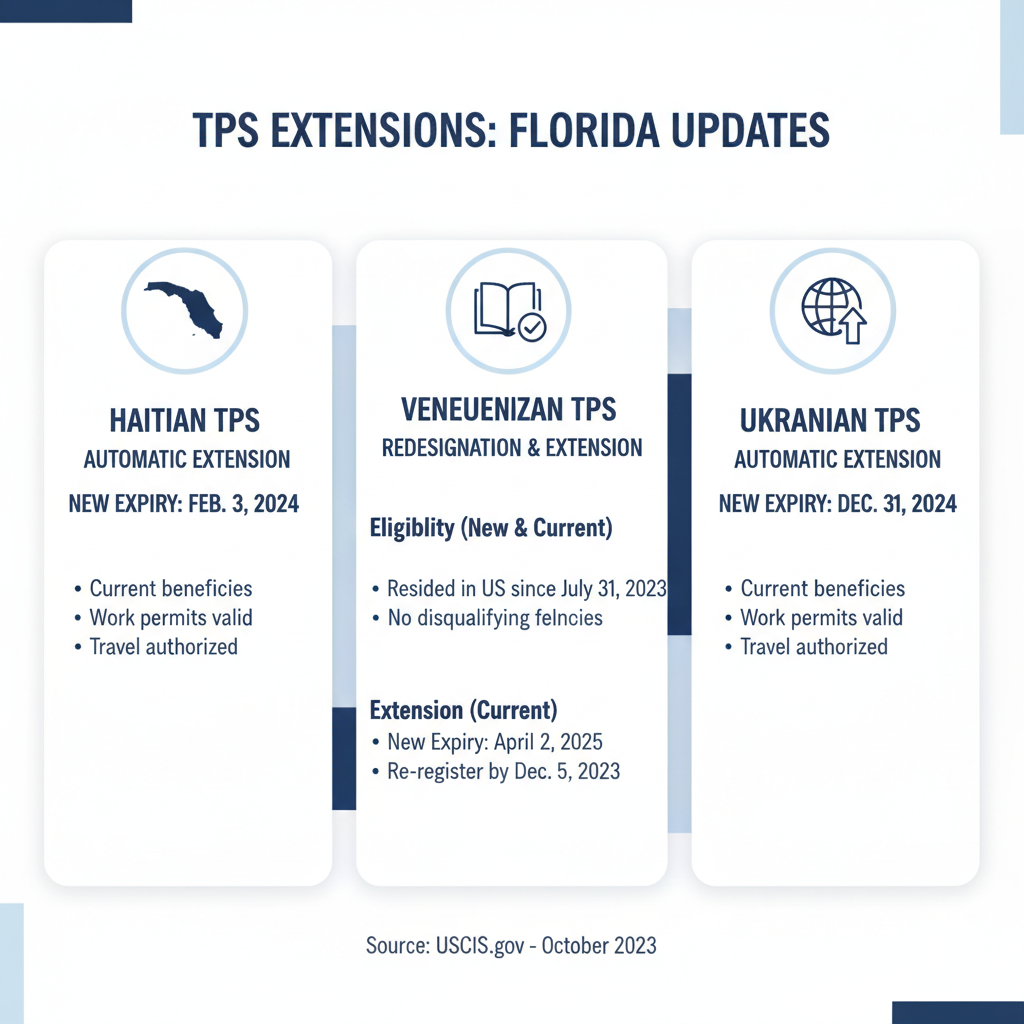
The landscape of U.S. immigration law is constantly shifting, and recent announcements regarding Temporary Protected Status (TPS) extensions are a prime example. For thousands of individuals and families living in Orlando, across Central Florida, and throughout the nation, these updates are not just headlines; they are critical lifelines that impact their ability to live, work, and contribute to their communities without fear of deportation.
Why this news is showing up now
Temporary Protected Status (TPS) is a humanitarian immigration benefit granted by the Secretary of Homeland Security to eligible nationals of certain countries who are already present in the United States. This designation occurs when conditions in a specific country temporarily prevent its nationals from returning safely, or when the country is unable to handle the return of its nationals adequately. These conditions often include ongoing armed conflict, environmental disasters, or other extraordinary and temporary conditions.
The "news" about TPS typically refers to a few key events: new country designations, extensions of existing designations, or redesignations for countries already on the list. When a country's TPS designation is extended, it means that eligible individuals from that country who already have TPS can re-register to maintain their status for an additional period, usually 18 months. A redesignation allows individuals who may not have been eligible under the original designation to apply, often because new conditions have arisen or the original conditions have worsened. These announcements are not arbitrary; they are the result of ongoing assessments by the Department of Homeland Security (DHS) regarding the safety and stability of the designated countries. Given the dynamic global environment, these evaluations are frequent, leading to a continuous cycle of extensions and redesignations for various countries.
Recent reports highlight a trend of extending TPS for several designated countries, reflecting a continued recognition by the U.S. government that conditions in these nations remain unsafe for the forced return of their citizens. These extensions are crucial because they allow current TPS holders to maintain their legal status, employment authorization, and protection from removal (deportation) from the United States. Without these extensions, many individuals would face an uncertain future, potentially losing their ability to work legally and facing the threat of being sent back to dangerous circumstances.
Important: Staying informed about these specific country designations and their respective deadlines is paramount. The details, including the eligibility criteria and registration periods, can vary significantly for each country.
How it can affect Florida residents
Florida, and particularly the vibrant community of Orlando, is home to a diverse immigrant population from across the globe. Many residents in Central Florida hail from countries that have, at various times, been designated for TPS. For these individuals, news of an extension means the continuation of stability and the ability to plan for their futures. It means:
- Continued Legal Presence: TPS holders can continue to reside legally in the United States, free from the immediate threat of deportation. This provides immense peace of mind for families, allowing them to remain united.
- Work Authorization: An extended TPS status typically comes with an automatic extension or eligibility to apply for a new Employment Authorization Document (EAD), also known as a work permit. This is vital for sustaining families, contributing to Florida’s economy, and building stable lives. Many businesses in Orlando and throughout the I-4 corridor rely on the skilled and dedicated workforce provided by immigrants.
- Travel Authorization: While not automatic, TPS holders may apply for a travel document (Form I-131, Application for Travel Document) to travel internationally and return to the U.S. This allows them to visit family in safe third countries or attend to urgent matters, although travel to the designated country is generally advised against and can affect future immigration applications.
- Community Stability: For cities like Orlando, having a stable immigrant population contributes to the overall well-being and economic vitality of the community. Children can continue their education without disruption, families can maintain their homes, and individuals can continue to contribute to the local economy and culture.
- Opportunity for Other Relief: While TPS itself is a temporary benefit and does not directly lead to a Green Card, maintaining TPS can provide a stable platform from which individuals may explore other potential avenues for permanent residency, if they become eligible through family petitions, employment-based visas, or other forms of relief.
For Central Florida residents, understanding these extensions is not merely academic. It requires immediate action, often within a specific re-registration window, to avoid lapsing status. Missing a deadline can have severe consequences, potentially leading to loss of status and increased risk of removal. This is why reliable legal guidance is not just helpful, but often essential.
Need Help? Our Orlando immigration team is ready to assist. Call +1 786-791-3106 for a free consultation, or message us online. Se Habla Español.
What Temporary Protected Status (TPS) Is (and Why It Matters)
Temporary Protected Status, or TPS, is a unique immigration program designed to offer a safe haven to foreign nationals from countries experiencing severe crises. It’s a humanitarian measure, reflecting the U.S. government’s commitment to not forcing individuals back into dangerous or unstable conditions. Understanding TPS is crucial for anyone whose home country is affected by conflict, disaster, or other extraordinary circumstances.
A plain-English definition
Imagine your home country suddenly becomes a very dangerous place to live – perhaps due to a massive natural disaster like an earthquake or hurricane, a devastating war, or other extreme and unusual circumstances that make it impossible for you to return safely. If you are already in the United States when this happens, the U.S. government might decide to grant "Temporary Protected Status" to people from your country.
In simple terms, TPS means you are allowed to stay in the U.S. legally for a temporary period. It protects you from being deported (removed) and allows you to obtain a work permit (Employment Authorization Document or EAD). You can also apply for permission to travel outside the U.S. and return, though this must be specifically authorized. TPS is temporary; it doesn't automatically lead to a Green Card or U.S. citizenship. It lasts for a specific period, usually 6, 12, or 18 months, and can be extended if the conditions in your home country don't improve.
This status is a vital lifeline for individuals who would otherwise face immense hardship or danger upon returning to their home countries. It allows them to live and work in safety, support their families, and contribute to their communities here in the U.S. while their home country recovers.
Key terms you need to know
Navigating TPS requires familiarity with several specific terms. Here’s a breakdown:
- Designation: This is the initial act by the Secretary of Homeland Security to identify a country as eligible for TPS. It means that, as of a certain date, individuals from that country who meet specific criteria can apply for TPS.
- Extension: When a country's TPS designation is nearing its end date, DHS reviews the conditions in that country. If the conditions warrant, the designation can be "extended" for another period, typically 6, 12, or 18 months. This means current TPS holders must re-register to maintain their status.
- Redesignation: Sometimes, conditions in a designated country worsen significantly, or new extraordinary conditions arise after the initial designation. In such cases, DHS might "redesignate" the country. A redesignation allows individuals who arrived in the U.S. after the initial designation's "continuous residence" date (but before the redesignation's new "continuous residence" date) to apply for TPS, in addition to those who were already eligible.
- Continuous Physical Presence (CPP): This refers to the requirement that an applicant must have been continuously physically present in the United States since a specific date set by the TPS designation for their country. Brief, casual, and innocent absences generally do not break CPP.
- Continuous Residence (CR): This refers to the requirement that an applicant must have continuously resided in the United States since a specific date set by the TPS designation for their country. Like CPP, brief, casual, and innocent absences do not necessarily break CR.
- Employment Authorization Document (EAD): Also known as a work permit, this document (Form I-766) allows TPS holders to work legally in the U.S. while their status is valid.
- Travel Authorization (Advance Parole): This is permission granted by USCIS (Form I-131) for a TPS holder to travel outside the U.S. and be allowed to return. Traveling without advance parole can result in the loss of TPS and inability to re-enter the U.S.
- Re-registration Period: This is a specific window of time, usually 60 days, during which current TPS holders must apply to extend their status when their country’s designation is extended. Missing this deadline without good cause can lead to the loss of TPS.
- USCIS: The U.S. Citizenship and Immigration Services is the government agency responsible for processing TPS applications and other immigration benefits. You can find more information on their official website.
Current Immigration Law: The Foundation of TPS
Temporary Protected Status is rooted in federal immigration law, specifically the Immigration and Nationality Act (INA). Understanding the legal framework is essential for grasping the nuances of TPS eligibility and the application process.
Federal requirements for TPS eligibility
The authority to designate a country for TPS stems from Section 244 of the Immigration and Nationality Act (INA), codified at 8 U.S.C. § 1254a. This section outlines the conditions under which the Secretary of Homeland Security can grant TPS and the criteria individuals must meet to be eligible. The federal requirements are uniform across the United States, including Florida, and generally include:
- Nationality: You must be a national of a country designated for TPS, or a person without nationality who last habitually resided in that designated country.
- Continuous Physical Presence (CPP): You must have been continuously physically present in the United States since the effective date of your country's most recent TPS designation or redesignation.
- Continuous Residence (CR): You must have continuously resided in the United States since the effective date of your country's most recent TPS designation or redesignation. Brief, casual, and innocent departures from the U.S. generally do not break continuous physical presence or continuous residence.
- Timely Application: You must apply for TPS during the initial registration period announced for your country, or during any subsequent re-registration period if your country's designation is extended. If you are applying for redesignation, you must apply during that specific registration period. Late applications may be accepted under limited circumstances.
- Admissibility: You must meet certain admissibility requirements. Certain criminal convictions, national security grounds, or other serious immigration violations can render an applicant ineligible for TPS. For example, individuals convicted of any felony or two or more misdemeanors in the U.S. are generally ineligible.
- No Inadmissibility Bars: You must not be subject to certain bars to asylum, such as having persecuted others, or having committed a particularly serious crime.
It’s important to note that the specific dates for Continuous Physical Presence (CPP) and Continuous Residence (CR) are unique to each country's designation or redesignation. These dates are announced by USCIS when a country is designated, extended, or redesignated for TPS. You can always check the USCIS official website for the latest country-specific information.
Florida-specific considerations for TPS applicants
While the federal requirements for TPS are universal, there can be practical considerations specific to applicants living in Florida, particularly in densely populated areas like Orlando and its surrounding counties (e.g., Orange County, Seminole County, Osceola County).
- Processing Centers: While applications are sent to specific USCIS Lockbox facilities based on the form and filing location, the ultimate processing is handled by USCIS service centers. Florida residents will have their applications processed similarly to those from other states. However, any in-person interviews or biometrics appointments (fingerprinting, photos) will typically be scheduled at a local USCIS Application Support Center (ASC) or Field Office. For Central Florida residents, this often means the Orlando USCIS Field Office or nearby ASCs.
- Community Resources: Florida has numerous community organizations and non-profits that offer assistance to immigrants. These groups can sometimes help with document translation, filling out forms, or referring individuals to legal aid services.
- Prevalence of Certain Nationalities: Due to historical migration patterns and geographic proximity, Florida is home to significant populations from various TPS-designated countries. For example, there are large communities from Haiti, Venezuela, and Nicaragua in Florida. This means there is often a strong network of support and information-sharing within these communities, but also a higher demand for qualified legal services.
- Legal Expertise: Navigating the specific requirements for re-registration or initial application, especially when conditions in a country lead to redesignation, can be complex. An attorney familiar with both federal immigration law and the specific needs of Florida's diverse immigrant population can be invaluable.
When applying for TPS, you will primarily use Form I-821, Application for Temporary Protected Status. If you also wish to work, you will need to file Form I-765, Application for Employment Authorization. If you need to travel outside the U.S., you will file Form I-131, Application for Travel Document. All these forms, along with their instructions and filing fees, can be found on the USCIS Forms page.
Don't risk your status. Timely and accurate filing is critical for TPS extensions. Contact Imigrar at +1 786-791-3106 for expert assistance in Orlando and nationwide. Se Habla Español.
How to Apply for or Re-register for TPS: A Complete Step-by-Step Guide
Whether you are applying for TPS for the first time under a new designation or redesignation, or re-registering to extend your current status, the process demands meticulous attention to detail. This step-by-step guide will help you navigate the application process.
1) Determine Your Eligibility and Country Designation
Before you begin, confirm that your country is currently designated for TPS or has been extended/redesignated. Verify the specific eligibility dates for Continuous Physical Presence (CPP) and Continuous Residence (CR) for your country. These dates are crucial. You must also ensure you meet the general eligibility requirements, such as not having certain criminal convictions or being subject to other inadmissibility grounds.
- Required Documents for this step (for self-assessment):
- Your passport or national identity document to confirm nationality.
- Travel records (e.g., flight tickets, entry stamps) to establish entry date into the U.S. and continuous presence.
- Proof of residence in the U.S. since the CR date (e.g., leases, utility bills, school records).
- Any court documents or police records, if applicable, to assess criminal history.
2) Gather All Required Documents
This is arguably the most critical step. USCIS requires substantial evidence to prove your identity, nationality, date of entry, continuous residence, and continuous physical presence in the U.S. since the designated dates. The more comprehensive and organized your documentation, the smoother the process will likely be.
- Proof of Identity and Nationality:
- Copy of passport or birth certificate with photo ID.
- Copy of national identity document from your country of origin bearing your photograph and/or fingerprint.
- Any other official document that proves your nationality (e.g., national military or draft record, identity card from your embassy).
- Proof of Entry into the U.S.:
- Copy of passport pages with U.S. entry stamps.
- Form I-94, Arrival/Departure Record (print from CBP website).
- Any other evidence of arrival (e.g., airline tickets, boarding passes).
- Proof of Continuous Residence (CR) since the specified date: (Provide as much as possible, for each year)
- Rent receipts, utility bills (electricity, water, gas, internet), or mortgage statements.
- Employment records (pay stubs, W-2s, letters from employers).
- School records (transcripts, enrollment letters).
- Hospital or medical records (bills, appointment confirmations).
- Affidavits from friends, family, or employers attesting to your residence.
- Bank statements.
- Tax returns.
- Letters from churches, unions, or other organizations.
- Any other dated documents showing you were physically present in the U.S.
- Criminal History (if any):
- Certified copies of all arrest records, court dispositions, and police clearances, even if charges were dismissed or you were acquitted. Failure to disclose can lead to denial.
- Previous Immigration Filings (if any):
- Copies of any previous applications or petitions filed with USCIS (e.g., asylum application, prior TPS application).
Reminder: All documents not in English must be accompanied by a complete English translation certified by the translator as accurate and competent. Keep original documents safe and send only copies unless USCIS specifically requests originals.
3) Complete Required Forms Accurately
Filling out immigration forms correctly is paramount. Errors or omissions can cause delays or even lead to denial. The primary forms for TPS are:
- Form I-821, Application for Temporary Protected Status: This is the main application form. Fill out every section completely and accurately. If a question doesn't apply, write "N/A."
- Form I-765, Application for Employment Authorization: If you want to work legally in the U.S., you must file this form along with or after your Form I-821. Make sure to select the correct eligibility category (usually (c)(19) for TPS).
- Form I-131, Application for Travel Document (Optional): If you anticipate needing to travel outside the U.S. while your TPS is valid, you must apply for Advance Parole using this form. Do NOT travel internationally without this document, or you risk being denied re-entry and losing your TPS.
Warning: Always use the latest version of the forms available on the USCIS Forms page. Instructions for each form provide detailed guidance on how to fill them out and where to send them.
4) Calculate and Pay Fees (or Request a Fee Waiver)
There are fees associated with filing Form I-821, Form I-765, and Form I-131. The fee amounts change periodically, so check the USCIS website for current fees. In addition to application fees, there is a biometric services fee for fingerprinting. USCIS provides options for fee waivers (Form I-912, Request for Fee Waiver) for those who can demonstrate an inability to pay based on income, receipt of means-tested benefits, or financial hardship. If you are re-registering for TPS, and only filing Form I-821, you may not need to pay a fee, but you will almost certainly need to pay the biometrics fee.
- Required Documents for this step:
- Check or money order made payable to "U.S. Department of Homeland Security" for the exact fee amount.
- If requesting a fee waiver: Form I-912 and supporting documentation (e.g., tax returns, proof of benefits, bank statements, pay stubs).
5) Prepare Your Application Package and File
Once all forms are completed and documents gathered, assemble your application package. It’s highly recommended to organize your documents with cover letters, tabs, and a table of contents to make it easy for the USCIS officer to review. Make a complete copy of everything you send for your records.
Mail your application to the correct USCIS Lockbox Facility. The filing address depends on your specific forms and the state you reside in. Check the "Where to File" section in the instructions for Form I-821 and Form I-765. For Florida residents, this will typically be a Lockbox in Chicago or Dallas, but always verify the most current instructions.
- Required Documents for this step:
- Completed and signed Form I-821.
- Completed and signed Form I-765 (if applying for EAD).
- Completed and signed Form I-131 (if applying for Advance Parole).
- All supporting documents (copies, not originals, unless specified).
- Fee payment or approved Form I-912.
- Two passport-style photos (if required by EAD or Advance Parole application, check instructions).
6) Attend Your Biometrics Appointment
After filing, you will receive a receipt notice (Form I-797C, Notice of Action) from USCIS. Subsequently, you will receive an appointment notice for biometrics (fingerprinting and photographs) at a local Application Support Center (ASC). For those in Orlando, this will likely be at the Orlando USCIS Field Office or a nearby ASC. It is mandatory to attend this appointment. If you cannot attend, you must reschedule immediately following the instructions on the notice.
- Required Documents for this step:
- Biometrics appointment notice.
- Valid photo identification (e.g., driver's license, passport).
7) Receive a Decision
Once USCIS has processed your application and biometrics, they will mail you a decision. If approved, you will receive an approval notice for Form I-821, and if you applied for an EAD, you will receive your new Form I-766 (work permit) in the mail. If your application is denied, the notice will explain the reasons. You may have options to appeal or reapply, but it is crucial to consult with an immigration attorney immediately if you receive a denial.
Reminder: You can check the status of your case online using the receipt number provided on your Form I-797C. Visit the USCIS Processing Times page for general estimates, but remember individual cases can vary significantly.

Practical Steps You Can Take Today
The news of TPS extensions often comes with a limited window for action. Proactive steps can make all the difference in securing or maintaining your status. Here’s what you can do today:
Actionable Checklist:
- Verify Your Country’s Status: Immediately check the USCIS TPS page for the latest information on your country's designation, extension, or redesignation. Note the specific dates for eligibility and the re-registration/initial registration period.
- Locate and Organize Existing Documents: Start gathering all documents related to your identity, nationality, entry to the U.S., and continuous residence. Create a dedicated folder for your immigration documents.
- Identify Any Gaps in Documentation: Review the list of required documents for your specific situation (initial application vs. re-registration) and identify any documents you are missing. Begin the process of obtaining them.
- Consult with an Immigration Attorney: This is perhaps the most crucial step. An experienced immigration lawyer can confirm your eligibility, help you gather and organize documents, accurately complete forms, and represent you if any issues arise. This is especially important if you have any criminal history, prior immigration violations, or complex travel history.
- Stay Informed: Regularly check official USCIS announcements and reliable legal news sources. Enroll in email updates from USCIS if available.
- Start Saving for Fees: If you anticipate needing to pay filing fees and do not qualify for a fee waiver, begin setting aside funds.
Document Preparation Guidance:
- Originals vs. Copies: Always keep your original documents. Submit clear photocopies to USCIS unless they specifically

