


The reporting that sparked this guide: TPS (Temporary Protected Status) Extension News (Legal News)
What This News Means for Immigrants in Orlando and Across Florida
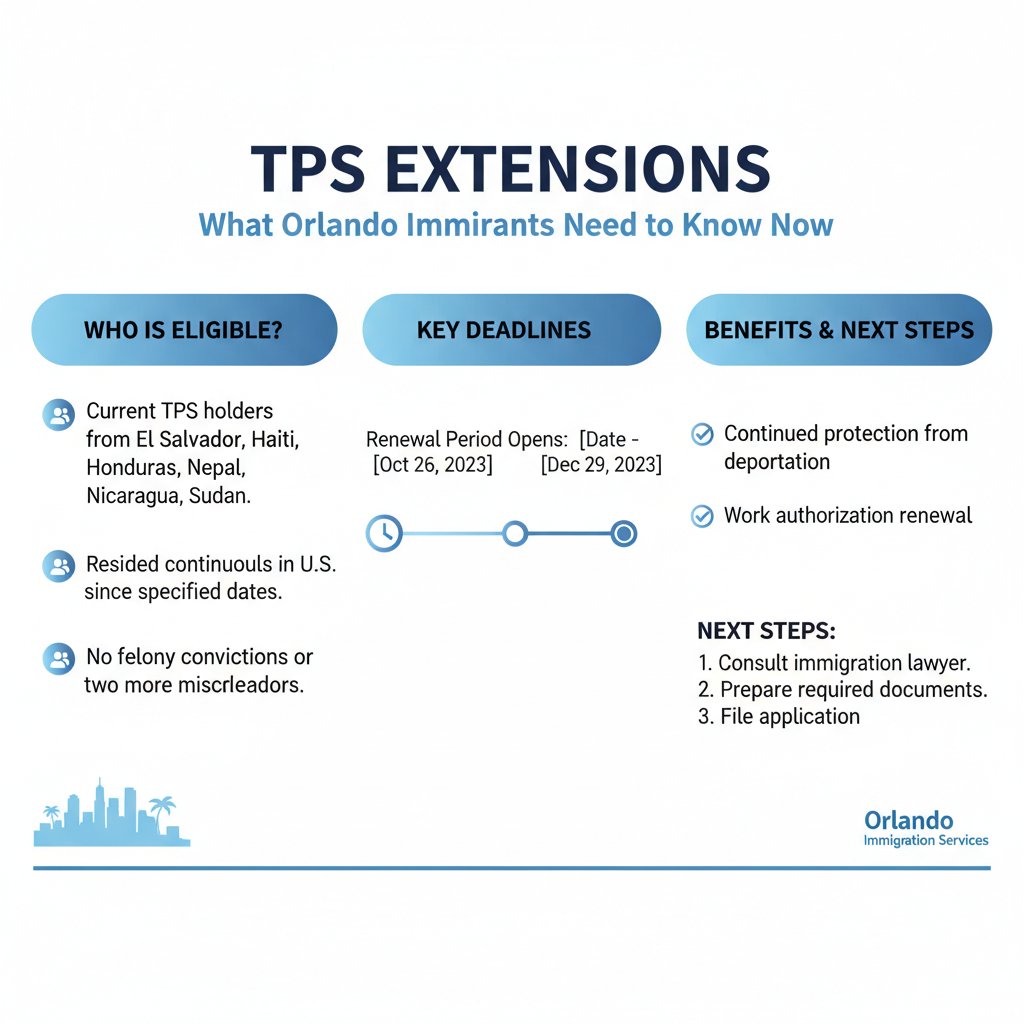
For many immigrants living in the United States, news regarding Temporary Protected Status (TPS) can be a beacon of hope and a source of stability. As of March 13, 2026, recent announcements regarding extensions and, in some cases, redesignations for several countries have once again brought TPS to the forefront of immigration discussions. At Imigrar, your trusted immigration law firm in Orlando, Florida, we understand the profound impact these updates have on individuals and families striving to build a secure future in the U.S.
This comprehensive guide is designed to cut through the legal jargon and provide clear, actionable information about the latest TPS developments. Our goal is to empower you with the knowledge needed to navigate these changes, whether you are a current TPS holder needing to re-register or someone who might now be eligible for the first time.
Why this news is showing up now
TPS is a temporary immigration status granted by the Secretary of Homeland Security to eligible nationals of designated countries facing extraordinary and temporary conditions that prevent their safe return. These conditions can include ongoing armed conflict, environmental disasters, or other extraordinary and temporary conditions. The Secretary reviews the conditions in designated countries periodically, typically 60 days before the expiration of the current designation, to determine whether to extend, terminate, or redesignate TPS for that country. This periodic review is why you often see news cycles around TPS extensions or redesignations.
The current wave of news reflects the U.S. government's recent evaluations of conditions in various countries. For some, this means an extension of their existing TPS, allowing current beneficiaries to continue living and working legally in the U.S. For others, a redesignation might open the door for new applicants from those countries who meet the eligibility criteria, or it could extend the status for existing beneficiaries while also expanding the eligibility pool based on a new date of continuous residence. These decisions are critical because they dictate the eligibility windows, re-registration periods, and the overall longevity of the protections offered by TPS.
Important: Always refer to official government announcements from USCIS official website for the most accurate and up-to-date information regarding specific country designations and deadlines.
How it can affect Florida residents
Florida, particularly Central Florida and the Orlando metropolitan area, is home to a vibrant and diverse immigrant community. Many individuals from countries currently designated for TPS reside here, contributing significantly to our economy and culture. Therefore, any changes to TPS policy have a direct and substantial impact on thousands of Florida residents.
- For current TPS holders: If your country’s TPS designation has been extended, you will need to re-register within the specified window to maintain your status and work authorization. Failing to re-register on time can lead to a lapse in your legal status and employment authorization, which can have severe consequences.
- For potential new applicants: If your country has been redesignated, or if you arrived in the U.S. before a new "continuous residence" date specified in a redesignation, you might now be eligible to apply for TPS for the first time. This offers a crucial pathway to legal status and work authorization, providing a much-needed sense of security.
- Employment Authorization: A key benefit of TPS is the ability to obtain an Employment Authorization Document (EAD), allowing you to work legally in the U.S. Extensions mean continued work authorization, while new designations mean new opportunities for employment.
- Protection from Deportation: TPS holders are protected from deportation. These extensions mean continued protection, keeping families together and allowing individuals to live without the constant fear of removal.
For those in Orlando, Kissimmee, and throughout the I-4 corridor, these updates require careful attention to detail and timely action. The Orlando USCIS Field Office processes many immigration applications, and local resources, including legal aid and community organizations, are often available to assist. Understanding these changes and acting swiftly is paramount to securing your future.
Need Help? Our Orlando immigration team is ready to assist. Call +1 786-791-3106 for a free consultation, or message us online. Se Habla Español.
What Temporary Protected Status (TPS) Is (and Why It Matters)
Temporary Protected Status (TPS) is a temporary immigration benefit provided by the United States government. It is a lifeline for individuals whose home countries are experiencing conditions that make it unsafe for them to return. Understanding what TPS is and its significance is the first step toward navigating the application or re-registration process.
A plain-English definition
Imagine your home country is going through a severe crisis – perhaps a devastating earthquake, a civil war, or an epidemic that has shattered its infrastructure. Under these circumstances, it would be dangerous, if not impossible, for you to return safely. Temporary Protected Status (TPS) is a temporary permission granted by the U.S. government that allows people from such countries, who are already in the U.S., to remain here lawfully for a specific period.
This status offers two critical protections:
- Protection from Deportation: You cannot be removed from the United States while your TPS is valid.
- Work Authorization: You can apply for and receive an Employment Authorization Document (EAD), which allows you to work legally in the U.S.
Additionally, some TPS beneficiaries may be eligible for travel authorization. It’s important to remember that TPS is temporary; it does not lead directly to a Green Card or permanent residency, but it can provide a bridge to other immigration pathways for some individuals.
Key terms you need to know
Navigating immigration law often requires understanding specific terminology. Here are some key terms related to TPS:
- Designation: This is the formal act by the Secretary of Homeland Security of identifying a country whose nationals are eligible for TPS due to extraordinary conditions. A designation specifies the start and end dates of the protection and the required "continuous residence" and "continuous physical presence" dates.
- Redesignation: Sometimes, a country's TPS status is not just extended but "redesignated." This means that while existing beneficiaries may continue their status, the criteria for eligibility might be expanded to include individuals who arrived in the U.S. at a later date, providing a new window for applicants.
- Extension: This occurs when the Secretary of Homeland Security determines that the conditions in a designated country continue to warrant TPS, and the existing designation is prolonged for another period, typically 18 months. Current beneficiaries must re-register during the specified window.
- Termination: If the Secretary determines that the conditions in a designated country no longer meet the statutory requirements for TPS, the status can be terminated. This means beneficiaries would lose their TPS protection at a future date, although a transition period is usually provided.
- Re-registration: This is the process that current TPS beneficiaries must complete during each extension period to maintain their status and work authorization. It typically involves filing Form I-821 and Form I-765 (for EAD).
- Employment Authorization Document (EAD): Often referred to as a "work permit," this document (Form I-766) allows foreign nationals with certain statuses, including TPS, to work legally in the U.S.
- Continuous Residence (CR): A requirement for TPS eligibility, meaning you must have been residing in the U.S. continuously since a specific date set for your country's designation or redesignation. Brief, casual, and innocent departures from the U.S. do not break continuous residence.
- Continuous Physical Presence (CPP): Another eligibility requirement, meaning you must have been physically present in the U.S. continuously since a specific date set for your country's designation or redesignation.
- Prima Facie Eligible: This term means that based on the initial evidence provided, you appear to meet the basic eligibility requirements for TPS. USCIS makes a preliminary determination of "prima facie" eligibility after reviewing your application.
Understanding these terms is crucial for correctly interpreting official announcements and completing your application or re-registration accurately. If any of these terms cause confusion, seeking legal counsel is always advisable.
Current Immigration Law: The Foundation for TPS
The authority for Temporary Protected Status is rooted in federal immigration law. Specifically, Section 244 of the Immigration and Nationality Act (INA), codified at 8 U.S.C. § 1254a, outlines the statutory framework for TPS. This law grants the Secretary of Homeland Security the power to designate a foreign country for TPS due to specific conditions.
The law specifies three primary grounds for designation:
- Ongoing Armed Conflict: The country is experiencing ongoing armed conflict, and returning nationals would pose a serious threat to their personal safety.
- Environmental Disaster: The country has experienced an earthquake, flood, drought, epidemic, or other environmental disaster resulting in a substantial, but temporary, disruption of living conditions, and the country is unable to handle the return of its nationals adequately.
- Extraordinary and Temporary Conditions: The country is experiencing extraordinary and temporary conditions that prevent nationals from returning safely, and granting TPS is consistent with U.S. foreign policy interests.
Each designation, redesignation, or extension comes with a specific Federal Register Notice published by the Department of Homeland Security (DHS). These notices are the official source for precise dates, deadlines, and eligibility criteria for each country.
Federal requirements
Beyond the country-specific designation, individuals must meet several federal eligibility requirements to be granted TPS:
- Be a national of a country designated for TPS (or a person without nationality who last habitually resided in that country).
- File Form I-821, Application for Temporary Protected Status, during the initial registration or re-registration period.
- Have been continuously physically present in the U.S. since the effective date of the most recent TPS designation for your country.
- Have been continuously residing in the U.S. since the date specified for your country's designation or redesignation.
- Not be inadmissible under certain grounds of the INA, including certain criminal and security-related grounds.
- Not have been convicted of any felony or two or more misdemeanors committed in the U.S.
- Not be subject to any of the mandatory bars to asylum, such as having persecuted others.
It's crucial to understand that even if your country is designated, you must individually meet these criteria. Any misrepresentation or failure to disclose relevant information can lead to denial or even future immigration problems. For comprehensive details, always refer to the USCIS TPS page.
Florida-specific considerations
While TPS is a federal program, its implementation has practical implications for Florida residents. There are no Florida-specific laws that add to or detract from federal TPS requirements. However, certain aspects are relevant for those living in the Sunshine State:
- USCIS Field Offices: If your case requires an interview or other in-person interaction, you would typically interact with the Orlando USCIS Field Office, located at 6680 Corporate Centre Blvd, Orlando, FL 32822. This office serves applicants residing in Orange County and surrounding Central Florida areas.
- Legal Support: Florida has a robust network of immigration legal professionals. For Central Florida residents, accessing experienced immigration attorneys in Orlando is crucial for proper guidance through the complex TPS process.
- Community Resources: Various non-profit organizations and community centers in Orlando and across Florida offer assistance with immigration forms, language support, and information sessions, particularly for newly arrived populations or those unfamiliar with U.S. legal processes.
Navigating the federal requirements while considering local resources can make the process smoother and more accessible for immigrants in Florida. Remember, the deadlines for re-registration or initial application are strict, so prompt action is essential.
How to Apply for or Re-register for TPS: A Complete Step-by-Step Guide
Whether you're applying for TPS for the first time or re-registering to maintain your status, the process requires careful attention to detail. This step-by-step guide will walk you through the essential actions.
1) Determine Your Eligibility and Gather Essential Information
Before you begin, confirm that your country has been designated or redesignated for TPS and that you meet the specific eligibility requirements for that designation. Check the USCIS official website for the latest Federal Register Notice pertaining to your country. Pay close attention to:
- The specific "continuous residence" (CR) date.
- The "continuous physical presence" (CPP) date.
- The registration/re-registration deadline.
Required Documents (Initial Assessment):
- Proof of nationality (e.g., passport, birth certificate with photo identification).
- Proof of identity (e.g., driver's license, state ID).
- Proof of residence in the U.S. since the CR date (e.g., utility bills, leases, school records, employment records, medical records).
- Proof of physical presence in the U.S. since the CPP date (e.g., entry stamps, travel records, employment records, school records).
- Any criminal history records, if applicable.
Warning: Do not guess your dates of entry or residence. Accuracy is critical.
2) Complete Required USCIS Forms
The primary form for TPS is Form I-821, Application for Temporary Protected Status. If you wish to work legally in the U.S., you will also need to file Form I-765, Application for Employment Authorization. For re-registration, you typically file both forms again.
- Form I-821: Fill out every section completely and accurately. If a section does not apply, write "N/A." Provide truthful answers to all questions, especially those pertaining to criminal history, immigration violations, and national security.
- Form I-765: Indicate that you are applying for an EAD based on your TPS status. The eligibility category for TPS is typically (c)(19).
Reminder: Download the latest versions of these forms from the USCIS Forms page. Instructions are specific and change periodically.
3) Gather All Supporting Documents
This is arguably the most critical step. Your application must be supported by compelling evidence. Organize your documents carefully.
Required Documents (Comprehensive List):
- Proof of Identity and Nationality:
- Copy of your passport (biographic page, visa pages, and entry stamps).
- Copy of your birth certificate with a photo ID.
- National identity card from your country of origin.
- Proof of Continuous Residence (CR):
- Rent receipts, utility bills (electricity, water, gas, internet) in your name.
- Employment records (pay stubs, W-2s, letters from employers).
- School records (transcripts, enrollment letters).
- Medical records (hospital bills, doctor's notes, vaccination records).
- Bank statements.
- Affidavits from individuals who can attest to your continuous residence.
- Proof of Continuous Physical Presence (CPP):
- Passport entry stamps.
- I-94 arrival/departure record.
- Any other government-issued documents showing your presence.
- Same documents as CR can often serve as CPP proof.
- Photographs: Two identical passport-style photos taken within 30 days of filing.
- Criminal History Records (if applicable):
- Certified court dispositions for any arrests or convictions.
- Police clearance certificates.
- Previous Immigration Records (if applicable):
- Copies of any previous immigration applications, notices, or decisions.
Tip: Create a checklist and make copies of everything you send to USCIS. Do not send original documents unless specifically requested.
4) Pay the Required Fees
There are fees associated with filing Form I-821 and Form I-765. You may also need to pay a biometrics services fee. Fee amounts can change, so always check the USCIS Fee Schedule.
- Form I-821 Fee: Varies depending on whether it's an initial application or re-registration, and if you are requesting an EAD.
- Form I-765 Fee: Required if you are requesting an EAD.
- Biometrics Services Fee: Required for all applicants aged 14 and older.
Fee Waivers: You may be eligible for a fee waiver if you can demonstrate an inability to pay. To apply for a fee waiver, you must file Form I-912, Request for Fee Waiver, along with your application. Provide clear evidence of your financial hardship, such as proof of public benefits, household income below 150% of the federal poverty line, or extreme financial difficulty.
Payment Method: You can pay by money order, personal check, cashier's check, or by credit card using Form G-1450, Authorization for Credit Card Transactions.
5) Mail Your Application Package
Once all forms are completed, documents gathered, and fees prepared, assemble your application package. The mailing address depends on your specific country’s designation and where you reside. Always check the USCIS website or the Federal Register Notice for the correct mailing address for your specific case.
- Organize: Place forms on top, followed by supporting documents, and then fee payment. Use tabs to label different sections (e.g., "Proof of Nationality," "Proof of Residence").
- Cover Letter: Consider including a cover letter listing all the forms and documents enclosed.
- Delivery Confirmation: Send your package via certified mail with return receipt requested, or a courier service that provides tracking. This provides proof of mailing and delivery.
Important: Ensure your application is postmarked within the designated registration or re-registration period. Late applications are almost always denied unless extraordinary circumstances apply.
6) Attend Your Biometrics Appointment
After USCIS receives your application, you will typically receive a receipt notice (Form I-797C). A few weeks later, you will receive an appointment notice (Form I-797C) for a biometrics services appointment at an Application Support Center (ASC).
- What to Expect: At the ASC, your fingerprints, photograph, and signature will be collected. This data is used for background checks.
- What to Bring: Your appointment notice, a valid photo ID (e.g., passport, driver's license), and any other requested documents.
- Orlando ASC: For Central Florida residents, your appointment will likely be at the Orlando ASC.
Warning: Missing your biometrics appointment without rescheduling can lead to a denial of your application.
7) Receive a Decision and Next Steps
After your biometrics appointment and USCIS reviews your application, you will receive a written decision. This could be an approval, a Request for Evidence (RFE), or a denial.
- Approval: If approved, you will receive an approval notice for Form I-821 and, if requested, your new EAD (Form I-766).
- Request for Evidence (RFE): USCIS may send an RFE if they need more information or clarification. Respond promptly and completely by the deadline provided.
- Denial: If your application is denied, the notice will state the reasons for denial. You may have options to appeal or refile, depending on the reason. This is when legal counsel becomes even more critical.
Timeline: Processing times vary widely. You can check current estimates for Form I-821 and Form I-765 on the USCIS Processing Times page. Be patient, but also proactive in checking your case status online using the receipt number.
Confused by the process? Our expert immigration attorneys at Imigrar can guide you through every step, ensuring accuracy and timeliness. Call +1 786-791-3106 today for a free consultation. Se Habla Español.

Practical Steps You Can Take Today
The immigration process can be daunting, but taking proactive steps can significantly improve your chances of success. Here’s an actionable checklist for individuals in Orlando and across Florida impacted by TPS news:
- Consult with an Immigration Attorney: This is the most crucial first step. An attorney can assess your specific situation, confirm your eligibility, and help you navigate the complexities of TPS applications or re-registrations. Imigrar offers free consultations to help you understand your options.
- Verify Your Country's Status and Deadlines: Immediately check the USCIS TPS page or the Federal Register for the latest updates on your country's TPS designation or extension. Note the exact start and end dates for re-registration or initial application.
- Gather and Organize Documents: Start compiling all necessary documents, including proof of identity, nationality, continuous residence, and continuous physical presence. Create a dedicated folder (physical and/or digital) for your immigration documents.
- Review Your Criminal Record: Be honest with yourself and your attorney about any arrests or convictions. Even minor offenses can impact eligibility. Obtain certified court dispositions for any interactions with law enforcement.
- Update Your Contact Information with USCIS: If you are a current TPS holder and have moved, ensure USCIS has your current address. File Form AR-11, Alien’s Change of Address Card, online or by mail within 10 days of moving. This ensures you receive important notices.
- Understand Your EAD Validity: If you are re-registering, be aware of the automatic extension period for your current EAD. USCIS often grants an automatic extension of existing EADs for beneficiaries of an extended TPS designation, typically for 180 days (or more, depending on the specific notice) beyond its expiration date, provided you re-register on time. Carry your expired EAD and the Federal Register Notice with you as proof of continued work authorization.
- Start Saving for Fees: If you anticipate filing fees, begin setting aside funds. If you believe you qualify for a fee waiver, gather the necessary financial documentation to support your Form I-912.
- Educate Yourself: Read through the official USCIS instructions for Form I-821 and Form I-765. Understanding the questions and requirements will help you prepare.
Document preparation guidance
Effective document preparation is key to a successful application:
- Copies, Not Originals: Unless specifically requested by USCIS, always send copies of your documents, not originals.
- Translations: Any document not in English must be accompanied by a complete and accurate English translation, certified by the translator as competent to translate and that the translation is accurate.
- Legibility: Ensure all copies are clear and legible. If a document is difficult to read, try to obtain a better copy.
- Chronological Order: For proof of continuous residence and physical presence, arrange documents in chronological order to clearly show your presence over time.
- Redundancy: It’s better to provide slightly more evidence than too little. Use multiple types of documents for each requirement (e.g., utility bills, bank statements, and employment letters for residence).
Timeline expectations
Processing times for TPS applications and EADs can vary significantly based on USCIS workload, the specific designation, and the completeness of your application. While general estimates are available on the USCIS Processing Times page, be prepared for:
- Receipt Notice: Expect to receive a receipt notice (Form I-797C) within 2-4 weeks after filing.
- Biometrics Appointment: An appointment notice for biometrics usually arrives 4-8 weeks after filing. The appointment itself will be


