


In the dynamic world of U.S. immigration law, changes and updates are constant, profoundly impacting the lives of individuals and families seeking safety and stability. One critical area that frequently sees legislative and administrative action is Temporary Protected Status (TPS).
Today, February 24, 2026, we're addressing significant news regarding TPS extensions for various designated countries. These announcements offer a lifeline to thousands of individuals already living in the U.S., including many right here in Orlando and across Florida. Understanding these updates is crucial for maintaining your status and planning your future.
The reporting that sparked this guide
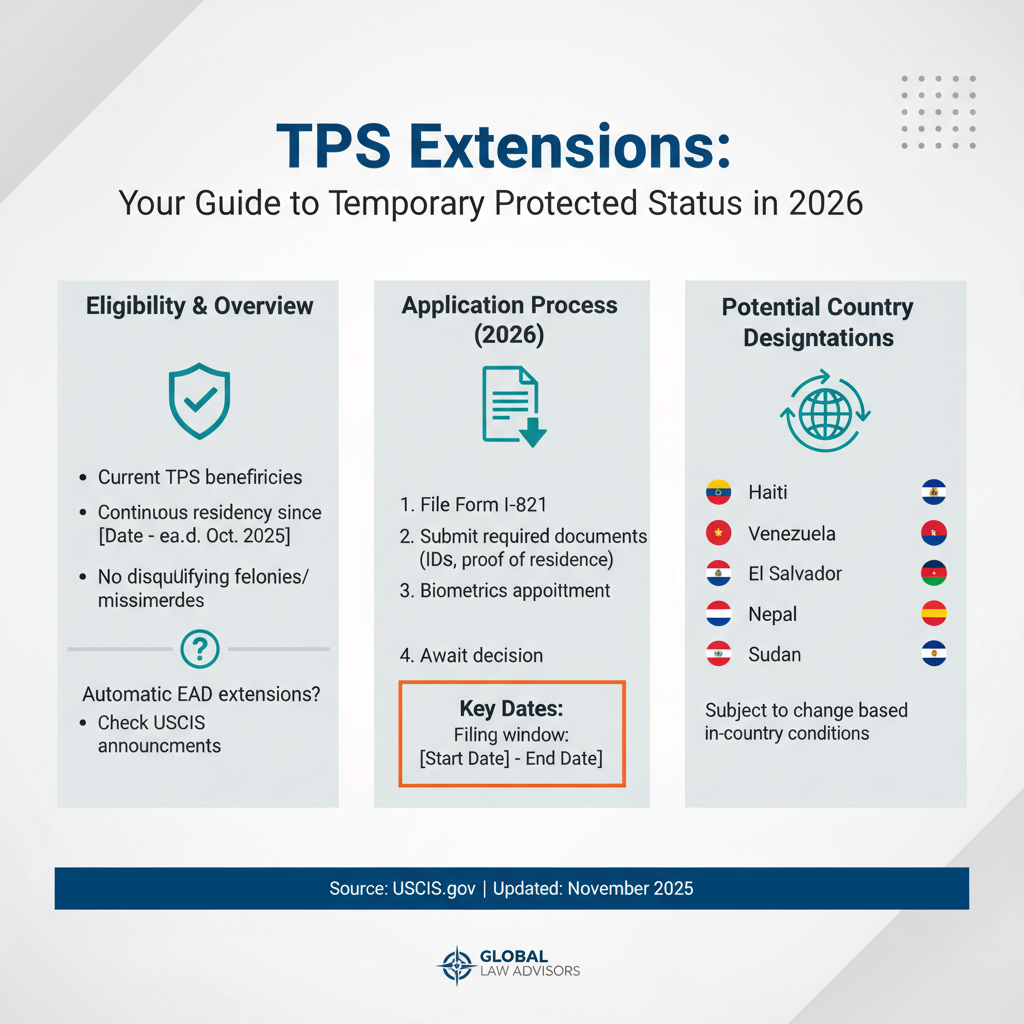
The recent wave of updates on Temporary Protected Status (TPS) extensions and re-designations has been widely covered in legal news outlets, reflecting ongoing humanitarian crises and evolving U.S. foreign policy. These developments are a direct response to conditions in various countries that prevent their nationals from returning safely. For more detailed reporting, you can refer to: TPS (Temporary Protected Status) Extension News (Legal News)
What This News Means for Immigrants in Orlando and Across Florida
The latest announcements regarding TPS extensions and re-designations are more than just legal bulletins; they represent renewed hope and continued protection for many families. For the thousands of individuals from designated countries residing in Florida, these updates directly impact their ability to live and work legally in the United States without fear of deportation.
Why this news is showing up now
TPS is a temporary immigration benefit granted to eligible nationals of certain countries who are already in the United States. The Secretary of Homeland Security may designate a country for TPS due to:
- Ongoing armed conflict (e.g., civil war).
- An environmental disaster (e.g., earthquake, hurricane), or an epidemic.
- Other extraordinary and temporary conditions.
The news of extensions typically arises when the Department of Homeland Security (DHS) reviews the conditions in a currently designated country and determines that the original reasons for designation persist, or new conditions warrant an extension. Similarly, a "re-designation" might occur if conditions worsen or new criteria are met, opening the door for new applicants from that country who arrived by a certain date. These decisions are made after careful assessment of on-the-ground realities and often follow extensive consultations with foreign policy experts, human rights organizations, and diplomatic channels.
Given the current global landscape, with ongoing conflicts, political instability, and the lingering effects of natural disasters in various regions, it is not uncommon to see such announcements. The U.S. government continuously monitors these situations, leading to periodic reviews and, subsequently, extensions or re-designations of TPS for affected countries.
How it can affect Florida residents
Florida is a vibrant mosaic of cultures, home to a significant population of immigrants from countries that are often subject to TPS designations. From the bustling streets of Miami to the family-friendly communities of Orlando and across the I-4 corridor, many individuals and families rely on TPS for their legal presence and ability to contribute to our economy.
- Continued Protection: For current TPS holders, an extension means they can continue to live and work in the U.S. legally, protected from deportation, for the duration of the extension period. This provides critical stability for families, allowing children to continue their education and adults to maintain employment.
- Re-registration Opportunities: Extensions typically come with a specific re-registration period. It is crucial for current TPS beneficiaries to re-register within this window to maintain their status. Missing this deadline can lead to loss of TPS benefits.
- New Applicants from Re-designated Countries: If a country is re-designated, it means that individuals from that country who have been continuously residing in the U.S. since a newly established cut-off date may become eligible to apply for TPS for the first time. This can be a life-changing opportunity for those who previously did not qualify.
- Economic Stability: TPS holders often possess Employment Authorization Documents (EADs), allowing them to work legally. Extensions ensure that these individuals can continue to be vital contributors to Florida's workforce, supporting local businesses and the state's economy.
- Community Impact: The stability provided by TPS extensions helps strengthen communities. Families can plan for the future, invest in their homes, and deepen their roots without the constant fear of being uprooted. This is particularly relevant for the diverse communities in Central Florida, including those around the Orlando USCIS Field Office, who directly benefit from these protections.
Important: The specific details of each extension or re-designation, including eligibility dates and re-registration deadlines, vary by country. It is paramount to consult the official USCIS announcements and seek legal counsel to understand how these changes apply to your specific situation.
Need Help? Our Orlando immigration team is ready to assist. Call +1 786-791-3106 for a free consultation, or message us online. Se Habla Español.
What Temporary Protected Status (TPS) Is (and Why It Matters)
Temporary Protected Status (TPS) is a vital humanitarian relief program that offers a temporary haven to foreign nationals in the United States whose home countries are experiencing extreme, life-threatening conditions. It's a cornerstone of the U.S. immigration system, designed to prevent individuals from being forced to return to dangerous environments.
A plain-English definition
Imagine your home country suddenly becomes unsafe due to a massive natural disaster, a widespread epidemic, or a civil war. If you are already in the United States when this happens, TPS allows you to stay here legally for a temporary period. It protects you from deportation and grants you the ability to work and sometimes travel, without fear. It's called "temporary" because the protection lasts only as long as the dangerous conditions in your home country persist. Once those conditions improve, the TPS designation for that country can be terminated.
TPS is not a path to a Green Card or permanent residency on its own, but it provides crucial stability and allows beneficiaries to live and contribute to U.S. society while their home country recovers.
Key terms you need to know
Understanding the following terms is essential when discussing TPS:
- Designated Country: A country officially identified by the Secretary of Homeland Security as meeting the criteria for TPS due to armed conflict, environmental disaster, or other extraordinary and temporary conditions. Examples include Haiti, El Salvador, Honduras, Nicaragua, Sudan, South Sudan, Syria, Venezuela, and others, though specific designations and eligibility periods vary.
- Eligibility Criteria: The specific requirements an individual must meet to qualify for TPS. These typically include continuous physical presence (CPP) and continuous residence (CR) in the U.S. since a certain date, being a national of a designated country, and passing security and criminal background checks.
- Re-registration Period: The specific timeframe during which current TPS beneficiaries must apply to extend their status when their country's designation is extended. Missing this deadline can result in the loss of TPS benefits. This period is typically 60 days but can vary.
- Employment Authorization Document (EAD): Also known as a work permit, this document allows TPS beneficiaries to legally work in the United States. It is usually issued for the duration of the TPS designation period.
- Advance Parole: A travel document that allows a TPS beneficiary to travel outside the United States and lawfully return without jeopardizing their TPS status. This must be obtained *before* traveling internationally.
- Continuous Physical Presence (CPP): Refers to the requirement that an applicant must have been physically present in the U.S. since a specific date set by the DHS for their country's designation. Brief, casual, and innocent departures typically do not break CPP.
- Continuous Residence (CR): Refers to the requirement that an applicant must have maintained residence in the U.S. since a specific date set by the DHS for their country's designation.
- Termination: The ending of a country's TPS designation, meaning beneficiaries would lose their TPS status unless they qualify for another immigration benefit.
Current Immigration Law: The Foundation of TPS
Temporary Protected Status is a statutory benefit derived from Section 244 of the Immigration and Nationality Act (INA), codified at 8 U.S.C. § 1254a. This law grants the Secretary of Homeland Security (DHS) the authority to designate countries for TPS under specific conditions.
Federal requirements
To be designated for TPS, a country must meet one or more of the statutory criteria:
- Ongoing Armed Conflict: If there is an ongoing armed conflict within the state, and requiring the return of nationals to that state would pose a serious threat to their personal safety.
- Environmental Disaster: If there has been an environmental disaster resulting in a substantial, but temporary, disruption of living conditions, and the foreign state is unable to handle the return of its nationals adequately.
- Extraordinary and Temporary Conditions: If there exist extraordinary and temporary conditions in the foreign state that prevent nationals from returning safely, and it is not contrary to the national interest of the United States to permit the nationals to remain temporarily.
Once a country is designated, individuals seeking TPS must meet their own set of eligibility requirements, which are consistent across all designated countries:
- Be a national of a country designated for TPS (or a person without nationality who last habitually resided in that designated country).
- Have been continuously physically present (CPP) in the U.S. since the effective date of the most recent designation or re-designation for their country.
- Have been continuously residing (CR) in the U.S. since the date specified for their country's designation.
- Apply for TPS within the initial registration period or during any extension of the designation (re-registration period).
- Pass security and background checks. Certain criminal offenses (felonies or two or more misdemeanors), persecution of others, or national security grounds can disqualify an applicant.
Warning: Brief, casual, and innocent departures from the U.S. do not break CPP or CR. However, unauthorized travel or extended absences can lead to disqualification. Always consult with an attorney before any international travel if you have TPS or are applying for it.
The primary forms used for TPS are: Form I-821, Application for Temporary Protected Status; Form I-765, Application for Employment Authorization (EAD); and if travel is desired, Form I-131, Application for Travel Document (for Advance Parole).
You can find official information and forms on the USCIS official website.
Florida-specific considerations
While TPS is a federal program, and the eligibility requirements are uniform nationwide, there are local considerations for Florida residents:
- Local Resources: Florida has numerous non-profit organizations and legal aid services, particularly in major metropolitan areas like Orlando, Miami, and Tampa, that assist immigrants with TPS applications.
- Orlando USCIS Field Office: If you reside in Central Florida, your biometrics appointment and potentially interviews related to other immigration benefits (if applicable) may be processed through the Orlando USCIS Field Office.
- Legal Expertise: Due to Florida's large and diverse immigrant population, there is a high demand for experienced immigration attorneys who understand the nuances of TPS, especially when considering concurrent applications for other immigration benefits or dealing with complex eligibility issues.
For Central Florida residents, particularly those in Orange County and along the I-4 corridor, staying informed about TPS updates is critical due to the significant presence of communities from designated countries. Imigrar, located in Orlando, is strategically positioned to assist these communities.
Need Help? Our Orlando immigration team is ready to assist. Call +1 786-791-3106 for a free consultation, or message us online. Se Habla Español.
How to Apply for TPS or Re-register: A Complete Step-by-Step Guide
Whether you're applying for TPS for the first time under a new designation or re-registering under an extension, precision and timeliness are paramount. Follow this detailed guide to navigate the process effectively.
1) Determine Your Eligibility and the Specific Deadlines
Before gathering documents or filling out forms, confirm that you meet all eligibility criteria for your country's specific TPS designation. This includes:
- Nationality: You must be a national of the designated country (or a person without nationality who last habitually resided in that country).
- Continuous Physical Presence (CPP): You must have been physically present in the U.S. since the date specified in the Federal Register notice for your country's designation or re-designation.
- Continuous Residence (CR): You must have been continuously residing in the U.S. since the date specified in the Federal Register notice for your country's designation or re-designation.
- Admissibility: You must not have been convicted of any felony or two or more misdemeanors committed in the U.S. You also cannot be found inadmissible under certain grounds of INA Section 212(a), including national security concerns or persecution of others.
- Registration Period: You must apply within the initial registration period or the re-registration period for your country. These deadlines are strict.
Important: Check the official USCIS website or the Federal Register for the most current information regarding your country's specific dates and deadlines. These dates are unique to each designation and extension.
2) Gather All Required Supporting Documents
This is arguably the most critical step. Organize all documents meticulously. Make copies of everything and never send original documents unless specifically requested by USCIS.
- Proof of Identity and Nationality:
- Passport or national identity card from your designated country.
- Birth certificate with photo identification.
- Any national identity document with your photo and/or fingerprint.
- Proof of Entry into the U.S. (if applicable):
- Form I-94, Arrival/Departure Record.
- Entry stamps in your passport.
- Proof of Continuous Residence (CR) in the U.S. since the specified date:
- Rental receipts, utility bills, or mortgage statements.
- Employment records (pay stubs, W-2s, letters from employers).
- School records (transcripts, report cards).
- Medical records (hospital bills, doctor's notes).
- Affidavits from friends, relatives, or employers attesting to your presence.
- Bank statements, tax returns.
- Any dated documents showing you were in the U.S. during the required period.
- Proof of Continuous Physical Presence (CPP) in the U.S. since the specified date:
- This often overlaps with CR documents. Any documents that show you were physically present.
- Passport-style Photos: Two identical, unmounted, passport-style color photographs taken within 30 days of filing.
- Evidence of Prior Immigration Filings (if applicable): Copies of any previous immigration applications, notices, or decisions.
- Court or Law Enforcement Records (if applicable): If you have any arrests, charges, or convictions, you must provide certified court dispositions, even if charges were dismissed or expunged.
Reminder: Any document not in English must be accompanied by a complete English translation and a translator's certification. USCIS Translation Requirements.
3) Complete and Prepare the Necessary Forms
You will need to fill out the following forms:
- Form I-821, Application for Temporary Protected Status: This is the primary form for TPS. Fill it out completely and accurately.
- Form I-765, Application for Employment Authorization: If you want to work legally in the U.S., you must file this form. Even if you don't plan to work immediately, having an EAD is often beneficial.
- Form I-131, Application for Travel Document (for Advance Parole): If you anticipate needing to travel outside the U.S. while your TPS application is pending or while you hold TPS, you must apply for Advance Parole. Do NOT travel internationally without this document, as it can jeopardize your TPS status.
Ensure all forms are the most current versions available on the USCIS Forms page. Read instructions carefully for each form.
4) Calculate and Pay the Filing Fees (or Apply for a Fee Waiver)
There are several fees associated with TPS applications:
- Form I-821 Filing Fee: This fee may vary based on your age. For re-registrations, the I-821 fee is often waived.
- Biometrics Services Fee: This is typically required for all applicants aged 14 and older.
- Form I-765 Filing Fee: Required if you are applying for an EAD.
- Form I-131 Filing Fee: Required if you are applying for Advance Parole.
You can pay fees by money order, personal check, cashier's check, or credit card using Form G-1450, Authorization for Credit Card Transactions. Make checks payable to "U.S. Department of Homeland Security."
Fee Waivers: If you cannot afford the fees, you may be eligible for a fee waiver by filing Form I-912, Request for Fee Waiver. You must provide evidence of your inability to pay, such as proof of public benefits, household income below 150% of the poverty level, or financial hardship.
Important: Check the USCIS Fee Schedule for the most up-to-date fee amounts, as they can change.
5) Submit Your Application Package
Assemble your complete application package, including all forms, supporting documents, photos, and payment/fee waiver request. Send it to the correct USCIS filing address for your designated country and state of residence. Filing addresses are specified in the Federal Register notice and on the USCIS website for TPS.
- Review Checklist: Before mailing, use the USCIS checklist for your specific forms to ensure nothing is missed.
- Keep Copies: Make a complete copy of your entire application package for your records.
- Mailing Method: Send your application via certified mail with a return receipt or a courier service that provides tracking. This provides proof of mailing and delivery.
6) Attend Your Biometrics Appointment
After USCIS receives your application, they will send you a receipt notice (Form I-797C, Notice of Action). Soon after, you will receive a separate appointment notice for biometrics (fingerprints, photograph, and signature) at an Application Support Center (ASC).
- Do not miss this appointment. If you cannot attend, follow the instructions on the notice to reschedule.
- Bring your appointment notice and a valid photo ID (e.g., passport, national ID card) to the ASC.
- For Central Florida residents, this appointment will likely be at the Orlando USCIS Field Office's ASC or another nearby location.
7) Await a Decision and Respond to RFEs
USCIS will process your application, conduct background checks, and review your submitted evidence. The processing times can vary significantly. You can check general processing times at USCIS Processing Times.
- Request for Evidence (RFE): USCIS may send you an RFE if they need more information or clarification. Respond to RFEs promptly and completely by the given deadline.
- Approval: If approved, you will receive an approval notice and your EAD card (if applied for).
- Denial: If your application is denied, the notice will explain the reasons. You may have options to appeal or reapply, depending on the reason for denial.
Need Help? Our Orlando immigration team is ready to assist. Call +1 786-791-3106 for a free consultation, or message us online. Se Habla Español.
Practical Steps You Can Take Today
Navigating the TPS process can feel overwhelming, but taking proactive steps can significantly improve your chances of a successful application or re-registration. Here’s an actionable checklist:
- 1. Confirm Your Country's Status and Deadlines: Immediately verify if your country's TPS designation has been extended or re-designated, and note the exact re-registration or initial application period. This information is always on the USCIS official website and in the Federal Register.
- 2. Consult with an Experienced Immigration Attorney: This is highly recommended. An attorney can help you determine eligibility, identify potential issues, prepare your application correctly, and represent you if complications arise. Our team at Imigrar in Orlando is ready to help.
- 3. Begin Gathering Documents NOW: Even if your country's re-registration period hasn't officially opened, start collecting all necessary documents for identity, nationality, and proof of continuous residence/physical presence. Missing documents are a primary cause of delays and denials.
- 4. Organize Your Records: Create a dedicated folder (physical and/or digital) for all immigration-related documents. Label everything clearly. Keep original documents safe and only submit copies unless specifically requested.
- 5. Understand the Fees and Fee Waiver Options: Determine the total cost of filing and whether you qualify for a fee waiver. Begin saving funds or preparing your Form I-912.
- 6. Update Your Address with USCIS: If you have moved, file Form AR-11, Alien's Change of Address Card, with USCIS immediately. Failure to receive notices can lead to missed deadlines and serious consequences.
- 7. Stay Informed: Regularly check the USCIS website for any further updates or changes related to your country's TPS designation.
Document preparation guidance
- Accuracy is Key: Ensure all information on your forms matches your supporting documents exactly. Discrepancies can raise red flags.
- Legibility: If you handwrite forms, use black ink and print clearly. Typed forms are preferred.
- Translations: For any document not in English, provide a certified English translation. The translator must sign a statement certifying their competence and the accuracy of the translation.
- Organization: Assemble your application package neatly. Use tabs for different sections (e.g., "Form I-821," "Proof of Residence," "Photos"). Do not staple excessively; use paper clips for sets of documents.
- Criminal Records: If you have any criminal history, no matter how minor or old, you *must* disclose it and provide certified court dispositions. Do not try to hide it, as USCIS will find out during background checks.
Timeline expectations
- Re-registration Window: Typically, a 60-day window is provided for re-registration following an extension announcement. Missing this deadline is extremely risky.
- Receipt Notices: Expect to receive a receipt notice (Form I-797C) within 2-4 weeks after USCIS receives your application.
- Biometrics Appointment: A biometrics appointment notice usually arrives 3-8 weeks after your receipt notice. The appointment itself will be scheduled a few weeks after that.
- EAD Processing: Processing times for EADs (Form I-765) can vary significantly, from a few months to over a year. During extensions, USCIS often issues automatic EAD extensions for a specific period to prevent gaps in work authorization, but always verify this for your specific country and extension.
- Final Decision: A decision on your TPS application or re-registration can take anywhere from 6 months to over a year, depending on the volume of applications and the complexity of your case. Check USCIS Processing Times for current estimates.

How Imigrar Helps Immigrants in Orlando Keep Families Together
At Imigrar, we understand that the process of applying for or re-registering for Temporary Protected Status can be complex and emotionally taxing. Our mission, "Keep Families Together," drives every action we take for our clients, especially those seeking humanitarian relief like TPS.
Based right here in Orlando, Florida, we are deeply committed to serving the diverse immigrant communities of Central Florida and nationwide. Our team of experienced immigration attorneys provides compassionate, expert legal guidance through every step of the TPS journey.
Our experience and expertise
Our legal professionals possess extensive knowledge of U.S. immigration law, including the intricacies of TPS designations, extensions, and re-designations. We have a proven track record of assisting clients with:
- Eligibility Assessment: Thoroughly evaluating your unique situation to determine if you meet all TPS requirements and identify any potential challenges.
- Application Preparation: Meticulously preparing and compiling all necessary forms (Form I-821, Form I-765, Form I-131) and supporting documents to ensure accuracy and completeness.
- Evidence Compilation: Guiding you on how to gather compelling evidence of continuous residence and physical presence, including affidavits and other hard-to-obtain documents.
- Responding to RFEs: Expertly responding to Requests for Evidence (RFEs) from USCIS, ensuring all additional information is


