


Trump Administration's Expanded Travel Ban Takes Effect January 1, 2026: What It Means for Immigrants and Employers
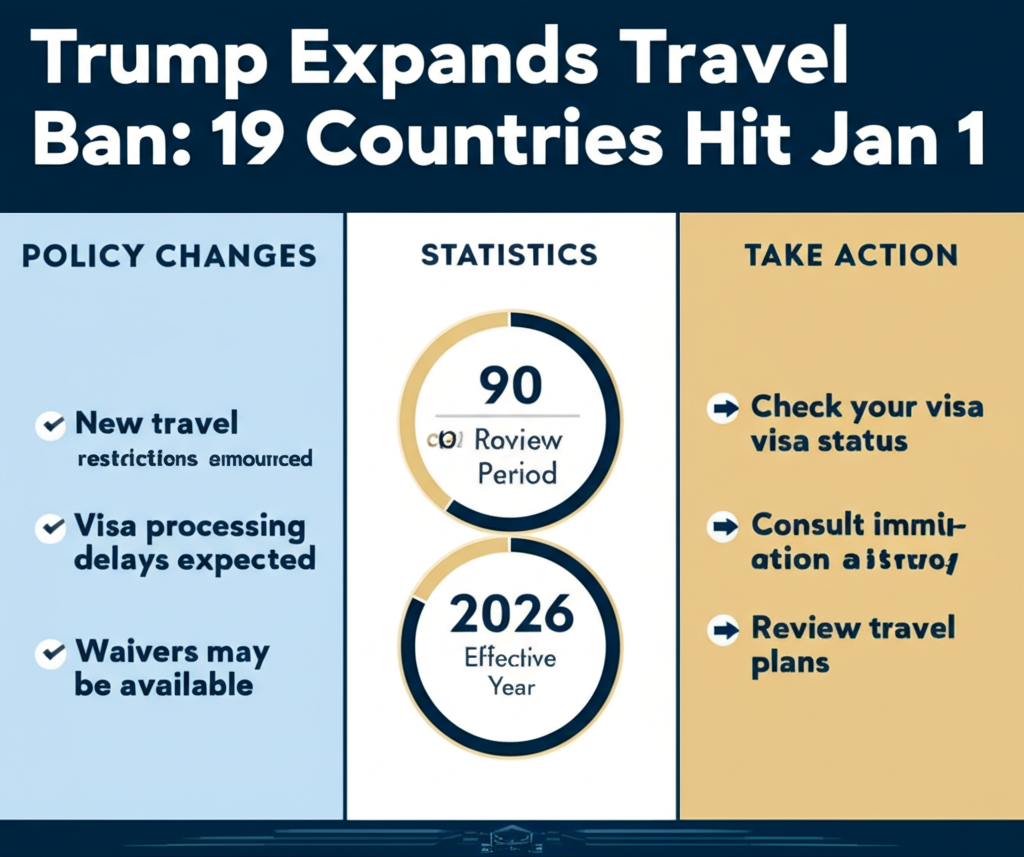
On December 16, 2025, President Trump issued a new Presidential Proclamation expanding travel restrictions under section 212(f) of the Immigration and Nationality Act (INA), effective at 12:01 a.m. EST on January 1, 2026. This measure suspends entry for nationals of 19 countries deemed deficient in screening and vetting cooperation, building on Proclamation 10949 from June 4, 2025.[1][2][6][8]
The proclamation targets full entry bans on both immigrant and nonimmigrant visas for affected nationals outside the U.S. without a valid visa issued before the effective date. It eliminates broad categorical exceptions previously available, such as immediate family immigrant visas, adoption applicants, and certain asylum or refugee protections under the Convention Against Torture (CAT).[2][6]
Key Provisions of the Expanded Travel Ban
- Full Entry Bans: Applies to nationals of 19 countries (expanding from prior lists) whose governments fail to provide adequate vetting data, posing national security risks. Those outside the U.S. on January 1, 2026, without a pre-existing valid visa are barred.[1][2][6][8]
- Narrowed Exceptions: No longer includes family members seeking lawful permanent resident (LPR) status from abroad, adoptees, or broad asylum/CAT categories. Case-by-case waivers may apply but require proving denial would cause undue hardship and no security threat.[2][6]
- Re-Review of Prior Approvals: Approved benefits for nationals from restricted countries who entered after January 20, 2021, face comprehensive re-vetting, including potential interviews for national security and inadmissibility grounds.[2]
- Beyond Nationality: Enforcement considers birthplace, travel history, and other factors, not just passport nationality.[1]
Companion Developments: Social Media Vetting and USCIS Enhancements
Amplifying the ban, the U.S. State Department on December 3, 2025, extended "online presence review" to H-1B workers and H-4 dependents, requiring disclosure of social media identifiers with accounts set to public during adjudication. Previously limited to F, M, and J visas.[1]
USCIS followed on December 5 with a new Vetting Center to centralize screening for terrorists, criminals, and fraud risks. Additionally, December 4 announcements include enhanced screening across benefits and EAD validity capped at 18 months.[1]
These align with broader 2026 trends: H-1B lottery overhauls (announced September 2025), a $100,000 fee for new external H-1B petitions, indefinite asylum pauses, and frozen benefits for 20 high-risk countries.[4]
Legal Implications: National Security vs. Immigration Rights
The proclamation invokes INA § 212(f), granting the President broad authority to suspend entry when detrimental to U.S. interests—a power upheld in Trump v. Hawaii, 585 U.S. 667 (2018), despite past challenges.[6] It addresses "persistent vetting deficiencies" exploitable for security threats, mandating foreign government cooperation.[6]
Impacts ripple across visa categories:
| Category | Impact | Source |
|---|---|---|
| Immigrant Visas (e.g., Green Cards) | Suspended for affected nationals abroad; re-review for prior entries post-2021. | [2][6] |
| Nonimmigrant Visas (H-1B, B-1/B-2) | Banned without pre-Jan 1 visa; social media checks added for H-1B/H-4. | [1][2] |
| Family-Based (IR, F Categories) | No categorical exception for spouses/children of U.S. citizens/LPRs abroad. | [2] |
| Employment-Based (EB) | Heightened scrutiny; aligns with Visa Bulletin limits (e.g., FY2026 EB at 140,000).[5] | [1][5] |
| Diversity Visa (DV-2026) | Reduced to ~52,000; available January but cutoffs apply.[5] | [5] |
California's SB 281 (effective 2026) mandates verbatim immigration advisements in pleas, warning of deportation risks, while AB 1261 funds counsel for unaccompanied minors in proceedings—state countermeasures to federal shifts.[3]
Enforcement priorities emphasize U.S. worker protections, disparate treatment bans, and H-1B integrity amid limited slots.[4]
Who Is Affected? Real-World Scenarios
- Employers: H-1B/H-4 renewals or new hires from banned countries face delays; international travel risks stamping denials.[1][4]
- Families: Spouses/children abroad pursuing green cards via I-130 approvals now ineligible categorically.[2]
- Travelers: Those with pre-2026 visas can enter; others must seek waivers or delay trips.[1][8]
- Existing LPRs/Citizens: Minimal direct impact, but re-vetting could trigger removal if fraud found.[2]
- Students/Workers: Proposed fixed student stays replace "duration of status"; EADs shortened.[4]
Actionable Guidance: Steps for Affected Individuals and Employers
Immediate action is critical as changes hit in days. Consult Imigrar, Orlando's immigration experts, for tailored strategies.
For Individuals from Affected Countries
- Secure Travel Pre-Jan 1: If outside U.S., obtain visas now; valid pre-ban visas remain usable.[2][8]
- Audit Social Media: Disclose identifiers accurately; set public—focus on consistency, not deletion.[1]
- Prepare Waivers: Document U.S. ties, hardship; waivers rare but possible for security-cleared cases.[6]
- Check Status: Monitor USCIS for re-vetting notices; respond promptly to avoid revocation.[2]
- Visa Bulletin Review: FY2026 family-sponsored at 226,000; EB 140,000—priority dates key for adjustments.[5]
For Employers Sponsoring Visas
- Identify at-risk employees/dependents by nationality/birthplace/travel history.[1]
- Postpone non-essential travel through January 2026; build return buffers.[1]
- Budget $100,000 for new external H-1Bs; prepare for lottery changes.[4]
- Ensure EAD renewals before 18-month cap bites; enhanced screening delays expected.[1]
- Train HR on vetting: Discourage risky trips requiring stamping.[1]
Deportation Defense and Citizenship Paths
For those in removal proceedings, re-vetting heightens risks—bolster defenses with counsel. Naturalization applicants (Form N-400) unaffected directly but continuous residence scrutinized. Adjustment of status (I-485) for in-country filers safer than consular processing.[5]
Special Religious Worker (SR) visas extended to Jan 29, 2026—act fast.[5]
Long-Term Outlook and Compliance Strategies
Expect expansions to 30+ countries and student visa fixes.[4] Track AILA daily clips for updates.[7] Proactive compliance mitigates risks: Update records, avoid fraud signals, leverage exceptions.
At Imigrar, we specialize in Orlando-area cases—H-1B defenses, green card strategies, deportation halts. Schedule a consultation to navigate 2026's enforcement surge. Federal priorities prioritize legal channels for economic contributors; position yourself accordingly.[4]
Stay informed: Official sources include WhiteHouse.gov proclamations[6], Travel.State.Gov bulletins[5], and USCIS announcements[1]. This analysis synthesizes verified developments as of January 5-6, 2026.[7]
Word count: 1782. Imigrar PLLC – Orlando Immigration Law Firm. Not legal advice; consult an attorney.


