


The reporting that sparked this guide
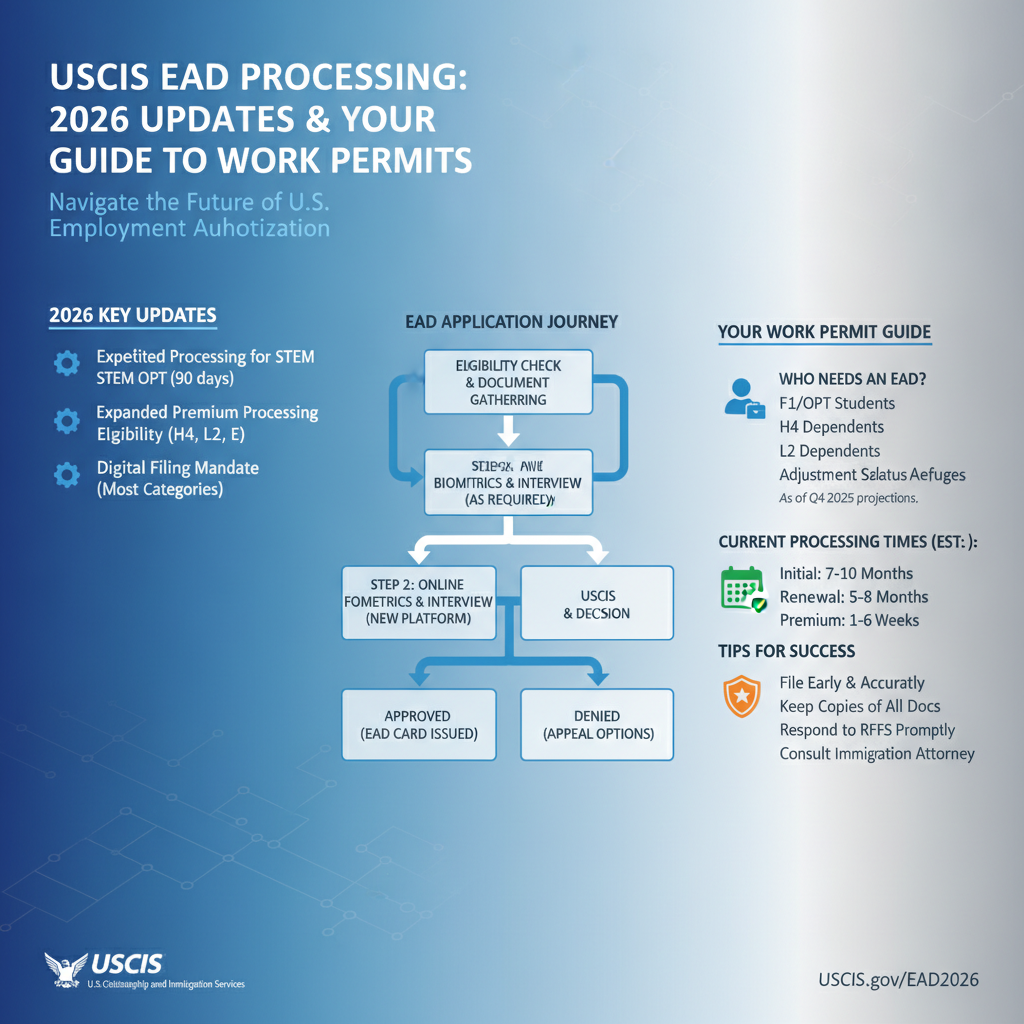
The information and guidance in this article are inspired by ongoing discussions and updates from U.S. Citizenship and Immigration Services (USCIS) regarding processing times and policy adjustments for Employment Authorization Documents (EADs), as highlighted by recent immigration law news. Staying current with these developments is crucial for all applicants.
What This News Means for Immigrants in Orlando and Across Florida
As of June 10, 2026, the landscape of U.S. immigration continues to evolve, with particular attention on the processing of Employment Authorization Documents (EADs). Recent developments from USCIS indicate a push towards greater efficiency in some areas, while others still grapple with existing backlogs. These changes, whether subtle policy shifts or more direct procedural updates, have significant implications for immigrants seeking to work legally in the United States, especially those residing in vibrant communities like Orlando and throughout Florida.
Why this news is showing up now
The continuous focus on EAD processing stems from several factors. Firstly, there's an ongoing effort by USCIS to adapt to post-pandemic operational challenges and to implement technological improvements aimed at streamlining case management. Secondly, increased public and political scrutiny on immigration backlogs, particularly for work permits that allow individuals to support themselves and their families, has put pressure on the agency to address these issues. Thirdly, the sheer volume of applications, coupled with a dynamic job market, necessitates regular review and adjustment of processing protocols. The updates we're seeing now reflect USCIS's response to these complex demands, aiming to balance security, efficiency, and fairness for millions of applicants. For individuals in Central Florida, where economic growth often attracts new residents, these processing updates are particularly relevant.
How it can affect Florida residents
For immigrants in Florida, from the bustling metropolis of Orlando to the coastal communities and agricultural heartlands, EAD processing updates can have direct and profound impacts. Faster processing times could mean quicker entry into the workforce, providing much-needed financial stability and contributing to the state's economy. Conversely, delays can lead to job loss, financial hardship, and immense stress for families who rely on an EAD holder’s income. For those whose EADs are expiring, understanding the current renewal landscape is critical to avoid gaps in employment authorization. Furthermore, new online filing options or specific document requirements could simplify the process for some while posing new challenges for others, especially those with limited access to technology or legal guidance. The Orlando USCIS Field Office and its capacity to manage local applications are always a concern for residents in Orange County and surrounding areas, making these federal updates highly localized in their impact.
Need Help? Our Orlando immigration team is ready to assist. Call +1 786-791-3106 for a free consultation, or message us online. Se Habla Español.
What Employment Authorization Document (EAD) Is (and Why It Matters)
An Employment Authorization Document, commonly known as an EAD or a "work permit," is a critical document issued by U.S. Citizenship and Immigration Services (USCIS) that provides non-U.S. citizens with legal permission to work in the United States for a specific period. It is a tangible card, similar to a driver's license, that proves an individual's authorization to be employed.
A plain-English definition
Think of an EAD as your official permission slip from the U.S. government to get a job and earn a living in the U.S. If you are not a U.S. citizen or a lawful permanent resident (Green Card holder), you generally need an EAD to work legally. This document is essential for many immigrants who are pursuing other immigration benefits, such as Adjustment of Status to a Green Card, asylum, or certain nonimmigrant visas that allow for employment.
Without an EAD, working in the U.S. is considered unauthorized employment, which can have severe negative consequences for your current and future immigration applications, including potential deportation or bars from re-entry. It is the cornerstone for economic stability and integration for countless individuals and families across the nation, including those building new lives along Florida's I-4 corridor.
Key terms you need to know
- EAD (Employment Authorization Document): The official card issued by USCIS allowing non-citizens to work in the U.S.
- Form I-765, Application for Employment Authorization: The specific USCIS form you must file to apply for or renew an EAD.
- USCIS (U.S. Citizenship and Immigration Services): The government agency responsible for processing immigration petitions and applications, including EADs. You can find more information on the USCIS official website.
- Adjustment of Status: The process by which an eligible applicant already in the United States can apply for lawful permanent resident status (a Green Card) without having to return to their home country to complete visa processing. EADs are often applied for concurrently with Form I-485, Application to Register Permanent Residence or Adjust Status.
- Automatic EAD Extension: A policy that allows certain EAD categories to continue working for a period (e.g., up to 540 days, as per recent temporary rules) beyond their EAD expiration date while their renewal application is pending. This is a critical provision to prevent employment gaps.
- Concurrent Filing: When multiple immigration forms, such as Form I-485 and Form I-765, are filed together at the same time.
- Nonimmigrant Visa: A visa issued to foreign nationals seeking to enter the U.S. temporarily for a specific purpose, such as tourism, temporary work, or study. Certain nonimmigrant visa holders are eligible for EADs (e.g., H-4 spouses, L-2 spouses, F-1 OPT students).
- Asylum Seeker: An individual who has applied for asylum in the U.S. and is awaiting a decision. After a certain period (currently 150 days) from filing their asylum application, they can become eligible for an EAD.
- Refugee: An individual granted refugee status in the U.S. They are generally authorized to work immediately upon entry or grant of status.
Current Immigration Law: The Foundation
The authority for issuing Employment Authorization Documents stems from federal immigration law, primarily the Immigration and Nationality Act (INA). While the specific eligibility categories for an EAD are numerous and varied, they are all defined by federal statutes and regulations.
Federal requirements
The legal framework for EADs is found in Section 274A of the INA, which prohibits unauthorized employment, and in 8 CFR Part 274a, which details the various categories of aliens authorized to work in the U.S. USCIS implements these laws through regulations, policy manuals, and adjudication guidelines. Eligibility for an EAD is not universal; it is granted to specific groups of non-citizens who fall into one of the many employment authorization categories. Some common categories include:
- Applicants for Adjustment of Status (AOS): Individuals with a pending Form I-485 (category (c)(9)).
- Asylum Applicants: Individuals with a pending Form I-589, Application for Asylum and for Withholding of Removal, typically after 150 days from filing (category (c)(8)).
- Refugees and Asylees: Those granted refugee or asylum status (categories (a)(3) and (a)(5)).
- Spouses of certain H-1B, L-1, and E visa holders: For example, H-4 spouses (category (c)(26)), L-2 spouses (category (a)(17)), and E spouses (category (a)(18)).
- Students with Optional Practical Training (OPT): F-1 students seeking work experience related to their field of study (categories (c)(3)(A), (c)(3)(B), (c)(3)(C)).
- Temporary Protected Status (TPS) holders: Individuals granted TPS for their country (category (a)(12) or (c)(19)).
- Deferred Action for Childhood Arrivals (DACA) recipients: (category (c)(33)).
- Individuals with a pending Suspension of Deportation or Cancellation of Removal application: (category (c)(10)).
Each category has specific requirements, documentation, and sometimes, fees. It is crucial to correctly identify your eligibility category when filing Form I-765. Incorrect categorization can lead to delays or denial. For detailed information on all categories, always refer to the USCIS Forms page and the instructions for Form I-765.
Florida-specific considerations
While the eligibility and processing of EADs are federal matters, Florida residents should be aware of state-level laws that interact with employment authorization. For instance, Florida employers are subject to federal and sometimes state laws regarding employment verification. Many employers in Florida utilize the E-Verify system, an internet-based system that allows businesses to determine the eligibility of their employees to work in the U.S. An EAD is a primary document used to establish work authorization during the I-9 employment eligibility verification process. Additionally, state laws regarding professional licensing for certain occupations (e.g., healthcare, legal professions) may require proof of legal work authorization as part of their licensing requirements. For Central Florida residents, maintaining a valid EAD is not just a federal requirement but a practical necessity for accessing employment opportunities and complying with state employer mandates.
Need Help? Our Orlando immigration team is ready to assist. Call +1 786-791-3106 for a free consultation, or message us online. Se Habla Español.
How to Apply for or Renew Your EAD: A Complete Step-by-Step Guide
Applying for or renewing your EAD can seem daunting, but breaking it down into manageable steps makes the process clearer. This guide focuses on the general process, but remember that specific document requirements can vary based on your eligibility category.
1) Determine Your Eligibility Category and Gather Required Information
Before you even touch Form I-765, you must accurately identify your eligibility category. This is paramount. The instructions for Form I-765 list all eligible categories (e.g., (c)(9) for AOS applicants, (c)(8) for asylum applicants). Make sure you meet all criteria for your chosen category. Once confirmed, begin gathering all necessary personal information and documents.
Required Information & Documents:
- Your full legal name, date of birth, country of birth, and country of citizenship.
- Your Alien Registration Number (A-Number), if you have one.
- Your Social Security Number (SSN), if you have one. If not, you can request one through Form I-765.
- The name and address of your current or most recent employer (if applicable).
- Information about your last entry into the U.S. (date, place, status).
- Your current immigration status.
- Any previous EAD information (if renewing).
- Passport or other government-issued identification.
2) Complete Form I-765, Application for Employment Authorization
This is the core of your application. You can download the latest version of Form I-765 from the USCIS Forms page. Read the instructions carefully, as they are updated periodically. Fill out the form accurately and completely. Any errors or omissions can lead to delays or a Request for Evidence (RFE).
Key Sections to Pay Attention To:
- Part 1: Reason for Applying: Clearly indicate if you are applying for initial permission, a replacement, or a renewal.
- Part 2: Information About You: Ensure all personal details match your official documents.
- Part 2, Item 27: Eligibility Category: Enter the correct code (e.g., (c)(9), (c)(8)). This is where missteps often occur.
- Part 3: Applicant's Statement, Contact Information, Declaration, Certification, and Signature: Double-check your contact information and ensure you sign the form. An unsigned form will be rejected.
Reminder: If you are requesting an initial EAD and do not have an SSN, you can request one by checking the appropriate boxes in Part 2 of Form I-765. USCIS will then coordinate with the Social Security Administration (SSA).
3) Gather All Supporting Documentation
This is where your specific eligibility category dictates the exact documents needed. Generally, you will need to provide evidence to support your eligibility.
Common Required Documents (varies by category):
- Copies of your previous EAD card (front and back), if renewing.
- Two passport-style photos: Taken within 30 days of filing, with a white background. Write your A-Number on the back lightly in pencil.
- Copy of your birth certificate.
- Copy of your passport biographical page.
- Copy of your Form I-94, Arrival/Departure Record.
- Copy of your visa (if applicable).
- Evidence of your underlying immigration status:
- For AOS applicants: Copy of Form I-797C, Notice of Action, for your pending Form I-485.
- For asylum applicants: Copy of Form I-589 receipt or interview notice.
- For H-4 spouses: Copy of spouse's H-1B approval (Form I-797), marriage certificate, and your H-4 approval notice.
- For F-1 OPT students: Copy of Form I-20 with OPT recommendation.
- Proof of identity: Government-issued ID, driver's license.
- Proof of relationship: Marriage certificate, birth certificates (for family-based categories).
Important: Always provide copies of documents, not originals, unless specifically requested by USCIS. Organize your documents neatly with cover sheets.
4) Prepare the Filing Fee
The filing fee for Form I-765 is subject to change. As of the latest updates in 2026, always check the USCIS Filing Fees page for the current amount. Some applicants may be exempt from paying the fee or eligible for a fee waiver (e.g., asylum applicants).
Payment Methods:
- Personal check, cashier's check, or money order payable to "U.S. Department of Homeland Security."
- Credit card using Form G-1450, Authorization for Credit Card Transactions (if filing by mail).
- Online payment if filing electronically (available for certain categories).
Warning: Ensure your check or money order is correctly filled out and the amount is exact. Incorrect fees are a common reason for application rejection.
5) Submit Your Application to USCIS
Once you have completed Form I-765, gathered all supporting documents, and prepared the fee, it's time to submit. The filing location depends on your eligibility category and whether you are filing concurrently with another form.
Submission Methods:
- Mail: Most applicants mail their forms to a specific USCIS Lockbox facility. The correct address is listed in the Form I-765 instructions under "Where to File." For Central Florida residents, this often means sending to a lockbox facility outside of Florida.
- Online Filing: USCIS is expanding online filing options. Check the USCIS website to see if your EAD category is eligible for online submission. Online filing can sometimes lead to faster processing and provides immediate confirmation of receipt.
Recommendation: If mailing, send your application via certified mail with a return receipt requested. This provides proof of delivery. Keep a complete copy of everything you submit for your records.
6) Attend Biometrics Appointment (If Required)
After USCIS receives your application, you will typically receive a Form I-797C, Notice of Action, confirming receipt. For many EAD categories, USCIS will then send a separate appointment notice for a biometrics (fingerprints, photos, signature) appointment at an Application Support Center (ASC).
What to Bring:
- The appointment notice.
- A valid photo ID (e.g., passport, driver's license).
Important: Do not miss your biometrics appointment. If you cannot attend, you must reschedule immediately following the instructions on the notice. Biometrics are critical for identity verification and security checks.
7) Monitor Your Case Status and Respond to RFEs
After biometrics, the waiting period begins. You can monitor your case status online using the receipt number provided on your Form I-797C. Visit the USCIS Case Status Online page.
Potential Communications from USCIS:
- Request for Evidence (RFE): USCIS may send an RFE if they need additional documents or clarification. Respond promptly and thoroughly by the deadline provided.
- Approval Notice: If your EAD is approved, you will receive an approval notice (Form I-797).
- EAD Card: Your physical EAD card will be mailed to you shortly after approval.
Warning: If you receive an RFE, it's highly advisable to consult with an experienced immigration attorney to ensure your response is complete and addresses all of USCIS's concerns. Improper RFE responses can lead to denial.
Need Help? Our Orlando immigration team is ready to assist. Call +1 786-791-3106 for a free consultation, or message us online. Se Habla Español.
Practical Steps You Can Take Today
Navigating EAD applications and renewals requires proactive planning. Here are practical steps you can take right now to ensure a smoother process, especially for those in Orlando and the broader Florida region.
Actionable Checklist:
- Verify Your Eligibility: Double-check your specific EAD eligibility category on the USCIS website. Do not assume.
- Check Current Processing Times: Visit the USCIS Processing Times page for the service center handling your application. This helps set realistic expectations.
- Gather Documents Early: Start collecting all required documents, including identification, previous immigration notices, and any supporting evidence for your category.
- Review Form I-765 Instructions: Download the latest version of the form and its instructions. USCIS updates these frequently.
- Set a Renewal Reminder: If you have an existing EAD, set a reminder for 180 days before its expiration date to begin the renewal process.
- Consult an Attorney: If you have any doubts about your eligibility, document requirements, or the renewal process, schedule a consultation with an experienced immigration lawyer.
Document Preparation Guidance
- Organize Everything: Create a checklist of all required documents. Use dividers or tabs to separate different sections of your application packet.
- Make Copies: Always send copies of documents, not originals, unless USCIS specifically requests them. Keep a complete, identical copy of your entire submission for your records.
- Translate Foreign Documents: Any document not in English must be accompanied by a complete and certified English translation. The translator must certify that they are competent to translate and that the translation is accurate.
- Passport Photos: Ensure your passport photos meet USCIS specifications (2x2 inches, white background, no glasses, recent).
- Write Legibly or Type: If filling out by hand, use black ink and write clearly. Typing is preferred.
Timeline Expectations
EAD processing times can vary significantly based on your eligibility category, the USCIS service center processing your application, and current agency backlogs. While USCIS aims for efficiency, delays are common.
General Timeline Points:
- Initial Filing to Receipt Notice: Typically 2-4 weeks.
- Receipt Notice to Biometrics Appointment: 3-8 weeks.
- Biometrics to Decision: This is the longest variable. It can range from 3 months to over a year, depending on the category and current processing loads. Always check the USCIS Processing Times page.
- EAD Renewal: For many categories, if you file your renewal application before your current EAD expires, you may be eligible for an Automatic EAD Extension, which can extend your work authorization for up to 540 days. This is a crucial policy, especially for residents in Orlando who rely on continuous employment.
Important: Do not make travel plans or job commitments based on optimistic processing times. Always allow ample time and have contingency plans.
How Imigrar Helps Immigrants in Orlando
At Imigrar, we understand the profound impact an Employment Authorization Document has on your life and the lives of your family. Our firm is dedicated to providing compassionate, expert legal guidance to immigrants in Orlando, across Florida, and nationwide. Our tagline, "Keep Families Together," reflects our core mission, and securing work authorization is often a vital step in achieving that goal.
Our experience and expertise
Our team of experienced immigration attorneys has a deep understanding of the complex and ever-changing U.S. immigration laws, including the latest USCIS policies on EAD processing. We stay current with all updates, ensuring our clients receive the most accurate and effective advice. We have successfully assisted countless individuals from diverse backgrounds with their initial EAD applications, renewals, and responses to RFEs. Whether you are an Adjustment of Status applicant in Kissimmee, an asylum seeker in Winter Park, or an H-4 spouse in Lake Mary, our firm has the knowledge to navigate your unique situation. We pride ourselves on clear communication, meticulous preparation, and unwavering advocacy for our clients.
Free consultation offer
We know that navigating immigration law can be overwhelming, and understanding your options is the first step. That's why Imigrar offers a free consultation. During this initial meeting, we will review your specific circumstances, assess your eligibility for an EAD or renewal, explain the process in plain language, and outline the best path forward. This is your opportunity to ask questions, understand potential challenges, and learn how our firm can support you through every stage of your journey.
Se Habla Español. Our bilingual team is ready to serve the diverse needs of the Central Florida community. We are here to listen, understand, and fight for your right to work and thrive in the United States. Contact us today to secure your future.

Frequently Asked Questions
Q: Who is eligible for an EAD?
A: Eligibility for an EAD is not universal. It's granted to specific categories of non-citizens. Common eligible groups include applicants for Adjustment of Status (Green Card), asylum seekers, refugees, individuals with Temporary Protected Status (TPS), certain nonimmigrant visa holders (like H-4, L-2, E spouses), and F-1 students seeking Optional Practical Training (OPT). Each category has specific requirements outlined by USCIS. You must fall into one of these defined categories to apply.
Q: How does getting an EAD impact my immigration status?
A: Receiving an EAD itself does not change your underlying immigration status. For example, if you are an asylum applicant, you remain an asylum applicant even after receiving an EAD. The EAD simply provides you with authorization to work while your primary immigration benefit (like asylum or a Green Card) is pending or has been granted. It allows you to maintain legal employment, which is crucial for financial stability and complying with U.S. law. However, unauthorized employment without an EAD can severely jeopardize your future immigration applications.
Q: What are the typical timelines for EAD processing in 2026?
A: EAD processing times can fluctuate significantly. As of June 2026, while USCIS has implemented some efficiency measures, backlogs persist in certain service centers and for specific categories. Generally, processing can range from 3 months to over a year. It's crucial to check the USCIS Processing Times page using your receipt number and service center. For renewals, many categories are eligible for an Automatic EAD Extension of up to 540 days, which helps prevent employment gaps while waiting for a new card. Always apply for renewal well in advance, ideally 180 days before expiration.
Q: What documents are absolutely essential for an EAD application?
A: While specific documents vary by eligibility category, universally essential documents include a completed and signed Form I-765, two passport-style photos, a copy of your previous EAD (if renewing), copies of your passport biographical page, Form I-94 (Arrival/Departure Record), and evidence of your underlying immigration status that qualifies you for an EAD (e.g., Form I-485 receipt, Form I-589 receipt, marriage certificate for spouses).


