


The reporting that sparked this guide
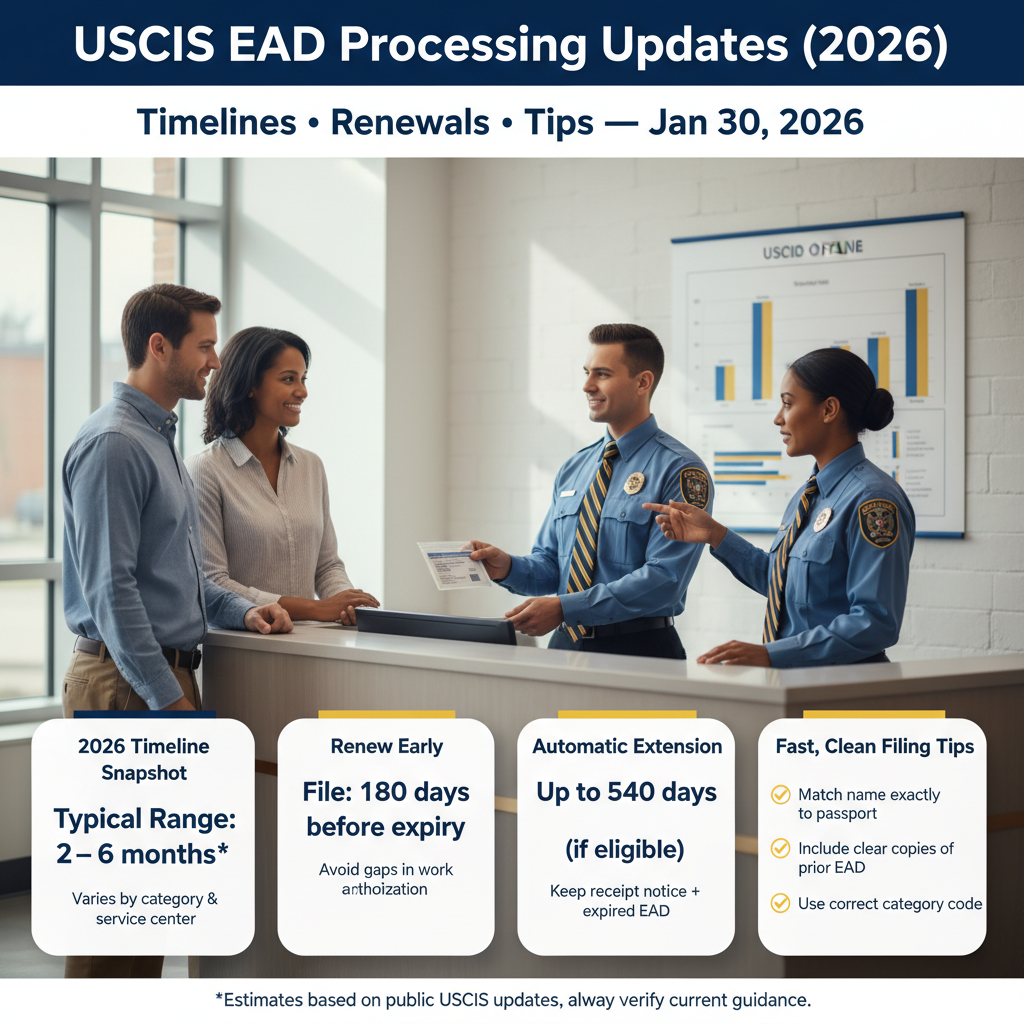
This article is based on recent USCIS-related reporting and public updates being surfaced in immigration news feeds. See the source link here: Employment Authorization Document Processing (USCIS).
Important: News headlines often summarize complex agency changes. Below, we translate what USCIS EAD processing updates typically mean in real life—how to file correctly, how to avoid gaps in work authorization, and what Florida applicants can do right now.
Need Help? Our Orlando immigration team is ready to assist. Call +1 786-791-3106 for a free consultation, or message us online. Se Habla Español.
What This News Means for Immigrants in Orlando and Across Florida
Why this news is showing up now
Employment Authorization Documents (EADs)—often called “work permits”—are one of the most time-sensitive benefits in the immigration system. When USCIS processing times shift, or when USCIS updates how it handles EAD renewals, it can immediately affect:
- Whether you can start a new job on time
- Whether you can keep working without interruption
- Whether your driver’s license renewal or I-9 verification goes smoothly
- Whether your family’s budget and stability are protected—especially for mixed-status households
USCIS EAD processing is “trending” because many applicants continue to experience uneven timelines depending on category, location, biometrics requirements, and whether the filing is online or by mail. At the same time, USCIS has continued to use policy tools like automatic extensions for certain renewal categories and operational changes (digital processing, fee updates, and shifting workload) that can change what applicants should do.
Reminder: USCIS rules can change by policy memo and Federal Register notices. Always verify current instructions and category-specific rules on the USCIS official website and the USCIS Forms page before filing.
How it can affect Florida residents
For Florida residents—especially in Central Florida along the I-4 corridor (Orlando, Kissimmee, Sanford, Lakeland, and Tampa)—EAD delays can ripple into daily life quickly:
- Employers in tourism, healthcare, logistics, and construction often require timely I-9 reverification when an EAD expires.
- DMV/driver’s license issues can arise when your lawful presence documentation is pending or expired.
- Household financial strain increases if there is a gap in work authorization.
If your case is in Orlando, you may also interact with the Orlando USCIS Field Office for related filings (like Adjustment of Status interviews for Form I-485) even though many EADs are processed through USCIS service centers. That means your overall strategy—what you file, when you file, and how you track it—matters.
What Employment Authorization Document Processing Is (and Why It Matters)
A plain-English definition
An Employment Authorization Document (EAD) is a photo ID card issued by USCIS that proves you are authorized to work in the United States for a specific period of time. Most EADs are requested using Form I-765 (Application for Employment Authorization).
“EAD processing” refers to everything USCIS does after you file Form I-765, including:
- Accepting your application and issuing a receipt notice
- Scheduling biometrics (if required)
- Reviewing eligibility in your category
- Requesting additional evidence (RFE) if needed
- Approving and producing the card
- Mailing the card and updating your case status
Why it matters: without valid work authorization, you may not be able to lawfully work, and you may face job loss, delayed onboarding, or interruptions to benefits tied to employment.
Key terms you need to know
- EAD: The work authorization card (often “Form I-766” is the card type, but you apply using Form I-765).
- Category code: A code like (c)(9) for pending Adjustment of Status applicants (based on Form I-485) or (a)(5) for asylees. The correct category is crucial.
- Receipt Notice (Form I-797C): Proof USCIS received your application; may help with automatic extension eligibility for renewals.
- Automatic Extension: For certain renewal categories, timely filing can extend work authorization for up to a set period (often referenced as 180 days, and in some categories/policy periods longer). Always confirm the current extension period and category list on USCIS.
- RFE (Request for Evidence): USCIS asks for more documents; this can significantly extend processing time.
- Expedite request: A request to process faster based on USCIS criteria (severe financial loss, humanitarian reasons, etc.).
- Processing times: Estimated time ranges posted by USCIS at USCIS Processing Times.
- Priority Date: A key concept in many green card processes (especially family- and employment-based). While EADs are not always tied to a Priority Date, your underlying case may be.
Warning: Working without authorization can create serious immigration consequences depending on your status and future applications. Do not assume you are authorized just because you filed an application—unless you qualify for an official automatic extension or another lawful basis to work.
Need Help? Our Orlando immigration team is ready to assist. Call +1 786-791-3106 for a free consultation, or message us online. Se Habla Español.
Current Immigration Law: The Foundation
EAD eligibility and processing are governed by federal immigration law and regulations, primarily under the Immigration and Nationality Act (INA) and Title 8 of the Code of Federal Regulations (8 C.F.R.). USCIS implements these rules through forms, instructions, and policy guidance.
Federal requirements
At the federal level, employment authorization is generally addressed through:
- INA provisions that authorize USCIS to grant benefits and regulate employment authorization for certain noncitizens.
- 8 C.F.R. § 274a (Employment Authorization), including categories eligible to apply for an EAD and rules for document issuance and renewal.
- Form I-765 and its USCIS instructions (category-specific requirements).
Common EAD-eligible groups include (not a complete list):
- Applicants with pending Adjustment of Status based on Form I-485 (often category (c)(9))
- Asylum applicants and asylees (category codes vary, including (c)(8) for pending asylum and (a)(5) for granted asylum)
- TPS holders (Temporary Protected Status)
- DACA recipients (Deferred Action for Childhood Arrivals)
- Certain parolees and humanitarian categories
Important: Your EAD eligibility depends on your exact immigration category—not just the fact that you are “in process.” For example, a pending Form I-130 alone does not automatically give you EAD eligibility, but a properly filed Form I-485 often does (if you are eligible to file it).
Official references you should use while preparing or checking your case:
- USCIS official website
- USCIS Forms
- USCIS Processing Times
- U.S. Department of State (for visa processing and travel documentation context)
- Executive Office for Immigration Review (if you are in immigration court proceedings that intersect with your status)
Florida-specific considerations
Immigration is federal law, so Florida does not create EAD eligibility rules. However, Florida residents often face state-level practical consequences that make EAD timing critical:
- Driver’s license and ID: Florida DMV verification can be impacted by expired documents or pending status. Plan renewals early and keep copies of receipts and approvals.
- Employment verification: Florida employers must comply with federal I-9 rules. An expiring EAD triggers reverification.
- Local economy realities: In Orange County and along the I-4 corridor, many workers are in industries with strict onboarding schedules; delays can mean losing a job opportunity.
If your case is in Orlando, it’s also common to have a “package” filing strategy where an EAD is filed together with family-based immigration forms such as Form I-130 and Form I-485. In those situations, one mistake in the overall package can create delays for everything.
How to Apply for or Renew an EAD: A Complete Step-by-Step Guide
This guide covers the most common scenario: filing Form I-765 for a first-time EAD or an EAD renewal. Because USCIS requirements vary by category, always confirm your category’s evidence list in the Form I-765 instructions.
1) Confirm your eligibility category and timing
Start by identifying the correct eligibility category for your EAD. This is not just a technicality—USCIS can reject or deny an I-765 if the category is wrong.
What to do:
- Identify the basis for your work authorization (pending Adjustment of Status, asylum, TPS, DACA, etc.).
- Confirm whether you are filing an initial EAD or a renewal.
- Check whether your category qualifies for an automatic extension upon timely renewal filing.
- Plan around deadlines like the 90-day window (a common planning concept for renewals—file early enough to avoid gaps; exact earliest filing rules vary by category).
Documents to gather at this step:
- Current/previous EAD card (front and back), if renewing
- USCIS receipt notices for underlying cases (e.g., I-485 receipt for (c)(9))
- Any approval notices relevant to your category (TPS approval, asylum approval, etc.)
- Passport biographic page and visa/I-94 if available
Warning: If you are not sure you’re eligible, do not “guess” a category. A denial may cause lost time, lost fees, and employment disruption.
2) Choose the correct filing method: online vs. paper
USCIS allows online filing for many (but not all) Form I-765 categories. Some applicants benefit from online filing because it can reduce mailing delays and improve tracking; others must file by mail due to category restrictions or because they are filing as part of a larger packet.
What to do:
- Confirm if your category is eligible for online filing through USCIS.
- If filing by mail, confirm the correct USCIS lockbox address for Form I-765 based on your category and delivery method.
- If filing with other forms (like Form I-485), follow the “concurrent filing” instructions carefully.
Documents to gather at this step:
- A complete copy of your prepared Form I-765 (draft)
- Filing fee information (or fee waiver request if eligible)
- Mailing labels and tracking (if paper filing)
- USCIS online account details (if filing online)
3) Prepare your Form I-765 and supporting evidence
USCIS adjudicators rely heavily on consistency across your forms and documents. Names, dates, addresses, and A-Numbers must match your prior filings.
What to do:
- Complete Form I-765 fully and accurately.
- Use your exact legal name and keep it consistent across Form I-130, Form I-485, and Form I-765 if you have a family-based case.
- Confirm your eligibility category code is correct.
- Prepare category-specific evidence (for example, I-485 receipt for (c)(9)).
Documents commonly required (varies by category):
- Two passport-style photos (if required for paper filing)
- Copy of government-issued photo ID (passport page)
- Copy of I-94 record (if applicable)
- Copy of prior EAD (if renewing)
- Copy of USCIS receipt notice for the underlying application/petition (e.g., I-485 receipt)
- Any prior EAD approval notices
- Certified translations for any non-English documents
Reminder: If you are filing based on a pending Adjustment of Status case, your EAD is usually tied to your Form I-485 (not your Form I-130 alone). Your Priority Date may matter for green card availability, but EAD eligibility usually turns on whether you properly filed the I-485.
4) File correctly and track receipt, biometrics, and case updates
After filing, your next goal is to obtain the receipt notice and ensure USCIS can complete biometrics (if required). Missing a biometrics appointment can delay or derail the application.
What to do:
- Save proof of delivery (USPS/UPS/FedEx tracking) for mailed filings.
- Watch for the I-797C receipt notice.
- Create or log into your USCIS online account to track updates (even for paper filings, you may be able to add the case).
- Attend biometrics if scheduled; reschedule only if absolutely necessary.
Documents to keep handy at this step:
- I-797C receipt notice
- Biometrics appointment notice (if issued)
- Government photo ID for biometrics appointment
- Copies of your full filing packet
If your case is in Orlando and you receive a biometrics appointment at a Florida ASC (Application Support Center), arrive early and bring exactly what the notice requires.
5) Understand renewals, automatic extensions, and I-9 re-verification
Renewals are where many people lose work authorization—not because they were ineligible, but because they filed too late or didn’t understand extension rules.
What to do:
- File your renewal as early as permitted for your category.
- Confirm whether you qualify for an automatic extension and for how long (often referenced as 180 days for many categories, but verify current policy).
- Keep your expired EAD and the receipt notice together; employers may use them for I-9 purposes if you qualify for the extension.
- Track the case at USCIS Processing Times and compare your receipt date to posted ranges.
Documents to collect at this step:
- Expired/expiring EAD card
- I-797C receipt notice for the renewal
- Category evidence (e.g., I-485 receipt for (c)(9))
- Employer’s I-9 reverification notice (if your employer issues one)
Warning: Not every EAD category qualifies for an automatic extension. If you assume you have one and you don’t, you could accidentally work without authorization.
6) Respond quickly to RFEs and fix delivery issues
Two common processing problems are (1) USCIS issues an RFE, or (2) the EAD is approved but the card is delayed/lost in the mail.
What to do if you receive an RFE:
- Read the RFE carefully and respond with exactly what USCIS asks for.
- Mail the response with tracking and keep a complete copy.
- Respond well before the deadline (don’t wait until the last week).
What to do if the card is lost/delayed:
- Confirm your address is correct in your USCIS account.
- Submit an online inquiry if the case status indicates “Card Was Mailed” but you did not receive it.
- Consider USPS Informed Delivery and secure mail handling.
Documents to gather at this step:
- RFE notice and your response packet copy
- Proof of timely response delivery
- Approval notice (if issued)
- Any USPS tracking information related to card delivery
7) Consider an expedite request when it truly fits USCIS criteria
USCIS may grant expedite requests in limited situations, such as severe financial loss to a person or company, urgent humanitarian reasons, or other criteria USCIS recognizes. Expedites are discretionary and not guaranteed.
What to do:
- Prepare a clear, evidence-backed explanation of the expedite basis.
- Include documentation (job offer letters, termination notices, medical letters, eviction notices, etc.).
- Submit the request through the USCIS channels available for your case type.
Documents to gather at this step:
- Employer letter describing the harm and timeline
- Pay stubs, bank statements, bills showing financial loss
- Medical/humanitarian documentation if applicable
- Case receipt number and filing history
Need Help? Our Orlando immigration team is ready to assist. Call +1 786-791-3106 for a free consultation, or message us online. Se Habla Español.
Practical Steps You Can Take Today
If EAD processing delays or renewal timing are affecting you, here is an actionable checklist you can start today—especially helpful for Central Florida residents who may be balancing employer deadlines, school schedules, and family responsibilities.
- 1) Check your EAD expiration date right now and set reminders at 180, 120, and 90 days before expiration. Even if your category allows an automatic extension, earlier filing reduces risk.
- 2) Download the newest edition date of Form I-765 from USCIS Forms. Using an outdated form can trigger rejection.
- 3) Verify your category code and match it to your underlying case. If you have a pending Form I-485 (a common Orlando family-based path), ensure the I-485 receipt is included for (c)(9) filings.
- 4) Build a “USCIS proof packet” (digital + paper) with:
- All receipt notices
- Prior approvals
- Front/back copies of all EADs
- Passport bio page and I-94
- Certified translations
- 5) Track your case weekly using USCIS Processing Times and your USCIS account. Save screenshots if your employer needs proof of progress.
- 6) If your employer is pressuring you, ask HR to provide the I-9 reverification date in writing and confirm whether your category qualifies for an extension. Warning: Do not present documents you don’t have or claim an extension you don’t qualify for.
- 7) If you moved, update your address with USCIS immediately to reduce the risk of a lost card or missed notice.
Timeline expectations (general guidance): EAD processing times vary widely by category and service center. Some applicants receive decisions faster, while others may wait months. Use the official tool at USCIS Processing Times for the most accurate estimate by form and category.
Reminder: If your case is in Orlando and you also have a pending Adjustment of Status interview at the Orlando USCIS Field Office, your EAD timeline may still be handled separately through a service center. Plan for the EAD as its own process, not as an automatic byproduct of your interview scheduling.
How Imigrar Helps Immigrants in Orlando
At Imigrar, we focus on practical, family-centered immigration strategies that protect work authorization and stability. Our tagline is “Keep Families Together”, and EAD continuity is often a key part of that mission—because employment is what keeps rent paid, health insurance active, and children supported while immigration cases move forward.
We help clients in Orlando, Orange County, and across the I-4 corridor—and we also serve clients nationwide—by:
- Confirming the correct Form I-765 eligibility category and evidence
- Preparing clean, consistent filings that match your Form I-130 and Form I-485 strategy (when applicable)
- Reducing RFE risk through front-loaded documentation
- Advising on automatic extension eligibility and employer I-9 compliance concerns
- Submitting expedite requests when the facts truly support USCIS criteria
- Troubleshooting lost cards, notice issues, and timing gaps
Se Habla Español. If you’re worried about a gap in work authorization or you’re unsure how USCIS updates affect your situation, we offer a free consultation to discuss next steps.
Frequently Asked Questions
Q: Am I eligible to apply for an EAD if I filed Form I-130?
A: Usually, a pending Form I-130 by itself does not make you eligible for an EAD. Many applicants become eligible when they file Form I-485 for Adjustment of Status (if they are eligible to file it) and then file Form I-765 under the appropriate category (commonly (c)(9)). If you are not sure whether you can file Form I-485 or whether your Priority Date is current, get legal guidance before filing.
Q: Will filing or renewing an EAD affect my immigration status?
A: Filing Form I-765 typically does not “create” immigration status; it requests work authorization based on an underlying status or pending benefit (such as TPS, asylum, or a pending Form I-485). However, inconsistencies or errors in the I-765 (wrong category, incorrect dates, missing prior immigration history) can raise questions that slow your case or lead to an RFE. Important: Always ensure your EAD filing matches your underlying case facts.
Q: How long does USCIS take to process EAD applications and renewals?
A: Processing times vary by category and workload. The most reliable way to estimate is to check USCIS Processing Times for Form I-765 and your eligibility category. If your case is outside posted processing times, you may be able to submit a case inquiry through USCIS channels. If you are in Orlando or Central Florida, your EAD may still be processed at a service center, so local field office scheduling is not always a predictor.
Q: What documents do I need for an EAD renewal?
A: Common renewal documents include: a copy of your current/expired EAD (front and back), a copy of your government ID (passport page), your prior approval notices, and proof of your underlying eligibility (for example, an I-485 receipt if filing under (c)(9)). Some categories require additional evidence. Reminder: Use the current Form I-765 instructions from USCIS Forms and include certified translations for any non-English documents.
Q: How much does it cost to apply for or renew an EAD?
A: USCIS fees can change, and the fee can vary depending on category and whether you are filing the I-765 alone or with another application. Always confirm the current fee and payment method directly on the USCIS official website. Some applicants may qualify for a fee waiver depending on the category and financial circumstances. Because a rejected payment can cause a full rejection of the application, we recommend double-checking fee amounts and payee instructions before filing.
Q: What happens if my EAD is denied?
A: A denial can happen for reasons like ineligibility, incorrect category selection, missing evidence, or issues with the underlying case. First, read the denial notice carefully—it explains the reason and whether a motion or appeal is allowed (often EAD denials have limited options, depending on category). You may be able to refile with corrected evidence, but timing is critical if your work authorization is expiring. Warning: If your EAD is tied to a pending Form I-485, a denial may signal a problem that could also affect your Adjustment of Status case.
Q: Can I travel internationally while my EAD is pending?
A: An EAD is not a travel document. If you have a pending Adjustment of Status case, traveling without proper advance permission may abandon the I-485 in many situations. Advance travel permission is typically requested on Form I-131 (not covered in depth here). For travel-related guidance, review U.S. Department of State resources and consult counsel before leaving the U.S.
Common Mistakes (and How to Avoid Them)
Mistake #1: Filing under the wrong eligibility category
This is one of the fastest ways to get rejected or denied. The category must match your underlying immigration basis (TPS, asylum, pending Form I-485 for Adjustment of Status, etc.).
How to avoid it: Confirm the category in the current I-765 instructions and cross-check your underlying receipt notices. If your case involves a family petition (Form I-130) and an AOS filing (Form I-485), ensure the EAD is connected to the correct filing.
Mistake #2: Renewing too late and assuming an automatic extension applies
Many people hear “180 days automatic extension” and assume it applies to everyone. It does not.
How to avoid it: File as early as allowed, confirm your category is eligible for the extension, and keep the receipt notice and expired card together for I-9 purposes if eligible. If your employer gives you a deadline, do not wait—talk to an attorney early.
Mistake #3: Ignoring address updates and missing USCIS notices
Card production and delivery are extremely address-sensitive. If USCIS mails your card to an old address, you may lose weeks or months fixing it.
How to avoid it: Update your address promptly and monitor your USCIS account. For Central Florida residents who move frequently due to rental changes, this is especially important.
Need Help? Our Orlando immigration team is ready to assist. Call +1 786-791-3106 for a free consultation, or message us online. Se Habla Español.

Closing: Protect Your Work Authorization While USCIS Processing Evolves
USCIS EAD processing updates can feel unpredictable, but most work-permit problems are preventable with the right plan: confirm category eligibility, file early, submit strong evidence, track your case, and respond quickly to any USCIS notice.
Important: If your case is in Orlando, or you’re anywhere in Central Florida along the I-4 corridor, do not wait until the last minute—especially if your employer is requesting I-9 reverification or your driver’s license renewal depends on your immigration documents.
Need help with an EAD application or renewal? Call Imigrar at +1 786-791-3106 for a free consultation, or message us online. Se Habla Español.


