


The ability to work legally in the United States is a cornerstone of building a new life for many immigrants. An Employment Authorization Document (EAD), often referred to as a work permit, is the key to unlocking this opportunity. At Imigrar, your trusted immigration law firm in Orlando, Florida, we understand the critical importance of timely and accurate EAD processing.
As of today, July 14, 2026, the U.S. Citizenship and Immigration Services (USCIS) continues to implement and refine policies aimed at improving the efficiency of EAD applications and renewals. These ongoing efforts are crucial for countless individuals and families who rely on work authorization to support themselves and contribute to their communities. Understanding these updates is vital for anyone seeking or renewing an EAD.
The reporting that sparked this guide
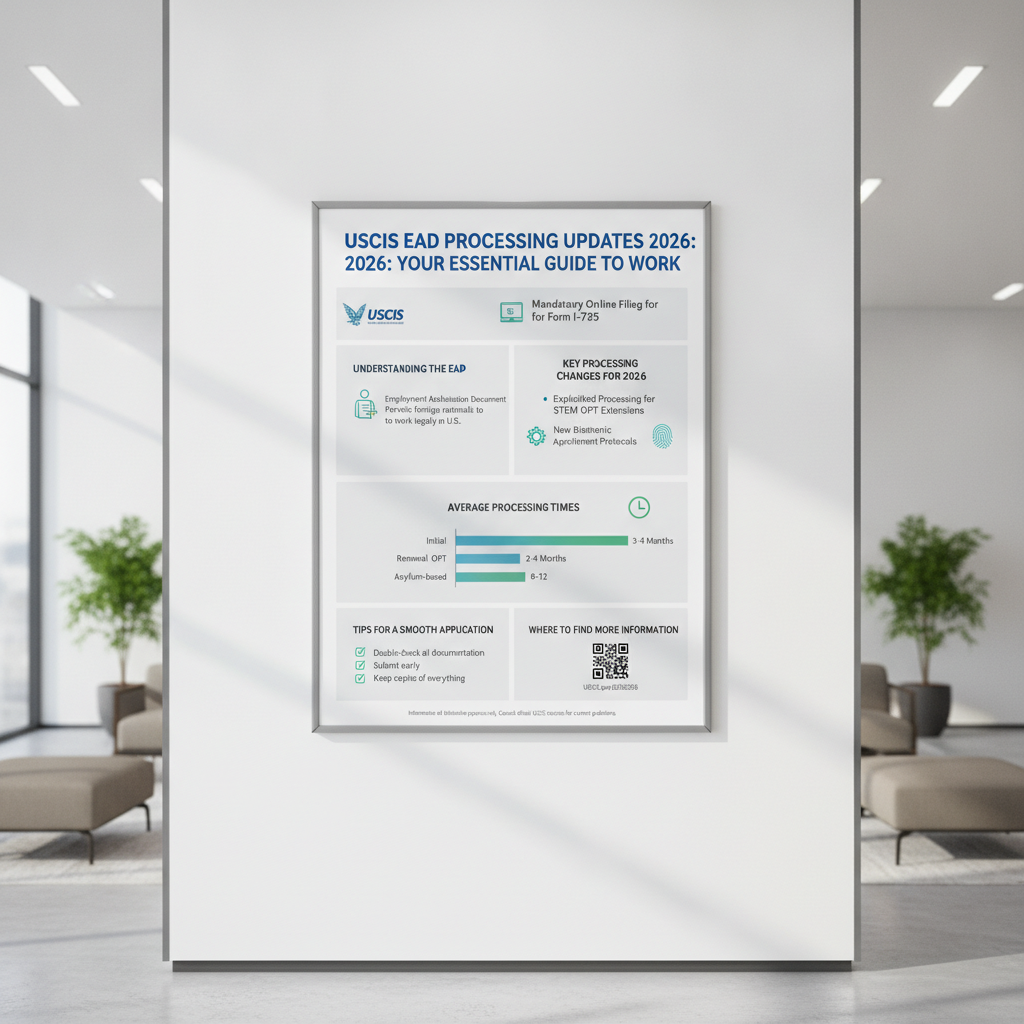
Our commitment to keeping families together and informed is why we closely monitor official announcements and legal developments. The insights and updates regarding Employment Authorization Document Processing (USCIS) from recent news reports and official USCIS releases underscore the dynamic nature of immigration policy and the continuous need for clear, actionable guidance.
What This News Means for Immigrants in Orlando and Across Florida
Recent USCIS announcements and ongoing policy adjustments regarding EAD processing have significant implications for immigrants nationwide, including the vibrant and growing immigrant communities in Orlando and throughout Florida. These changes are designed to address historical backlogs and streamline the application process, but understanding the specifics is crucial.
Why this news is showing up now
The discussion around EAD processing is prominent now because USCIS has been actively working to reduce processing backlogs that accumulated over previous years. These efforts gained momentum in late 2021 and continued through 2022, 2023, 2024, and 2025 with various policy changes, including automatic EAD extensions, increased validity periods for certain categories, and internal operational improvements. As of mid-2026, these initiatives are still being refined and their effects are being observed. The goal is to ensure that eligible non-citizens can receive and renew their work permits more efficiently, minimizing disruptions to their employment and livelihoods. This ongoing commitment to efficiency is why you continue to see news and updates regarding EAD processing.
How it can affect Florida residents
For individuals residing in Florida, particularly in bustling metropolitan areas like Orlando, Tampa, and Miami, these USCIS updates directly impact their ability to work, sustain their families, and contribute to the local economy. Florida has a large and diverse immigrant population, meaning a significant number of residents rely on EADs. Here’s how these changes can affect you:
- Reduced Processing Times: While processing times can still vary, USCIS’s concerted efforts aim to reduce the lengthy waits many applicants have experienced. This means less uncertainty and quicker access to employment for those in Central Florida and beyond.
- Automatic Extensions: The expanded automatic extension period for certain EAD renewal applicants (up to 540 days in some cases, though this can fluctuate based on policy) is a lifeline for many. This policy prevents gaps in employment authorization, allowing individuals in Orlando to continue working legally while their renewal application is pending.
- Increased Validity Periods: For certain categories, USCIS has increased the validity period of initial and renewed EADs to 5 years. This reduces the frequency of renewals, saving applicants time, money, and stress, which is a significant benefit for long-term residents in Florida.
- Economic Stability: For families in Orange County and surrounding areas, stable work authorization means stable income, which translates to greater economic security. This impacts everything from housing and education to daily living expenses.
- Local USCIS Field Office Impact: While EAD applications are generally processed nationally, the efficiency of the overall system affects how local USCIS field offices, like the one in Orlando, manage related inquiries and appointments. Faster national processing can free up resources for other local immigration services.
Important: While these updates are largely positive, navigating the specifics of eligibility, application requirements, and understanding which policies apply to your unique situation can be complex. Consulting with an experienced Orlando immigration attorney is always recommended to ensure you benefit fully from these changes.
Need Help? Our Orlando immigration team is ready to assist. Call +1 786-791-3106 for a free consultation, or message us online. Se Habla Español.
What Employment Authorization Documents (EADs) Are (and Why They Matter)
At its core, an Employment Authorization Document (EAD) is a temporary work permit issued by USCIS that grants foreign nationals legal permission to work in the United States for a specific period. It is a plastic card, similar to a driver's license, and is crucial for many immigrants to provide for themselves and their families.
A plain-English definition
Think of an EAD as your official "permission slip" from the U.S. government to get a job. If you're not a U.S. citizen or a lawful permanent resident (green card holder), but you're in the process of adjusting your immigration status, have applied for asylum, or fall into certain other categories, you likely need an EAD to work legally. Without it, most employers cannot legally hire you.
Key terms you need to know
Understanding these terms will help you navigate the EAD process:
- USCIS (U.S. Citizenship and Immigration Services): The government agency responsible for overseeing lawful immigration to the United States. They process EAD applications.
- Form I-765: This is the official application form you must submit to USCIS to request an Employment Authorization Document.
- Work Permit: Another common name for an EAD. They are the same thing.
- Adjustment of Status: The process of applying for lawful permanent resident status (a green card) while physically present in the United States. Many individuals applying for adjustment of status are eligible for an EAD while their green card application is pending.
- Asylum Seeker/Asylee: An individual who has applied for asylum in the U.S. (asylum seeker) or who has been granted asylum (asylee) is generally eligible for an EAD.
- DACA (Deferred Action for Childhood Arrivals): A program that provides eligible young undocumented immigrants with deferred action from deportation and eligibility for an EAD.
- TPS (Temporary Protected Status): A temporary immigration status granted to eligible nationals of certain countries facing ongoing armed conflict, environmental disaster, or other extraordinary and temporary conditions. TPS beneficiaries are eligible for EADs.
- Nonimmigrant Visa Holders: Certain nonimmigrant visa categories (e.g., F-1 students with Optional Practical Training (OPT), J-2 spouses of exchange visitors) are also eligible for EADs.
- Automatic Extension: A USCIS policy that allows certain EAD renewal applicants to continue working for a specific period (currently up to 540 days for many categories) beyond the expiration date of their current EAD, provided they filed their renewal application on time and remain eligible.
The EAD is more than just a piece of plastic; it represents independence, financial stability, and the opportunity to build a meaningful life in the U.S. For many immigrants in Orlando and nationwide, it's a vital step towards achieving their American dream, allowing them to support their families, pay taxes, and contribute to their new communities.
Current Immigration Law: The Foundation of Your Work Authorization
The authority for granting employment authorization to non-citizens in the United States is primarily derived from the Immigration and Nationality Act (INA) and its subsequent regulations. These laws establish various categories of non-citizens who are eligible for employment authorization, either incident to their status or by applying for an EAD.
Federal requirements
Under federal law, specifically 8 CFR §274a.12, USCIS outlines the categories of non-citizens who are authorized to work in the U.S. without specific employment authorization from USCIS (e.g., lawful permanent residents, asylees) and those who must apply for an EAD. The key federal requirements revolve around proving eligibility for one of the specific categories listed in the regulations.
Common categories eligible to apply for an EAD include:
- Individuals with a pending application for Adjustment of Status (Form I-485).
- Asylum applicants with a pending asylum application (Form I-589) who have waited at least 150 days after filing.
- Asylees and refugees.
- Individuals granted Temporary Protected Status (TPS).
- Certain nonimmigrant visa holders, such as spouses of E, L-1, and H-1B visa holders (EADs for H-4 spouses are particularly relevant).
- Students with F-1 visas engaging in Optional Practical Training (OPT) or Curricular Practical Training (CPT).
- Applicants for suspension of deportation or cancellation of removal.
- Individuals with Deferred Action, such as DACA recipients.
Each category has specific requirements for eligibility, which must be met at the time of application. For instance, an applicant for adjustment of status (Form I-485) must have a concurrently filed or pending immigrant visa petition (e.g., Form I-130, Form I-140) and be eligible to adjust their status in the U.S.
Reminder: The specific eligibility criteria for each EAD category are detailed in the instructions for Form I-765 and in USCIS policy manuals. It is crucial to identify the correct eligibility category for your situation.
Florida-specific considerations
While immigration law is federal, its impact is deeply felt at the state and local levels. For Florida residents, especially those in Orlando, the availability of EADs directly affects the workforce and economy. There are no Florida-specific laws that alter federal EAD eligibility, but state laws regarding employment, driver's licenses, and professional licenses often require proof of federal work authorization.
- Employment Verification: Florida employers are subject to federal regulations requiring them to verify the employment eligibility of all new hires using Form I-9, Employment Eligibility Verification. An EAD is a primary document used to satisfy both identity and employment authorization requirements.
- Driver's Licenses: In Florida, an EAD can be used as a primary document to obtain a driver's license or state identification card, which is essential for daily life, commuting along the I-4 corridor, and accessing services in Orange County. The validity period of your EAD will typically determine the validity period of your Florida driver's license.
- Professional Licensing: For individuals seeking to work in licensed professions (e.g., healthcare, education) in Florida, possessing a valid EAD is a prerequisite for obtaining the necessary state licenses.
The Orlando USCIS Field Office, located at 5449 Forbes Pl, Orlando, FL 32812, handles certain in-person services, including biometrics appointments, for residents of Central Florida. While EAD applications are filed centrally, understanding your local resources and how your EAD status impacts other state-level benefits is part of a comprehensive approach to immigration.
Always refer to the USCIS official website for the most up-to-date forms, instructions, and policy guidance.
How to Apply for or Renew Your EAD: A Complete Step-by-Step Guide
Applying for or renewing an Employment Authorization Document (EAD), also known as a work permit, involves careful attention to detail and adherence to USCIS requirements. Here’s a comprehensive step-by-step guide to help you navigate the process.
1) Determine Your Eligibility and Correct Category
Before you even fill out a form, you must confirm that you are eligible for an EAD and identify the correct eligibility category. This is the most crucial first step, as filing under the wrong category will lead to denial.
- Review USCIS Instructions: Carefully read the instructions for Form I-765, Application for Employment Authorization. These instructions detail all eligible categories (e.g., (c)(9) for Adjustment of Status applicants, (c)(8) for asylum applicants).
- Identify Your Basis: Are you applying for an EAD based on a pending green card application (Form I-485)? Are you an asylum applicant? A DACA recipient? A spouse of an L-1 visa holder? Each scenario corresponds to a specific eligibility category code.
- Consult with an Attorney: If you are unsure about your eligibility or category, especially if your immigration situation is complex, seek legal advice from an experienced immigration attorney at Imigrar.
Required Documents for this step (for self-assessment):
- Any immigration notices or receipts (e.g., Form I-797C Notice of Action for Form I-485, Form I-589, etc.)
- Your current immigration status documents (visa, I-94 record).
2) Gather All Required Supporting Documents
Once you know your eligibility category, compile all necessary supporting documents. Missing or incorrect documents are a common reason for delays or denials.
- Proof of Identity and Nationality: Copy of your birth certificate, passport, national identity card.
- Photos: Two identical, color passport-style photos taken within the last 30 days. Write your name and Alien Registration Number (A-Number) lightly on the back of each photo.
- Proof of Previous EAD (if renewing): A copy of your most recent EAD card (front and back).
- Proof of Immigration Status: Copy of your Form I-94, Arrival/Departure Record, visa stamp, or other relevant immigration documents.
- Evidence of Eligibility: This is category-specific:
- For Adjustment of Status (c)(9): Copy of your Form I-485 receipt notice (Form I-797C).
- For Asylum Applicants (c)(8): Copy of your Form I-589 receipt notice.
- For DACA: Copy of your most recent DACA approval notice.
- For Spouses of L-1 or E Visa Holders: Copy of your spouse's visa, I-94, marriage certificate.
- For F-1 OPT: Copy of your Form I-20 with the OPT recommendation.
- Previous EADs or Work Permits: Copies of any previously issued EADs.
- Translation of Foreign Language Documents: Any document not in English must be accompanied by a complete English translation and a translator's certification.
3) Complete Form I-765, Application for Employment Authorization
Fill out Form I-765 accurately and completely. You can download the latest version from the USCIS Forms page.
- Use the Latest Form: Always use the edition of Form I-765 specified in the instructions.
- Provide All Information: Answer every question truthfully and completely. If a question does not apply, write "N/A" (not applicable).
- Sign the Form: An unsigned form will be rejected.
- Choose Correct Eligibility Category: Double-check that you have entered the correct eligibility category code (e.g., (c)(9), (c)(8), (c)(3)(C)).
- Consider Online Filing: For certain categories, USCIS allows online filing of Form I-765. This can sometimes expedite processing and reduce errors.
4) Pay the Filing Fee
The filing fee for Form I-765 can change, so always check the USCIS website for Form I-765 for the current fee. Some categories are exempt from the fee.
- Current Fee: As of July 2026, verify the exact fee on the USCIS website.
- Payment Method: You can pay by money order, personal check, cashier’s check, or by credit card using Form G-1450, Authorization for Credit Card Transactions. Do not send cash.
- Fee Waivers: Certain applicants, such as those with pending asylum applications or some TPS applicants, may be eligible for a fee waiver by filing Form I-912, Request for Fee Waiver. Ensure you meet the criteria before applying for a waiver.
5) Submit Your Application Package
Assemble your application package carefully and mail it to the correct USCIS lockbox facility. The correct address depends on your eligibility category and whether you are filing other forms concurrently.
- Compile Package: Place the completed Form I-765, supporting documents, and fee payment (or fee waiver request) in a sturdy envelope.
- Check Filing Address: Always verify the correct filing address on the USCIS website for Form I-765. Sending it to the wrong address will cause significant delays.
- Make Copies: Make a complete copy of the entire application package for your records before mailing it.
- Tracking: Send your application via certified mail with a return receipt or a courier service that provides tracking. This provides proof of mailing and delivery.
6) Attend Your Biometrics Appointment (If Applicable)
After USCIS accepts your application, you may receive a notice for a biometrics appointment at an Application Support Center (ASC).
- Appointment Notice: You will receive Form I-797C, Notice of Action, scheduling your biometrics appointment.
- What to Bring: Bring the appointment notice and a valid photo ID (e.g., passport, driver's license).
- Purpose: At the appointment, USCIS will collect your fingerprints, photograph, and signature for background checks. For Central Florida residents, this appointment will likely be at the Orlando USCIS Application Support Center.
7) Receive Decision and EAD Card
Once USCIS processes your application, they will mail you a decision notice and, if approved, your EAD card.
- Check Status Online: You can check the status of your case using the receipt number provided on your Form I-797C via the USCIS Case Status Online tool.
- Processing Times: Monitor current USCIS Processing Times for your specific form and field office/service center.
- EAD Card Delivery: If approved, your EAD card will be mailed to the address on file. Ensure your address is always up to date with USCIS.
Warning: Never assume your EAD will be renewed automatically or that you can continue working without proper authorization. Plan ahead, file early, and seek legal guidance to avoid gaps in employment.
Need Expert Guidance on Your EAD Application? Don't risk delays or denials. Contact Imigrar for personalized assistance. Call +1 786-791-3106 for a free consultation. Se Habla Español.
Practical Steps You Can Take Today for Your EAD Application
Navigating the EAD application process can feel overwhelming, but taking proactive steps can significantly improve your chances of a smooth and timely approval. Here are some practical actions you can implement right away:
Actionable Checklist:
- Confirm Your Eligibility: Before anything else, re-verify your EAD eligibility category. USCIS rules change, so always check the latest Form I-765 instructions on the USCIS website.
- Gather Documents Early: Start collecting all necessary supporting documents (identity, photos, previous EADs, immigration notices, marriage certificates, etc.) as soon as possible. Some documents, like birth certificates from overseas, can take time to obtain.
- Review Form I-765 Thoroughly: Download the latest version of Form I-765 and read every question and instruction carefully. Make a draft copy first to avoid errors on the official form.
- Calculate Fees Accurately: Check the current filing fee on the USCIS website. If you are eligible for a fee waiver, begin preparing Form I-912 and its supporting evidence.
- Make Copies of Everything: Before mailing, scan or photocopy your entire application package. This record is invaluable if documents are lost or if USCIS requests further information.
- Update Your Address with USCIS: If you've moved, ensure your address on file with USCIS is current by filing Form AR-11, Alien's Change of Address Card. Incorrect addresses lead to missed notices and delays.
Document Preparation Guidance:
- Organization is Key: Arrange your documents in the order listed in the Form I-765 instructions or in a logical, tabbed manner. This makes it easier for USCIS officers to review your application.
- Clear Copies: Provide clear, legible copies of all required documents. Do not send originals unless specifically requested by USCIS.
- Professional Photos: Ensure your passport-style photos meet all USCIS specifications (size, background, no glasses, recent). Many pharmacies or photo studios in Orlando offer this service.
- Translations: If any document is not in English, provide a certified English translation. The translator must certify that they are competent to translate and that the translation is accurate.
Timeline Expectations:
Understanding processing times helps manage expectations and plan your employment status.
- Check USCIS Processing Times: Regularly check the USCIS Processing Times website for the most current estimates for Form I-765 based on your eligibility category and the service center handling your application.
- Automatic Extension for Renewals: For many EAD renewal categories, USCIS provides an automatic extension of your current EAD's validity for up to 540 days (as per current policy, verify on USCIS site) from the expiration date, provided you filed your renewal application on time before your current EAD expired. This is a critical protection against employment gaps. Your receipt notice for Form I-765, along with your expired EAD, serves as proof of continued work authorization during this period.
- File Early for Renewals: Due to potential processing delays, Imigrar strongly recommends filing your EAD renewal application at least 180 days before your current EAD expires. This gives USCIS ample time to process your application and helps ensure you can take advantage of the automatic extension.
- Premium Processing: As of July 2026, premium processing is not generally available for all EAD categories. However, USCIS has expanded premium processing to certain student (F-1 OPT) and other categories. Check the USCIS website for updates on whether your specific EAD category is eligible for
Related Articles
You may also be interested in:
-
TPS Extensions & Redesignations: Your Guide to Temporary
Stay informed on the latest TPS (Temporary Protected Status) updates affecting immigrants in Florida. Learn about eligibility, re-registration, and ho...
-
EAD Updates 2026: Navigating Your Work Permit in Florida
Stay informed on the latest EAD processing updates from USCIS. This guide for Orlando and Florida residents covers eligibility, application steps, and...
-
Green Card Interview Success: Your Ultimate Prep Guide | Imigrar
Prepare for your Green Card interview with confidence. This comprehensive guide from Imigrar provides expert tips, document checklists, and legal insi...
-
Master Your Green Card Interview: Expert Tips for 2026 Success
Navigate your Green Card interview with confidence. This comprehensive guide from Imigrar provides expert tips, document checklists, and crucial advic...
-
TPS Extensions & Redesignations: Your Guide to Temporary


