


For many immigrants, the ability to work legally in the United States is not just a right but a necessity – the key to building a new life, supporting families, and contributing to their communities. The document that grants this crucial authorization is the Employment Authorization Document, commonly known as an EAD or "work permit."
As an immigration law firm based in Orlando, Florida, Imigrar understands the profound impact that EAD processing times and policies have on the lives of our clients, both locally and nationwide. We constantly monitor updates from U.S. Citizenship and Immigration Services (USCIS) to provide the most current and accurate guidance.
Today, we delve into the latest USCIS updates regarding EAD applications and renewals, providing you with a comprehensive guide to navigate this vital process successfully in 2026.
Need Help? Our Orlando immigration team is ready to assist. Call +1 786-791-3106 for a free consultation, or message us online. Se Habla Español.
The reporting that sparked this guide
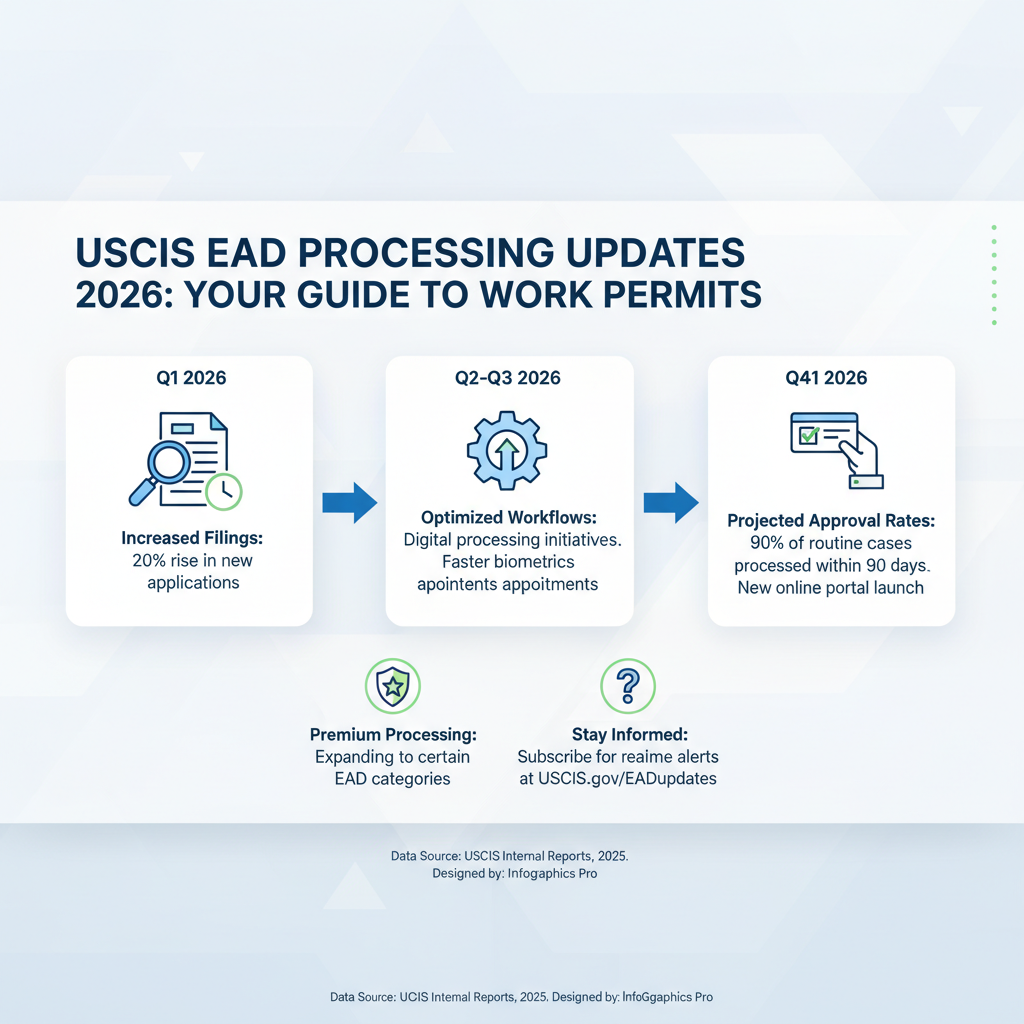
Recent discussions and policy adjustments from USCIS regarding the processing of Employment Authorization Documents have been a significant topic in immigration news. These ongoing efforts to address backlogs and streamline processes directly impact thousands of individuals nationwide, including many in Central Florida. This guide is inspired by the critical need to clarify these evolving procedures for immigrants and their families seeking to live and work legally in the U.S.
Employment Authorization Document Processing (USCIS)
What This News Means for Immigrants in Orlando and Across Florida
Why this news is showing up now
The conversation around EAD processing isn't new, but it has gained renewed urgency in recent years due to several factors. USCIS has faced unprecedented backlogs across various application types, including Form I-765, Application for Employment Authorization. These backlogs were exacerbated by the COVID-19 pandemic, staffing challenges, and increased application volumes.
In response, USCIS has implemented various strategies to mitigate these delays. These include temporary final rules extending the validity period for certain EADs, efforts to increase processing efficiency, and expanded eligibility for premium processing for certain categories. As of early 2026, these initiatives are still in various stages of implementation and refinement, leading to ongoing news and updates as USCIS strives to improve service delivery. The goal is to reduce processing times and prevent gaps in employment authorization for eligible individuals, a critical concern for families dependent on continuous work authorization.
Specifically, USCIS continues to adjust its internal procedures and public guidance to address the "pendency" of EAD applications. This involves a focus on optimizing workload management, leveraging technology for faster processing, and clarifying policies regarding automatic extensions for renewals. For anyone awaiting an EAD, these changes represent a beacon of hope for faster resolution and greater stability.
How it can affect Florida residents
For immigrants residing in Florida, particularly those in the vibrant and diverse Orlando metropolitan area and along the I-4 corridor, these EAD processing updates have direct and significant implications. Florida is a major destination for immigrants from around the globe, and many rely on their EADs to secure employment, obtain driver's licenses, and establish financial stability.
- Job Market Access: Faster EAD processing means quicker entry or re-entry into Florida's dynamic job market, which is crucial for sectors like tourism, hospitality, healthcare, and agriculture, all prominent in Central Florida. Delays can lead to job loss, financial hardship, and uncertainty.
- Economic Stability: The ability to work legally directly impacts the economic well-being of families. Timely EADs ensure continued income, allowing residents to pay bills, support local businesses, and contribute to the state's economy.
- Local USCIS Impact: While EAD applications are generally processed at national service centers, the Orlando USCIS Field Office plays a role in biometrics appointments and, in some cases, interviews for underlying applications (like Adjustment of Status) that are tied to EAD eligibility. Efficient national processing alleviates pressure on local resources and streamlines the overall immigration journey for Orlando residents.
- Driving Privileges: In Florida, a valid EAD is often required to obtain or renew a driver's license or state identification card. Processing delays can therefore impact mobility and daily life for many immigrants in Orange County and surrounding areas.
- Community Integration: Having legal work authorization fosters a greater sense of security and belonging, allowing immigrants to integrate more fully into their communities without the constant stress of potential employment gaps.
Imigrar, located in Orlando, is acutely aware of these local impacts. Our mission is to ensure that our clients across Florida receive accurate, timely advice to navigate these crucial updates, helping them maintain their ability to work and thrive.
What Employment Authorization Document (EAD) Processing Is (and Why It Matters)
A plain-English definition
An Employment Authorization Document, or EAD, is a physical card issued by USCIS that grants non-citizens permission to work legally in the United States for a specific period. It's often referred to as a "work permit." This card is distinct from a visa or green card; it simply authorizes employment. Not all non-citizens need an EAD to work – for example, lawful permanent residents (green card holders) and U.S. citizens have inherent work authorization. However, many individuals in various immigration statuses, such as those with pending Adjustment of Status applications, asylum seekers, certain visa holders' spouses, and DACA recipients, *do* need an EAD to be lawfully employed.
The processing of an EAD refers to the entire lifecycle of your application, from the moment USCIS receives your Form I-765 until a decision is made and the card is mailed. This process involves verifying eligibility, conducting background checks, scheduling biometrics appointments, and ultimately producing the EAD card.
Why does it matter so much? For many, an EAD is their lifeline. Without it, they cannot legally earn income, support their families, or often even obtain basic necessities like a driver's license or open a bank account. Delays in EAD processing can lead to job loss, financial distress, and immense emotional strain, making efficient and timely processing a top priority for immigrants and their advocates.
Key terms you need to know
Navigating immigration processes requires understanding specific terminology. Here are some key terms related to EAD processing:
- EAD (Employment Authorization Document): The official name for the work permit card issued by USCIS.
- USCIS (U.S. Citizenship and Immigration Services): The government agency responsible for processing immigration benefits, including EAD applications. USCIS official website
- Form I-765, Application for Employment Authorization: The primary form you must file to apply for an EAD or renew an existing one.
- A-Number (Alien Registration Number): A unique identification number assigned to non-citizens by the Department of Homeland Security. It’s crucial for all immigration applications.
- Concurrent Filing: The practice of filing Form I-765 at the same time as an underlying application, such as Form I-485 (Application to Register Permanent Residence or Adjust Status).
- Adjustment of Status (AOS): The process by which an eligible non-citizen already in the United States applies to become a lawful permanent resident (get a green card) without having to return to their home country. Many AOS applicants are eligible for an EAD.
- Nonimmigrant Visa: A visa issued to foreign nationals seeking to enter the U.S. temporarily for a specific purpose (e.g., H-1B, L-1, J-1). Spouses of some nonimmigrant visa holders (like H-4, L-2, J-2) may be eligible for an EAD.
- Expedited Processing: A request to USCIS to speed up the processing of an application due to urgent circumstances. This is rarely granted for EADs unless specific criteria are met (e.g., severe financial loss, humanitarian reasons).
- Automatic EAD Extension: A policy allowing certain EAD categories to continue working for a specific period (currently up to 540 days) beyond their EAD expiration date, provided they filed a timely renewal application and meet other conditions. This is a critical provision to prevent employment gaps.
- Biometrics Appointment: An appointment at an Application Support Center (ASC) where USCIS collects fingerprints, photographs, and signatures for background checks.
- Request for Evidence (RFE): A letter from USCIS asking for additional documents or information to support your application.
- Prima Facie Eligibility: Refers to whether an application, on its face, appears to meet the basic eligibility requirements.
Need Help? Our Orlando immigration team is ready to assist. Call +1 786-791-3106 for a free consultation, or message us online. Se Habla Español.
Current Immigration Law: The Foundation for EADs
The authority for USCIS to grant employment authorization stems from the Immigration and Nationality Act (INA) and its implementing regulations, primarily 8 CFR § 274a.12. This section outlines the various categories of foreign nationals who are eligible to receive an Employment Authorization Document. It’s crucial to understand that eligibility for an EAD is not universal; it is tied to specific immigration statuses or applications.
Federal requirements
The INA and federal regulations define numerous categories under which an individual may be eligible for an EAD. These categories are listed on Form I-765 and generally fall into several broad groups:
- Asylum Seekers and Refugees: Individuals granted asylum or refugee status, as well as those with pending asylum applications (after 180 days). (Categories (a)(3), (a)(5), (c)(8))
- Applicants for Adjustment of Status (Green Card): Individuals with a pending Form I-485, Application to Register Permanent Residence or Adjust Status. This is one of the most common categories. (Category (c)(9))
- Certain Nonimmigrant Visa Holders' Spouses: Spouses of certain nonimmigrant visa holders, such as H-4 spouses of H-1B workers (Category (c)(26)) and L-2 spouses of L-1 intracompany transferees (Category (a)(18)). J-2 spouses of J-1 exchange visitors (Category (a)(5)) also qualify.
- Students with Specific Employment Needs: F-1 students seeking Optional Practical Training (OPT) or Curricular Practical Training (CPT) (Categories (c)(3)(A), (c)(3)(B), (c)(3)(C)) or those experiencing severe economic hardship.
- Deferred Action Recipients: Individuals granted deferred action, such as Deferred Action for Childhood Arrivals (DACA) recipients. (Category (c)(33))
- Temporary Protected Status (TPS): Individuals granted TPS. (Category (a)(12) or (c)(19))
- Others: Various other categories exist, including parolees, individuals with pending cancellation of removal, and certain family-based petitioners awaiting visa availability.
Each category has specific requirements that must be met. For instance, an Adjustment of Status applicant typically needs to have their Form I-485 pending to be eligible for an EAD under category (c)(9). It is essential to correctly identify your eligibility category on Form I-765, as an incorrect selection can lead to delays or denial.
For detailed information on eligibility categories and to access the necessary forms, always refer to the USCIS official website. You can find all forms, including Form I-765, at USCIS Forms.
Florida-specific considerations
While EAD eligibility and processing are governed by federal immigration law, there are some state-specific considerations that impact EAD holders in Florida:
- Driver's License and State ID: In Florida, a valid EAD is a primary document used to prove lawful presence when applying for or renewing a driver's license or state identification card. The Florida Department of Highway Safety and Motor Vehicles (FLHSMV) will verify the validity of your EAD with USCIS. Delays in EAD issuance or renewal can directly impact your ability to drive legally in the state.
- Employment Verification: Florida employers are required to verify the employment eligibility of all new hires using the E-Verify system, or by examining physical documents like an EAD. A current and valid EAD is essential for this process.
- Local Resources: While EAD applications are filed with USCIS service centers, residents of Orlando and Central Florida will typically attend their biometrics appointments at the Orlando USCIS Field Office, located at 5448 Hoffner Ave, Orlando, FL 32812. Knowing the location and procedures for this office can be helpful.
It's important to note that Florida does not have its own specific laws regarding EAD eligibility or processing that supersede federal regulations. However, the practical implications of EAD validity on daily life in Florida, from commuting along the I-4 corridor to accessing social services, are significant. Always ensure your EAD is current to avoid any disruptions.
How to Apply for or Renew Your EAD: A Complete Step-by-Step Guide
Applying for or renewing an EAD involves careful attention to detail and adherence to USCIS instructions. This guide breaks down the process into actionable steps.
1) Determine Your Eligibility and Gather Required Documents
Before you begin, confirm that you are eligible for an EAD under one of the specific categories recognized by USCIS. Your eligibility is often tied to your current immigration status or a pending application (e.g., Form I-485, asylum application).
Required Documents for Eligibility Determination (Initial Phase):
- Your current immigration document (e.g., visa, I-94 Arrival/Departure Record, Form I-797C Notice of Action for a pending petition).
- Any prior EAD cards (if renewing).
- Proof of the underlying status that grants EAD eligibility (e.g., receipt notice for Form I-485, asylum application, H-1B approval for an H-4 spouse).
Reminder: If you are renewing, apply well in advance of your EAD's expiration date. USCIS recommends filing at least 180 days before expiration, although 120-150 days is often sufficient given current automatic extension policies for certain categories.
2) Complete Form I-765, Application for Employment Authorization
This is the core of your EAD application. The form can be complex, so read all instructions carefully. Ensure you select the correct eligibility category. Many applicants can now file Form I-765 online, which can sometimes lead to faster processing.
Key Information for Form I-765:
- Personal details (name, address, date of birth, country of birth).
- Your A-Number (if you have one).
- Social Security Number (SSN) (if you have one; you can request one through the form).
- Your eligibility category (e.g., (c)(9) for Adjustment of Status applicants, (c)(33) for DACA, (c)(26) for H-4 spouses).
- Information about previous EADs or immigration applications.
Important: Answer every question accurately and completely. Incomplete forms are a leading cause of delays and RFEs.
3) Prepare Supporting Evidence
The documents you need to submit depend entirely on your eligibility category. Always refer to the specific instructions for Form I-765 and your category. Generally, you will need:
Common Supporting Documents:
- Two passport-style photos: Taken within 30 days of filing, unmounted, unretouched.
- Copy of your most recent I-94 Arrival/Departure Record: If applicable, proving lawful entry.
- Copy of your last EAD card: (If renewing).
- Copy of government-issued identification with photo: Such as a passport identity page, birth certificate, or national identity card.
- Proof of eligibility: This is critical and varies by category:
- For (c)(9) Adjustment of Status: Copy of Form I-485 receipt notice (Form I-797C).
- For (c)(8) Asylum Applicant: Copy of Form I-589, Application for Asylum and for Withholding of Removal, receipt notice and proof of pending status for 180 days.
- For (c)(26) H-4 Spouse: Copy of spouse's H-1B approval notice (Form I-797), proof of marriage, and spouse's current pay stubs or employment verification.
- For (c)(33) DACA: Copy of most recent Form I-797C for deferred action approval.
- Proof of severe economic hardship: (If applying under F-1 student economic hardship category).
Organize your documents clearly. If submitting paper copies, do not send originals unless specifically requested by USCIS.
4) Pay the Filing Fee (or Request a Fee Waiver)
As of 2026, the filing fee for Form I-765 is subject to change, so always check the USCIS website for current fees. Some categories are exempt from the fee (e.g., asylum applicants). You can pay by money order, personal check, cashier's check, or credit card (using Form G-1450, Authorization for Credit Card Transactions). If filing online, payment is made electronically.
If you cannot afford the fee, you may be eligible for a fee waiver by filing Form I-912, Request for Fee Waiver. Eligibility for a fee waiver is strict and generally based on income below 150% of the Federal Poverty Guidelines, receipt of means-tested benefits, or financial hardship.
5) Submit Your Application
Once your form is complete, signed, and all supporting documents are gathered, you must submit it to USCIS. The correct mailing address depends on your eligibility category and whether you are filing concurrently with another form (like Form I-485).
- Online Filing: USCIS encourages online filing for many EAD categories (e.g., C09, C33, A18, C26). This often provides a faster receipt notice and tracking.
- Mail Filing: If filing by mail, check the "Where to File" section on the USCIS website for Form I-765. Use a trackable mailing service (e.g., USPS Certified Mail with Return Receipt) to ensure proof of delivery.
Warning: Sending your application to the wrong address will cause significant delays.
6) Attend Your Biometrics Appointment
After USCIS accepts your application, you will typically receive a receipt notice (Form I-797C) and, shortly thereafter, an appointment notice for biometrics. This appointment will be at a local Application Support Center (ASC), such as the Orlando USCIS Field Office.
During Your Biometrics Appointment:
- Bring your appointment notice (Form I-797C) and a valid photo ID (e.g., passport, driver's license).
- USCIS will collect your fingerprints, photograph, and signature. This data is used for background checks.
- This is usually a quick appointment and no interview is conducted.
Important: Do not miss your biometrics appointment. If you have an unavoidable conflict, follow the instructions on your notice to reschedule, but be aware that rescheduling can cause delays.
7) Monitor Your Case and Receive a Decision
You can monitor the status of your EAD application online using the receipt number provided on your Form I-797C. Visit USCIS Case Status Online.
- Processing Times: Check USCIS Processing Times for an estimate of how long your application might take.
- Requests for Evidence (RFEs): If USCIS needs more information, they will send an RFE. Respond promptly and thoroughly.
- Decision: If approved, you will receive an approval notice, followed by your EAD card in the mail. If denied, you will receive a denial letter explaining the reasons.
Reminder: For renewal applications, if you are in an eligible category and filed timely, your receipt notice (Form I-797C) may serve as temporary proof of employment authorization for up to 540 days beyond your EAD expiration. Keep this notice with your expired EAD card.

Practical Steps You Can Take Today for Your EAD Application
Navigating the EAD application or renewal process can be daunting, but taking proactive steps can significantly improve your chances of a smooth and timely approval. Here's a practical checklist to get started:
Actionable Checklist:
- Identify Your EAD Category: Clearly understand which eligibility category on Form I-765 applies to you. This is the foundation of your application.
- Gather Core Documents: Start collecting essential documents immediately. This includes your passport, visa, I-94, previous EADs, and any receipt notices for underlying petitions (e.g., Form I-485, Form I-589).
- Check USCIS Website for Updates: Regularly visit the USCIS official website for the latest version of Form I-765, current filing fees, and "Where to File" instructions. Policy changes, especially regarding automatic extensions, are frequently updated.
- Review Processing Times: Use the USCIS Processing Times tool to get an estimate of how long your application might take. This helps manage expectations and plan for renewal windows.
- Consider Online Filing: If your EAD category is eligible for online filing, strongly consider this option. It often provides immediate receipt confirmation and can sometimes expedite processing.
Document Preparation Guidance:
- Organize and Label: Keep all your documents organized in a folder. If mailing, use cover sheets to clearly label each type of document (e.g., "Copy of Passport," "Form I-485 Receipt Notice").
- High-Quality Copies: Submit clear, legible copies of all required documents. USCIS will not accept blurry or unreadable copies.
- Two Passport-Style Photos: Ensure your photos meet USCIS specifications (2x2 inches, white background, no glasses, taken within 30 days). Write your A-Number and full name lightly on the back of each photo.
- Translations: Any document not in English must be accompanied by a complete English translation certified by the translator as accurate and competent.
- Keep Copies: Make a complete copy of your entire application package (form, supporting documents, check/money order) before sending it to USCIS. This is your personal record.
Timeline Expectations:
EAD processing times can vary significantly based on the filing service center, the specific eligibility category, and current USCIS workloads. While USCIS aims to process EADs within a reasonable timeframe, delays are common.
- Initial EADs: For concurrent filings (e.g., with Form I-485), EADs can sometimes take anywhere from 3-12 months, or even longer, depending on the service center.
- EAD Renewals: Filing your renewal application 120-180 days before your current EAD expires is generally recommended.
- Automatic Extensions: For many renewal categories, if you file a timely renewal application, your existing EAD (along with your Form I-797C receipt notice) is automatically extended for up to 540 days. This is a critical provision to prevent gaps in employment, especially for those in Orlando's workforce. Confirm your eligibility for this extension.
- Check Online: The most accurate timeline estimate will always


