

The reporting that sparked this guide
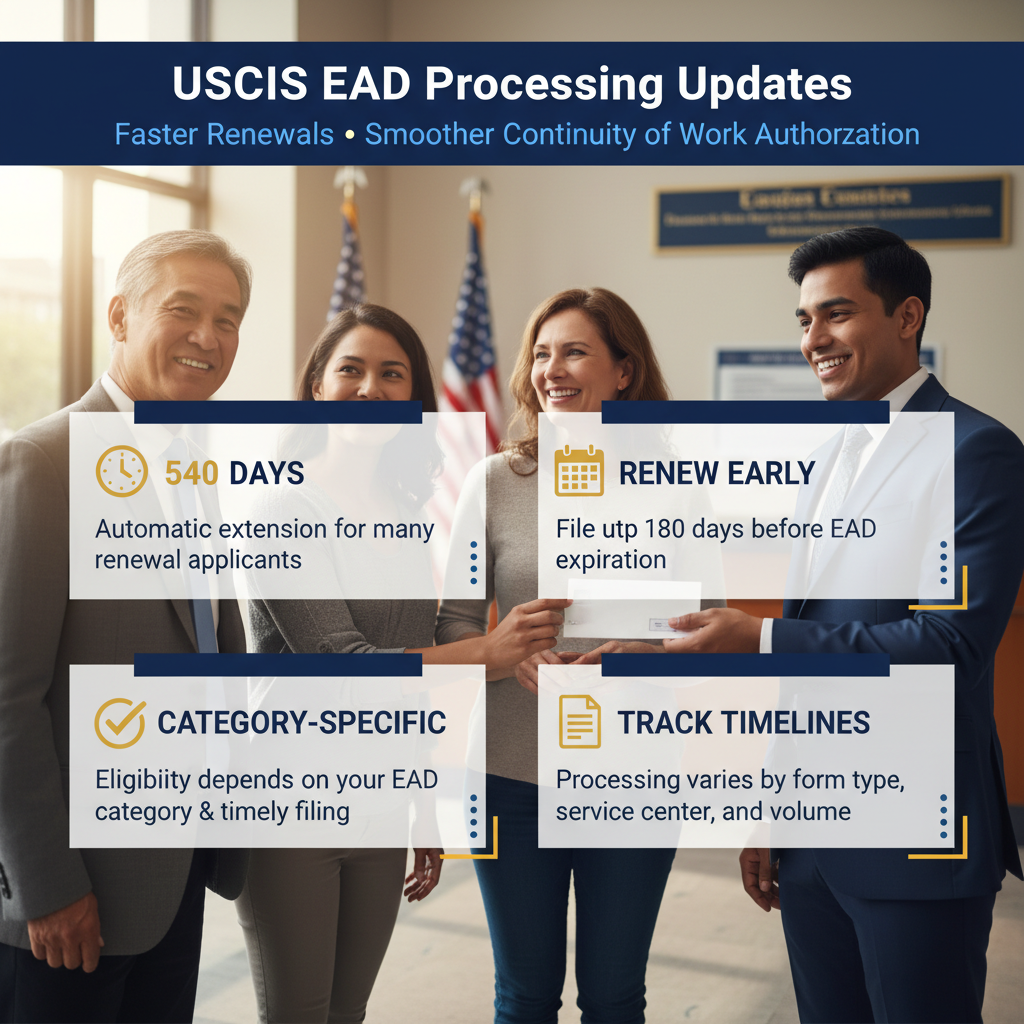
This article is based on recent public-facing updates and ongoing coverage related to USCIS work authorization processing trends, including: Employment Authorization Document Processing (USCIS).
Important: News coverage can summarize or amplify USCIS announcements, but your eligibility and timeline depend on your specific category, filing history, and USCIS workload. Always verify requirements on the USCIS official website and consult qualified counsel for case-specific advice.
Need Help? Our Orlando immigration team is ready to assist. Call +1 786-791-3106 for a free consultation, or message us online. Se Habla Español.
What This News Means for Immigrants in Orlando and Across Florida
Why this news is showing up now
Employment Authorization Documents (EADs)—often called “work permits”—are a lifeline for many immigrants and their families. When EAD processing slows down, people can lose jobs, health insurance, and stability. When it speeds up or USCIS expands policies like automatic extensions, families can avoid gaps in employment.
USCIS processing has been especially newsworthy because:
- More people are filing EADs through Adjustment of Status and humanitarian programs, increasing volume.
- USCIS has continued expanding online filing and internal workflow changes for certain forms.
- Automatic extension rules for some renewal categories can prevent employment interruptions—if you file correctly and on time.
- Employers are paying closer attention to I-9 compliance, which makes timing and documentation critical.
Reminder: “Trending” does not always mean “new law.” Often it reflects shifting processing times, operational changes, or policy clarifications that affect how quickly USCIS issues EAD cards.
How it can affect Florida residents
For Florida residents—especially those in high-growth areas like Orlando, Orange County, and the I-4 corridor—EAD timing can directly affect:
- Job start dates for new hires waiting on initial EAD approval.
- Renewal continuity for current employees whose EAD is expiring.
- Driver’s license renewals (often tied to immigration document validity).
- Family finances (rent, childcare, medical coverage) if income is interrupted.
If your case is in Orlando, you may interact with the Orlando-area USCIS ecosystem in two different ways: (1) your EAD may be adjudicated by a USCIS service center (not the local office), and (2) your underlying case (like Form I-485) may be interviewed at The Orlando USCIS Field Office. Understanding that split helps set realistic expectations.
What Employment Authorization Document Processing Is (and Why It Matters)
A plain-English definition
“Employment Authorization Document processing” refers to how USCIS receives, reviews, and decides applications for work authorization—most commonly filed on Form I-765 (Application for Employment Authorization)—and how it produces and delivers the physical EAD card.
Processing includes:
- Accepting and receipting the filing (issuing a receipt notice).
- Biometrics scheduling (if required).
- Reviewing eligibility under a specific category (for example, pending Adjustment of Status).
- Approving, requesting evidence (RFE), or denying.
- Producing the card and mailing it to you.
Key terms you need to know
- EAD: The work permit card showing you are authorized to work in the U.S. for a certain period.
- Form I-765: The USCIS form used to request an EAD.
- Renewal: Filing a new Form I-765 before your current EAD expires.
- Automatic extension: For certain categories, timely filing a renewal can extend work authorization for up to 180 days (and in some situations longer based on USCIS policy), if you qualify and your category is covered.
- Receipt Notice (Form I-797): Proof USCIS accepted your filing—often crucial for employers when an automatic extension applies.
- RFE: Request for Evidence—USCIS asks for additional documents before deciding.
- Priority Date: A key concept for many green card categories; your place in line for an immigrant visa number. (Commonly relevant with Form I-130 and employment-based cases.)
- Adjustment of Status: The process of applying for a green card from inside the U.S., usually using Form I-485.
- 90-day window: Many people use this phrase informally to describe “file early,” but the correct filing window depends on category; some renewals can be filed well before 90 days. Always confirm the rules for your category.
Warning: Not everyone is eligible for an EAD, and not every immigration status allows employment. Working without authorization can create serious immigration consequences.
Need Help? Our Orlando immigration team is ready to assist. Call +1 786-791-3106 for a free consultation, or message us online. Se Habla Español.
Current Immigration Law: The Foundation
EAD eligibility and processing are governed by federal immigration law, regulations, and agency policy. The legal backbone includes:
- The Immigration and Nationality Act (INA) (8 U.S.C.).
- Department of Homeland Security regulations at 8 C.F.R. § 274a (employment authorization rules) and related provisions.
- USCIS form instructions and policy guidance.
You can confirm forms, instructions, and updates on the USCIS official website and the USCIS Forms page.
Federal requirements
At the federal level, USCIS generally requires:
- A properly filed Form I-765 with the correct eligibility category (for example, (c)(9) for certain pending Form I-485 applicants).
- The correct filing fee (or an approved fee waiver, when permitted).
- Evidence of identity and eligibility (varies by category).
- Compliance with biometrics requirements when USCIS requires it.
Many EAD applicants are also filing related forms such as Form I-130 (family petition) and Form I-485 (green card application), or are in humanitarian categories. The EAD is not a visa; it is evidence of work authorization for a limited time.
To monitor trends, always check: USCIS Processing Times. Processing times can change month to month and vary by form type and category.
Florida-specific considerations
Florida does not create federal work authorization, but Florida residents often face local, practical issues tied to EAD validity:
- DMV/Driver’s license timing: Many applicants in Orange County and surrounding Central Florida counties find that license validity tracks document expiration. Plan renewals early.
- Employment verification: Employers across the I-4 corridor (hospitality, healthcare, logistics, construction) often have strict onboarding timelines. A delayed EAD can mean a lost opportunity.
- Address stability: Frequent moves can lead to returned cards. If you move, update USCIS promptly (and consider mail forwarding carefully).
If your case is in Orlando, remember: even if your interview is scheduled at The Orlando USCIS Field Office, your EAD production and mailing are still handled through USCIS’s broader workflow. That’s why two people living in the same neighborhood can have very different EAD timelines.
How to Apply for or Renew an EAD: A Complete Step-by-Step Guide
Below is a practical filing roadmap. Because EAD eligibility varies widely, treat this as a general guide and verify your specific category in the Form I-765 instructions on the USCIS Forms page.
1) Confirm your eligibility category (and whether you need an initial EAD or renewal)
The first and most important step is selecting the correct eligibility category on Form I-765. A wrong category can trigger delays, RFEs, or denial.
Documents to gather (examples—varies by category):
- Passport biographic page and visa (if applicable).
- Most recent I-94 (if applicable).
- Current EAD (front/back) if renewing.
- Receipt notices for underlying filings (e.g., Form I-485 receipt for (c)(9)).
- Any prior USCIS approval notices.
Reminder: If your EAD is tied to a pending Adjustment of Status case, your ability to renew often depends on the underlying case still being pending and properly filed.
2) Decide your filing strategy: online vs. paper (and timing to avoid gaps)
USCIS allows online filing for some Form I-765 categories, while others require paper filing. The best strategy depends on your category, your comfort with uploads, and how quickly you need a receipt notice.
Documents to gather:
- A complete list of prior immigration filings and dates.
- Digital copies (PDF/JPG) of identity documents.
- Two passport-style photos (if required for your filing method/category).
- Payment method (credit card for online; check/money order or credit card authorization for paper, as allowed).
Important: For many renewal categories, filing early can be the difference between uninterrupted work authorization and a forced leave. Don’t rely on a casual “90-day window” rule of thumb—some categories can and should file earlier.
3) Prepare the application package carefully (Form I-765 + evidence)
Whether you file online or by mail, your package should be consistent, legible, and complete.
Documents to gather and prepare:
- Completed and signed Form I-765 (wet signature for paper filings).
- Copy of current/previous EAD (front and back), if applicable.
- Government-issued photo ID (passport, etc.).
- Proof of your underlying eligibility:
- Pending Form I-485 receipt notice (common for (c)(9)).
- Approval notice or status document for other categories, as applicable.
- Filing fee or fee waiver request (only where permitted).
- Any required photos per the form instructions.
Warning: Small mistakes��like an outdated edition date of the form, missing pages, or an incorrect fee—can cause rejection at the lockbox, which can be devastating if your EAD expiration is near.
4) File the application and track receipts, biometrics, and notices
After filing, USCIS should issue a receipt notice. If biometrics are required, USCIS will schedule an appointment at an Application Support Center (ASC). Many Florida applicants attend biometrics locally.
Documents to keep accessible:
- Your Form I-765 receipt notice (Form I-797).
- Biometrics appointment notice (if issued).
- Photo ID for biometrics appointment.
- A complete copy of what you filed (application + evidence).
If your employer asks about your renewal, your receipt notice may be crucial—especially if an automatic extension of up to 180 days applies for your category.
5) Respond to any Request for Evidence (RFE) quickly and strategically
An RFE does not mean denial. It means USCIS needs more information. But RFEs pause adjudication and can add weeks or months.
Documents to gather (depending on the RFE):
- The RFE notice (read every line carefully).
- Updated proof of eligibility (new receipts, approvals, or status documents).
- Clear copies of identity documents.
- A well-organized cover letter matching each RFE item to a labeled exhibit.
Important: Submit exactly what USCIS requests, by the deadline, to the address listed on the RFE. Keep delivery proof.
6) Approval, card production, delivery, and employer verification (I-9)
Once approved, USCIS produces the EAD card and mails it. Delivery issues—especially after moving—are a common cause of panic.
Documents to keep:
- Approval notice (if issued).
- The EAD card (store safely; keep copies front/back).
- Any SSN documentation if you requested a Social Security number through the application (where available).
Employers must comply with federal verification rules. If you are extending based on a timely renewal and eligibility for an automatic extension, your employer may need to review your receipt notice and the rules that apply to your category.
7) If there’s a delay: processing-time checks, service requests, and escalation options
If your case is outside normal timeframes, you may have options to inquire or escalate.
Documents to gather:
- Receipt number and filing date.
- Category and underlying case receipts (e.g., Form I-485 receipt).
- Evidence of urgent harm (job offer letter, employer letter, financial hardship evidence), if seeking expedited handling where available.
Start with USCIS Processing Times to confirm whether you are outside posted times. In some situations, you can submit a service request or seek help through formal channels.
Need Help? Our Orlando immigration team is ready to assist. Call +1 786-791-3106 for a free consultation, or message us online. Se Habla Español.
Practical Steps You Can Take Today
If EAD processing updates have you worried about delays or work gaps, here’s a checklist you can act on immediately.
- 1) Check your EAD expiration date today. Set calendar reminders at 180, 120, and 90 days before expiration. (Even if people talk about a “90-day window,” earlier planning is safer.)
- 2) Confirm your eligibility category. Compare your last approved EAD category to the category you plan to file now. Don’t guess.
- 3) Build a “renewal packet” folder. Keep copies of your current EAD, passport, I-94, and underlying receipts (like Form I-485 receipt notices) in one place.
- 4) Track USCIS processing times monthly. Use the official tool: USCIS Processing Times.
- 5) Prepare your employer conversation. If an automatic extension of up to 180 days could apply, be ready to provide the receipt notice and explain that your work authorization may continue while the renewal is pending (category-dependent).
- 6) Update your address properly if you move. Card-delivery problems are common. Keep your mailing address stable when possible.
- 7) If you have urgent harm, document it. Save job offers, HR emails, schedules, medical insurance notices, and proof of financial obligations.
Timeline expectations (general guidance): EAD timelines vary significantly by category and workload. Some applicants receive approvals in weeks; others wait months. Plan as if it will take longer than you hope—especially during peak filing seasons.
For Central Florida residents, practical planning matters: if your employer needs a valid document for onboarding, you may need to negotiate a later start date or provide permissible documentation for I-9 purposes while your renewal is pending (when allowed).
How Imigrar Helps Immigrants in Orlando
At Imigrar, we focus on helping immigrants and families stay stable and employed—because our mission is to Keep Families Together. EAD delays can jeopardize a family’s entire plan, especially when a green card case, humanitarian case, or employer transition is underway.
We help clients nationwide, with a strong presence supporting families and workers in Orlando, Orange County, and throughout the I-4 corridor by:
- Confirming the correct Form I-765 category and strategy to reduce avoidable delays.
- Preparing clean, well-documented filings designed to prevent RFEs.
- Coordinating EAD timing with related filings like Form I-130 and Form I-485 for Adjustment of Status.
- Advising on renewal timing to minimize work gaps and protect eligibility for automatic extensions (where applicable).
- Supporting responses to RFEs and addressing denials with a plan.
We offer a free consultation to discuss your EAD situation and timeline concerns. Se Habla Español.
Frequently Asked Questions
Q: Who is eligible to apply for an EAD?
A: Eligibility depends on your immigration category. Common eligible groups include certain applicants with pending Adjustment of Status (often tied to Form I-485), some students with authorized employment, certain TPS or asylum-related categories, and other humanitarian programs. The safest approach is to confirm your category directly in the Form I-765 instructions on the USCIS Forms page, because filing under the wrong category can lead to rejection or denial.
Q: Will applying for or renewing an EAD affect my immigration status?
A: Filing Form I-765 generally does not “create” status; it requests work authorization under an existing eligible basis. However, information you provide must be accurate and consistent with your immigration record. Warning: If you have prior unauthorized work, overstays, arrests, or removal proceedings, an EAD filing may intersect with bigger legal issues. If you are in immigration court, your case may involve the Executive Office for Immigration Review, and you should get individualized legal advice.
Q: How long does USCIS take to process EADs right now?
A: Processing times vary by eligibility category and the USCIS office handling the case. The most reliable public tool is USCIS Processing Times. Reminder: Two people in Orlando may have different timelines because their cases can be routed to different service centers or require different security checks.
Q: What documents do I need for an EAD renewal?
A: Most renewals require: (1) a completed Form I-765, (2) a copy of your current EAD (front/back), (3) proof of identity (passport, etc.), (4) proof you remain eligible (such as a pending Form I-485 receipt notice for many adjustment-based renewals), and (5) the correct fee or fee waiver request if permitted. If your underlying case is family-based (for example, through Form I-130), keep those receipts and notices organized because USCIS may need them to confirm eligibility.
Q: How much does it cost to apply for or renew an EAD?
A: Fees depend on your category and whether USCIS charges a fee for that specific Form I-765 filing. USCIS fee rules can change, so verify the current fee and whether a fee waiver is allowed for your category on the USCIS Forms page and the form’s instructions. If you file with the wrong fee, USCIS may reject the application, costing you time and potentially risking a work gap.
Q: What happens if my EAD application is denied?
A: If denied, USCIS will issue a written decision explaining the reason. Next steps depend on the denial basis: it could be a fixable documentation issue, a category eligibility issue, or a problem with the underlying case. Important: A denial can impact your ability to work immediately, and in some scenarios it may signal issues with your pending Form I-485 or other filings. Speak with counsel quickly to evaluate whether refiling is possible, whether an RFE response was mishandled, or whether the underlying eligibility needs to be addressed.
Q: Can I travel internationally while my EAD is pending?
A: An EAD is not a travel document. If you have a pending Adjustment of Status case (Form I-485), traveling without advance permission may be risky. Many applicants use Form I-131 (Advance Parole) for travel authorization, and USCIS sometimes issues a combined card in certain cases. For immigrant visa processing abroad, the U.S. Department of State provides official information. Because travel can trigger abandonment issues in some scenarios, get individualized advice before leaving the U.S.
Common Mistakes (and How to Avoid Them)
Mistake #1: Filing under the wrong eligibility category
Choosing the wrong category on Form I-765 is one of the fastest ways to get delayed or denied. How to avoid it: Cross-check your last EAD, your underlying receipt notices (like Form I-485), and the current Form I-765 instructions.
Mistake #2: Waiting too long and assuming an automatic extension will save you
Some categories may receive an automatic extension of up to 180 days if a renewal is timely filed, but not everyone qualifies and employers must follow specific I-9 rules. How to avoid it: File early, keep your receipt notice, and confirm your category is covered before relying on an extension.
Mistake #3: Address problems that lead to returned cards
EAD cards are frequently returned due to moves, apartment mailroom issues, or incorrect addresses. How to avoid it: Keep your address consistent during processing, monitor tracking when available, and update USCIS promptly if you move. If your case is in Orlando and you move within Orange County, don’t assume USPS forwarding alone will fix USCIS delivery problems.
Need Help? Our Orlando immigration team is ready to assist. Call +1 786-791-3106 for a free consultation, or message us online. Se Habla Español.
Official resources to bookmark (external authority links)
Orlando and Central Florida timing notes (what to expect locally)
If your case is in Orlando, your EAD may still be processed by a USCIS service center outside Florida, while your interview (if any) for the underlying benefit may be scheduled at The Orlando USCIS Field Office. For Central Florida residents along the I-4 corridor—Orlando, Kissimmee, Sanford, and surrounding Orange County communities—this often means:
- Your EAD timeline may not match your neighbor’s, even with similar filings.
- Interview scheduling and EAD issuance are related but not identical processes.
- Keeping your mailing address stable is especially important in apartment-heavy areas.
Reminder: If you are tracking a family-based case, your Priority Date and visa availability can affect the overall green card timeline—even if your EAD is approved sooner.

Closing: Protect your job, your timeline, and your family’s stability
EAD processing updates matter because even small delays can create major life disruptions. The best protection is a proactive plan: confirm eligibility, file correctly, file early, track notices, and respond quickly to USCIS requests.
If you’re worried about an expiring work permit, a delayed renewal, or how your EAD connects to a pending Form I-130 or Form I-485 through Adjustment of Status, Imigrar can help you build a strategy designed to minimize risk and avoid preventable mistakes.
Need Help? Our Orlando immigration team is ready to assist. Call +1 786-791-3106 for a free consultation, or message us online. Se Habla Español.


