


The reporting that sparked this guide
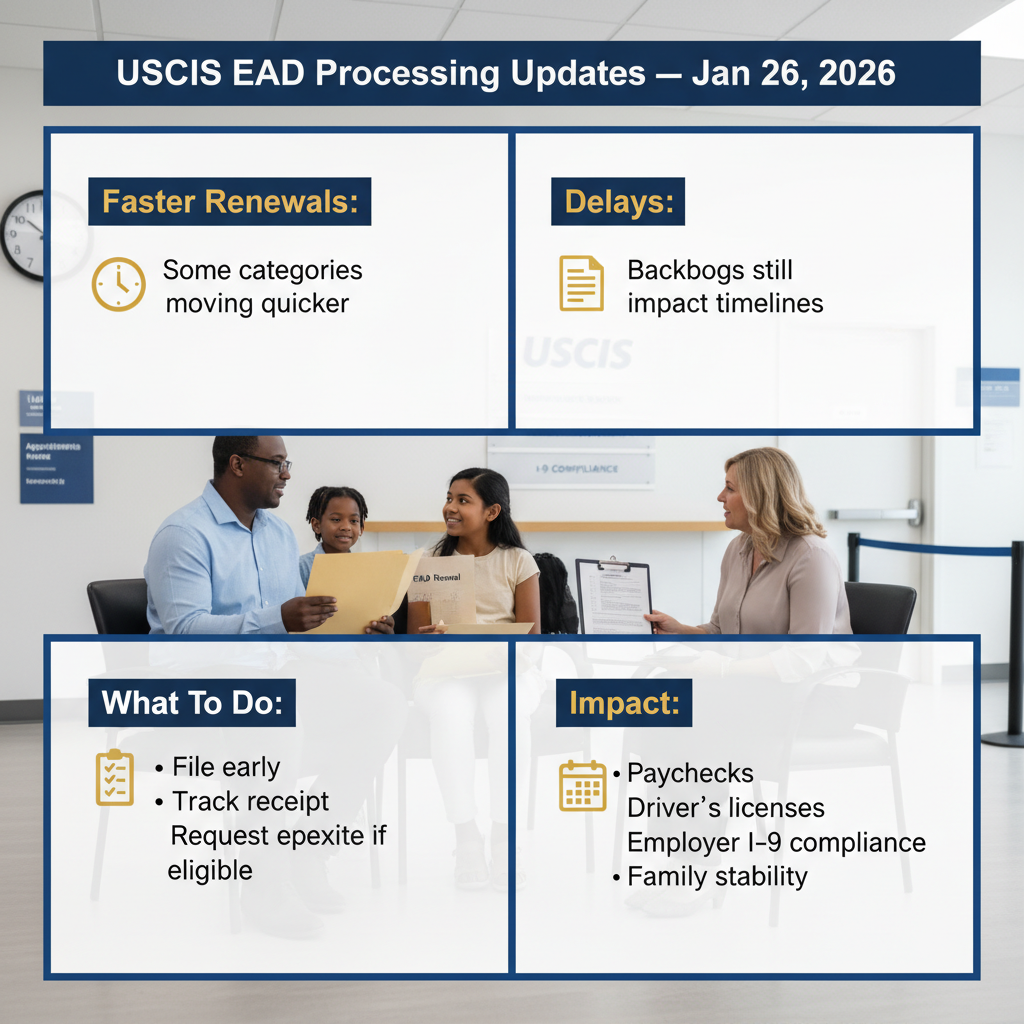
EAD processing updates have been trending across immigration news because work authorization affects paychecks, driver’s licenses, employer compliance, and family stability—especially for people with pending cases or humanitarian protections.
This guide is based on the ongoing reporting and public updates that appear through: Employment Authorization Document Processing (USCIS).
Reminder: News headlines can move faster than official policy. When you make decisions about your work authorization, always verify details directly with the USCIS official website and your case-specific notices.
Need Help? Our Orlando immigration team is ready to assist. Call +1 786-791-3106 for a free consultation, or message us online. Se Habla Español.
What This News Means for Immigrants in Orlando and Across Florida
Why this news is showing up now
Employment Authorization Documents (EADs), often called “work permits,” are one of the most time-sensitive immigration benefits. When USCIS processing times shift—even slightly—families feel it immediately. This topic is trending now for a few practical reasons:
- Backlogs and uneven processing: USCIS has continued efforts to reduce backlogs, but EAD timing can still vary by category, service center, and filing method.
- Renewal anxiety: Many immigrants are trying to avoid gaps in work authorization by filing earlier, tracking eligibility for 180 days automatic extensions, and watching the 90-day window (where applicable to certain categories or employer timelines).
- Employer compliance pressure: Employers along the I-4 corridor—from Orlando to Tampa and Daytona—are increasingly strict about I-9 compliance, making delays more disruptive.
- More people filing EADs: EADs are commonly filed with Adjustment of Status cases, asylum-related applications, TPS renewals, and other humanitarian programs—many of which have seen higher volumes.
Important: “Trending” does not necessarily mean a brand-new law was passed. Often it reflects USCIS operational changes, shifting workloads, or policy updates affecting how quickly cases move.
How it can affect Florida residents
For Florida residents, EAD timing affects more than employment. It can impact:
- Job offers and promotions (especially in hospitality, healthcare, construction, and tourism—major industries in Central Florida).
- Driver’s license and ID renewals depending on your status and your local DMV documentation requirements.
- Family budgeting, childcare plans, and the ability to maintain stable housing.
- Immigration strategy when planning to file Form I-485 (green card) with ancillary benefits like Form I-765 (EAD) and Form I-131 (Advance Parole).
If your case is in Orlando, your underlying immigration filing might be handled by a USCIS service center while interviews (if required) may be scheduled through The Orlando USCIS Field Office. Understanding where your case is processed helps set realistic expectations.
What Employment Authorization Document Processing Is (and Why It Matters)
A plain-English definition
“Employment Authorization Document processing” refers to how USCIS receives, reviews, and decides applications for permission to work in the United States. The EAD is typically issued as a plastic card (Form I-766) that shows:
- Your name and photo
- Your EAD category (based on eligibility)
- The dates your work authorization is valid
Many immigrants in Florida rely on an EAD while waiting for a longer immigration process—like Adjustment of Status through Form I-485, asylum, or certain humanitarian programs.
Key terms you need to know
- Form I-765: The USCIS application to request an EAD (work permit).
- Category code: A code on your EAD (and on Form I-765) that describes the legal basis for work authorization (for example, based on a pending Form I-485 or TPS).
- Receipt Notice (Form I-797): Proof USCIS accepted your filing. This can be crucial for certain automatic extension rules.
- Biometrics: Fingerprints/photo appointment (not required for every EAD category; USCIS may reuse biometrics).
- RFE (Request for Evidence): USCIS asks for more documents before deciding.
- Automatic extension: Some EAD renewal applicants may receive an automatic extension of work authorization if they file on time and meet category rules—often discussed as 180 days, though certain categories may have different extension lengths depending on current USCIS policy.
- Priority Date: The “place in line” date for certain immigrant visa categories. While Priority Date is usually more relevant to green card timing than EAD timing, it can affect when you’re eligible to file Form I-485 and thus when you can file for an EAD based on that pending case.
Warning: An EAD is not the same as lawful status. Some people can have work authorization without having a long-term immigration status, and others may have lawful status without needing an EAD (for example, certain nonimmigrant work visas).
Need Help? Our Orlando immigration team is ready to assist. Call +1 786-791-3106 for a free consultation, or message us online. Se Habla Español.
Current Immigration Law: The Foundation
EAD eligibility and processing are grounded in federal immigration law and regulations. While USCIS can adjust internal workflows and issue policy guidance, the legal authority generally comes from:
- The Immigration and Nationality Act (INA), including general authority for immigration benefits administration.
- Federal regulations at 8 C.F.R. § 274a (employment authorization rules, including categories and conditions).
- Category-specific statutes and regulations (for example, asylum, TPS, and certain parole programs).
Federal requirements
Most EAD applicants file Form I-765 under a specific eligibility category. Common examples include:
- Pending Adjustment of Status applicants with a pending Form I-485 (often filed together with Form I-130 family petitions in family-based cases).
- Asylum applicants and asylees (category rules are highly specific; eligibility timing can depend on “asylum clock” and filing posture).
- Temporary Protected Status (TPS) beneficiaries (often tied to country designation and re-registration windows).
- Certain parole-based or humanitarian categories.
USCIS fees, filing addresses, and online filing availability can change. Always confirm current instructions on the USCIS Forms page and the specific Form I-765 instructions.
To track general timing, USCIS publishes a public tool here: USCIS Processing Times. Reminder: The posted times are averages and do not guarantee a decision by a specific date.
Florida-specific considerations
Immigration law is federal, meaning Florida does not create EAD eligibility rules. However, Florida residents can face practical, local impacts:
- DMV documentation: Florida driver’s license/ID issuance may require valid immigration documentation and can be affected by EAD expiration dates.
- Employer verification culture: Many employers in Orange County and across the I-4 corridor follow strict E-Verify and I-9 practices, making EAD gaps more disruptive.
- Field office logistics: If an interview is required for a related benefit (like Form I-485), scheduling and rescheduling at The Orlando USCIS Field Office can affect overall planning, even if the EAD itself is processed elsewhere.
Important: If you move within Florida (for example, from Kissimmee to Orlando, or from Orange County to Seminole County), update your address with USCIS promptly using the official process to avoid lost notices and card delivery issues.
For official updates and policy announcements, start with the USCIS official website. For broader immigration system context (visa processing abroad and consular steps), see the U.S. Department of State. For immigration court information (separate from USCIS), see the Executive Office for Immigration Review.
How to Apply for or Renew an EAD: A Complete Step-by-Step Guide
Below is a practical, step-by-step roadmap for most people filing Form I-765 for an initial EAD or renewal. Because category rules vary, treat this as a framework and confirm category-specific instructions.
1) Identify your eligibility category and timing strategy
First, determine the correct eligibility category for your EAD. This is not just a technicality—choosing the wrong category can cause rejection, delays, or a denial.
Timing matters too. Many renewal applicants aim to file as early as allowed to reduce the risk of a work authorization gap. Some categories may qualify for an automatic extension if you file a renewal on time and meet the required conditions.
- Important: Confirm whether your category qualifies for an automatic extension (often discussed as 180 days for certain renewal categories) and what proof your employer needs.
- Warning: Filing too early (when not permitted) can lead to rejection; filing too late can lead to a gap.
Documents to gather for Step 1:
- Current EAD (front/back) if renewing
- Your USCIS receipt notices (Form I-797) for the underlying case (e.g., pending Form I-485)
- Passport biographic page and visa page (if available)
- I-94 record (if applicable)
2) Prepare Form I-765 and confirm the correct filing method
Next, complete Form I-765 carefully. USCIS may allow online filing for certain categories, while others must be mailed. The correct filing address can change, so verify it on the USCIS Forms page.
If you are filing based on a pending Adjustment of Status, your EAD application may be filed together with Form I-485 (and often supported by a family petition like Form I-130). The way you package filings can affect intake and receipt notices.
Documents to gather for Step 2:
- Completed Form I-765 (correct edition date)
- Two passport-style photos (if required by category/filing method)
- Government-issued ID (passport, prior EAD, or other acceptable ID per instructions)
- Copies of prior USCIS approval notices (if relevant)
3) Pay the correct fee (or request a fee waiver if eligible)
USCIS fees depend on the category and whether the EAD is bundled with another application. Some applicants may qualify for a fee waiver using Form I-912 (Request for Fee Waiver), but eligibility is strict and evidence-heavy.
Reminder: Incorrect fees are a common reason for rejection at the lockbox stage, which can cost you weeks.
Documents to gather for Step 3:
- Payment method per USCIS instructions (check, money order, or online payment if filing online)
- If requesting a waiver: completed Form I-912 and supporting evidence (income, benefits, hardship)
- Fee schedule printout or screenshot for your records
4) Submit the application and create a tracking system
After filing, USCIS issues a receipt notice. This notice is your proof of filing and includes your receipt number, which you can use to track your case and to discuss your case with USCIS.
For Central Florida residents, mail delivery reliability can vary by neighborhood and apartment complex. If your case is in Orlando, consider a tracking method that reduces the chance of missed notices (for example, USPS Informed Delivery and a secure mailing address).
Documents to gather for Step 4:
- Courier tracking confirmation (USPS/UPS/FedEx) if mailing
- Copy of the full filing packet (PDF scan)
- Receipt notice(s) once received (Form I-797)
5) Attend biometrics (if scheduled) and respond quickly to any RFE
USCIS may schedule biometrics or may reuse prior biometrics. If you receive an appointment notice, attend it. Missing biometrics can lead to denial.
If USCIS issues an RFE, respond by the deadline with a clear, organized packet. RFEs often ask for identity documents, proof of eligibility category, or missing pages/signatures.
Warning: RFE deadlines are strict. Late responses can result in denial, even if you were otherwise eligible.
Documents to gather for Step 5:
- Biometrics appointment notice
- Photo ID for biometrics appointment
- RFE notice (if issued)
- Requested evidence (organized with a cover letter and tabs)
6) Monitor processing times and escalation options if you’re outside normal timeframes
Use the USCIS Processing Times tool to see typical ranges. If your case is beyond posted timeframes, you may be able to submit a service request.
In some circumstances, you can request expedited processing. Expedite requests are discretionary and usually require evidence of severe financial loss, urgent humanitarian reasons, or other qualifying criteria.
Documents to gather for Step 6:
- Evidence of urgent need (job offer letter, employer letter, financial statements, medical documentation)
- Proof of filing and receipt number
- Any prior USCIS correspondence
7) Receive the EAD card, verify accuracy, and update your employer
When approved, USCIS produces and mails the EAD card. Check the card immediately for errors (name spelling, category, validity dates). If there’s a mistake, you may need to request a correction.
Provide your updated work authorization to your employer for Form I-9 purposes. If you rely on an automatic extension, confirm the employer understands the rule and documentation required.
Documents to gather for Step 7:
- New EAD card (front/back copy for your records)
- Approval notice
- Employer HR contact info and I-9 update instructions
Need Help? Our Orlando immigration team is ready to assist. Call +1 786-791-3106 for a free consultation, or message us online. Se Habla Español.
Practical Steps You Can Take Today
If you’re worried about EAD delays or a renewal gap, you can reduce risk by acting early and organizing your case like a project.
Actionable checklist (do this now)
- Confirm your category: Verify the correct eligibility category code for Form I-765 and whether you qualify for an automatic extension (often 180 days) on timely renewal filings.
- Calendar your key dates: Set reminders for EAD expiration, your target filing date, and employer deadlines. If your employer uses an internal 90-day window to request updated documents, plan around that.
- Build a “USCIS packet” folder: Keep a single PDF with your last 3 USCIS notices, your current EAD, ID documents, and proof of your underlying case (like Form I-485 receipt).
- Check address accuracy: Make sure USCIS has your current mailing address to avoid card delivery issues—especially if you’ve moved within Orange County or along the I-4 corridor.
- Track processing times: Review the USCIS Processing Times tool monthly and keep screenshots.
- Prepare employer communication: If you expect to rely on an automatic extension, prepare a short email to HR with your receipt notice and a link to USCIS guidance.
Document preparation guidance
Delays often come from missing identity documents, unclear copies, or category confusion. Aim for:
- Clear, full-page scans (no cut-off edges)
- Consistent name format across documents
- Translations for any non-English documents (with proper certification)
- A cover letter listing what you are filing and why
Timeline expectations (realistic planning)
USCIS EAD processing times fluctuate. Some applicants receive cards quickly; others wait longer due to service center workload, RFEs, or category-specific checks.
- Initial filing to receipt: often 1–4 weeks (varies)
- Receipt to biometrics (if required): may be waived or scheduled within weeks
- Receipt to decision: depends heavily on category and USCIS workload
Important: If you have a pending Form I-485 and you also need travel permission, consider how EAD timing interacts with Form I-131 (Advance Parole). Traveling without proper authorization can create serious problems in some cases.
How Imigrar Helps Immigrants in Orlando
At Imigrar, our mission is simple: Keep Families Together. EAD issues are not just paperwork—they’re about stability, employment, and protecting your long-term immigration plan.
We help clients in Orlando, across Central Florida, and nationwide with:
- EAD initial filings and renewals under Form I-765
- Work authorization strategy tied to Adjustment of Status cases (including Form I-130 and Form I-485)
- RFE responses and case troubleshooting
- Expedite request preparation (when appropriate)
- Employer documentation support for automatic extensions and I-9 updates
If your case is in Orlando and you’re worried about timing, we can help you create a filing calendar, assemble a clean evidence packet, and reduce the chance of preventable delays.
We offer a free consultation. Se Habla Español.
Frequently Asked Questions
Q: Am I eligible for an EAD if I have a pending green card case?
A: Many applicants with a pending Form I-485 (green card application) may be eligible to file Form I-765 for an EAD, depending on the underlying basis and whether USCIS accepts the filing. In family-based cases, the pending Form I-485 is often connected to a filed or approved Form I-130. Eligibility is category-specific, so confirm the correct Form I-765 category and include proof of the pending case (receipt notices). If you’re unsure, get legal guidance before filing to avoid category mistakes.
Q: Will applying for or renewing an EAD affect my immigration status?
A: Filing Form I-765 generally does not “create” immigration status by itself. It is a request for work authorization based on an underlying status or pending benefit. Warning: If your underlying status has lapsed or your pending case is denied, your EAD eligibility may end as well. Always evaluate the whole case—especially if you are relying on Adjustment of Status or humanitarian eligibility.
Q: How long does USCIS take to process EAD applications and renewals?
A: Processing times vary by eligibility category and USCIS workload. The best public reference is the USCIS Processing Times tool, but it provides ranges, not guarantees. Important: If your case goes beyond posted timeframes, you may be able to submit a service request. If you have urgent circumstances, you can explore an expedite request, but approval is discretionary and evidence-based.
Q: What documents do I need for Form I-765?
A: The exact list depends on your category, but most applicants should expect to provide: proof of identity (passport or prior EAD), proof of eligibility category (for example, a Form I-485 receipt notice), photos if required, and any prior EADs for renewals. Reminder: Use the latest instructions on the USCIS Forms page and submit clear, complete copies to reduce the risk of an RFE.
Q: How much does an EAD cost?
A: USCIS fees can change and depend on category and whether your EAD is filed with another application. Check the current fee details on the USCIS official website and the Form I-765 page. Some applicants may qualify for a fee waiver using Form I-912, but you must provide strong supporting evidence and meet USCIS criteria.
Q: What happens if my EAD is denied?
A: If USCIS denies Form I-765, the denial notice should explain why (category ineligibility, missing evidence, underlying case problems, etc.). Next steps depend on the reason. Sometimes you can refile with corrected evidence; other times the denial signals a deeper issue with your underlying immigration case. Warning: A denial can also affect your ability to work and may trigger employer action. Speak with an immigration attorney quickly to assess options and protect your broader strategy.
Q: If my case is in Orlando, does the Orlando USCIS Field Office decide my EAD?
A: Often, EADs are processed by USCIS service centers rather than the local field office, even if your interview for Form I-485 is eventually scheduled at The Orlando USCIS Field Office. However, local field office activity can still matter for your overall timeline and planning. If you receive a notice that requires in-person action, follow it carefully and on time.
Common Mistakes (and How to Avoid Them)
Mistake #1: Filing Form I-765 under the wrong category
This is one of the most common and most costly errors. The category determines eligibility, required evidence, and whether an automatic extension may apply.
- How to avoid it: Match your eligibility to the category listed in the Form I-765 instructions and confirm it aligns with your underlying case (for example, pending Form I-485 tied to Form I-130).
Mistake #2: Waiting too long and assuming the “180 days” extension always applies
Many people hear “180 days automatic extension” and assume it applies to all renewals. It does not. Eligibility depends on category and timely filing, and employers may require specific documentation.
- How to avoid it: File renewals as early as permitted, keep your receipt notice, and verify whether your category qualifies for an automatic extension.
Mistake #3: Ignoring address issues and missing USCIS mail
USCIS can deny cases for missed biometrics appointments or unresponded RFEs. Lost mail is a preventable risk—especially for apartment complexes and frequent movers along the I-4 corridor.
- How to avoid it: Keep your address updated, use tracking when you mail filings, and monitor your USCIS online account if available.
Need Help? Our Orlando immigration team is ready to assist. Call +1 786-791-3106 for a free consultation, or message us online. Se Habla Español.

Closing: Protect Your Work Authorization and Your Immigration Plan
EAD processing changes can feel stressful because your job, income, and stability are on the line. The best approach is proactive: confirm your eligibility category, file correctly, keep proof of delivery and receipts, and respond quickly to any USCIS notice.
If your case is in Orlando—or anywhere in Florida—and you want a clear plan to avoid work authorization gaps, Imigrar is here to help.
Need help now? Call Imigrar at +1 786-791-3106 for a free consultation or contact us online. Se Habla Español. We serve clients nationwide from Orlando, Florida.


