


The reporting that sparked this guide
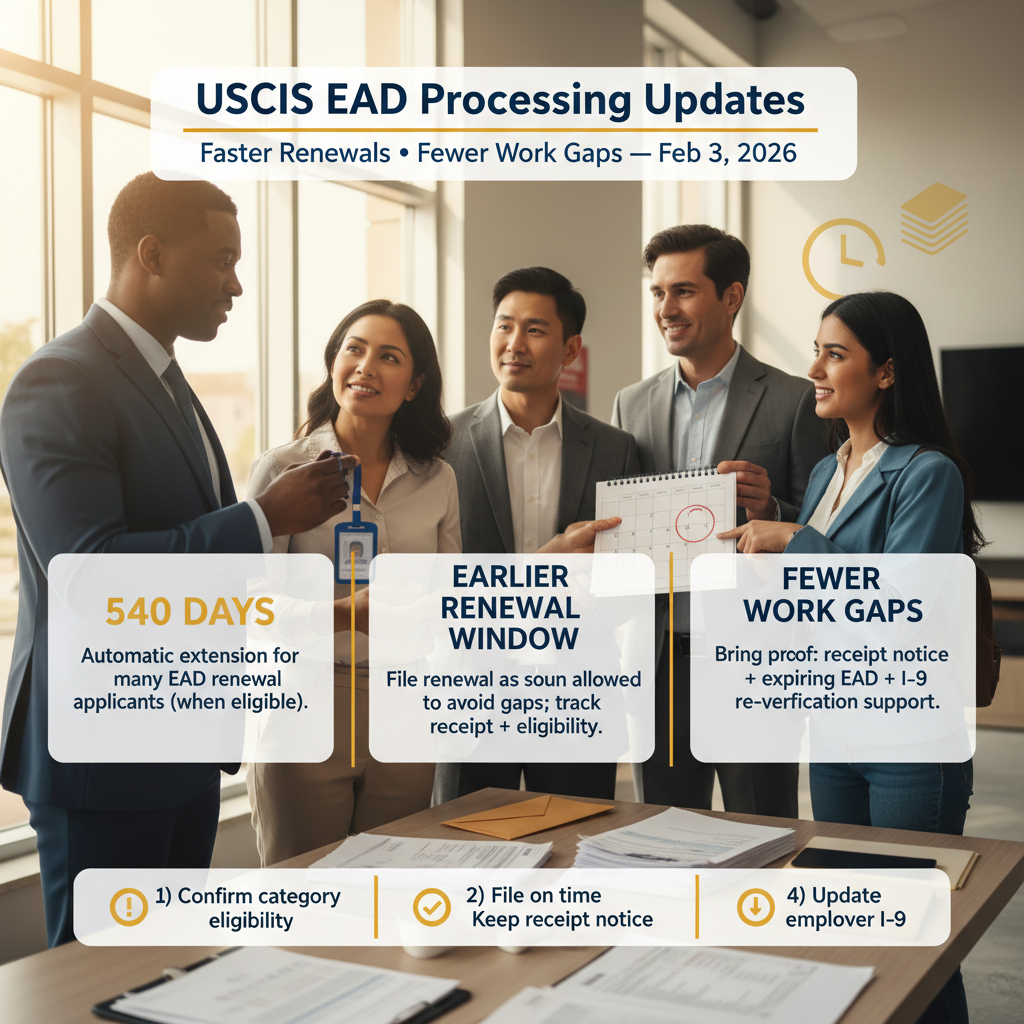
This article is based on recent USCIS-related reporting and updates circulating in immigration news feeds. The specific item that prompted this practical guide is: Employment Authorization Document Processing (USCIS).
Reminder: News headlines can move faster than official policy text. For the most reliable information, always cross-check with the USCIS official website and your case-specific receipt notices.
Need Help? Our Orlando immigration team is ready to assist. Call +1 786-791-3106 for a free consultation, or message us online. Se Habla Español.
What This News Means for Immigrants in Orlando and Across Florida
Why this news is showing up now
Employment Authorization Documents (EADs)—often called “work permits”—are one of the most time-sensitive benefits in U.S. immigration. When EAD processing slows down, immigrants can face job loss, driver’s license issues, and interruptions in family stability. When EAD processing speeds up (or when USCIS changes how it handles renewals, biometrics, or automatic extensions), people may suddenly have new options to avoid gaps in work authorization.
EAD processing has been a recurring national topic because USCIS has been working through backlogs while also implementing operational changes, including:
- Shifts in intake and adjudication workflows at USCIS service centers
- Changes to how biometrics are scheduled or reused
- More online filing and account-based case tracking
- Policy updates affecting certain categories’ renewal rules and evidence requirements
Important: The “trend” is not just about speed. It’s also about predictability—how to plan renewals inside the right window (often discussed as a 90-day window or longer, depending on category), how to document eligibility, and how to avoid avoidable Requests for Evidence (RFEs).
How it can affect Florida residents
For immigrants living and working along the I-4 corridor—Orlando, Kissimmee, Sanford, Winter Park, and across Orange County—EAD timing can affect:
- Employment continuity (avoiding unpaid leave or termination when HR cannot re-verify work authorization)
- Driver’s license renewals and Real ID compliance, which often depend on valid immigration documents
- Family finances (rent, childcare, health insurance, and household stability)
- Immigration strategy (for example, whether to file Form I-485 Adjustment of Status with Form I-765)
If your case is in Orlando, it’s common to have a “split” process: the EAD may be handled at a USCIS service center, while your green card interview (if any) may be scheduled by The Orlando USCIS Field Office. Understanding which part of the agency controls which step helps you track your case realistically.
What Employment Authorization Document Processing Is (and Why It Matters)
A plain-English definition
“Employment Authorization Document processing” refers to how USCIS receives, reviews, and decides applications for an EAD card. The EAD is generally requested using Form I-765 (Application for Employment Authorization). If approved, USCIS issues a photo ID card that shows:
- Your name and A-Number (if you have one)
- Your EAD category (such as (c)(9), (c)(8), etc.)
- The dates you are authorized to work
The “processing” part includes intake, fee processing (if required), biometrics (if required), background checks, eligibility review, and card production. Delays can happen at any stage—and the fix depends on where the case is stuck.
Key terms you need to know
- EAD: The work permit card issued by USCIS after approval of Form I-765.
- Category: The eligibility code on the EAD (for example, (c)(9) for many Adjustment of Status applicants).
- Receipt Notice: USCIS notice confirming your filing and assigning a case number. This can be critical for certain automatic extension rules.
- RFE (Request for Evidence): USCIS asks for more documents before deciding.
- Automatic Extension: Some renewal applicants may receive an extension of work authorization if they file timely and meet category requirements.
- USCIS Processing Times: Posted estimates by form type and service center at USCIS Processing Times.
- Priority Date: A key concept in many green card categories, affecting when a green card can be issued. Even though EADs are different, your Priority Date may affect your overall strategy if you’re employment-based or family-based.
Warning: Not everyone is eligible for an EAD, and not every immigration status allows employment. Filing the wrong category—or filing without eligibility—can cause denial and may create immigration risks.
Current Immigration Law: The Foundation
EAD authority comes from federal immigration law and USCIS regulations. In most cases, USCIS issues work authorization under the Immigration and Nationality Act (INA) and implementing regulations in Title 8 of the Code of Federal Regulations (8 C.F.R.), including rules that define who may apply and how renewals work.
Many EAD applicants also have related filings such as Form I-485 (Adjustment of Status), Form I-130 (family petition), Form I-589 (asylum), or other humanitarian or employment-based filings.
Federal requirements
At the federal level, the key “building blocks” include:
- Properly filed Form I-765 in the correct eligibility category
- Required fee (or approved fee waiver, if eligible)
- Identity evidence and immigration status evidence
- Biometrics/background checks when required
- Timely renewal filings (especially when seeking any automatic extension benefits)
You can confirm current filing addresses, edition dates, and instructions through: USCIS Forms and the USCIS official website.
Important: If your EAD is connected to a pending Form I-485, your EAD eligibility may depend on maintaining a properly pending adjustment case (and responding to any USCIS notices on time).
Florida-specific considerations
Immigration law is federal, but Florida residents often face local “real-life” consequences of EAD timing:
- Employment verification: Florida employers use Form I-9 rules (federal), but HR practices vary; many employers will not accept an expired EAD unless a valid automatic extension applies.
- DMV/driver’s license: Florida DHSMV document acceptance may depend on current immigration documents; EAD delays can affect renewals.
- Local case logistics: For Central Florida residents, appointments, mail delivery, and address changes can affect notices and biometrics scheduling.
If your case is in Orlando, pay close attention to address accuracy. Missing a USCIS notice because of an outdated address can cause denials that are difficult to fix quickly.
Need Help? Our Orlando immigration team is ready to assist. Call +1 786-791-3106 for a free consultation, or message us online. Se Habla Español.
How to Apply for or Renew an EAD: A Complete Step-by-Step Guide
Below is a practical, step-by-step roadmap for most applicants filing Form I-765. Because eligibility categories differ, treat this as a framework and always confirm the requirements for your specific category in the official instructions.
1) Confirm your EAD eligibility category (before you file)
The single most important decision is choosing the correct eligibility category for Form I-765. The category controls what evidence you must submit, whether you must pay a fee, and whether you may qualify for an automatic extension on renewal.
Common examples include:
- (c)(9): Certain applicants with pending Form I-485 (Adjustment of Status)
- (c)(8): Certain asylum applicants with pending asylum applications
- Other categories based on parole, TPS, certain humanitarian programs, or specific nonimmigrant statuses
Documents to gather for Step 1:
- Copy of your most recent EAD (front/back), if renewing
- Your latest I-94 record (if applicable)
- Copies of USCIS receipt notices for related filings (e.g., Form I-485, Form I-589)
- Any approval notices you currently rely on
Warning: If you select the wrong category, USCIS may deny the application—even if you “deserve” a work permit under a different category.
2) Plan your timing to avoid gaps (renewal strategy)
Renewal timing is where many applicants lose months of work eligibility. Some categories may qualify for an automatic extension if you file a renewal on time and meet specific requirements.
Because rules can change and category rules differ, consider these best practices:
- Start preparing your renewal packet as early as possible
- Track your expiration date and your employer’s re-verification schedule
- Check current estimates at USCIS Processing Times
Reminder: People often talk about a 90-day window for EADs, but many categories allow earlier filing than 90 days. Always follow the current I-765 instructions for your category.
Documents to gather for Step 2:
- Calendar proof of EAD expiration date
- Employment letter (optional but helpful for expedite requests)
- Pay stubs and proof of financial obligations (optional but helpful if requesting expedite)
3) Prepare Form I-765 and supporting evidence
Completing Form I-765 correctly requires consistency with your other filings. Names, addresses, and immigration history should match what USCIS already has on file.
Documents to gather for Step 3 (typical):
- Government-issued ID (passport biographic page, if available)
- Two passport-style photos (if filing by mail and required by category/instructions)
- Copy of your I-94 (if applicable)
- Copy of your last EAD (renewals)
- Receipt notices for underlying applications (e.g., Form I-485, Form I-589)
- Any prior EAD approval notices (if available)
- Certified translations for any non-English documents
Important: If you have a pending family-based case through Form I-130 and you are filing Form I-485 concurrently or later, your EAD strategy often ties to whether you can file Adjustment of Status now and whether your Priority Date is current (in categories where that matters).
For immigrant visa processing abroad (consular processing), the EAD may not be available in the same way. For those cases, review the U.S. Department of State resources.
4) File the application (online or by mail) and keep proof
USCIS allows online filing for certain I-765 categories and paper filing for others. The correct method depends on your eligibility category and USCIS system availability.
Documents to gather for Step 4:
- Payment method (credit card authorization form, check, or online payment, if required)
- Cover letter (recommended)
- Full copy of the filing packet for your records
- Courier tracking (if mailing)
Reminder: Always download or print your confirmation page/receipt. If your case later needs an expedite request or a correction, proof of filing is essential.
5) Attend biometrics (if scheduled) and respond to USCIS notices
Some EAD applicants must attend a biometrics appointment at an Application Support Center (ASC). Others may have biometrics reused.
Documents to gather for Step 5:
- Biometrics appointment notice (original)
- Photo ID (passport, driver’s license, or other acceptable ID)
- Any USCIS-issued identity documents
If USCIS issues an RFE, respond fully and on time. Missing deadlines can lead to denial. While many immigration contexts mention 180 days for certain benefits, your RFE deadline will be stated on the notice—follow that exact date.
6) Track adjudication, request help when appropriate, and prepare for delivery
Once filed, track your case through your USCIS online account and the case status tool. If your case is outside normal processing times, you may be able to submit a service request.
Documents to gather for Step 6:
- Receipt number(s)
- USCIS online account screenshots (optional)
- Evidence supporting an expedite request (job loss letter, medical hardship, etc.)
Warning: Card delivery issues (returned mail, wrong address, mailbox theft) are more common than people expect. If you move, update USCIS promptly and keep proof.
7) Use your EAD correctly (I-9, SSN, renewal planning)
After approval, you can generally use your EAD for employment verification (Form I-9) and, in many cases, to obtain or update a Social Security number record.
Documents to gather for Step 7:
- Your new EAD card
- Social Security card (if you have one)
- Employer’s I-9 instructions and deadlines
- Calendar reminders for your next renewal cycle
For those also in immigration court proceedings, EAD timing can interact with case strategy. For court information, see the Executive Office for Immigration Review.
Practical Steps You Can Take Today
If EAD processing updates have you worried about timing, here is an actionable checklist you can start immediately.
Actionable checklist
- Check your category on your current EAD card and confirm your renewal category matches.
- Pull your receipts: Find your USCIS receipt notices for related filings like Form I-485 or Form I-130.
- Review your expiration date and set reminders at 6 months, 120 days, and 60 days before expiration.
- Download your I-94 (if applicable) and keep a PDF copy.
- Prepare employer documentation (job offer letter, HR letters, pay stubs) in case an expedite becomes necessary.
- Confirm your address is current with USCIS and your USCIS online account.
- Track processing times weekly at USCIS Processing Times.
Document preparation guidance
Build a single “EAD folder” (paper and digital) that includes:
- All EAD cards you have ever received (front/back copies)
- Your passport bio page and any U.S. visas
- I-94 record(s), if any
- USCIS receipt notices and approval notices
- Certified translations
Important: Consistency matters. USCIS often issues RFEs when names, dates, or addresses differ across filings. If you have used multiple versions of your name, talk to counsel about how to document it.
Timeline expectations
EAD timelines vary by category, service center workload, and whether biometrics are required. While USCIS publishes estimates, real timelines can be shorter or longer.
- Receipt notice: often within days to a few weeks after filing (varies by filing method and volume)
- Biometrics: sometimes waived/reused; if scheduled, typically within weeks to a few months
- Decision and card production: varies widely; check current estimates and your case status
For Central Florida residents, factor in mail delivery time and keep an eye on your USPS Informed Delivery when possible, because many USCIS notices are time-sensitive.
Need Help? Our Orlando immigration team is ready to assist. Call +1 786-791-3106 for a free consultation, or message us online. Se Habla Español.
How Imigrar Helps Immigrants in Orlando
At Imigrar, we focus on practical, family-centered immigration solutions—because our mission is to Keep Families Together. EAD problems are rarely “just paperwork.” They affect jobs, housing, children, and long-term stability.
Our Orlando-based team supports clients across Florida and nationwide with:
- EAD initial filings and renewals under the correct eligibility category
- Case strategy when EADs are tied to Form I-485 Adjustment of Status or other pending applications
- RFE responses and document organization to reduce delays
- Expedite request preparation when legally appropriate
- Planning for related filings such as Form I-130 and family-based pathways
If your case is in Orlando, we also help you think through the “local logistics,” including how your case may move between service centers and The Orlando USCIS Field Office.
Se Habla Español. We offer a free consultation so you can understand your options before you file or while your case is pending.
Frequently Asked Questions
Q: Who is eligible to apply for an EAD using Form I-765?
A: Eligibility depends on your immigration category. Many people qualify through a pending Form I-485 Adjustment of Status case, a pending asylum case, TPS, certain parole programs, or specific nonimmigrant statuses. The key is selecting the correct I-765 category and submitting the exact evidence listed in the form instructions. If you’re unsure, speak with an immigration attorney before filing—filing the wrong category can result in denial.
Q: Will applying for or renewing an EAD affect my immigration status?
A: Filing Form I-765 generally does not “create” status by itself; it is usually a benefit based on an underlying status or pending application. If your underlying case is denied (for example, a denied Form I-485), your EAD eligibility can end. Warning: If you are out of status or in a complex situation (prior removal order, unlawful presence concerns, or misrepresentation issues), get legal advice before filing anything.
Q: How long does EAD processing take right now?
A: Processing time varies by category and service center. The best public tool is USCIS Processing Times, but those are estimates. Your real timeline may be shorter or longer depending on biometrics, RFEs, or workload. If your case is outside normal processing times, you may be able to submit a service request through USCIS.
Q: What documents do I need for an EAD renewal?
A: Most renewals require: a completed Form I-765, a copy of your prior EAD (front/back), proof of your underlying eligibility (such as an I-485 receipt for (c)(9) applicants), identity documents (passport page), and any required photos/fees. If your eligibility is tied to family-based filings like Form I-130 and Form I-485, include the receipts and confirm your case remains pending.
Q: How much does an EAD application cost?
A: Fees depend on the category and whether the filing is an initial application or renewal. USCIS also updates fees periodically. Always verify the current fee and payment method directly on the USCIS official website and the USCIS Forms page for Form I-765. Some applicants may qualify for a fee waiver depending on category and financial circumstances.
Q: What happens if my EAD is denied?
A: USCIS will issue a written denial notice explaining the reason. Common reasons include wrong category selection, missing evidence, failure to respond to an RFE, or lack of underlying eligibility (for example, the related Form I-485 was denied). Next steps may include refiling (if eligible), filing a motion (in limited situations), or fixing the underlying case problem. Important: A denial can have broader consequences depending on your status—talk to an attorney immediately.
Q: Can I work while my renewal is pending?
A: Sometimes. Certain renewal categories may qualify for an automatic extension if the renewal is filed timely and you meet all requirements. Your receipt notice and category matter. If your employer is re-verifying and you are relying on an extension, you must provide the correct documents. Because automatic extension rules are category-specific and can change, confirm current guidance with USCIS or an attorney before assuming you can keep working.
Q: If my case is in Orlando, does that change my EAD processing time?
A: Often, yes and no. Many EADs are adjudicated at USCIS service centers, not at the local field office. However, Orlando-area logistics still matter: address changes, biometrics scheduling, and how quickly you receive mail can affect your overall timeline. Also, if your EAD is tied to Form I-485, your green card interview may be handled by The Orlando USCIS Field Office, which can indirectly affect your planning.
Common Mistakes (and How to Avoid Them)
Mistake #1: Filing the wrong I-765 category or mixing categories
USCIS adjudicates by category rules. A common error is selecting a category that “sounds right” or was used years ago, even though your current eligibility is different. How to avoid it: Match your category to your current underlying case (such as pending Form I-485) and verify with the latest I-765 instructions.
Mistake #2: Waiting too long and assuming the 90-day window is universal
Some applicants wait until the last minute because they heard they can only file within a 90-day window. In reality, timing depends on category and USCIS rules. How to avoid it: Build a renewal plan early and check USCIS guidance for your category. If you may qualify for an automatic extension, timely filing is critical.
Mistake #3: Ignoring address updates and missing notices
Missing a biometrics notice or RFE can lead to denial. This is especially common for people who move apartments along the I-4 corridor or within Orange County. How to avoid it: Keep your USCIS address current, monitor your mail, and save digital copies of every notice.
Additional Official Resources (Bookmark These)
- USCIS official website
- USCIS Forms
- USCIS Processing Times
- U.S. Department of State
- Executive Office for Immigration Review
Reminder: If your immigration plan involves consular processing, the Department of State timeline and document rules may be just as important as USCIS steps. If you are in removal proceedings, EOIR court scheduling may affect your broader strategy.
Need Help? Our Orlando immigration team is ready to assist. Call +1 786-791-3106 for a free consultation, or message us online. Se Habla Español.

Closing: Get Help with Your EAD Application or Renewal
USCIS EAD processing updates can create opportunities—but they can also create confusion. The safest approach is to confirm your eligibility category, file with a complete evidence package, and plan early to avoid gaps.
If you live in Orlando, Orange County, or anywhere in Central Florida—and especially if your EAD is tied to a pending Form I-485 Adjustment of Status or family petition such as Form I-130—Imigrar can help you create a clear plan and reduce delays.
Need support now? Call Imigrar at +1 786-791-3106 for a free consultation, or message us online. Se Habla Español.


