


The reporting that sparked this guide
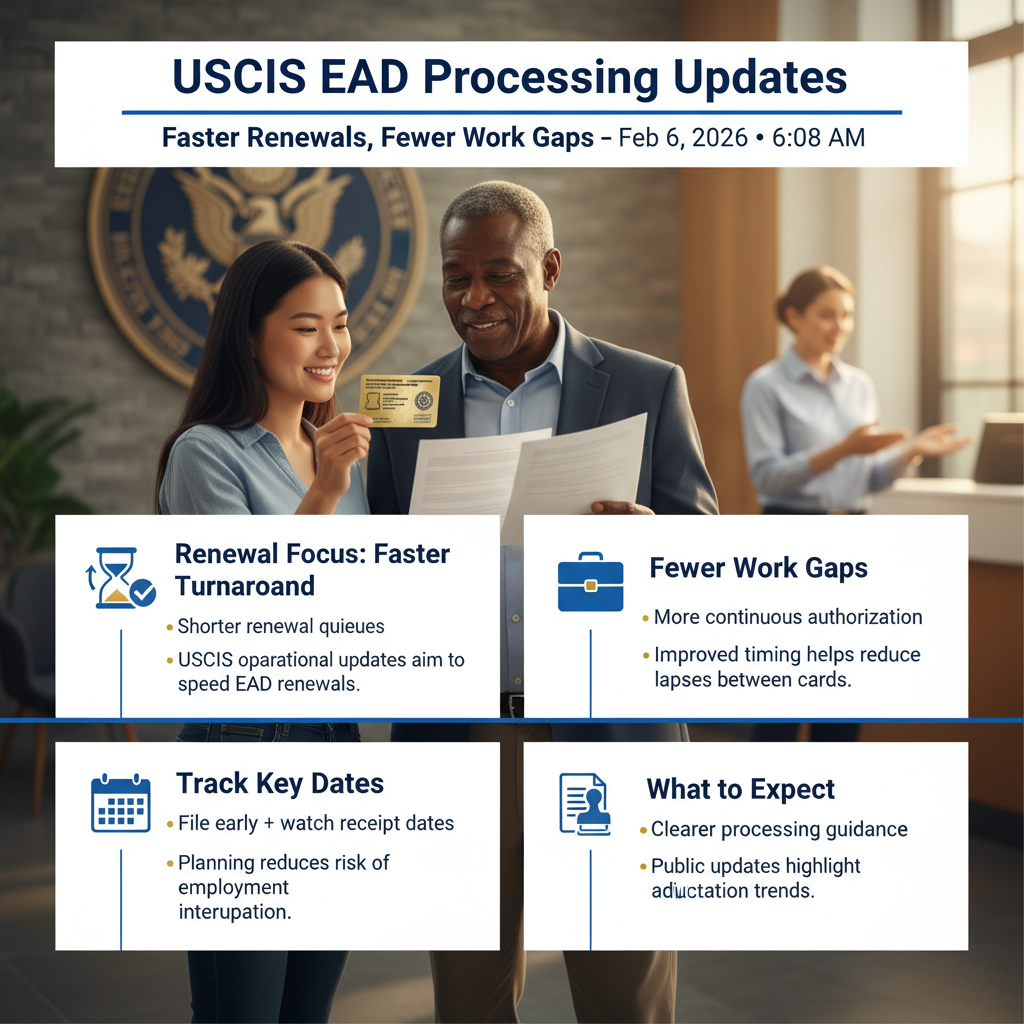
This article is based on trending coverage and public updates tied to USCIS operations and Employment Authorization Document (EAD) adjudications, as reflected in the following news aggregator source:
Employment Authorization Document Processing (USCIS)
Reminder: Google News links to multiple outlets and official statements. USCIS policies can shift quickly. Always confirm current instructions on the USCIS official website and the specific form pages on USCIS Forms.
Need Help? Our Orlando immigration team is ready to assist. Call +1 786-791-3106 for a free consultation, or message us online. Se Habla Español.
What This News Means for Immigrants in Orlando and Across Florida
Why this news is showing up now
EAD processing is trending because work authorization affects daily life in an immediate way—jobs, driver’s licenses, professional licensing, and family stability. USCIS has also been under sustained pressure to reduce backlogs and improve customer experience. Recent cycles of operational updates have included:
- USCIS efforts to reduce case backlogs and modernize filing and adjudication systems.
- Renewal timing guidance and increased public attention to automatic extensions in certain categories.
- Frequent changes in demand for EADs based on humanitarian programs, asylum filings, and Adjustment of Status filings.
Important: “EAD processing updates” does not always mean a single new rule. Often it reflects a combination of (1) processing-time fluctuations, (2) internal workflow changes, and (3) category-specific policies (for example, some applicants qualify for automatic extensions while others do not).
How it can affect Florida residents
For Florida residents—especially those along the I-4 corridor from Tampa to Orlando to Daytona—EAD delays can create ripple effects:
- Employment interruptions: If your EAD expires and you don’t qualify for an automatic extension, you may have to stop working.
- Driver’s license and ID renewals: Many applicants use EADs as proof of lawful presence for Florida licensing and renewals.
- Employer compliance: Employers must follow Form I-9 rules and may reverify work authorization when an EAD expires.
- Family finances: Work gaps can affect rent/mortgages, childcare, and health insurance.
If your case is in Orlando, your overall immigration process may involve the Orlando USCIS Field Office for interviews (for example, many Form I-485 cases), while EADs are typically adjudicated by USCIS service centers. Even if your interview is local, the EAD timeline may depend on national workloads.
What Employment Authorization Document Processing Is (and Why It Matters)
A plain-English definition
An Employment Authorization Document (EAD)—often called a “work permit”—is a USCIS-issued card that proves you are authorized to work in the United States for a specific time period. “EAD processing” refers to how USCIS receives, reviews, approves/denies, and produces your EAD card after you file the application (or renewal).
Many immigrants in Florida rely on an EAD while they are waiting for a longer-term immigration benefit, such as:
- Pending Adjustment of Status applications (Form I-485)
- Pending asylum applications
- Temporary Protected Status (TPS)
- Certain parole or humanitarian categories
- Certain family-based categories with pending applications (often filed together with Form I-485)
Key terms you need to know
- EAD category (eligibility category): The code USCIS uses to identify why you qualify for work authorization (for example, based on a pending Form I-485 or TPS). Choosing the wrong category can delay or derail your case.
- Renewal: A new EAD application filed before your current card expires.
- Automatic extension: Some EAD categories receive an automatic extension of work authorization if the renewal is filed on time and other requirements are met. The extension length and rules are category-specific.
- Receipt notice: USCIS document confirming they received your application and accepted it for processing. This notice is often crucial for proving an automatic extension to an employer.
- Biometrics: Fingerprints/photo appointment used for identity and background checks. USCIS may reuse biometrics in some cases.
- Processing time: The estimated time USCIS posts for case completion, which can be checked at USCIS Processing Times.
- Priority Date: A key concept in many green card processes (especially through family- or employment-based immigrant petitions). While a Priority Date is not an EAD requirement by itself, it often affects the broader case that makes you eligible for an EAD (for example, when you can file Form I-485).
Warning: An EAD is not a visa and not a green card. It does not automatically grant lawful status. Your underlying status or pending application is what matters for immigration compliance.
Need Help? Our Orlando immigration team is ready to assist. Call +1 786-791-3106 for a free consultation, or message us online. Se Habla Español.
Current Immigration Law: The Foundation
EADs exist under federal immigration law and regulations. While USCIS policy guidance can change, the baseline authority comes from the Immigration and Nationality Act (INA) and the Code of Federal Regulations (CFR).
Federal requirements
Key federal legal authorities include:
- INA § 274A (8 U.S.C. § 1324a): Governs unlawful employment and employment verification rules (Form I-9 obligations for employers).
- 8 C.F.R. § 274a: The main regulatory framework for employment authorization, EAD eligibility categories, and documentation rules.
- Form I-765 (Application for Employment Authorization): The core form used for most EAD applications and renewals.
USCIS publishes official instructions and filing addresses on the form page and on the USCIS official website. Always use the most current edition of the form from USCIS Forms.
Other forms commonly connected to EAD eligibility include:
- Form I-485 (Application to Register Permanent Residence or Adjust Status) – often filed with Form I-765 for work authorization while the green card case is pending.
- Form I-130 (Petition for Alien Relative) – the family petition that often supports a later Adjustment of Status filing.
- Form I-131 (Application for Travel Document) – often filed for Advance Parole while Form I-485 is pending.
Reminder: If you are dealing with immigration court, the Executive Office for Immigration Review (EOIR) manages court proceedings, not USCIS. However, USCIS still adjudicates many benefits (including many EAD categories), so court posture can affect eligibility.
Florida-specific considerations
Florida does not create immigration work authorization—only the federal government does. But Florida residents often face state-level practical issues tied to EAD timing:
- Driver’s license/ID timing: If your EAD is expiring soon, plan early. Delays can affect state ID renewals and employment onboarding.
- Local employer practices: In Central Florida (Orange County and the broader I-4 corridor), large employers often have strict compliance departments and may require updated documents quickly for I-9 reverification.
- Address stability: Frequent moves (common in high-growth areas like Orlando) make it essential to update USCIS promptly to avoid returned cards and missed notices.
Important: If your case is in Orlando and you have an upcoming interview at the Orlando USCIS Field Office, your EAD may still be processed elsewhere. Don’t assume an interview notice means your EAD is automatically “about to be approved.” Track each case separately.
For consular processing questions (visa issuance abroad), consult the U.S. Department of State, since visa processing is handled by the Department of State rather than USCIS.
How to File or Renew an EAD: A Complete Step-by-Step Guide
This step-by-step guide focuses on the most common scenario we see at Imigrar: filing Form I-765 for an initial EAD or an EAD renewal, often connected to a pending Form I-485 (Adjustment of Status) or another qualifying category.
Warning: EAD eligibility is category-specific. The steps below are general. Always confirm your category’s requirements on USCIS instructions and/or with qualified counsel.
1) Confirm your eligibility category and timing
Start by identifying the exact eligibility category for your EAD. This determines your required evidence, whether you qualify for an automatic extension, and how you should time your renewal.
Timing tip: Many renewals should be filed as early as allowed by USCIS instructions for your category. People often refer to a 90-day window, but the correct filing window depends on the category and USCIS rules. Some categories allow earlier filing than 90 days.
Documents to gather:
- Current/previous EAD (front and back copy)
- I-94 record (if applicable)
- Passport biographic page and visa page (if applicable)
- USCIS receipt notices for underlying case (e.g., Form I-485 receipt)
- Any prior USCIS approval notices relevant to the category
2) Prepare Form I-765 and check filing method
Complete Form I-765 carefully and consistently with your other filings. USCIS uses identity data across applications; small inconsistencies (name format, prior addresses, A-Number, I-94) can trigger delays.
Confirm whether your category can be filed online or must be mailed. USCIS expands online filing options over time, but not every category is eligible.
Documents to gather:
- Completed Form I-765 (correct edition)
- Two passport-style photos (if required for your filing type; follow USCIS photo specs)
- Government-issued photo ID copy
- Any name-change documents (marriage certificate, court order) if applicable
3) Assemble supporting evidence for your specific category
Your evidence should prove (1) identity and (2) eligibility under the category you selected. For example, a pending Adjustment of Status EAD typically relies on proof that Form I-485 is properly filed and pending.
Documents to gather (examples):
- Form I-485 receipt notice (if EAD is based on pending AOS)
- Form I-797 approval/receipt notices for TPS, asylum, or other basis (as applicable)
- Prior EADs and approval notices (for renewals)
- Evidence of current status (if applicable)
- Translations (certified) for any non-English documents
Important: Do not submit original civil documents unless USCIS specifically requests originals. Use clear copies.
4) Pay the correct fee (or file a fee waiver, if eligible)
USCIS fees depend on category, age, and whether biometrics are required. Always verify current fees directly from USCIS before filing. Fee mistakes are a top cause of rejected filings (which can destroy your timeline).
Documents to gather:
- Payment method allowed for your filing channel (check, money order, or online payment)
- If requesting a fee waiver (when permitted): financial evidence supporting eligibility
- Cover letter summarizing contents (recommended)
Warning: A “rejection” (wrong fee, unsigned form, wrong edition) is not the same as a “denial”—but it can still cause a work gap if you lose time and miss eligibility-based deadlines.
5) File the application and track receipts, biometrics, and notices
After filing, you should receive a receipt notice. If you qualify for an automatic extension, the receipt notice may be essential for proving continued work authorization to your employer.
Track your case using your USCIS receipt number and monitor posted timeframes at USCIS Processing Times.
Documents to gather and keep organized:
- Delivery confirmation (USPS/UPS/FedEx tracking, if mailed)
- USCIS receipt notice (Form I-797C)
- Biometrics appointment notice (if issued)
- Any Requests for Evidence (RFEs) and your response proof
Reminder: If you move in Orange County or elsewhere in Florida, update your address with USCIS promptly to avoid missing biometrics or having your card returned.
6) Respond quickly to RFEs and watch for card production
If USCIS issues an RFE, respond by the deadline with exactly what is requested. Late or incomplete RFE responses commonly lead to denials. Once approved, USCIS will produce and mail the EAD card.
Documents to gather:
- RFE notice (read carefully)
- RFE response packet with tabs and a cover letter
- Proof of timely mailing (tracking + delivery confirmation)
Important: If your EAD is approved but never arrives, you may need to pursue a USCIS non-delivery inquiry and/or replacement depending on circumstances.
7) After approval: update your employer and protect your future filings
Once you receive your EAD, give your employer the updated document for Form I-9 purposes (if reverification is required). Keep copies of the card and approval notice. These records often help with future renewals, green card processes, and compliance questions.
Documents to keep:
- EAD card copy (front/back)
- Approval notice
- All receipts for underlying filings (Form I-130, Form I-485, etc.)
- Timeline notes (filed date, receipt date, biometrics date, approval date)
Need Help? Our Orlando immigration team is ready to assist. Call +1 786-791-3106 for a free consultation, or message us online. Se Habla Español.
Practical Steps You Can Take Today
If you are worried about EAD processing delays or a possible work gap, the best strategy is proactive preparation and documentation. Here is an actionable checklist you can start today.
Actionable checklist (do these now)
- Check your category rules: Confirm whether your EAD category may qualify for an automatic extension and what proof your employer needs (often the receipt notice plus the expired card).
- Calendar your expiration date: Set reminders at 180, 120, and 60 days before expiration. Even if people talk about a 90-day window, many applicants should plan earlier to avoid last-minute surprises.
- Create a “USCIS filing packet” folder: Keep PDFs of every form, receipt, photo page, and prior EAD (front/back).
- Verify your mailing address: If you live in Orlando, Kissimmee, Winter Park, or anywhere in Orange County and you move frequently, double-check that USCIS has your current address before card production.
- Track processing times monthly: Use USCIS Processing Times to see trends and set realistic expectations.
- Prepare employer communication: If you qualify for an automatic extension (often discussed as 180 days in many categories), prepare a simple email to HR with your receipt notice and a reference to USCIS guidance.
Document preparation guidance
- Use consistent names across all filings (including accents, hyphens, and multiple last names).
- Scan documents in high resolution and keep them in a secure cloud folder.
- For any non-English documents, obtain proper certified translations.
- Keep proof of lawful entry/status when applicable (passport, I-94).
Timeline expectations (realistic planning)
EAD processing times vary widely by category and workload. Some cases move quickly; others take months. Use USCIS’s official tools and plan for variability:
- Check your form type and category at USCIS Processing Times.
- Build a buffer: aim to file as early as allowed and avoid waiting until the last minute.
- If your underlying case is Adjustment of Status (pending Form I-485), remember your EAD timeline may not match your interview timeline at the Orlando USCIS Field Office.
Reminder: If you are also planning international travel, do not assume an EAD allows reentry. Many applicants need Advance Parole (often via Form I-131) before leaving the U.S.
How Imigrar Helps Immigrants in Orlando
At Imigrar, we help immigrants and families in Orlando and across the United States navigate EAD filings with a focus on stability and keeping work authorization uninterrupted—because our mission is to Keep Families Together.
We assist with:
- EAD initial filings and renewals across common categories
- EADs based on pending Form I-485 (Adjustment of Status)
- Coordinated filing strategies when submitting Form I-130 + Form I-485 + Form I-765 (when eligible)
- RFE responses and case troubleshooting
- Planning for employer I-9 reverification and documentation
If your case is in Orlando, we also help you understand how local steps (like interviews at the Orlando USCIS Field Office) interact with national EAD processing.
Free consultation: Call +1 786-791-3106 to discuss your timeline and options. Se Habla Español.
Frequently Asked Questions
Q: Am I eligible to apply for an EAD?
A: Eligibility depends on your immigration category. Common eligible groups include applicants with pending Adjustment of Status (Form I-485), TPS holders, certain asylum applicants, and certain parole/humanitarian categories. The fastest way to confirm is to review Form I-765 instructions on the USCIS official website and match your situation to the correct eligibility category. If you’re unsure, get legal guidance before filing—choosing the wrong category can cause delays or denial.
Q: Will filing an EAD affect my immigration status or my green card case?
A: In most categories, filing Form I-765 does not harm your underlying case, but errors can create complications. For example, inconsistencies between your Form I-765 and Form I-485 can trigger RFEs. Also, an EAD does not grant status by itself—your lawful status (or authorized stay) depends on the underlying basis (pending application or approved status).
Q: How long will my EAD take to process?
A: Processing times vary by category and service center workload. The most reliable public estimate is the USCIS tool at USCIS Processing Times. For Central Florida residents, the fact that you live near the Orlando USCIS Field Office does not necessarily speed up EAD adjudication, because EADs are usually processed by service centers rather than local field offices.
Q: What documents do I need for an EAD renewal?
A: Most renewals require: (1) a completed Form I-765, (2) copies of your current/expired EAD (front and back), (3) proof of your eligibility category (such as a Form I-485 receipt notice if your EAD is based on pending Adjustment of Status), (4) identity documents (passport/I-94 if applicable), and (5) the correct fee or an approved fee waiver request (if permitted). Always follow the category-specific instructions.
Q: How much does it cost to apply for or renew an EAD?
A: USCIS fees can change and may differ by category and filing method. Verify the current fee directly on the USCIS official website and the USCIS Forms page for Form I-765. Warning: Submitting the wrong fee can lead to a rejection, which can cause a work gap if you lose time.
Q: What happens if my EAD renewal is denied?
A: If denied, USCIS will issue a written decision explaining why. Next steps depend on the reason for denial—sometimes it’s a missing document or eligibility issue, and sometimes it’s tied to the underlying status. You may need to refile, file a motion (in limited situations), or address the underlying case. If you are close to expiration or already expired, speak with counsel immediately to reduce the risk of unlawful employment and to explore alternatives.
Q: Can I keep working while my EAD renewal is pending?
A: Some categories allow continued work authorization through an automatic extension if you file the renewal on time and meet the category rules. People commonly discuss 180 days of automatic extension in many eligible categories, but eligibility is not universal. Your employer may require the receipt notice plus the expired EAD as proof. If you do not qualify for an automatic extension, you generally must stop working when your EAD expires.
Q: Does my Priority Date affect my EAD?
A: Indirectly, it can. A Priority Date matters in many green card processes because it affects when you can file Form I-485. If you cannot file Form I-485 yet, you may not be eligible for an EAD based on pending Adjustment of Status. For family-based cases, the underlying petition is often Form I-130, but the EAD is usually tied to the pending Form I-485, not the petition alone.
Common Mistakes (and How to Avoid Them)
Mistake #1: Filing the wrong category or mixing category evidence
USCIS adjudicates EADs by eligibility category. If you pick the wrong category code on Form I-765 or submit evidence that doesn’t match your category, you can trigger delays, RFEs, or denial.
How to avoid it: Confirm the category directly in the Form I-765 instructions and align your evidence to that category. When in doubt, get legal review before filing.
Mistake #2: Waiting too long and assuming the “90-day window” is universal
Many applicants wait until 90 days before expiration because they’ve heard that rule online. In reality, the permissible filing window depends on your category and USCIS instructions, and processing times fluctuate.
How to avoid it: Plan early, calendar your expiration date, and file as soon as you are allowed. Build in a buffer for mail delays, rejections, or RFEs.
Mistake #3: Not preparing for employer I-9 reverification and automatic extension proof
Even if you qualify for an automatic extension (often discussed as 180 days), you may still face HR confusion. Some employers are unfamiliar with the receipt notice rules and may incorrectly insist you stop working.
How to avoid it: Provide HR with your receipt notice and any USCIS guidance relevant to your category. If needed, consult counsel to communicate with your employer correctly and lawfully.
Additional Official Resources (Use These, Not Rumors)
Because EAD processing news changes quickly, rely on primary sources and official tools:
- USCIS official website
- USCIS Forms (download current editions and instructions)
- USCIS Processing Times (check current estimates)
- U.S. Department of State (visa processing and consular information)
- Executive Office for Immigration Review (immigration court information)
Reminder: If you are considering a family-based green card path, you may hear about Form I-130, Form I-485, and Adjustment of Status. EAD timing often depends on when and how those filings are made.

Closing: Protect Your Job and Your Family—Plan Your EAD Strategy
EAD processing updates are a reminder that work authorization is not just paperwork—it is the foundation for stability. For Central Florida residents, especially in Orange County and across the I-4 corridor, a delayed EAD can mean lost wages, paused careers, and unnecessary stress.
Important: The best way to reduce risk is to (1) confirm eligibility, (2) file correctly the first time, (3) file early, and (4) maintain a complete evidence record.
Need Help? Our Orlando immigration team is ready to assist. Call +1 786-791-3106 for a free consultation, or message us online. Se Habla Español.
How to reach Imigrar: Call +1 786-791-3106. We serve clients in Orlando and nationwide. Se Habla Español. Our mission is to Keep Families Together.


