

The reporting that sparked this guide
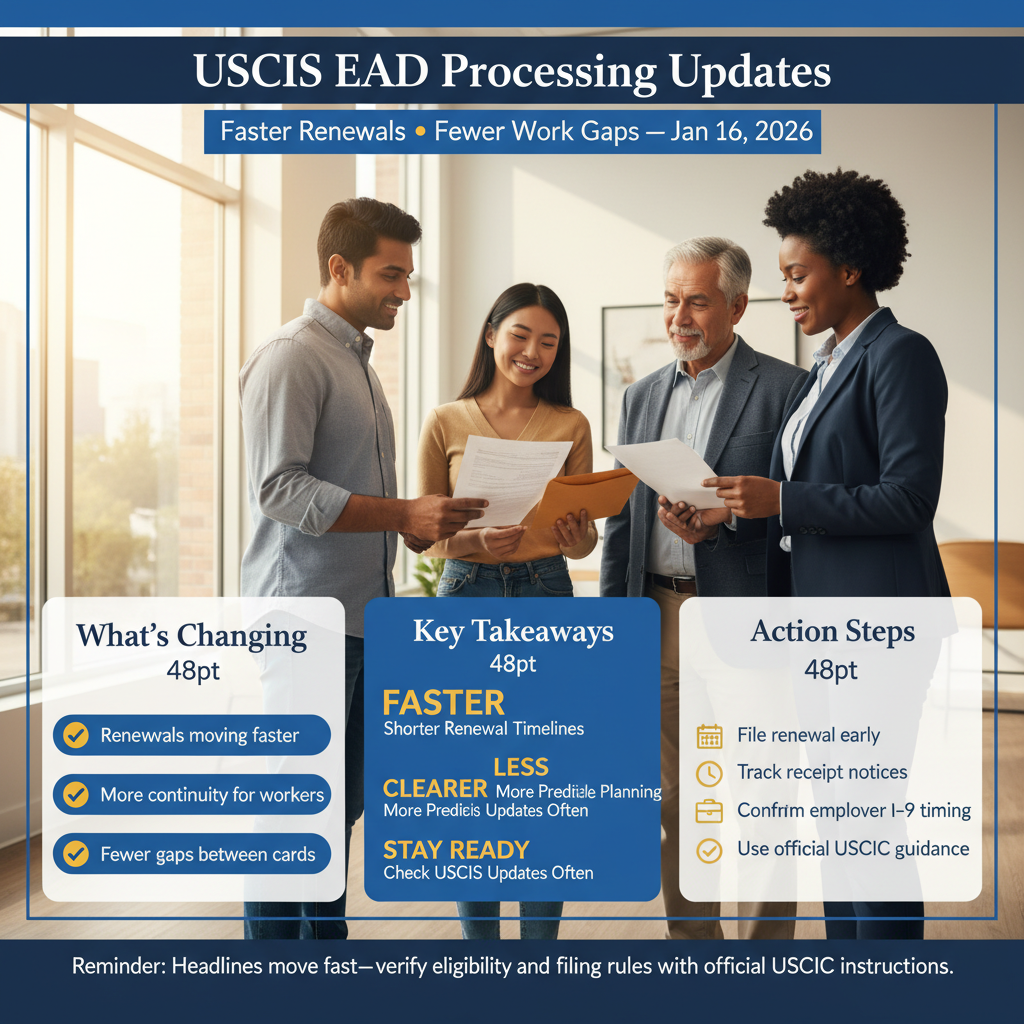
This article is based on ongoing USCIS-related reporting and public updates being surfaced in immigration news feeds, including: Employment Authorization Document Processing (USCIS).
Reminder: News headlines move fast. The most reliable source for day-to-day rules, eligibility, and filing instructions remains the USCIS official website.
Need Help? Our Orlando immigration team is ready to assist. Call +1 786-791-3106 for a free consultation, or message us online. Se Habla Español.
What This News Means for Immigrants in Orlando and Across Florida
Why this news is showing up now
Employment Authorization Documents (EADs), often called “work permits,” are a pressure point in the U.S. immigration system because a delay can quickly become a job-loss issue, a driver’s license issue, and a family-stability issue. USCIS processing trends and policy updates around EADs often become “trending news” when:
- USCIS announces operational changes to address backlogs (staffing, digitization, premium processing expansions for certain categories).
- There are surges in filings (for example, asylum-based EADs, family-based Adjustment of Status EADs, TPS-based renewals, or humanitarian programs).
- Employers and HR departments raise alarms about expiring documents and I-9 compliance.
- Applicants experience gaps between an EAD expiration date and the approval of a renewal—even when an automatic extension might apply.
Important: Not every EAD category has the same rules. Some categories qualify for an automatic extension (commonly up to 180 days if filed on time and eligible), while others do not. A “processing update” that helps one group may not help another.
How it can affect Florida residents
For Florida residents—especially in Central Florida along the I-4 corridor (Orlando, Kissimmee, Sanford, Lakeland, Tampa)—EAD timing affects more than income:
- Job continuity: Many employers will suspend work when an EAD expires unless an automatic extension applies and is properly documented.
- Driver’s license renewals: Florida DMV requirements often tie license validity to lawful status/document validity; an expired EAD can complicate renewals.
- Family stability: A work gap can affect rent, childcare, health insurance, and school plans.
- Travel planning: If your EAD is tied to a pending Form I-485, travel may require Advance Parole (Form I-131)—and timing matters.
If your case is in Orlando, the local reality is that families often have mixed timelines: one spouse’s EAD renewal, a child’s school schedule, and a pending interview at the Orlando USCIS Field Office (for certain applications) can all collide. Planning early is the best way to reduce risk.
What Employment Authorization Document Processing Is (and Why It Matters)
A plain-English definition
An Employment Authorization Document (EAD) is a photo ID card issued by USCIS that proves you are authorized to work in the United States for a specific time period. Most EADs are requested using Form I-765 (Application for Employment Authorization).
“EAD processing” refers to the entire USCIS workflow for:
- Reviewing your Form I-765 and supporting evidence
- Taking biometrics if required
- Issuing a Request for Evidence (RFE) if something is missing
- Approving/denying the application
- Producing and mailing the EAD card
Why it matters: An EAD is often the document that allows you to keep your job legally, obtain or renew certain state IDs, and maintain financial stability while your immigration case continues (for example, while your Form I-485 is pending).
Key terms you need to know
- EAD category: The code on your EAD (for example, (c)(9) for many pending Adjustment of Status applicants). Category drives eligibility and extension rules.
- Receipt Notice: USCIS notice (Form I-797) confirming they accepted your filing. This can be critical for automatic extensions.
- Automatic extension: Some renewal applicants may receive an automatic extension of work authorization if they file timely and meet category requirements—often up to 180 days.
- RFE (Request for Evidence): USCIS asks for missing or clarifying documents. RFEs can significantly delay processing.
- Processing times: USCIS estimates by form and service center. Check: USCIS Processing Times.
- Priority Date: In many green card categories, your Priority Date affects when you can file Form I-485 and related benefits like EAD. (Not every case uses a priority date.)
- 90-day window / filing windows: Some benefits have timing rules. For EAD renewals, the “safe” window is often earlier than people expect; many categories allow filing up to 180 days before expiration, but not all.
Warning: Online advice often mixes categories. A rule that applies to asylum-based EADs may not apply to TPS, DACA, or (c)(9) EADs. Always verify category-specific rules on the USCIS official website.
Current Immigration Law: The Foundation
Federal requirements
EAD authority comes from federal immigration regulations and agency policy. The main legal framework includes:
- Immigration and Nationality Act (INA) (the primary federal immigration statute), implemented through regulations.
- 8 C.F.R. § 274a (employment authorization rules, including categories eligible for employment authorization and EAD issuance).
- 8 C.F.R. § 274a.13 (procedures for applying for employment authorization and related timelines/requirements).
- USCIS form instructions and policy guidance (which control practical filing requirements).
The primary form for EADs is Form I-765. Many applicants file it:
- With a pending Form I-485 (green card application inside the U.S.)
- Based on asylum status or a pending asylum case
- Based on TPS, parole, certain humanitarian categories, or other eligibility bases
In family-based cases, EADs often appear alongside:
- Form I-130 (family petition)
- Form I-485 (Adjustment of Status)
- Form I-864 (Affidavit of Support)
- Form I-131 (Advance Parole for travel, when applicable)
Reminder: Always download current editions and instructions from USCIS Forms to avoid rejections for outdated versions.
Florida-specific considerations
Florida does not create immigration status, but state-level realities affect EAD holders:
- Driver’s licenses and state IDs: Florida’s DHSMV typically requires proof of lawful presence and document validity. An expiring or expired EAD can create renewal barriers.
- Employment verification (Form I-9): Employers in Florida must follow federal I-9 rules; many will reverify when an EAD expires.
- Local scheduling and logistics: For Central Florida residents, travel time, mail delays, and appointment availability can add friction—especially if you need biometrics or must respond to an RFE quickly.
If your case is in Orlando, keep in mind that the Orlando USCIS Field Office may handle interviews for certain benefits (like Form I-485), while EAD adjudication is typically handled by USCIS service centers. That means your EAD timeline may not match your interview timeline.
For official guidance, start with the USCIS official website and, for visa processing abroad, the U.S. Department of State. If you are in immigration court proceedings, consult the Executive Office for Immigration Review.
Need Help? Our Orlando immigration team is ready to assist. Call +1 786-791-3106 for a free consultation, or message us online. Se Habla Español.
How to Apply for or Renew an EAD: A Complete Step-by-Step Guide
1) Confirm your EAD category and eligibility (before you file)
The first step is identifying the correct eligibility category for Form I-765. Filing under the wrong category is one of the fastest ways to get delayed or denied.
- Check your current EAD card: Look for the category (for example, (c)(9)).
- Check your underlying case: Are you renewing based on a pending Form I-485? TPS? Asylum?
- Confirm automatic extension eligibility: Some categories qualify if you file a renewal before expiration and meet category requirements (commonly up to 180 days).
Documents to gather for this step:
- Copy (front/back) of your current or most recent EAD
- USCIS receipt notices for related cases (for example, Form I-485 receipt; asylum receipt; TPS approval/receipt)
- Passport biographic page and visa (if available)
- I-94 record (if applicable)
Important: If you have multiple pending cases, confirm which one supports the EAD. For example, a family-based case may involve Form I-130 and Form I-485, but the EAD is usually tied to the pending Adjustment of Status (Form I-485) rather than the Form I-130 alone.
2) Choose your filing method and timing (online vs. mail)
USCIS allows online filing for certain Form I-765 categories, while others must be mailed. The best method depends on your category, whether you need to include fee waivers, and how you want to track delivery.
Timing guidance:
- Many renewal categories allow filing up to 180 days before the EAD expiration date.
- Warning: Filing too late can cause a work gap even if you qualify for an automatic extension, because the extension rules require a timely filed renewal.
- Build in mailing and receipt delays. Your goal is to have the USCIS receipt notice in hand well before expiration.
Documents to gather for this step:
- USCIS online account details (if filing online)
- Reliable mailing address (consider USPS Informed Delivery if available)
- Proof of prior filings (receipts, approvals) to avoid category confusion
3) Prepare Form I-765 and supporting evidence correctly
Complete Form I-765 carefully. Small inconsistencies—like different spellings of your name, missing A-Number, or mismatched addresses—can trigger delays or RFEs.
Common supporting documents (varies by category):
- Copy of government-issued photo ID (passport biographic page, prior EAD)
- I-94 record (if applicable)
- Two passport-style photos (if required for your filing method/category)
- Copy of prior EAD(s) front/back
- Receipt notice for the underlying benefit (e.g., Form I-485 receipt for (c)(9))
- Any prior USCIS approval notices relevant to your category
Reminder: Use the current form edition and instructions from USCIS Forms. USCIS can reject submissions that use outdated editions or incorrect fees.
If you are filing an EAD alongside a family-based green card package, your overall packet may include Form I-130, Form I-485, and Form I-765. A clean, well-organized filing can reduce RFEs and speed up the process.
4) Pay the correct fees (or request a fee waiver if eligible)
Fees depend on the category and whether the EAD is filed with another application. Some applicants pay a separate fee; others may have a $0 fee depending on the underlying filing and current USCIS rules.
Documents to gather for this step:
- Current USCIS fee information (verify on USCIS official website)
- Payment method (credit card form for mailed filings, check/money order, or online payment)
- If seeking a fee waiver: financial documents supporting eligibility (income, benefits, hardship evidence)
Warning: Incorrect fees are a common reason for rejection (meaning your case is not “received,” and you may lose time needed for an automatic extension).
5) Track your case, respond to RFEs fast, and plan for the card delivery
After filing, you should receive a receipt notice (Form I-797). Use it to track your case and, if eligible, to support an automatic extension of work authorization.
What to do after filing:
- Create/monitor your USCIS online account (even for paper filings, you may be able to link cases).
- Check case status regularly.
- Review estimated timelines on USCIS Processing Times.
- Watch your mail closely for RFEs or appointment notices.
- Plan for card delivery issues (address changes, mailbox security, USPS delays).
Documents to gather for this step:
- Receipt notice (Form I-797)
- Copy of the entire filing packet (what you sent)
- Any RFE notice and your response packet (keep proof of delivery)
- Evidence of address updates if you move (AR-11 confirmation, if applicable)
Important: If your EAD renewal qualifies for an automatic extension, your employer may need: (1) your expired EAD, and (2) your receipt notice showing a timely filed renewal in an eligible category. HR departments sometimes misunderstand these rules—be ready to provide clear documentation.
6) If you face a work gap, evaluate expedite options and alternatives
If your EAD is delayed and you are at risk of losing your job, you may have options—but they must be handled carefully.
- Expedite request: USCIS may expedite for severe financial loss, emergencies, humanitarian reasons, nonprofit interests, or clear USCIS error (criteria are strict).
- Congressional assistance: You may request help from your U.S. Representative/Senator’s office to inquire about a delayed case.
- Ombudsman inquiry: In some situations, you can request assistance when normal channels fail.
Documents to gather for this step:
- Job letter showing risk of termination or suspension
- Pay stubs, bills, lease/mortgage, childcare costs (to prove financial loss)
- Medical or emergency documentation (if applicable)
- USCIS receipt notice and case history
Reminder: Expedites are discretionary. A strong, well-documented request is essential.
Practical Steps You Can Take Today
Whether you are applying for your first EAD or renewing, the most effective strategy is proactive planning—especially for families and workers in fast-moving industries across Orange County and Central Florida.
- 1) Check your EAD expiration date today and set calendar alerts for 180 days before expiration, 120 days before, and 60 days before.
- 2) Confirm your category code on the card and match it to your intended Form I-765 eligibility category.
- 3) Build a “renewal folder” (digital + paper) with:
- Front/back copies of every EAD you’ve had
- All USCIS receipt notices (especially Form I-485 receipts if applicable)
- Passport ID page, I-94, and prior approvals
- 4) Check processing times monthly at USCIS Processing Times and adjust your filing strategy.
- 5) Prepare your employer conversation early if you may rely on an automatic extension. Provide HR with your receipt notice and explain the extension period (often up to 180 days for eligible categories).
- 6) Keep your address current with USCIS to avoid lost cards or RFEs. Missing an RFE deadline can lead to denial.
- 7) If you have a pending green card case, keep it consistent: your name, address, and dates should match across Form I-130, Form I-485, and Form I-765.
Timeline expectations (general guidance):
- Receipt notice: often within a few weeks (varies by workload and filing method).
- Biometrics: may be reused in some cases; if scheduled, it can add time.
- Adjudication: varies widely by category and service center—check posted estimates.
- Card production and delivery: after approval, allow additional time for printing and mailing.
Important: If you are counting on an automatic extension, do not wait until the last minute. A late filing or rejected packet can eliminate extension eligibility and cause an avoidable work gap.
Need Help? Our Orlando immigration team is ready to assist. Call +1 786-791-3106 for a free consultation, or message us online. Se Habla Español.
How Imigrar Helps Immigrants in Orlando
At Imigrar, our mission is simple: Keep Families Together. EAD delays can put that mission at risk—because work authorization is often what keeps rent paid, health insurance active, and families stable while USCIS processes longer-term applications.
We help clients in Orlando, across Orange County, and nationwide with:
- EAD applications and renewals under the correct category
- Family-based filings that commonly include Form I-130, Form I-485, and Form I-765
- RFE prevention through organized, evidence-forward filing strategies
- RFE responses with clear legal narratives and supporting documentation
- Expedite request preparation when a job loss or emergency is imminent
- Case tracking and troubleshooting (receipt issues, delivery issues, online account issues)
If your case is in Orlando and you’re worried about timing—especially if you commute along the I-4 corridor and cannot afford a work interruption—we can help you build a plan.
Call for a free consultation at +1 786-791-3106. Se Habla Español.
Frequently Asked Questions
Q: Am I eligible to apply for an EAD if I have a pending green card case?
A: Many applicants with a pending Form I-485 (Adjustment of Status) can apply for an EAD using Form I-765 under category (c)(9). Eligibility depends on having a properly filed, pending I-485 and meeting USCIS requirements (including admissibility and procedural compliance). If your green card process is based on a family petition such as Form I-130, the EAD usually becomes available after the I-485 is filed (not merely after the I-130 is filed). Always verify category rules on the USCIS official website.
Q: Will filing or renewing an EAD affect my immigration status?
A: Filing Form I-765 typically does not “create” status by itself; it requests work authorization based on an underlying eligibility category (such as a pending Form I-485, TPS, or asylum). However, inconsistencies or misstatements in your I-765 can create problems for the underlying case. Warning: If you are out of status or have prior violations, you should get legal advice before filing—especially in family-based cases where eligibility for Adjustment of Status can be complex.
Q: How long does EAD processing take right now?
A: Processing times vary by category and the USCIS office/service center handling the case. The best way to check is the official tool: USCIS Processing Times. In practice, timelines can range from weeks to many months depending on workload, biometrics needs, RFEs, and category-specific surges. For Central Florida residents, it’s smart to plan as though delays are possible and file as early as allowed.
Q: What documents do I need for an EAD renewal?
A: Most renewals require: (1) a completed Form I-765, (2) a copy of your current/expired EAD (front/back), (3) proof of the underlying eligibility (for example, a Form I-485 receipt notice for (c)(9)), and (4) identity documents such as a passport ID page and I-94 (if applicable). Some categories require photos or additional evidence. Reminder: Use the checklist in the current I-765 instructions from USCIS Forms.
Q: How much does it cost to apply for or renew an EAD?
A: Costs depend on your eligibility category and whether the EAD is filed with another benefit request. USCIS fees can change, and some categories may have reduced fees or no fee in certain circumstances. Always confirm current fees and fee waiver rules directly on the USCIS official website. Important: A wrong fee can cause a rejection, which may lead to a work authorization gap.
Q: What happens if my EAD application is denied?
A: If USCIS denies your Form I-765, the denial notice should explain why (ineligibility, missing evidence, failure to respond to an RFE, or issues with the underlying case). Next steps may include refiling with corrected evidence, addressing the underlying case problem (for example, a rejected or denied Form I-485), or exploring other work-authorized categories. Warning: A denial can also signal broader concerns that may affect your immigration status or future applications—consult an attorney promptly to assess risk and options.
Q: If my EAD expires, can I keep working with the receipt notice?
A: Only some renewal applicants can continue working based on an automatic extension—often up to 180 days—and only if they filed a timely renewal in an eligible category and can document it properly (typically using the expired EAD plus the I-797 receipt notice). Not all categories qualify, and employers may need guidance for I-9 purposes. If you are unsure, get legal advice before assuming you can keep working.
Common Mistakes (and How to Avoid Them)
Mistake #1: Filing under the wrong category or relying on “generic” advice
EAD rules are category-specific. A strategy that works for one person may be wrong for another. How to avoid it: Confirm your category code, match it to the I-765 instructions, and verify on the USCIS official website.
Mistake #2: Waiting too long and losing automatic extension protection
People often file close to the expiration date and then discover they needed more buffer time. How to avoid it: File as early as permitted, track delivery, and keep proof of timely filing. Build your plan around the 180 days concept where applicable, not around hope.
Mistake #3: Submitting incomplete evidence or ignoring an RFE deadline
RFEs are time-sensitive, and missing the deadline can lead to denial. How to avoid it: Keep a full copy of your filing, respond with a well-organized packet, and use trackable mailing. If you move, update your address immediately.
Need Help? Our Orlando immigration team is ready to assist. Call +1 786-791-3106 for a free consultation, or message us online. Se Habla Español.

Closing: Protect Your Work Authorization and Your Family’s Stability
EAD processing “updates” are important because they directly affect whether you can keep working legally while your immigration case moves forward. The best outcome usually comes from early filing, correct category selection, strong documentation, and a plan for employer compliance.
If your case is in Orlando—or you live anywhere in Central Florida along the I-4 corridor—Imigrar can help you file, renew, and troubleshoot your EAD strategy, including cases connected to Form I-130, Form I-485, and Adjustment of Status timelines and Priority Date considerations.
Need help now? Call Imigrar at +1 786-791-3106 for a free consultation, or message us online. Se Habla Español. We’re here to help you Keep Families Together.


