


The reporting that sparked this guide
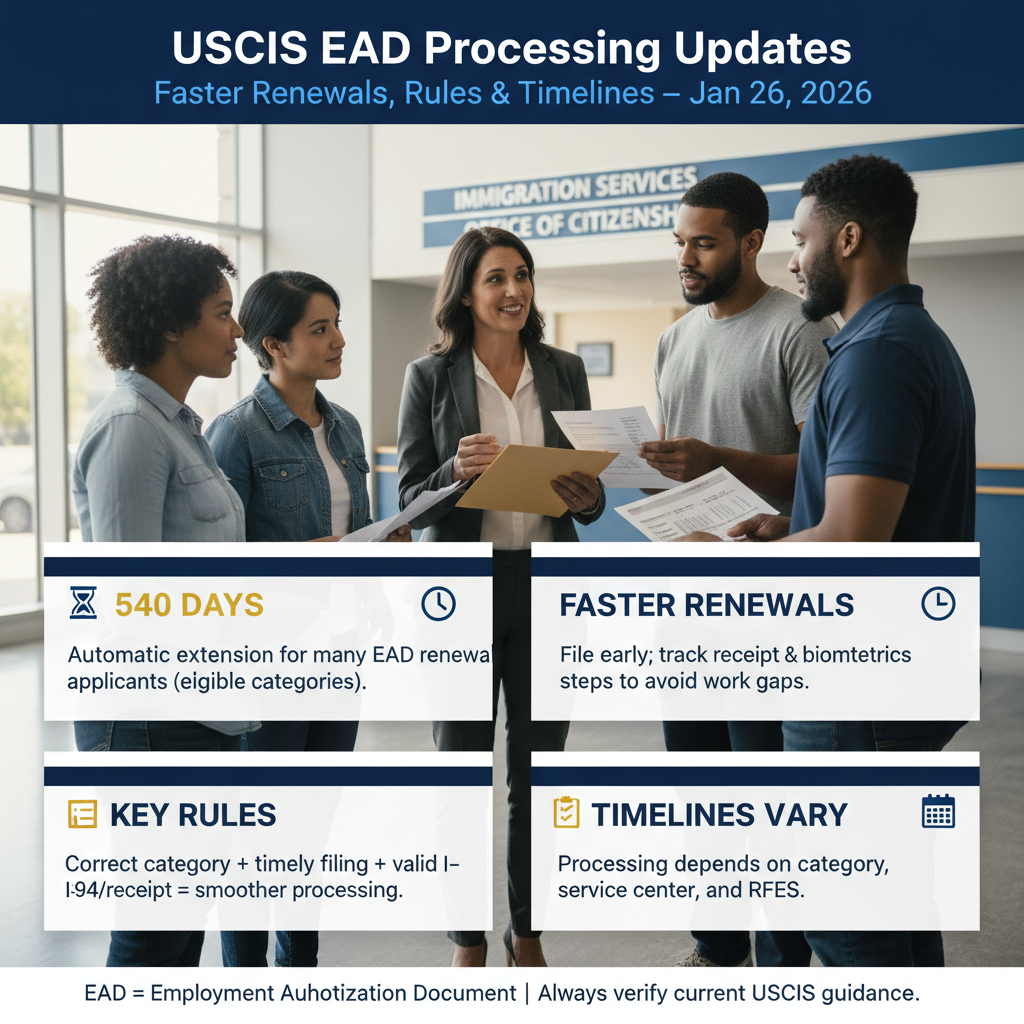
This article is based on recent USCIS-focused coverage and ongoing public updates around Employment Authorization Document (EAD) processing and renewal practices. The specific news feed that prompted this guide is: Employment Authorization Document Processing (USCIS).
Important: News cycles can move faster than official policy. Where possible, we anchor this guide in official USCIS regulations, form instructions, and USCIS operational pages so you can make decisions based on reliable sources.
Need Help? Our Orlando immigration team is ready to assist. Call +1 786-791-3106 for a free consultation, or message us online. Se Habla Español.
What This News Means for Immigrants in Orlando and Across Florida
Why this news is showing up now
Employment Authorization Document processing is trending because work permits are the “bridge” benefit for many immigration categories—especially people waiting on Adjustment of Status applications, asylum-related filings, TPS renewals, and certain parole-based programs. When processing slows, families feel it immediately: jobs are lost, driver’s licenses expire, and employers may pause onboarding.
Several forces tend to drive EAD news coverage at the same time:
- USCIS operational shifts (staffing, workload distribution, digitization, and lockbox intake changes).
- Regulatory and policy updates affecting who qualifies, how renewals work, and what evidence is required.
- High filing volumes from humanitarian programs and periodic re-registrations (for example, TPS cycles).
- Employer compliance pressure because Form I-9 rules require valid work authorization.
Reminder: Even when a “new update” is discussed in the news, your case outcome still depends on your category, your filing history, and whether you qualify for protections like the 180 days automatic extension (when available).
How it can affect Florida residents
Florida’s economy—especially along the I-4 corridor—relies heavily on industries that often hire immigrants and mixed-status families: hospitality, construction, healthcare support roles, logistics, and tourism. If your EAD is delayed, the consequences can be immediate:
- Employment interruptions due to I-9 re-verification deadlines.
- Income loss that affects rent, childcare, and medical coverage.
- Driver’s license complications (many Florida DMV transactions rely on lawful presence/work authorization documentation).
- Stress on family-based cases filed with Form I-130 and Form I-485, where the EAD is often filed concurrently.
If your case is in Orlando, timing matters because local employers often have strict onboarding requirements and seasonal hiring cycles. For Central Florida residents, planning around processing times and renewal windows can prevent gaps in authorization.
What Employment Authorization Document Processing Is (and Why It Matters)
A plain-English definition
An Employment Authorization Document (EAD) is a card issued by USCIS that proves you are allowed to work in the United States for a specific period of time. When people say “EAD processing,” they usually mean:
- How long USCIS takes to decide your EAD application (initial or renewal).
- How USCIS handles requests for evidence (RFEs), biometrics, and identity verification.
- How quickly USCIS produces and mails the physical card once approved.
In many family-based and humanitarian cases, the EAD is the practical tool that lets you legally work while your underlying immigration case is pending—often months or longer.
Key terms you need to know
- Form I-765: The application used to request an EAD (work permit).
- Category (c)(…): The eligibility code on the I-765 (for example, (c)(9) for many Adjustment of Status applicants).
- Receipt Notice (Form I-797): Proof USCIS received your filing; often essential for tracking and, in some categories, automatic extensions.
- Biometrics: Fingerprints/photo appointment; USCIS may reuse biometrics in some cases.
- RFE (Request for Evidence): USCIS asks for additional documents; delays are common if responses are late or incomplete.
- Expedite request: A request asking USCIS to speed up due to severe financial loss, emergencies, humanitarian reasons, etc.
- Priority Date: Relevant in many visa categories; while EADs are not always governed by a Priority Date, your underlying case timing often is.
- 90-day window: Many applicants informally plan around a “90 days” expectation, but actual EAD processing times vary widely by category and workload. Always verify current estimates at the official tool.
Warning: Working without authorization can create serious immigration consequences in many categories. Always confirm you are authorized before starting work, even if your underlying case is pending.
Current Immigration Law: The Foundation
EADs exist because federal immigration law allows certain noncitizens to work in the U.S. either incident to status (automatic work authorization in some statuses) or by applying for employment authorization. The most important point: an EAD is not a “visa” and not the same as lawful permanent residence. It is a time-limited benefit tied to a specific eligibility basis.
Federal requirements
Federal authority for employment authorization and EAD issuance comes from the Immigration and Nationality Act (INA) and DHS regulations. Key legal anchors include:
- INA § 274A (8 U.S.C. § 1324a): Governs unlawful employment and employer verification obligations (Form I-9 framework).
- 8 C.F.R. § 274a.12: Lists classes of noncitizens authorized to accept employment and categories eligible for EADs.
- 8 C.F.R. § 274a.13: Governs EAD application procedures and (in certain categories) automatic extensions tied to timely renewal filings.
The most common USCIS forms connected to EAD processing include:
- Form I-765 (Application for Employment Authorization)
- Form I-485 (Application to Register Permanent Residence or Adjust Status) for many family-based and employment-based applicants
- Form I-130 (Petition for Alien Relative) in family-based green card pathways
- Form I-131 (Application for Travel Document) often filed with I-485 for Advance Parole
For official instructions and updates, use the USCIS official website and the USCIS Forms library.
Important: If your EAD is based on a pending Adjustment of Status filing (often category (c)(9)), USCIS generally expects a properly filed Form I-485 and a valid basis for adjustment. A problem in the underlying case can impact the EAD.
Florida-specific considerations
Immigration is federal, but Florida residents face practical, state-level impacts:
- Driver’s license/ID timing: Florida credential validity may be tied to your immigration document expiration. Plan renewals early to avoid gaps.
- Employment verification: Florida employers may have strict internal compliance timelines for I-9 reverification when an EAD is expiring.
- Local logistics: If you live in Orange County or along the I-4 corridor, mailing reliability, address changes, and appointment travel can affect how smoothly your case moves.
The Orlando USCIS Field Office may handle interviews for underlying applications (like Form I-485), while EADs are often processed through USCIS service centers. Even so, what happens locally—missed mail, move-related address issues, or interview scheduling—can indirectly affect your EAD timeline.
Need Help? Our Orlando immigration team is ready to assist. Call +1 786-791-3106 for a free consultation, or message us online. Se Habla Español.
How to Apply for or Renew an EAD: A Complete Step-by-Step Guide
1) Confirm your eligibility category and timing
Start by identifying the exact eligibility basis for your EAD. USCIS requires you to select the correct category on Form I-765. Filing under the wrong category is a common reason for rejection, RFE, or denial.
Timing matters even more for renewals. Many applicants should file as early as allowed by their category and instructions to avoid a gap. Some categories may qualify for an automatic extension if the renewal is timely filed—often discussed as an additional 180 days of work authorization, but eligibility depends on the category and rule in effect for that category.
- Required documents to gather now:
- Current/expired EAD (front and back copy) if renewing
- Your USCIS receipt notices (Form I-797) for the underlying case (e.g., Form I-485 receipt)
- Passport biographic page copy and visa page (if any)
- I-94 record (if applicable)
- Any prior EAD approval notices
Reminder: Don’t assume your friend’s category rules apply to you. Two people can both “have a work permit,” but one may be eligible for an automatic extension and the other may not.
2) Choose your filing method: online vs. paper (and verify the address)
USCIS allows online filing for certain Form I-765 categories. Other categories still require paper filing. The correct filing method depends on your eligibility category and whether you are filing concurrently with other forms.
- Required documents/information for this step:
- USCIS online account access (if eligible to file online)
- Correct USCIS lockbox address for paper filings (varies by category and location)
- Fee amount confirmation (fees can change; always verify)
- Proof of any fee waiver eligibility (if applicable)
Use official resources to prevent misfiling: USCIS Forms and the USCIS official website.
Warning: A paper filing sent to the wrong address can be rejected or significantly delayed, which can be catastrophic if your EAD is close to expiring.
3) Prepare Form I-765 carefully (category, names, and prior history)
USCIS treats Form I-765 like a sworn statement. Inconsistencies—especially around names, A-Number, prior filings, and immigration history—often trigger delays.
- Required documents for accurate completion:
- All prior USCIS receipt numbers (I-797) for any immigration filings
- Any prior A-Number documentation
- Marriage certificate or court order for name changes (if relevant)
- Prior EAD cards and approval notices
Important: If you are filing based on a pending Form I-485 (common category (c)(9)), make sure the I-485 receipt number and personal identifiers match exactly. Typos can lead to biometrics confusion or “unable to match to file” delays.
4) Assemble evidence and photos to USCIS specifications
USCIS wants clear identity evidence and proof of eligibility. In many categories, the evidence is straightforward; in others, it can be complex (for example, where eligibility depends on a pending application, humanitarian designation, or court posture).
- Common required evidence (varies by category):
- Government-issued photo ID (passport page, national ID, or driver’s license where appropriate)
- I-94 record (if applicable)
- Two passport-style photos (for paper filings, when required)
- Copy of your latest I-797 receipt notice for the underlying case (e.g., Form I-485 receipt)
- Copy of prior EAD (front/back) for renewals
- Any USCIS notices showing status/classification (TPS approval, asylum receipt, etc.)
Reminder: Always follow the specific Form I-765 instructions for your category. Evidence lists differ across eligibility codes.
5) File, track your receipt, and plan for biometrics or reuse
After filing, USCIS will issue a receipt notice (Form I-797). That receipt notice is your lifeline for tracking and, in some renewal categories, may serve as proof of an automatic extension (again, only if your category qualifies and the filing was timely).
- Required documents to keep accessible:
- USCIS receipt notice (I-797) for the I-765
- Delivery confirmation (USPS/UPS/FedEx tracking) for paper filings
- USCIS online account login and case status screenshots (optional but helpful)
- Biometrics appointment notice (if issued)
You can monitor general timelines at USCIS Processing Times. Keep in mind: the tool shows estimates, not guarantees.
6) Respond quickly to RFEs, address issues, or USCIS requests
If USCIS issues an RFE, your deadline will be listed on the notice. Late responses usually result in denial. Incomplete responses often cause additional delays.
- Required items for an RFE response packet:
- A copy of the RFE notice (placed on top of the response)
- All requested documents, clearly labeled
- Translations with proper certification (if any document is not in English)
- Proof of delivery for the response
Warning: If you move, update your address promptly with USCIS. Missing an RFE or biometrics notice because of an address issue can derail your EAD and underlying case.
7) After approval: verify the card, correct errors, and coordinate with your employer
Once approved, USCIS produces the card and mails it to the address on file. When it arrives, check it immediately for errors (name, dates, category). If there is a mistake, you may need to request a correction—how you do that depends on the error type and USCIS instructions.
- Required actions/documents after approval:
- Photocopy the EAD (front/back) for your records
- Compare the card details to your approval notice and passport
- Provide your employer with updated work authorization for I-9 purposes
- Store the original card securely (you may need it for DMV or travel documentation)
Practical Steps You Can Take Today
EAD processing delays are easier to manage when you plan early and file cleanly. Below is a practical checklist we use with clients at Imigrar to reduce avoidable problems.
Actionable checklist
- 1) Track your expiration date now. Set reminders for 120, 90, and 60 days before expiration (even if you expect a 180 days automatic extension).
- 2) Download your full USCIS filing history. Keep a folder with every I-797 receipt/approval notice, including your Form I-130 and Form I-485 receipts if you’re in Adjustment of Status.
- 3) Verify your address is correct. If your case is in Orlando and you move within Orange County (or anywhere along the I-4 corridor), mail forwarding is not always reliable for government notices.
- 4) Check category-specific rules before you file. Do not guess your I-765 category. A wrong code can lead to rejection or denial.
- 5) Prepare employer communication. If you expect a gap, talk to HR early about reverification timing and what documents you will present.
- 6) Use official processing tools. Track estimates at USCIS Processing Times and keep screenshots for your records.
- 7) Consider expedite strategy if you qualify. Expedites are discretionary and evidence-driven. If you have severe financial loss or urgent medical needs, prepare documentation early.
Document preparation guidance
- Make clear, full-page scans (avoid cut-off edges).
- Use consistent names across documents; document any name changes.
- Translate non-English documents with proper certification.
- Keep proof of delivery for everything you mail to USCIS.
Timeline expectations (realistic planning)
EAD processing times can fluctuate significantly by category and service center. Some applicants receive approvals relatively quickly; others wait longer due to biometrics, background checks, RFEs, or underlying case issues.
Plan as if you may need several months, and verify current trends using the official tool: USCIS Processing Times.
Reminder: If your EAD is connected to a broader immigration strategy (for example, a family case with Form I-130 + Form I-485), the best way to avoid EAD problems is often to strengthen the underlying case and keep it moving.
Need Help? Our Orlando immigration team is ready to assist. Call +1 786-791-3106 for a free consultation, or message us online. Se Habla Español.
How Imigrar Helps Immigrants in Orlando
At Imigrar, we help individuals and families in Orlando and nationwide protect their ability to work lawfully while pursuing long-term immigration goals. Because EADs are often tied to bigger cases—like family petitions (Form I-130), green card applications (Form I-485), and humanitarian filings—our approach is not just “fill out the I-765,” but to align the work permit strategy with the overall case.
- We verify your correct I-765 eligibility category and evidence list.
- We prepare clean, consistent filings to reduce RFEs and preventable delays.
- We advise on renewal timing, including whether an automatic extension may apply.
- We help prepare expedite requests when the facts and documentation support it.
- We support Central Florida residents with practical logistics—mailing, address updates, and case tracking.
Se Habla Español. If you’re worried about an EAD delay, a renewal deadline, or a job offer that depends on timing, we can help you build a plan.
Call +1 786-791-3106 for a free consultation, or message us online at https://www.imigrar.com/contact.
Frequently Asked Questions
Q: Who is eligible to apply for an EAD (work permit)?
A: Eligibility depends on your immigration category under federal regulations (see 8 C.F.R. § 274a.12). Common eligible groups include certain Adjustment of Status applicants with a pending Form I-485, asylum applicants (after meeting eligibility criteria), TPS beneficiaries, certain parolees, and others. The key is selecting the correct category on Form I-765 and submitting the required proof for that category.
Q: Will applying for or renewing my EAD affect my immigration status?
A: An EAD application generally does not “create” immigration status by itself; it is a benefit based on an underlying status or pending application. However, what you disclose on Form I-765 matters. Inconsistencies with your Form I-485, prior entries, or past filings can create issues. If you are unsure about your history, get legal guidance before filing.
Q: How long does USCIS take to process EADs right now?
A: Processing times vary by eligibility category and workload. The best way to estimate is the official tool at USCIS Processing Times. Reminder: Online anecdotes can be misleading—two applicants in different categories can have very different timelines.
Q: What documents do I need for Form I-765?
A: It depends on your category, but common items include proof of identity (passport page), proof of your current immigration basis (such as an I-797 receipt for Form I-485), prior EAD copies for renewals, photos (for certain paper filings), and any category-specific evidence. Always cross-check the USCIS Forms instructions for Form I-765.
Q: How much does it cost to apply for or renew an EAD?
A: Fees vary by eligibility category and may change. Some categories have a fee, others do not, and some applicants may request a fee waiver if eligible. Because USCIS fee rules can be updated, confirm the current fee and payment method directly on the USCIS official website before filing. If your EAD is filed together with Form I-485, the fee treatment may differ based on current USCIS rules.
Q: What happens if my EAD application is denied?
A: A denial means USCIS concluded you were not eligible, the filing was not properly documented, or there was an underlying issue. The denial notice explains the reason. Next steps may include refiling (if appropriate), addressing the underlying eligibility problem, or exploring other options. Warning: A denial can sometimes signal a broader issue with your underlying case (such as a pending Form I-485), so it’s wise to speak with an immigration attorney before taking action.
Q: Can I travel while my EAD is pending?
A: The EAD itself is not a travel document. If you have a pending Adjustment of Status case (Form I-485), traveling without proper authorization (often Advance Parole) can create serious problems. For travel rules and visa information, review U.S. Department of State resources and consult counsel for case-specific advice.
Q: If I’m in immigration court, does that change EAD processing?
A: It can. People in removal proceedings may have different eligibility bases, and court posture can affect what documents are needed and how USCIS evaluates eligibility. If your matter involves the immigration courts, it helps to understand the role of the Executive Office for Immigration Review and coordinate your strategy carefully.
Common Mistakes (and How to Avoid Them)
Mistake #1: Filing the wrong I-765 category (or assuming you qualify for an automatic extension)
Many delays come from selecting the wrong eligibility code or misunderstanding whether a renewal qualifies for an automatic extension (often described as 180 days). Avoid this by confirming the correct category under 8 C.F.R. § 274a.12 and reviewing the Form I-765 instructions for your specific basis.
Mistake #2: Inconsistent information across forms and prior filings
USCIS cross-checks your identity and history. Differences in names, dates, prior addresses, or A-Numbers between Form I-765, Form I-485, and prior filings can trigger RFEs or delays. Keep a master “immigration history” document and use it consistently.
Mistake #3: Waiting too long to renew (or missing mail from USCIS)
People often wait until the last minute and then get hit with biometrics, RFEs, or mailing delays. If your case is in Orlando or anywhere in Central Florida, address changes and mail timing can be unpredictable. File as early as allowed and confirm USCIS has your correct address.
Putting EAD Processing News Into a Smart Florida Strategy
EAD processing updates can feel overwhelming, but the most effective approach is structured:
- Know your category and your underlying case posture (for example, a pending Form I-485 through a family petition on Form I-130).
- File early enough to absorb delays and still protect your job.
- Use official tools and references—not rumors—to plan your timeline.
- Escalate responsibly (service requests, expedite requests) when you truly qualify and can document it.
For Central Florida residents, planning is especially important because many employers along the I-4 corridor have strict start dates and re-verification policies. The Orlando USCIS Field Office may not directly “speed up” your EAD, but what happens locally—missed notices, interview scheduling for Adjustment of Status, or address issues—often affects your overall case stability.
Important: If your work permit is tied to a pending green card process, your long-term solution is usually to keep the underlying case strong and moving (complete medicals when required, attend interviews, respond to RFEs quickly, and avoid travel or employment missteps).
Need Help? Our Orlando immigration team is ready to assist. Call +1 786-791-3106 for a free consultation, or message us online. Se Habla Español.
Official Resources (Bookmark These)

Closing: Protect Your Job, Your Timeline, and Your Family
EAD processing news matters because it affects real life—work, stability, and the ability to “Keep Families Together.” If you are preparing an initial EAD or renewal, the best time to act is before you are up against a deadline.
Need tailored help for your situation? Call Imigrar at +1 786-791-3106 for a free consultation, or message us online. Se Habla Español.


