

The reporting that sparked this guide
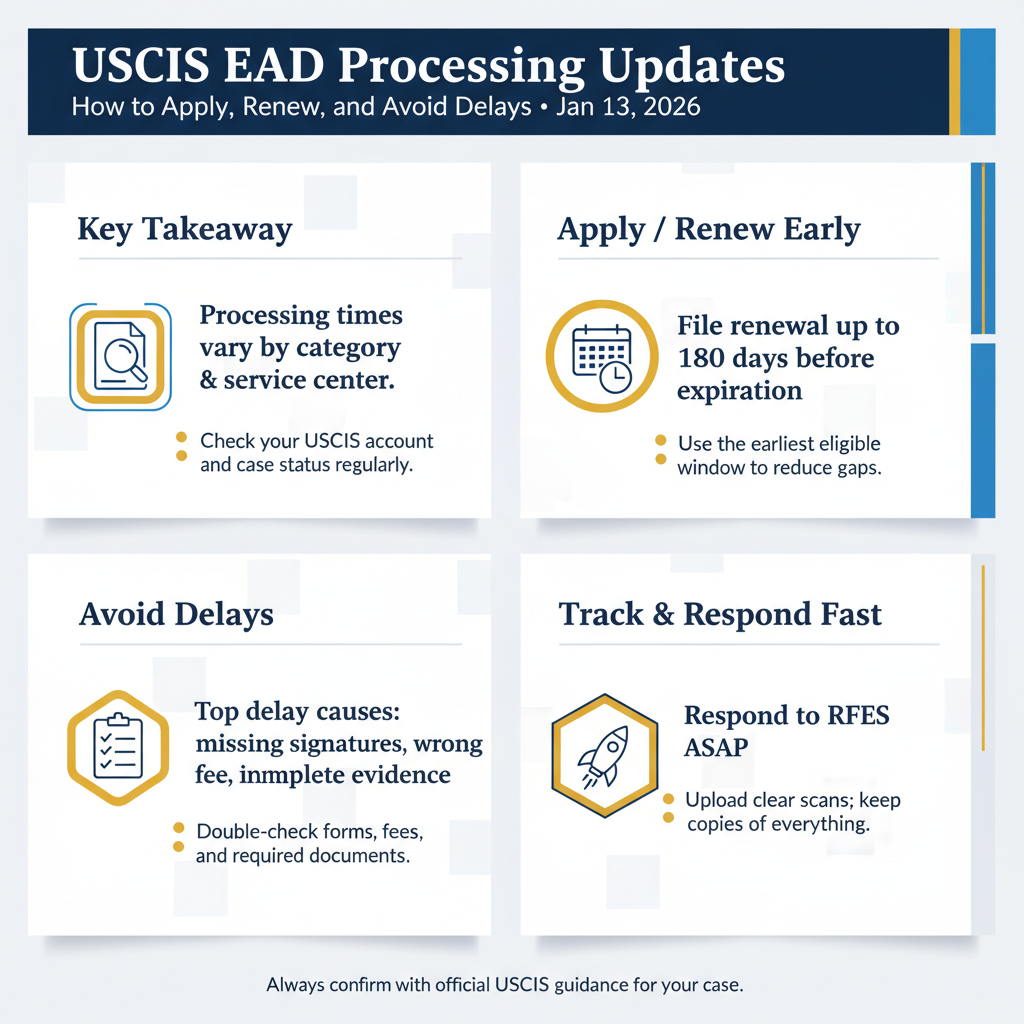
This article is based on recent USCIS-related reporting and public updates circulating in immigration news feeds, including: Employment Authorization Document Processing (USCIS).
Reminder: News headlines move fast, but your case strategy should be grounded in official guidance and your specific eligibility category. For official updates, always cross-check with the USCIS official website.
Need Help? Our Orlando immigration team is ready to assist. Call +1 786-791-3106 for a free consultation, or message us online. Se Habla Español.
What This News Means for Immigrants in Orlando and Across Florida
Why this news is showing up now
Employment Authorization Document (EAD) processing is trending because many immigrants are experiencing real-world pressure from:
- Backlogs and fluctuating adjudication speeds across USCIS service centers
- Higher volumes of filings (including renewals) in common EAD categories
- More people applying for work authorization through Adjustment of Status and humanitarian programs
- Employer compliance concerns (Form I-9) when an EAD is expiring
- Heightened attention to “gap periods” where a person is eligible but cannot work because the card has not arrived
USCIS has also continued to modernize processes (online accounts, electronic notices, and internal workflow changes). These efforts can improve outcomes over time, but in the short term they can create confusion about what is “new,” what is “policy,” and what is simply a change in processing patterns.
How it can affect Florida residents
For Florida residents—especially in Central Florida—EAD timing can directly affect:
- Your ability to start a new job, keep your current job, or accept additional hours
- Driver’s license renewals (often tied to lawful presence and document validity)
- Housing applications that require proof of income and employment
- Family stability—Imigrar’s mission is to Keep Families Together, and employment is often the foundation
Important: If your case is in Orlando, you may interact with multiple parts of the system: a USCIS service center (which often adjudicates EADs) and, depending on your underlying case, The Orlando USCIS Field Office (which may handle interviews for Form I-485 cases). Understanding who does what can reduce stress and help you plan.
For Central Florida residents along the I-4 corridor (Orlando, Kissimmee, Sanford, and nearby Orange County communities), a delayed EAD can mean missed job opportunities in high-growth sectors like hospitality, healthcare, logistics, and construction.
What Employment Authorization Document Processing Is (and Why It Matters)
A plain-English definition
An Employment Authorization Document (EAD), often called a “work permit,” is a card issued by USCIS that proves a noncitizen is authorized to work in the United States for a specific time period.
“EAD processing” refers to the end-to-end timeline and steps USCIS uses to:
- Accept your application (or renewal)
- Schedule and complete biometrics (if required)
- Review eligibility and supporting evidence
- Approve/deny the request
- Produce and mail the physical card
If you are waiting on an EAD, it can feel like your life is “on hold.” That is why understanding processing trends—and how to file correctly the first time—matters.
Key terms you need to know
- Form I-765: The USCIS application for an EAD (initial or renewal)
- Category code: A code on the I-765 (like (c)(9) for many Adjustment of Status applicants) that controls eligibility and evidence
- Receipt notice: USCIS proof your case was received (often Form I-797). This date can matter for extensions in certain categories
- Biometrics: Fingerprints/photo appointment; sometimes waived or reused
- RFE (Request for Evidence): USCIS asks for more documents; this can add weeks or months
- Expedite request: A request to speed up a case based on specific criteria (not guaranteed)
- Automatic extension: Some renewal categories may receive an automatic extension of work authorization if filed on time and otherwise eligible (rules vary by category)
- Priority Date: A key date in some immigrant visa processes; while not an EAD concept by itself, it often affects the underlying case timeline and strategy
Warning: Not everyone qualifies for an EAD, and not everyone qualifies for an automatic extension. Many problems happen when people assume “renewal receipt = work authorization.” The details matter.
Need Help? Our Orlando immigration team is ready to assist. Call +1 786-791-3106 for a free consultation, or message us online. Se Habla Español.
Current Immigration Law: The Foundation
EAD eligibility and processing are governed by federal immigration law, regulations, and USCIS policy guidance. While news coverage may highlight “updates,” the legal foundation remains relatively stable: you must fit within a category authorized by law/regulation and provide the required evidence.
Federal requirements
At the federal level, employment authorization for noncitizens is rooted in the Immigration and Nationality Act (INA) and implemented through regulations, including:
- INA framework (including employment eligibility and immigration benefits administration)
- 8 C.F.R. § 274a (employment authorization rules and categories)
- USCIS policy manual and form instructions (how USCIS applies the rules)
Most EAD applicants file Form I-765. Many also have an underlying case such as:
- Form I-485 (Application to Register Permanent Residence or Adjust Status) for Adjustment of Status
- Form I-130 (Petition for Alien Relative) in family-based pathways (often paired with Form I-485 if eligible)
Important: An EAD is not a visa, not a green card, and not automatically proof of lawful status by itself. It is proof of work authorization for a defined period, tied to an eligibility basis.
Official references you should bookmark:
- USCIS official website
- USCIS Processing Times
- USCIS Forms
- U.S. Department of State (for visa processing and consular guidance)
- Executive Office for Immigration Review (for immigration court information, if applicable)
Florida-specific considerations
Immigration law is federal, but Florida residents face practical, local issues that can make EAD timing more stressful:
- Driver’s license/ID timing: Florida DHSMV processes vary, and many applicants need an unexpired EAD to renew
- Employment verification: Employers across Orange County and the I-4 corridor may be cautious when documents are near expiration
- Field office logistics: If your underlying Form I-485 case requires an interview, The Orlando USCIS Field Office may be involved (even if the EAD itself is handled elsewhere)
Reminder: Florida does not create EAD eligibility rules, but local realities can affect your planning—especially if you need to avoid work gaps or keep a professional license active.
How to Apply for or Renew an EAD: A Complete Step-by-Step Guide
Below is a practical roadmap for most EAD applicants and renewals. Your exact steps may vary by eligibility category, whether you can file online, and whether USCIS reuses biometrics.
1) Confirm your eligibility category and timing
Before you file, identify the correct Form I-765 category (the code in the eligibility section). This is one of the most common causes of delays and denials.
- Adjustment of Status applicants often file under category (c)(9) while Form I-485 is pending
- Asylees, refugees, TPS holders, certain parolees, and others have different categories and evidence rules
Renewal planning is critical. Many categories allow filing up to a certain time before expiration. A commonly used planning benchmark is a 90-day window or more (depending on category and current processing realities), but some categories allow earlier filing. Always follow current USCIS instructions for your category.
Documents to gather (eligibility step):
- Current/previous EAD (front and back), if renewing
- Your I-94 record (if applicable)
- Receipt notices for underlying cases (e.g., Form I-485, asylum, TPS)
- Passport biographic page and any U.S. visas (if available)
- Any USCIS approval notices relevant to your category
2) Choose filing method and create your USCIS online account (if eligible)
Many applicants can file Form I-765 online through a USCIS account, while some categories still require paper filing. Filing method can affect how quickly you receive notices and how easily you can track the case.
Documents to prepare (filing method step):
- Email address you can access reliably
- A secure place to store login credentials
- Digital scans (PDF/JPG) of supporting evidence
- Payment method (credit/debit) if filing online
Important: If you move, update your address with USCIS promptly. Address problems are a major reason EAD cards get returned or lost.
3) Prepare the I-765 packet correctly (forms, fees, photos, evidence)
A strong EAD filing is not just “fill in the blanks.” It is a carefully organized packet that matches your category requirements and reduces the chance of an RFE.
Documents to include (packet step):
- Completed and signed Form I-765 (correct edition date)
- Filing fee or fee waiver request (if eligible) per USCIS instructions
- Two passport-style photos (if required for your filing method/category)
- Copy of government-issued ID (passport, prior EAD, etc.)
- Evidence of eligibility category (e.g., pending Form I-485 receipt for (c)(9))
- Any prior USCIS notices relevant to your case
Warning: Submitting unclear scans, missing pages, or inconsistent names/dates can trigger delays. If your name changed (marriage/divorce), include proof and keep it consistent across filings.
4) File the application and track receipts, biometrics, and notices
After filing, USCIS will issue a receipt notice. Some applicants will receive a biometrics appointment notice; others may have biometrics reused.
Documents to keep and track (tracking step):
- I-765 receipt notice (Form I-797)
- Biometrics appointment notice (if scheduled)
- USCIS account case status screenshots (optional but helpful)
- Delivery confirmation (if you mailed a paper packet)
You can monitor general timelines at: USCIS Processing Times.
Reminder: Processing times are estimates and can change quickly. They are not a guarantee.
5) Respond quickly to RFEs or requests for updated evidence
If USCIS issues an RFE, treat it like a deadline-driven project. Many RFEs are fixable, but slow or incomplete responses can lead to denial.
Documents to prepare (RFE step):
- A complete copy of the RFE notice
- The requested evidence (exactly as listed)
- A cover letter explaining what you are submitting and why it meets the request
- Organized exhibits with labels and pagination
Important: Do not submit original identity documents unless USCIS specifically requests originals. Send clear copies unless instructed otherwise.
6) Plan for approval, card production, and delivery (and employer verification)
Approval is not the final step. Many people lose time after approval due to card production and mailing issues.
Documents to prepare (delivery/employer step):
- USCIS approval notice (if issued separately)
- Tracking information (if available)
- Your unexpired identity documents for Form I-9 verification
- A copy of your new EAD (front/back) once received
Reminder: Employers must follow Form I-9 rules. If your EAD is expiring, talk to HR early. If your category provides an automatic extension, confirm what documents your employer needs to document it correctly.
7) If delayed, consider service requests, expedite options, and legal strategy
If your EAD is outside normal processing, you may have options such as:
- Submitting a USCIS service request (when eligible)
- Requesting an expedite based on USCIS expedite criteria (e.g., severe financial loss, humanitarian reasons)
- Seeking help from an attorney to identify category-specific solutions
Documents to prepare (delay/expedite step):
- Evidence of urgent need (job offer letter, termination notice, past-due bills)
- Medical or humanitarian documentation (if applicable)
- Proof your filing is complete and pending (receipt notices)
- Timeline summary of events (filing date, biometrics date, RFE date, etc.)
Need Help? Our Orlando immigration team is ready to assist. Call +1 786-791-3106 for a free consultation, or message us online. Se Habla Español.
Practical Steps You Can Take Today
Whether you are filing an initial EAD or a renewal, the goal is the same: reduce delays, avoid gaps, and keep your underlying immigration case on track.
- Checklist item #1: Build a “renewal calendar.” Mark your EAD expiration date and set reminders at 180, 120, and 90 days before expiration. While not all categories use the same filing window, planning early helps you avoid panic. Reminder: Many people aim to file well before a 90-day window because processing can fluctuate.
- Checklist item #2: Make a clean document set. Scan your EAD (front/back), passport photo page, I-94 (if any), and all USCIS receipt/approval notices into one secure folder.
- Checklist item #3: Verify your name, DOB, and A-Number consistency. Small typos can cause big delays—especially if your underlying case includes Form I-130 and Form I-485 filings.
- Checklist item #4: Track mail carefully and update your address. If you move within Orange County or anywhere along the I-4 corridor, update USCIS immediately to prevent returned cards.
- Checklist item #5: Prepare your employer conversation. If your EAD expires soon, talk to HR now. Ask what they need for I-9 reverification and whether they understand automatic extension rules for your category (if applicable).
- Checklist item #6: Watch for biometrics notices. Missing biometrics can stall a case. If you receive a notice and cannot attend, reschedule properly and keep proof.
Timeline expectations (general): EAD processing can range from a few weeks to many months depending on category, service center workload, and whether an RFE is issued. Check current estimates at USCIS Processing Times.
Important: Some applicants assume their underlying case (like Adjustment of Status) will be decided quickly, making the EAD “less important.” In reality, EADs often serve as the bridge that allows you to work legally while the larger case moves forward.
How Imigrar Helps Immigrants in Orlando
At Imigrar, we help clients in Orlando, across Central Florida, and nationwide navigate EAD applications and renewals with a focus on preventing delays and protecting long-term immigration goals. Our approach is practical: we identify the correct eligibility category, build a clean evidence record, and plan around real-world timelines.
- Category-specific review of Form I-765 eligibility and strategy
- Document organization to reduce RFEs and avoid preventable denials
- Coordination with underlying filings such as Form I-130 and Form I-485
- Guidance for families pursuing Adjustment of Status while maintaining employment authorization
- Support for urgent situations where an expedite request may be appropriate
We offer a free consultation to help you understand options and timelines. Se Habla Español.
Frequently Asked Questions
Q: Who is eligible to apply for an EAD?
A: Eligibility depends on your immigration category under federal regulations (8 C.F.R. § 274a). Many people qualify through pending Adjustment of Status (Form I-485), asylum-related categories, TPS, certain parole categories, and other specific programs. The key is choosing the correct Form I-765 category code and providing evidence that matches that category. If you are unsure, get legal advice before filing—an incorrect category can lead to delays or denial.
Q: Will applying for an EAD affect my immigration status or my pending green card case?
A: In many situations, applying for an EAD is a standard, expected step and does not harm your underlying case. For example, many family-based applicants file Form I-130, Form I-485, and Form I-765 together. However, inaccurate information, missing disclosures, or inconsistencies between filings can create issues. Reminder: Always keep your biographic information consistent across all forms.
Q: How long does EAD processing take right now?
A: Processing times vary widely by eligibility category and which USCIS office/service center handles the case. The best public tool is the official tracker: USCIS Processing Times. Important: Even after approval, card production and mailing can add additional time. If your case is outside posted processing times, you may be able to submit a service request or explore expedite options.
Q: What documents do I need for an EAD application or renewal?
A: Most applicants need: a completed Form I-765, proof of identity (passport and/or prior EAD), proof of eligibility category (such as a Form I-485 receipt for (c)(9)), photos if required, and any prior USCIS notices. Renewals typically require a copy of the expiring EAD (front/back). If you have a name change, include legal proof. Warning: Missing category evidence is a common reason for RFEs.
Q: How much does it cost to file Form I-765?
A: Filing fees depend on your eligibility category and whether the I-765 is filed with another application (for example, some Adjustment of Status packages may have different fee structures depending on current USCIS fee rules). Always confirm the current fee and edition requirements on the USCIS Forms page and the I-765 instructions. Some applicants may qualify for a fee waiver, but it is category-specific.
Q: What happens if my EAD is denied?
A: A denial can happen for several reasons: wrong category, missing evidence, ineligibility, or issues tied to the underlying case. First, read the denial notice carefully—it explains the basis. Next, speak with an immigration attorney to evaluate whether you can refile, file a motion, or fix the underlying issue. Important: A denied EAD may also signal a problem USCIS sees in the underlying benefit request, so it should be addressed promptly.
Q: Can I travel while my EAD is pending?
A: The EAD itself is about work authorization, not travel. Travel rules depend on your underlying status or pending application. For example, many Adjustment of Status applicants need advance parole (often filed on Form I-131) to travel without abandoning the I-485. For travel guidance and visa information, see the U.S. Department of State. Because travel can have serious consequences, get legal advice before leaving the U.S.
Common Mistakes (and How to Avoid Them)
Mistake #1: Filing under the wrong I-765 category code
This is one of the most frequent and costly errors. USCIS adjudicates based on the category selected and the evidence required for that category. How to avoid it: Confirm your category using the I-765 instructions and your underlying case type (for example, pending Form I-485 for many Adjustment of Status applicants).
Mistake #2: Waiting too long to renew and assuming a receipt notice is enough
Some applicants wait until the last minute, then discover processing is slower than expected. Others assume any pending renewal automatically allows them to work. How to avoid it: Plan early (many people set reminders at 180 days, 120 days, and 90 days). Confirm whether your specific category qualifies for an automatic extension and what documents your employer needs.
Mistake #3: Ignoring address updates and missing notices
USCIS notices can include biometrics appointments, RFEs, or card delivery issues. Missing mail can derail an otherwise approvable case. How to avoid it: Keep your address current, monitor your USCIS online account, and save every notice. If your case is in Orlando and you move within Orange County, update USCIS immediately.
Need Help? Our Orlando immigration team is ready to assist. Call +1 786-791-3106 for a free consultation, or message us online. Se Habla Español.
Putting It All Together for Orlando and Central Florida Families
EAD processing is more than a “USCIS timeline”—it’s the difference between keeping a job and losing one, between stability and uncertainty. If your case is in Orlando, remember that your EAD may be processed at a USCIS service center even while your family-based green card case may later be handled by The Orlando USCIS Field Office.
For Central Florida residents across Orange County and the I-4 corridor, proactive planning is the best protection:
- File correctly the first time
- Track receipts and biometrics
- Respond fast to RFEs
- Plan early to avoid work gaps
If immigration court is part of your situation, keep informed through the Executive Office for Immigration Review and coordinate your strategy carefully—court timelines and USCIS benefit timelines can interact in complex ways.
Closing: Protect Your Work Authorization and Your Future
EAD delays are stressful—but many delays are preventable with правиль category selection, complete documentation, and early renewal planning. If you are filing alongside a family case like Form I-130 or a green card application like Form I-485, it’s especially important that your entire immigration record is consistent and well-supported.
Important: Every case is different. If you are worried about timing, eligibility, or a potential work gap, speaking with an immigration attorney early can save months of uncertainty.
Need Help? Our Orlando immigration team is ready to assist. Call +1 786-791-3106 for a free consultation, or message us online. Se Habla Español.

CLOSING CTA SECTION
Ready to protect your ability to work legally in the U.S.? Imigrar is here to help you file, renew, and troubleshoot EAD cases—whether you live in Orlando, elsewhere in Florida, or anywhere in the country.
Call +1 786-791-3106 for a free consultation or message us online at https://www.imigrar.com/contact. Se Habla Español.


