


The reporting that sparked this guide
This article is based on trending USCIS-related coverage and public updates circulating in immigration news feeds. The specific item referenced here is:
Employment Authorization Document Processing (USCIS)
Important: USCIS processing policies and timelines can change quickly. Always verify your category-specific rules and current estimates on the USCIS official website and the USCIS Processing Times page.
Need Help? Our Orlando immigration team is ready to assist. Call +1 786-791-3106 for a free consultation, or message us online. Se Habla Español.
What This News Means for Immigrants in Orlando and Across Florida
Why this news is showing up now
Employment Authorization Documents (EADs), commonly called “work permits,” are one of the most time-sensitive immigration benefits because they directly affect your ability to work lawfully, keep a job, obtain a driver’s license, and sometimes even maintain housing or insurance. USCIS EAD processing becomes “trending” whenever:
- USCIS reports changing backlogs and shifting processing times by category;
- Applicants see delays (or faster approvals) depending on the service center handling Form I-765;
- There are updates on automatic extensions for certain renewal categories;
- New filing procedures, fee rules, or online filing options roll out;
- Large groups (asylum applicants, family-based Adjustment of Status applicants, TPS holders, students) experience spikes in demand.
Reminder: EAD processing is not “one-size-fits-all.” Your eligibility category (the code on your EAD, such as (c)(9), (c)(8), (a)(12), etc.) can dramatically change timelines, evidence requirements, and whether you qualify for an automatic extension.
How it can affect Florida residents
For Central Florida residents—especially along the I-4 corridor (Orlando, Kissimmee, Sanford, Daytona, Tampa)—EAD delays can create real-life problems fast:
- Job interruptions: Employers may place you on unpaid leave or terminate employment when your EAD expires if you cannot document continued work authorization.
- Driver’s license issues: Florida DHSMV often ties license validity to immigration document expiration dates.
- Family financial stress: A gap in work authorization can affect rent, childcare, and healthcare continuity.
- Immigration strategy changes: If you were planning to file Form I-485 (family-based or employment-based Adjustment of Status) or travel with advance parole, EAD timing can affect your overall case plan.
If your case is in Orlando, your EAD may still be adjudicated by a USCIS service center (not the local field office). However, the The Orlando USCIS Field Office may become relevant for your related interview or Form I-485 processing, which can indirectly affect your EAD strategy.
What Employment Authorization Document Processing Is (and Why It Matters)
A plain-English definition
An Employment Authorization Document (EAD) is a card issued by USCIS that proves you are authorized to work in the United States for a specific period of time. Most applicants request an EAD by filing Form I-765, Application for Employment Authorization.
“EAD processing” refers to everything USCIS does after you file: accepting your application, issuing a receipt notice, scheduling biometrics (if required), reviewing evidence, requesting additional documents (if needed), and either approving and producing the card or denying the application.
Why it matters: For many immigrants, the EAD is the bridge between “I have a pending case” and “I can legally work while it’s pending.” It can also be essential for:
- Completing Form I-9 employment verification;
- Obtaining or renewing a Social Security number (in some situations);
- Maintaining professional licenses or employment eligibility;
- Reducing vulnerability to workplace exploitation by ensuring lawful work authorization.
Key terms you need to know
- EAD: The physical work permit card (often called an “EAD card”).
- Form I-765: The USCIS form used to apply for an initial EAD or renew an EAD.
- Category code: The eligibility category printed on the EAD (for example, (c)(9) for many Adjustment of Status applicants).
- Receipt notice: USCIS Form I-797C confirming USCIS received your filing and assigned a receipt number.
- Biometrics: Fingerprints and photo appointment (not always required for every I-765 filing).
- RFE (Request for Evidence): USCIS request for missing or additional documents.
- Automatic extension: Some EAD renewal categories may receive an automatic extension of work authorization if filed on time and if the category qualifies. The length depends on current USCIS rules and your category.
- Priority Date: A key date in many green card processes (especially employment-based and some family-based categories). While not directly an EAD concept, it can affect your overall immigration timeline and when you can file Form I-485.
- 90-day window and 180 days:
Warning: Many people use “90-day window” informally to describe how early they should start preparing a renewal. But some categories allow filing much earlier than 90 days. Also, “180 days” is commonly associated with certain automatic extension rules and employment authorization continuity concepts. Always confirm your exact category’s rule on USCIS guidance.
Current Immigration Law: The Foundation
EAD eligibility and processing are governed by federal immigration law and regulations, primarily:
- The Immigration and Nationality Act (INA), including provisions authorizing employment for certain noncitizens;
- 8 C.F.R. § 274a (employment authorization rules and categories);
- USCIS policy guidance and Federal Register notices that create or modify automatic extension periods and category-specific rules.
Because EADs are federal benefits, the governing rules are national. However, how delays affect you in Florida can be different due to state-level licensing and employer practices.
Federal requirements
At the federal level, most applicants apply using Form I-765. Your eligibility is tied to your underlying immigration category (for example, pending Form I-485, pending asylum, TPS, certain parole programs, certain student employment types, etc.).
Common USCIS forms that often connect to EAD eligibility include:
- Form I-765 (work permit application/renewal)
- Form I-485 (application for Adjustment of Status)
- Form I-130 (family petition—often a step before Form I-485)
- Form I-589 (asylum application—often linked to (c)(8) EAD eligibility)
- Form I-821 (TPS—often linked to (a)(12) or (c)(19) EAD categories)
Important: Filing an EAD does not “create” lawful status by itself. It only authorizes work if you already qualify under a specific category.
For the most accurate, current instructions, always use the USCIS official website and confirm the correct edition of the form on USCIS Forms.
Florida-specific considerations
Florida does not set immigration eligibility rules for EADs, but Florida residents often face practical issues tied to EAD timing:
- Driver’s licenses and state ID: Florida DHSMV may issue IDs that expire when your immigration document expires. If your EAD renewal is delayed, you may have difficulty renewing your license on time.
- Employment verification: Employers across Orange County and the broader I-4 corridor frequently use E-Verify and strict I-9 compliance practices. Even if you qualify for an automatic extension, HR departments sometimes misunderstand what documents are acceptable.
- Local field office vs. service centers: The Orlando USCIS Field Office typically handles interviews and certain in-person services, while EAD adjudication is often done at a USCIS service center. Your mailing address and category determine where your filing goes.
Need Help? Our Orlando immigration team is ready to assist. Call +1 786-791-3106 for a free consultation, or message us online. Se Habla Español.
How to Apply for or Renew an EAD: A Complete Step-by-Step Guide
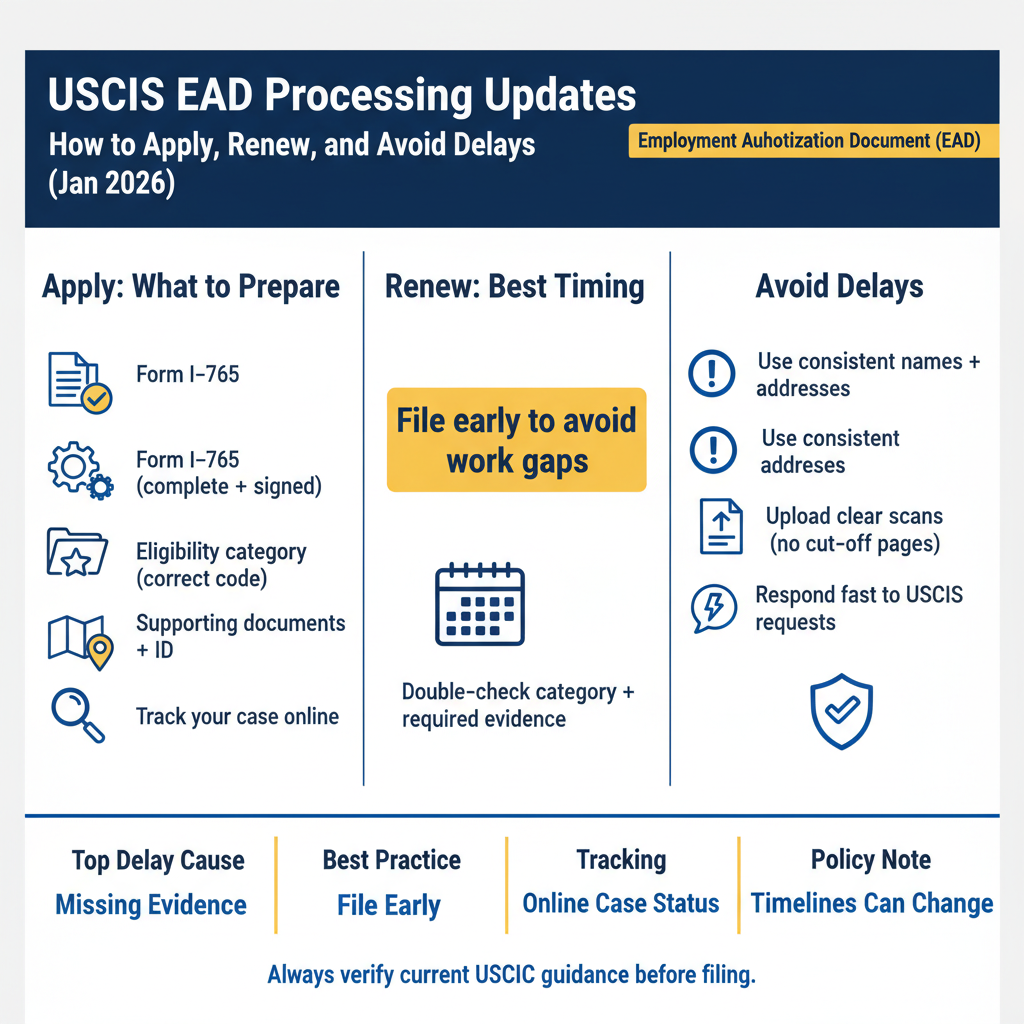
This step-by-step guide is designed for the most common EAD scenarios: initial EADs and renewals through Form I-765. Always confirm your eligibility category and category-specific evidence before filing.
1) Identify your eligibility category and goal (initial vs. renewal)
Start by determining whether you are applying for an initial EAD or renewing an existing one, and which eligibility category you qualify under. Your category affects fees, evidence, and whether an automatic extension may apply.
Documents to gather (category identification):
- Copy of your current EAD (front/back), if renewing
- Your I-797 receipt notices for pending cases (for example, Form I-485 receipt)
- Passport biographic page and most recent U.S. visa (if any)
- I-94 record (if applicable)
- Any prior USCIS approval notices relevant to your status
Important: If you are filing based on a pending family-based green card case, you may be in category (c)(9) tied to Adjustment of Status (pending Form I-485). If you are not sure, an attorney can confirm the correct category to avoid rejections or denials.
2) Confirm timing rules and whether an automatic extension may apply
Before filing, check (a) when you are allowed to file, and (b) whether timely filing triggers an automatic extension for your category. Many delays become emergencies only because the renewal was filed too late.
Documents to gather (timing and extension support):
- Current EAD expiration date
- USCIS receipt notice for the renewal filing (once filed)
- Proof of category match (current EAD category code and renewal category code)
- Employer I-9 documentation needs (if your employer requests proof)
Use the USCIS Processing Times tool to set realistic expectations. If your case is in Orlando or anywhere in Florida, the processing time is still typically driven by the service center and category.
Reminder: Don’t rely on a generic “90-day window” rule you saw online. Some categories can and should file earlier to reduce risk of gaps.
3) Prepare Form I-765 and supporting evidence carefully
USCIS rejects many EAD filings for avoidable reasons: incorrect fee, missing signature, wrong edition date, or insufficient evidence for the category. Take time to prepare a clean, consistent packet (or online submission where available).
Documents to gather (typical I-765 evidence):
- Completed and signed Form I-765 (correct edition)
- Two passport-style photos (if required by your filing method/category)
- Copy of government-issued photo ID (passport, prior EAD, etc.)
- Copy of I-94 (if applicable)
- Copy of prior EAD(s) (front/back), if renewing
- Category-specific evidence (for example, Form I-485 receipt notice for (c)(9))
- If applicable, any prior name-change documents (marriage certificate, court order)
Warning: If your name, date of birth, or A-number is inconsistent across filings, USCIS may issue an RFE or the card may be produced incorrectly—causing delays when you need the EAD most.
4) File the application (online or by mail) and keep proof
Depending on your category, USCIS may allow online filing or require paper filing. Follow the exact USCIS instructions for your category and filing address.
Documents to gather (proof of filing):
- Copy of the entire filing packet (PDF scan recommended)
- Delivery confirmation (USPS/UPS/FedEx tracking)
- Payment confirmation (if filing with a fee)
- USCIS receipt notice (I-797C) once issued
Always confirm filing instructions on the USCIS Forms page and the form’s official instructions on the USCIS official website.
Important: If you are concurrently filing a family-based case (for example, Form I-130 with Form I-485), your EAD strategy should be coordinated so you don’t miss related benefits like advance parole.
5) Attend biometrics (if scheduled) and respond quickly to any RFE
Some applicants will receive a biometrics appointment notice. Others may receive a biometrics “reuse” notice. If you receive an RFE, answer it by the deadline with organized evidence.
Documents to gather (biometrics/RFE stage):
- Biometrics appointment notice (I-797C), if issued
- Government-issued photo ID for the appointment
- RFE notice (if any) and a copy of your response packet
- Updated supporting documents requested by USCIS
Reminder: Missing a biometrics appointment can delay your EAD significantly. If you must reschedule, do it immediately and keep proof.
6) Track the case, plan for work continuity, and escalate when appropriate
After filing, track your case status with your receipt number and set calendar reminders for critical dates (expiration, HR deadlines, and expected processing ranges).
Documents to gather (tracking and continuity):
- USCIS online account access (if applicable)
- Receipt number and copies of notices
- Employer letters or HR notices (if you’re at risk of losing your job)
- Evidence of financial hardship (if considering expedite)
If your EAD is far beyond normal processing times, you may be able to submit an inquiry through USCIS tools or request assistance. In some situations, an expedite request may be possible, but it must be supported with documentation and meet USCIS expedite criteria.
Practical Steps You Can Take Today
Whether you are applying for your first EAD or renewing, these steps can reduce delays and protect your ability to work.
Actionable checklist (do these now)
- Check your EAD category code and confirm you are using the correct eligibility category for Form I-765.
- Start early: Build your renewal plan well before expiration—don’t wait for a “90-day window” if your category allows earlier filing.
- Create a “USCIS folder” (digital + paper) with every receipt notice, approval notice, and a full copy of anything you file.
- Use consistent biographic information (name format, address history, A-number) across Form I-130, Form I-485, and Form I-765.
- Monitor processing times using USCIS Processing Times and compare them to your receipt date.
- Prepare for HR conversations: If you may qualify for an automatic extension, gather the receipt notice and any USCIS guidance your employer may need.
- Plan for Florida DMV timing: If you need to renew a driver’s license in Orange County or nearby counties, schedule early and bring updated immigration receipts.
Document preparation guidance
USCIS delays often start with avoidable errors. Before filing:
- Confirm you are using the correct form edition from USCIS Forms.
- Review the filing address and category instructions carefully.
- Use clear scans/copies (front/back of cards), and label exhibits.
- Include certified translations for any document not in English.
Warning: A rejected filing (for example, wrong fee or missing signature) can cost weeks—sometimes long enough to cause a work authorization gap.
Timeline expectations (realistic planning)
Processing times vary widely by category and service center. As a practical planning method:
- Assume USCIS may take several months for many EAD categories.
- Track your receipt date and compare it to the current “normal” range on the USCIS processing time tool.
- If your case is outside posted times, consider a case inquiry and speak with counsel about escalation options.
Reminder: If you are also pursuing a green card through Adjustment of Status (pending Form I-485), your EAD is often just one moving piece. Your overall timeline can also depend on your Priority Date (especially in employment-based contexts) and interview scheduling at the local field office.
Need Help? Our Orlando immigration team is ready to assist. Call +1 786-791-3106 for a free consultation, or message us online. Se Habla Español.
How Imigrar Helps Immigrants in Orlando
At Imigrar, our mission is to Keep Families Together. EAD delays can threaten job stability and family security, especially for clients with pending family-based cases (like Form I-130 + Form I-485) or humanitarian filings.
We help by:
- Confirming your correct EAD eligibility category and strategy (initial vs. renewal);
- Preparing a complete Form I-765 filing with strong supporting evidence;
- Coordinating EAD filings with Adjustment of Status plans, travel needs, and interview readiness;
- Responding to RFEs and fixing avoidable errors (wrong category, missing evidence, inconsistent identity data);
- Advising on work continuity documentation for employers and practical steps for Florida DMV needs.
Se Habla Español. We serve clients in Orlando, Orange County, and across the I-4 corridor—and we also assist clients nationwide.
Important: A “simple” EAD case can become complicated if you have prior immigration history, arrests/charges, removal proceedings, or status violations. If you have an immigration court case, guidance from the Executive Office for Immigration Review may also be relevant to your broader situation.
Call us for a free consultation to discuss your timeline and options.
Frequently Asked Questions
Q: Am I eligible to apply for an EAD if I filed a family petition (Form I-130)?
A: Filing Form I-130 alone does not automatically make you eligible for an EAD. Many people become eligible when they file Form I-485 for Adjustment of Status (if eligible to adjust in the U.S.). In that common scenario, the EAD is typically requested through Form I-765 under the (c)(9) category. If you are not sure whether you can file Form I-485, speak with an attorney before filing anything to avoid triggering complications.
Q: Will applying for or renewing an EAD affect my immigration status?
A: An EAD is generally a benefit tied to an existing immigration category (pending case, approved humanitarian status, etc.). It does not usually “change” your status by itself. However, mistakes—like selecting the wrong category, submitting inconsistent information, or failing to disclose required details—can create issues that affect your underlying case. Warning: If you are in removal proceedings or have prior violations, get legal advice before filing.
Q: How long does EAD processing take right now?
A: It depends on your eligibility category and which USCIS office is processing your Form I-765. The best public tool is USCIS Processing Times. If your case is in Orlando, your related interview may be at the local field office, but EAD adjudication often happens at a service center. If your case is outside normal times, you may be able to submit a case inquiry or consult counsel about escalation options.
Q: What documents do I need for an EAD renewal?
A: Most renewals require: (1) a properly completed Form I-765, (2) a copy of your current/expired EAD (front and back), (3) proof you still qualify under the same category (such as a pending Form I-485 receipt notice), and (4) identity documents. If USCIS requires photos or biometrics, follow the instructions exactly. Reminder: Category-specific evidence matters—what works for TPS may not work for a pending asylum case.
Q: How much does it cost to file Form I-765?
A: Fees depend on your category and whether USCIS charges a fee for your specific filing. Some applicants pay a fee; others may have a $0 fee due to the underlying application type or policy. Always verify the current fee and payment rules directly on the USCIS Forms page for Form I-765. Important: If you send the wrong fee, USCIS may reject the filing, causing delays.
Q: What happens if my EAD application is denied?
A: A denial can happen for ineligibility, missing evidence, incorrect category selection, or unresolved identity/security issues. The denial notice should explain the reason. Next steps may include refiling correctly, addressing the underlying eligibility problem, or exploring other immigration options. Warning: If your EAD was tied to a pending Form I-485 or other case, a denial may signal issues that could affect the main application too—so it’s wise to speak with an attorney immediately.
Q: Can I travel internationally while my EAD is pending?
A: An EAD is not a travel document. If you have a pending Adjustment of Status case (Form I-485), international travel without advance parole may be risky and can be treated as abandoning the I-485 in many situations. Always confirm travel rules for your category and check guidance from the U.S. Department of State for visa-related information. Talk to counsel before traveling.
Common Mistakes (and How to Avoid Them)
Mistake #1: Filing under the wrong eligibility category
Choosing the wrong category code on Form I-765 can lead to rejection, RFE, or denial. This is especially common when someone has multiple pending filings (for example, a pending Form I-130 and a pending Form I-485) and assumes the petition alone provides work authorization.
How to avoid it: Match your I-765 category to your underlying eligibility and include the correct proof (receipt notices, approvals, or status documentation).
Mistake #2: Waiting too long and assuming processing will be “fast this time”
Even when USCIS improves processing in some months, backlogs can return quickly. Waiting until the last minute can cause a work authorization gap.
How to avoid it: Build a renewal timeline early. Don’t rely on a generic 90-day window; confirm what your category allows and plan conservatively.
Mistake #3: Submitting an incomplete packet (or ignoring an RFE)
Missing signatures, incorrect fees, poor copies, or missing category evidence can cause rejection or RFEs. An RFE response that is late or disorganized can lead to denial.
How to avoid it: Use a checklist, keep copies, label exhibits, and respond well before the deadline. If you receive an RFE and your case is in Orlando or elsewhere in Florida, don’t assume you can “walk it in” to the field office—RFEs usually require mail/online submission exactly as instructed.
Additional Official Resources (Bookmark These)
- USCIS official website (policy updates, instructions, accounts)
- USCIS Processing Times (category-based estimates)
- USCIS Forms (official editions, fees, filing addresses)
- U.S. Department of State (visa and travel information)
- Executive Office for Immigration Review (immigration court information)
Reminder: If you are dealing with a pending court case or removal proceedings, EAD strategy can be different. Get legal advice before filing.
Need Help? Our Orlando immigration team is ready to assist. Call +1 786-791-3106 for a free consultation, or message us online. Se Habla Español.
Closing: Protect Your Job, Your Timeline, and Your Family
USCIS EAD processing updates matter because work authorization is often the difference between stability and crisis. If you live in Orange County, along the I-4 corridor, or anywhere in Florida, a delayed EAD can impact your employer, your driver’s license renewal, and your family’s finances—even when your underlying immigration case is moving forward.
Important: The safest approach is proactive: verify your category, file correctly, keep proof, and plan early for renewals and work continuity documentation.
Need personalized guidance? Imigrar is here to help you build a clear plan and submit a strong application.
Need Help? Our Orlando immigration team is ready to assist. Call +1 786-791-3106 for a free consultation, or message us online. Se Habla Español.


