

The reporting that sparked this guide
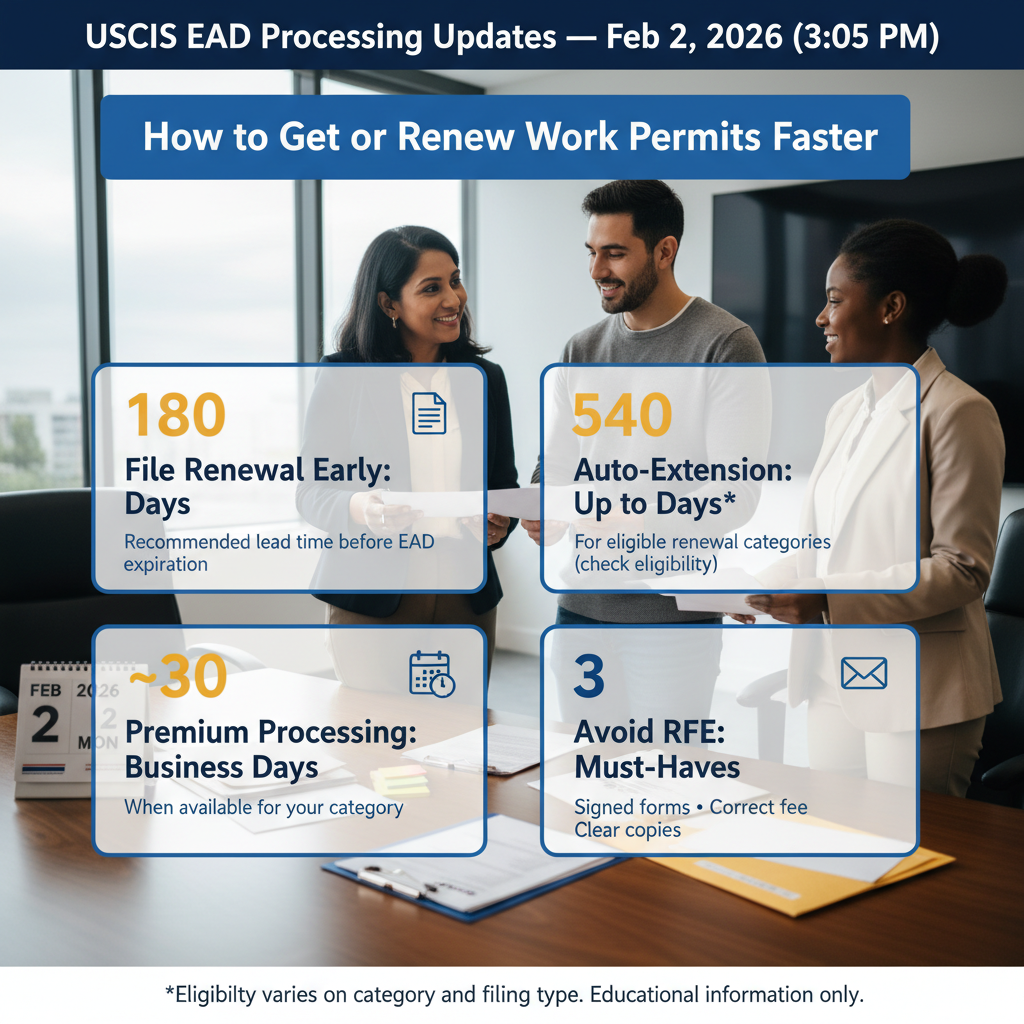
We’re seeing increased public attention on USCIS Employment Authorization Document (EAD) timelines, backlogs, and renewal strategies. The reporting that prompted this practical guide can be found here: Employment Authorization Document Processing (USCIS).
Important: This article is educational and not legal advice. EAD eligibility and strategy depend on your specific category, filing history, and any immigration court or DHS proceedings.
Need Help? Our Orlando immigration team is ready to assist. Call +1 786-791-3106 for a free consultation, or message us online. Se Habla Español.
What This News Means for Immigrants in Orlando and Across Florida
Why this news is showing up now
Employment Authorization Documents (EADs)—often called “work permits”—are one of the most time-sensitive benefits USCIS processes. When EAD processing slows down or rules change, families and employers feel it immediately: people can’t start jobs, renew driver’s licenses, or maintain income while a green card case is pending.
Several factors commonly drive EAD “processing update” headlines:
- USCIS workload shifts (surges in filings in humanitarian categories, seasonal filing spikes, or policy changes).
- Policy adjustments affecting 180 days automatic extensions for certain renewal categories and how USCIS issues receipt notices.
- Operational changes like digitization, staffing, and fee rule updates that can change practical timelines.
- Increased public reliance on EADs due to more applicants filing Adjustment of Status cases, asylum-related applications, TPS renewals, and parole-related filings.
If your case is in Orlando or anywhere along the I-4 corridor, the same national USCIS processing dynamics apply—but local realities (job markets, DMV practices, employer onboarding timelines, and travel needs) can make EAD delays especially disruptive.
How it can affect Florida residents
Florida workers are often in industries that require quick onboarding—hospitality, healthcare support, construction, logistics, and tourism. A delayed EAD can mean:
- Lost job offers or delayed start dates.
- Gaps in employment authorization that can interrupt paychecks.
- Driver’s license renewal complications (requirements can vary; always confirm with Florida DHSMV and bring updated USCIS proof).
- Stress for families trying to “bridge” time between a pending green card case and lawful work authorization.
Reminder: A pending immigration application does not automatically authorize employment. In most categories, you must have an approved EAD (or another employment-authorizing status) to work lawfully.
What Employment Authorization Document Processing Is (and Why It Matters)
A plain-English definition
“EAD processing” refers to how USCIS receives, reviews, and decides applications for an Employment Authorization Document—typically filed on Form I-765. The EAD is the physical card (often called the “work permit”) that proves you are authorized to work in the United States for a specific period of time.
EAD processing includes:
- USCIS accepting your packet (or online filing), cashing the fee (if required), and issuing a receipt notice.
- Biometrics scheduling (if required for your category) and background checks.
- Review of eligibility based on your immigration category (for example, pending Form I-485 Adjustment of Status, asylum applicant, TPS holder, etc.).
- Approval, card production, and mailing—or a Request for Evidence (RFE) or denial.
Key terms you need to know
- Form I-765: The application for an EAD (work permit).
- Renewal: A new EAD application filed before the current card expires (some categories may qualify for an automatic extension upon timely filing).
- Automatic extension: Some renewal applicants receive continued work authorization for a set period (often 180 days) if they file on time and meet category rules.
- Receipt Notice (Form I-797C): Proof USCIS received the filing. For some categories, the receipt notice plus the expired EAD can serve as temporary proof of continued authorization during the automatic extension period.
- Category code: The eligibility category printed on the EAD (for example, (c)(9) for many pending Form I-485 applicants). Choosing the wrong category can cause delays or denial.
- Expedite request: A request to USCIS to speed up processing based on qualifying criteria (e.g., severe financial loss). Approval is discretionary.
- Premium processing: A paid faster processing option that exists for certain employment petitions and, in limited situations, certain EAD-related requests; availability depends on USCIS programs and category rules.
- Priority Date: A key term in many green card categories that affects visa availability. While Priority Date is not an “EAD term,” it often drives when someone can file Form I-485 and then apply for an EAD.
- 90-day window: Many immigration benefits have timing windows (though EAD rules vary by category). The practical takeaway is: file renewals early when allowed and track deadlines carefully.
Need Help? Our Orlando immigration team is ready to assist. Call +1 786-791-3106 for a free consultation, or message us online. Se Habla Español.
Current Immigration Law: The Foundation
EADs are authorized by federal immigration law and implemented through DHS/USCIS regulations. While day-to-day “processing updates” may change, the legal foundation stays relatively consistent.
Federal requirements
The main legal framework includes:
- Immigration and Nationality Act (INA) provisions authorizing DHS to regulate employment authorization for noncitizens in specific circumstances.
- 8 C.F.R. § 274a (employment authorization regulations), which governs who may be authorized to work and how EADs are issued.
- 8 C.F.R. § 274a.13 (procedures for applying for employment authorization and processing rules).
- Category-specific regulations (for example, asylum-related rules, TPS rules, parole-based eligibility, and pending adjustment eligibility).
The most common USCIS forms tied to EAD eligibility include:
- Form I-765 (EAD application)
- Form I-485 (Application to Register Permanent Residence or Adjust Status) — Adjustment of Status
- Form I-130 (Petition for Alien Relative) — often paired with Form I-485 in family-based cases
- Form I-589 (Asylum)
- Form I-821 (TPS, when applicable)
- Form I-131 (Advance Parole/travel document—often filed with adjustment cases)
For official instructions and updates, always cross-check on the USCIS official website and the dedicated forms library: USCIS Forms.
Florida-specific considerations
Immigration law is federal, but Florida residents often face state-and-local practical issues tied to EAD timing:
- DMV/driver’s license timing: Florida DHSMV may require unexpired proof of lawful presence and employment authorization. If you’re on an automatic EAD extension, bring your expired card and the I-797 receipt notice and confirm whether it will be accepted at your local office.
- Employer onboarding: Employers must complete Form I-9 employment verification. Many HR departments are unfamiliar with automatic extension documents. Being prepared can prevent job delays.
- Orlando USCIS Field Office: While EADs are generally processed at service centers (not field offices), your local field office may be relevant if your underlying Form I-485 interview is scheduled in Orlando or if you need an in-person appointment for certain issues.
If your case is in Orlando (or you live in Orange County or along the I-4 corridor), planning for processing variability is essential—especially if you’re changing jobs, renewing a driver’s license, or traveling.
Warning: Working without authorization can create serious immigration consequences. If your EAD expires and you do not qualify for an automatic extension, talk to an immigration attorney before continuing employment.
How to Apply for or Renew an EAD: A Complete Step-by-Step Guide
Below is a practical, category-agnostic roadmap. Because eligibility varies, the most important first step is confirming your correct Form I-765 category and whether your renewal qualifies for an automatic extension (often 180 days) based on timely filing and category rules.
1) Confirm your eligibility category and timing
Start by identifying the underlying basis for your EAD. Common examples include:
- Pending Form I-485 (Adjustment of Status)
- Asylum applicant or asylee
- TPS applicant/holder (when designated)
- Certain parole categories
- Other humanitarian or employment-based categories
Then confirm whether you are filing an initial EAD or a renewal. For renewals, check whether you can file early and whether an automatic extension applies. Many categories require filing before expiration to benefit from an extension.
- Required documents (eligibility step):
- Copy of your current EAD (front/back), if renewing
- USCIS receipt notices for your underlying case (e.g., Form I-485, Form I-589, TPS filing)
- Passport biographic page and U.S. visa page (if available)
- I-94 record (if applicable)
- Prior approval notices (if applicable)
Important: Selecting the wrong category code on Form I-765 is one of the most common reasons for delays, RFEs, and denials.
2) Choose your filing method and prepare the correct USCIS form packet
Depending on your category, you may be able to file Form I-765 online or by mail. USCIS also changes filing addresses periodically, so always verify the current address and filing rules on USCIS official website.
- Required documents (packet preparation):
- Completed and signed Form I-765 (correct edition date)
- Filing fee or fee waiver request (if eligible), per USCIS instructions
- Two passport-style photos (if required for your filing method/category)
- Copy of government-issued ID (passport, prior EAD, etc.)
- Proof of underlying eligibility (e.g., Form I-485 receipt notice; asylum receipt; TPS documentation)
- Any prior EADs and approval notices
Reminder: Use the official form instructions and confirm you are using the correct version from USCIS Forms.
3) File the application and track your receipt notice
After filing, USCIS will issue a receipt notice (Form I-797C). This receipt number is essential to track your case, request updates, and (in some categories) prove an automatic extension.
- Required documents (tracking step):
- USCIS receipt notice (Form I-797C)
- Delivery confirmation (if mailed)
- USCIS online account access (if applicable)
- Copy of your complete filing packet for your records
Track general timelines here: USCIS Processing Times.
Important: If you are relying on an automatic extension, keep your expired EAD and the receipt notice together. Employers often need both for Form I-9 purposes.
4) Complete biometrics (if USCIS requires it)
USCIS may schedule biometrics (fingerprints/photo) at an Application Support Center (ASC), unless reused from a prior case. Missing a biometrics appointment can significantly delay or derail your EAD.
- Required documents (biometrics step):
- Biometrics appointment notice
- Passport or government-issued photo ID
- Current/expired EAD (if you have one)
- Any USCIS receipt notices relevant to your filing
For Central Florida residents, plan ahead: traffic along the I-4 corridor and appointment availability can make same-day rescheduling difficult.
Warning: If you can’t attend, follow the instructions on the notice immediately to request a reschedule. Do not ignore it.
5) Respond quickly to any RFE (Request for Evidence)
If USCIS issues an RFE, your case pauses until USCIS receives your response. RFEs often ask for proof of eligibility, identity documents, or clarification of category.
- Required documents (RFE response step):
- Original RFE notice (include it as the first page of your response)
- Requested evidence (organized and labeled)
- Cover letter summarizing what you are submitting
- Copies of relevant receipts/approvals (e.g., Form I-485 receipt)
- Translation + certification for any non-English documents
Important: Respond by the deadline on the RFE. Late responses can lead to denial.
6) If needed, request an expedite (and document your reason)
USCIS may expedite an EAD in limited circumstances, such as severe financial loss to a person or company, emergencies, or humanitarian reasons. Expedites are discretionary and require strong evidence.
- Required documents (expedite step):
- Job offer letter with start date and consequences of delay
- Employer letter describing business impact
- Evidence of financial hardship (rent notices, utility shutoff, medical bills)
- Proof of dependent needs (childcare, school, medical)
- Any prior communications with USCIS
Reminder: An expedite request is not a guarantee. A well-prepared underlying filing is still the best way to avoid delays.
7) Receive the decision, verify the card, and update employer/DMV records
When approved, USCIS produces and mails the EAD card. Check the card immediately for errors (name, dates, category). If there is a mistake, fix it quickly—errors can cause I-9 issues and driver’s license problems.
- Required documents (post-approval step):
- EAD card (inspect front/back)
- Approval notice (if issued)
- Social Security card (if you have one; request/updates may be needed)
- Employer I-9 update documents
- DMV appointment confirmation and identity documents (if renewing license)
If your case is in Orlando and you also have a pending Form I-485, keep your EAD approval with your green card case file. These cases often move on separate tracks, and good recordkeeping prevents missed deadlines.
Need Help? Our Orlando immigration team is ready to assist. Call +1 786-791-3106 for a free consultation, or message us online. Se Habla Español.
Practical Steps You Can Take Today
Here’s a real-world checklist to reduce EAD delays and protect your ability to work while USCIS processes your case.
- 1) File as early as your category allows. If you’re eligible for renewal, file early enough to avoid gaps—especially if your category relies on an automatic extension of 180 days.
- 2) Build a “work authorization folder.” Keep (a) your current/expired EAD, (b) your Form I-765 receipt notice, (c) underlying receipts (like Form I-485), and (d) your passport/I-94 copies together.
- 3) Verify your mailing address with USCIS. Many EAD problems are delivery problems. Update your address promptly and keep proof of the update.
- 4) Check USCIS processing times monthly. Use the official tool: USCIS Processing Times.
- 5) Prepare employer education for Form I-9. If you qualify for an automatic extension, bring printed USCIS guidance and your receipt notice to HR. Don’t assume they know how it works.
- 6) Plan for Florida DMV timing. For Central Florida residents, schedule ahead and bring extra documents. If the DMV questions your extension, politely ask for a supervisor and bring USCIS proof.
- 7) If hardship is real, document it early. If you may need an expedite, gather evidence now (rent ledger, medical bills, shutoff notices, job offer letters).
Timeline expectations: EAD timelines vary widely by category and USCIS workload. Some applicants receive decisions in weeks; others wait months. If your EAD is tied to a pending Adjustment of Status case, your timeline can also be affected by biometrics reuse, RFEs, and background checks.
Reminder: Your green card case and your EAD case are related but separate. A fast-moving Form I-485 does not guarantee a fast EAD—and vice versa.
How Imigrar Helps Immigrants in Orlando
At Imigrar, we help clients in Orlando, across Central Florida, and nationwide prepare strong EAD filings and renewal strategies that reduce delays and protect work authorization. We also advise on how EADs interact with family-based cases (like Form I-130 + Form I-485), humanitarian cases, and immigration court realities.
Our support often includes:
- Confirming the correct Form I-765 category code and eligibility basis.
- Preparing complete filing packets with clear supporting evidence.
- RFE responses with organized exhibits and legal framing.
- Expedite request preparation when criteria are met.
- Strategic planning for families—so work authorization aligns with your broader immigration goals.
If your case is in Orlando and your underlying green card interview will be handled by The Orlando USCIS Field Office, we can help you coordinate your documentation across filings to avoid inconsistent answers or missing records.
Call us at +1 786-791-3106 for a free consultation. Se Habla Español.
Frequently Asked Questions
Q: Am I eligible to apply for an EAD if I have a pending green card case?
A: Many applicants with a pending Form I-485 (Adjustment of Status) are eligible to apply for an EAD using Form I-765, typically under a category associated with pending adjustment. You must have properly filed the Form I-485 and remain eligible. Keep copies of your Form I-485 receipt notice and any biometrics notices. If you’re unsure, consult an attorney because certain inadmissibility issues or filing defects can affect eligibility.
Q: Will applying for or renewing an EAD affect my immigration status?
A: Filing Form I-765 generally does not “create” immigration status by itself; it requests work authorization based on an existing category (like pending Form I-485, asylum pending, TPS, etc.). However, inconsistencies, incorrect category selection, or underlying ineligibility can trigger RFEs or denials and may expose issues in the underlying case. Important: Always ensure your EAD filing matches your current immigration posture and prior filings.
Q: How long does USCIS take to process an EAD right now?
A: Processing times vary by eligibility category and service center. The most reliable public benchmark is the official tool at USCIS Processing Times. Use your receipt notice to identify the form type and service center. In practice, timelines can change quickly. If your case is in Orlando, remember: EADs usually aren’t decided by the local field office, even if your Form I-485 interview is at the Orlando office.
Q: What documents do I need for an EAD renewal?
A: Common renewal documents include: (1) completed Form I-765, (2) copy of your current/expired EAD (front/back), (3) proof of your eligibility category (for example, Form I-485 receipt notice or TPS documentation), (4) passport photo page and I-94 (if applicable), (5) required photos (if required), and (6) the correct fee or a fee waiver request if eligible. Reminder: Always check the current instructions on USCIS Forms.
Q: How much does it cost to file for an EAD?
A: The fee depends on your eligibility category and whether the EAD is bundled with another benefit (for example, some applicants filing Form I-485 may have different fee rules than standalone EAD applicants). USCIS fees also change over time, so confirm the current fee and payment method directly on the USCIS official website. Important: Submitting the wrong fee can cause rejection, which can be devastating if you’re close to expiration.
Q: What happens if my EAD application is denied?
A: If USCIS denies your EAD, they will issue a written decision explaining why. Next steps depend on the basis for denial: it could be a correctable issue (missing evidence, wrong category, fee problem), or it could reflect a deeper eligibility issue in the underlying case. Warning: Do not assume you can keep working. Talk to an immigration attorney immediately to evaluate re-filing options, timing, and whether the denial impacts your underlying case (like a pending Form I-485 or asylum case).
Q: Can I travel while my EAD is pending?
A: An EAD is not a travel document. If you have a pending Adjustment of Status case, leaving the U.S. without proper authorization (often Advance Parole on Form I-131) may cause USCIS to consider the Form I-485 abandoned in many situations. Always confirm travel rules for your category and review guidance from U.S. Department of State when consular processing is involved.
Common Mistakes (and How to Avoid Them)
Mistake #1: Filing under the wrong category or mixing categories across cases
USCIS ties EAD eligibility to specific legal categories. Choosing the wrong category code—or submitting evidence that doesn’t match the category—can lead to RFEs, denials, and months of delay.
How to avoid it: Match your Form I-765 category to your underlying basis (for example, pending Form I-485 vs. TPS vs. asylum). Keep your receipts and approval notices organized so your filing tells one consistent story.
Mistake #2: Waiting too long to renew and missing the automatic extension window
Many people learn about automatic extensions only after their card is close to expiring. If you file too late, you may lose the benefit—or you may not have enough time to correct a rejected filing.
How to avoid it: Calendar your expiration date and create a renewal plan well in advance. Treat USCIS mailing and rejection risk as real. Build in buffer time, not just the “minimum.”
Mistake #3: Ignoring USCIS notices (biometrics, RFE, or delivery problems)
USCIS deadlines are unforgiving. Missing biometrics or responding late to an RFE can cause denial. Delivery issues can also create silent delays if you don’t receive notices.
How to avoid it: Use a stable mailing address, track your case online when possible, and open USCIS mail immediately. If you move, update USCIS promptly and keep proof.
For people also navigating immigration court, remember that proceedings and deadlines can create additional complexity. If you have EOIR involvement, consult resources at Executive Office for Immigration Review and speak with counsel before making changes to your filing strategy.
Need Help? Our Orlando immigration team is ready to assist. Call +1 786-791-3106 for a free consultation, or message us online. Se Habla Español.
Additional official resources to monitor EAD processing
Because “EAD processing updates” can change quickly, rely on primary sources and official tools:

Closing: Protect your work authorization and your family’s stability
EAD processing delays can be stressful—especially for families trying to stay financially stable while a larger immigration case moves forward. The best outcomes usually come from early planning, accurate category selection, complete documentation, and fast responses to USCIS notices.
If your case is in Orlando, if you’re in Orange County, or if you live anywhere along the I-4 corridor and need help creating a reliable EAD strategy, Imigrar is here to support you.
Need Help? Our Orlando immigration team is ready to assist. Call +1 786-791-3106 for a free consultation, or message us online. Se Habla Español.


