


The reporting that sparked this guide
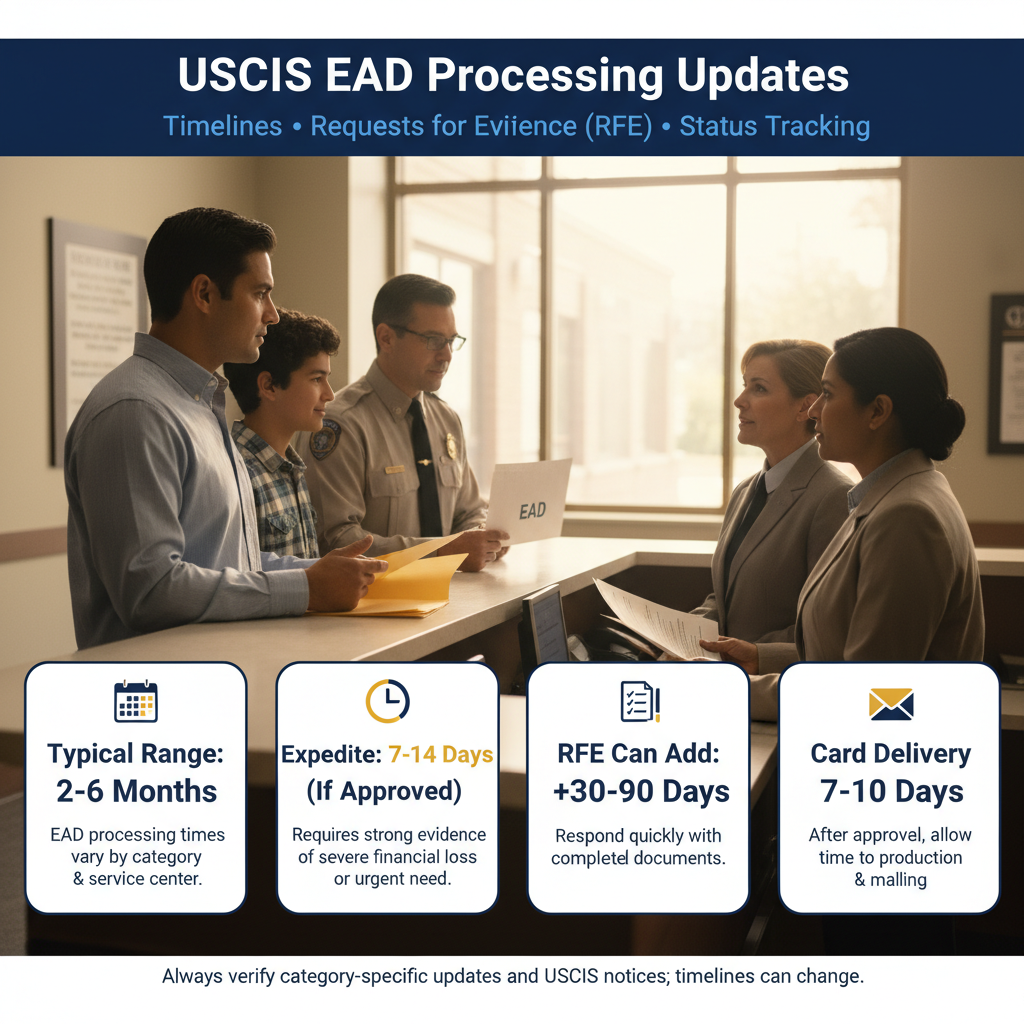
The reporting that sparked this guide comes from ongoing USCIS-related coverage and updates being surfaced through Google News. We are referencing: Employment Authorization Document Processing (USCIS).
Reminder: News headlines often summarize complex policy and operational changes. This article explains how Employment Authorization Document (EAD) processing works in practice, what USCIS updates typically mean, and how to protect your ability to work lawfully while your case is pending.
Need Help? Our Orlando immigration team is ready to assist. Call +1 786-791-3106 for a free consultation, or message us online. Se Habla Español.
What This News Means for Immigrants in Orlando and Across Florida
Why this news is showing up now
Employment Authorization Document Processing is trending because work authorization touches nearly every major immigration pathway—family-based cases, asylum, TPS, humanitarian parole programs, and many employment-based categories. USCIS processing capacity changes throughout the year due to:
- Fluctuations in application volume (especially during program redesignations, court-related changes, and seasonal filing spikes).
- Operational changes (biometrics reuse, digitization, and staffing shifts).
- Policy updates affecting automatic extensions for certain renewal applicants.
- Increased public attention to delays that impact jobs, driver’s licenses, and family stability.
Important: USCIS doesn’t “approve faster” just because EADs are in the news. But heightened attention often coincides with USCIS publishing reminders about eligibility, renewal timing, and tools like online accounts and processing-time pages.
How it can affect Florida residents
For immigrants living and working in Florida—especially in high-growth regions like Orlando, Kissimmee, and throughout the I-4 corridor—EAD timing can affect:
- Job start dates and onboarding (I-9 verification requirements).
- Driver’s license renewals and REAL ID compliance (Florida often requires proof of lawful status and unexpired work authorization, depending on category).
- Income stability for households in Orange County and surrounding counties.
- Employer compliance—employers must reverify work authorization when required and must follow anti-discrimination rules.
If your case is in Orlando, delays can also intersect with local appointment availability (for biometrics) and coordination with the Orlando USCIS Field Office for related filings like Adjustment of Status interviews (for those who filed Form I-485).
What Employment Authorization Document Processing Is (and Why It Matters)
A plain-English definition
An Employment Authorization Document (EAD)—often called a “work permit”—is a card issued by USCIS that proves you are authorized to work in the United States for a specific period of time. The EAD is typically requested using Form I-765.
“EAD processing” refers to the time and steps USCIS takes to receive your application, verify eligibility, collect biometrics (if needed), run background checks, and either approve and produce the card or deny/issue a request for evidence.
Warning: An EAD is not the same thing as a visa, a green card, or citizenship. It is a work authorization document tied to a specific immigration category and validity period.
Key terms you need to know
- Form I-765: The USCIS application for an EAD (initial or renewal).
- Category code (example: (c)(9), (a)(5), etc.): The eligibility category printed on the EAD and selected on the I-765. Choosing the wrong code can cause delays or denial.
- Adjustment of Status: The process of applying for a green card from inside the U.S., commonly filed on Form I-485. Many applicants file EADs under category (c)(9).
- Priority Date: A key date in many family- and employment-based green card processes. While not always directly tied to EAD eligibility, it often determines whether you can file Form I-485 (and therefore potentially an EAD).
- Automatic extension: Certain EAD renewals can receive an automatic extension of work authorization if filed timely and if the category qualifies (rules and categories can change; confirm current guidance).
- Biometrics: Fingerprints and photo appointment, usually at an ASC (Application Support Center). USCIS may reuse biometrics in some cases.
- RFE (Request for Evidence): USCIS asks for missing or additional proof. RFEs can add weeks or months to processing.
Reminder: The best “processing update” you can control is the quality and completeness of your filing—correct category, correct fee, correct evidence, and correct address.
Need Help? Our Orlando immigration team is ready to assist. Call +1 786-791-3106 for a free consultation, or message us online. Se Habla Español.
Current Immigration Law: The Foundation
EAD eligibility is rooted in federal immigration law and regulations, primarily the Immigration and Nationality Act (INA) and the Code of Federal Regulations (CFR). USCIS implements these rules through policy guidance and form instructions.
Federal requirements
Key legal authorities include:
- INA (Immigration and Nationality Act): The primary federal immigration statute.
- 8 CFR § 274a: Regulations governing employment authorization and documentation.
- 8 CFR § 274a.12: Lists categories of aliens authorized to accept employment and categories eligible to apply for an EAD.
Many common pathways that lead to EAD eligibility involve other filings, such as:
- Family-based immigration through Form I-130 (Petition for Alien Relative), often followed by Form I-485 for Adjustment of Status if eligible.
- Asylum applicants and asylees (rules vary by stage and timing).
- Temporary Protected Status (TPS) applicants and beneficiaries.
- Certain parole-based programs and humanitarian categories (each with specific eligibility rules).
For official guidance, always verify details on the USCIS official website and the USCIS Forms page for the latest Form I-765 instructions.
Florida-specific considerations
Immigration law is federal, but Florida residents often face state-level practical issues tied to EAD validity:
- Driver’s license/ID timing: Florida’s DMV processes may require unexpired proof of lawful presence and may issue licenses that expire when the EAD expires.
- Employment markets: Central Florida employers frequently require clear, unexpired work authorization for onboarding—especially in healthcare, hospitality, logistics, and construction along the I-4 corridor.
- Address stability: If you move within Orange County or elsewhere in Florida, you must update USCIS promptly to avoid missing notices.
Important: If you move, file your change of address as required (typically online through USCIS). Missing a biometrics notice or RFE because of an old address is one of the most avoidable causes of delay.
Useful government resources to monitor your case include: USCIS Processing Times and the USCIS official website. If your situation involves immigration court, consult the Executive Office for Immigration Review. For consular processing and visa-related steps outside the U.S., see the U.S. Department of State.
How to Apply for or Renew an EAD: A Complete Step-by-Step Guide
This step-by-step guide focuses on the most common EAD path: filing Form I-765 for an initial card or a renewal. Exact requirements vary by category. If you’re unsure which category applies, legal guidance can prevent costly delays.
1) Confirm your eligibility category and timing
Before you file, identify the correct eligibility category (the code in parentheses on the I-765). This is one of the most important decisions in the entire process.
- Some categories allow an initial EAD only after a waiting period.
- Some categories allow renewals with potential automatic extensions if filed on time.
- Some categories require a pending underlying application (for example, many Adjustment of Status EADs require a pending Form I-485).
Reminder: If your EAD is expiring, do not wait until the last month. Many applicants aim to file as early as permitted to avoid gaps.
Documents to gather for Step 1:
- Current EAD (front and back), if renewing
- I-94 record (if applicable)
- Receipt notices for underlying cases (example: Form I-485, TPS, asylum receipt), if applicable
- Passport biographic page and U.S. visa page (if applicable)
2) Prepare Form I-765 correctly (and decide online vs. paper filing)
USCIS may allow online filing for certain categories. Other categories must be filed by mail. Filing method affects how you upload evidence and receive updates.
Pay special attention to:
- Your name format (match your passport/USCIS records)
- Your mailing address vs. physical address
- Category code selection
- Prior EAD history and Social Security questions
Warning: A rejected filing (wrong fee, wrong signature, wrong edition date, missing pages) can cost critical time and may cause a lapse in work authorization.
Documents to gather for Step 2:
- Completed Form I-765 (correct edition date)
- Government-issued photo ID (passport, prior EAD, etc.)
- Two passport-style photos (if required for your filing method/category)
- Any prior USCIS notices relevant to your eligibility category
3) Assemble supporting evidence (category-specific proof)
USCIS adjudicates EADs based on category eligibility. Evidence requirements vary widely, but common examples include:
- (c)(9) AOS-based EAD: proof of pending Form I-485 (receipt notice), identity documents, prior EAD if renewing.
- TPS-based EAD: proof of TPS approval or pending TPS application and identity documents.
- Asylum-based EAD: proof of pending asylum and compliance with applicable waiting periods and rules.
Important: If you have ever had a name change, provide consistent documentation (marriage certificate, court order, etc.). Inconsistent identity evidence is a common trigger for RFEs.
Documents to gather for Step 3:
- Copy of your I-94 (if applicable)
- Copy of passport biographic page
- Copy of visa page (if applicable)
- Receipt/approval notices for underlying status (category dependent)
- Prior EAD copies (front/back), if renewing
- Name change documents (if applicable)
4) Pay the correct fee (or file a fee waiver if eligible)
EAD filing fees depend on the category and whether USCIS charges a fee for that category at the time you file. Some categories have no fee; others do. USCIS fee rules can change, so confirm on the USCIS Forms page and the specific Form I-765 instructions.
If you cannot afford the fee, you may be able to request a fee waiver using Form I-912 (if eligible) or request a reduced fee where available.
Warning: Incorrect fee or payment method is one of the top reasons USCIS rejects applications at the lockbox, which can destroy your timing for renewals and any potential automatic extension.
Documents to gather for Step 4:
- Payment (check/money order or card authorization if permitted) OR
- Form I-912 fee waiver request with supporting evidence (income, benefits, hardship), if eligible
- Copy of fee schedule confirmation/printout for your records
5) File your application and track your receipt notice
After filing, USCIS will issue a receipt notice (Form I-797). This receipt number is essential for tracking.
Track your case and estimated times using: USCIS Processing Times and your USCIS online account (if applicable).
If your filing qualifies for an automatic extension, your receipt notice and your expiring EAD may together serve as temporary proof of continued work authorization for a period (depending on category and current rules).
Reminder: Keep multiple copies (digital and paper) of everything you send, including delivery confirmation.
Documents to gather for Step 5:
- Complete copy of the filing packet (what you mailed or uploaded)
- Delivery confirmation (FedEx/USPS/UPS tracking)
- USCIS receipt notice (once received)
- USCIS online account login details (if used)
6) Attend biometrics (if scheduled) and respond quickly to any RFE
USCIS may schedule biometrics at an Application Support Center (ASC). For Central Florida residents, appointments may be within driving distance along the I-4 corridor.
Important: Missing biometrics can lead to denial. If you must reschedule, follow the notice instructions immediately.
If USCIS issues an RFE, respond by the deadline with organized evidence. An RFE response should be complete, labeled, and easy for an officer to review.
Documents to gather for Step 6:
- Biometrics appointment notice
- Valid photo ID for the appointment
- RFE notice (if issued)
- RFE response packet with tabbed exhibits and translations (if needed)
7) Receive the decision, card production, and plan your next renewal
If approved, USCIS will produce and mail your EAD card. Review it immediately for errors (name spelling, category, validity dates).
- If there is an error, request correction promptly following USCIS instructions.
- Update your employer’s I-9 records as required (your employer must follow lawful verification rules).
- Plan ahead for the next renewal—many categories require proactive timing.
Reminder: Some applicants also file for travel authorization (Advance Parole) using Form I-131 when eligible, especially those with pending Form I-485. Travel without proper authorization can create serious risks in some cases.
Documents to gather for Step 7:
- Approval notice (if issued)
- New EAD card (front/back scanned copy)
- Employer I-9 update documentation (as applicable)
- Calendar reminder for renewal timing (example: 180 days before expiration, if allowed for your category)
Need Help? Our Orlando immigration team is ready to assist. Call +1 786-791-3106 for a free consultation, or message us online. Se Habla Español.
Practical Steps You Can Take Today
If your goal is to avoid a work authorization gap, the best strategy is to treat your EAD like a passport: track dates, keep copies, and file early when permitted.
Actionable checklist
- 1) Check your EAD expiration date and set reminders at 180 days, 120 days, and 90 days before expiration.
- 2) Confirm your eligibility category on your current EAD and match it to your new Form I-765.
- 3) Build a “renewal folder” with your last 3 USCIS notices, last EAD copy, passport, I-94, and supporting eligibility documents.
- 4) Track processing times using USCIS Processing Times and compare to your timeline.
- 5) Update your address with USCIS if you moved (especially common for renters in Orange County and the I-4 corridor).
- 6) Prepare for employer questions about automatic extensions (if applicable). Bring your receipt notice and expiring card to HR.
- 7) Avoid international travel if your status/filings make travel risky—especially if you have a pending Adjustment of Status case without proper travel authorization.
Document preparation guidance
- Scan everything in PDF format, clearly named (e.g., “I-765_Signed.pdf,” “EAD_FrontBack.pdf,” “I-485_Receipt.pdf”).
- Use consistent personal information across forms (same spelling, same date format).
- If a document is not in English, include a proper translation with certification.
Timeline expectations (real-world)
EAD timelines vary by category and USCIS workload. Use the official tool: USCIS Processing Times to check estimates for your form and category.
Important: If your EAD renewal is pending and you are approaching a job-impacting deadline, you may have options depending on the category (including inquiries, escalation steps, and in limited cases expedite requests). These options are category- and fact-specific.
Reminder: A common planning approach is the 90-day window mindset for gathering documents—start assembling evidence at least 90 days before the earliest filing date so you can file immediately once eligible.
How Imigrar Helps Immigrants in Orlando
At Imigrar, we help clients in Orlando and across the U.S. protect their ability to work lawfully by preparing strong, organized EAD filings and renewal strategies tied to the bigger picture of their immigration goals—family unity, stability, and lawful status.
- We confirm the correct eligibility category and timing for your Form I-765.
- We review your immigration history to reduce the risk of RFEs and avoidable denials.
- We coordinate EAD strategy with family-based filings like Form I-130 and green card filings like Form I-485 when appropriate.
- We help Central Florida residents prepare for local practical issues (DMV timing, employer reverification, address changes).
Our mission is simple: Keep Families Together. And we do it with careful planning and clear communication.
Call for a free consultation at +1 786-791-3106. Se Habla Español.
Frequently Asked Questions
Q: Who is eligible to apply for an EAD using Form I-765?
A: Eligibility depends on your immigration category under federal regulations (generally found under 8 CFR § 274a.12). Common eligible groups include certain Adjustment of Status applicants with a pending Form I-485, TPS applicants/beneficiaries, asylum applicants (subject to rules and timing), certain parolees, and others. The correct category code on the I-765 is critical—using the wrong category can lead to delay or denial. When in doubt, confirm on the USCIS official website and consider legal review.
Q: Will filing an EAD affect my immigration status or my green card case?
A: For many categories, the EAD is a benefit tied to a pending or approved underlying case (for example, a pending Form I-485 for Adjustment of Status). Filing Form I-765 typically does not “harm” a properly filed underlying case. However, mistakes—like inconsistent information, missing disclosures, or filing under the wrong category—can create complications. If your case involves prior violations, removal proceedings, or complex history, get individualized advice.
Q: How long does USCIS take to process an EAD in 2026?
A: Processing times vary by eligibility category, workload, and service center. The most reliable public estimate is the official tool at USCIS Processing Times. Important: Use the correct form and category inputs. If your case is outside normal processing times, you may be able to submit an inquiry through USCIS channels.
Q: What documents do I need for an EAD renewal?
A: Most renewals require: (1) a properly completed Form I-765, (2) a copy of your current/expired EAD (front and back), (3) proof you still qualify in the same category (such as a receipt/approval notice for the underlying benefit), and (4) identity documents (often passport/I-94). If you changed your name, include the legal name-change document. Always follow the current USCIS Forms instructions for your category.
Q: How much does an EAD cost?
A: Fees depend on your eligibility category and USCIS’s current fee rules. Some categories have no fee, while others require a filing fee. Confirm the latest fee and payment method requirements on the USCIS Forms page and the Form I-765 instructions. If you cannot afford the fee, you may be eligible to request a waiver using Form I-912 (where permitted) with supporting financial evidence.
Q: What happens if my EAD is denied?
A: A denial means USCIS determined you were not eligible or your filing was not properly supported. Review the denial notice carefully to understand the reason (wrong category, insufficient evidence, missed biometrics, unresolved identity issues, etc.). Next steps may include refiling with corrected evidence, addressing the underlying eligibility issue, or exploring other immigration options. Warning: A denied EAD can also signal problems with the underlying case—especially if eligibility depended on a pending status. If you receive a denial, speak with an immigration attorney promptly.
Q: If my EAD expires, can I keep working while my renewal is pending?
A: It depends. Certain EAD renewal categories may qualify for an automatic extension if the renewal was filed timely and other requirements are met (USCIS rules and categories can change). Your employer may accept the combination of your expiring EAD and your receipt notice as temporary proof for I-9 purposes when the automatic extension applies. If you’re not sure whether your category qualifies, get legal guidance—working without authorization can have serious immigration consequences.
Common Mistakes (and How to Avoid Them)
Mistake #1: Filing under the wrong category code
USCIS uses the category code to decide what evidence is required and whether you qualify. A wrong code can trigger an RFE, denial, or misrouted processing.
- How to avoid it: Match your code to your underlying case type and your prior EAD (if renewing). Confirm using the current Form I-765 instructions on the USCIS Forms page.
Mistake #2: Waiting too long and missing strategic filing timing
Many people start gathering documents only when their EAD is about to expire. That’s when delays become emergencies.
- How to avoid it: Build your renewal packet early and file as soon as you’re allowed. Use a calendar system with reminders at 180 days and within a 90-day window for document collection.
Mistake #3: Missing USCIS notices due to address changes or mail problems
If you move within Orlando, Orange County, or anywhere along the I-4 corridor, you may miss biometrics notices or RFEs—leading to denial.
- How to avoid it: Update your address promptly and keep proof of the update. Track your case online when possible and keep copies of all notices.
Need Help? Our Orlando immigration team is ready to assist. Call +1 786-791-3106 for a free consultation, or message us online. Se Habla Español.
Putting It All Together: EAD Processing Strategy for 2026
The practical takeaway from trending USCIS EAD processing updates is that your best protection is a proactive plan:
- Know your category and keep your underlying case healthy (for example, a pending Form I-485 in a family case supported by Form I-130 where applicable).
- File early when permitted and keep proof of delivery and receipts.
- Use official tools and references: USCIS official website and USCIS Processing Times.
- Prepare for real life in Florida: DMV timing, employer reverification, and stable mailing addresses.
If your case is in Orlando and you’re balancing work authorization with a pending green card process, the timeline coordination matters—especially when your Priority Date or eligibility to file Adjustment of Status is part of the strategy.
Important: This article is general information, not legal advice. Your best next step is a case-specific review.

Closing: Protect Your Work Authorization and Your Family’s Stability
EAD delays can quickly become job loss, missed opportunities, and unnecessary stress. With the right filing strategy, many delays are preventable. Imigrar is here to help you file correctly, respond to USCIS effectively, and keep your long-term immigration plan on track—so you can keep working and keep your family together.
Need help now? Call Imigrar at +1 786-791-3106 for a free consultation, or message us online. Se Habla Español.


