


As of June 8, 2026, the landscape of U.S. immigration continues to evolve, with critical updates frequently emerging from USCIS that directly impact the lives of immigrants and their families. One area that consistently draws significant attention is the processing of Employment Authorization Documents (EADs), often referred to as work permits. For many, an EAD is the gateway to legal employment, financial stability, and a more secure future in the United States.
At Imigrar, an immigration law firm based in Orlando, Florida, we understand the profound importance of these updates. Our mission is to "Keep Families Together," and a crucial part of that involves helping individuals navigate the complexities of obtaining and maintaining their legal right to work. This comprehensive guide is designed to provide professional, accurate, and actionable information on the latest EAD processing news, helping you understand what it means for you, your family, and your journey in Florida and beyond.
Need Help? Our Orlando immigration team is ready to assist. Call +1 786-791-3106 for a free consultation, or message us online. Se Habla Español.
The reporting that sparked this guide
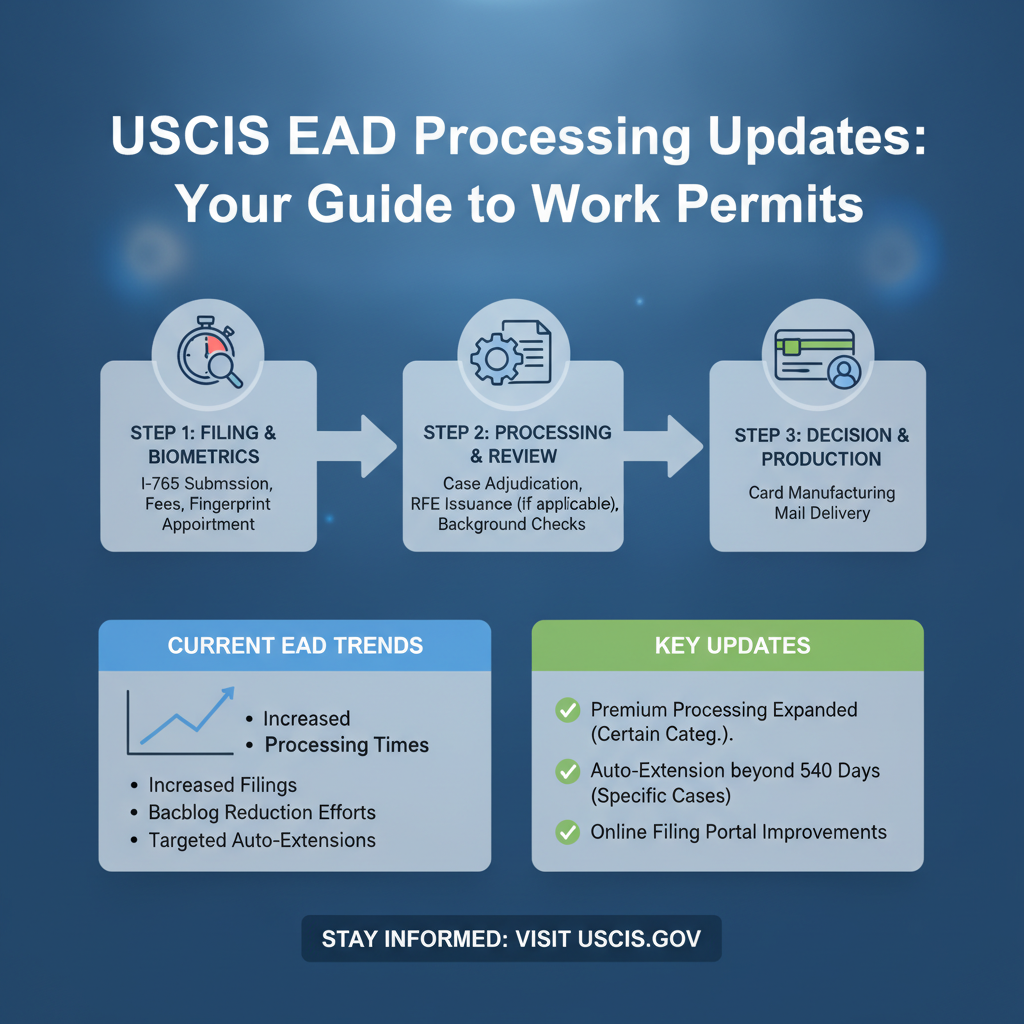
Recent reports from USCIS indicate ongoing efforts to streamline the processing of Employment Authorization Documents, reduce backlogs, and provide greater clarity and flexibility for applicants. These efforts, often stemming from public feedback and internal reviews, aim to enhance efficiency and address long-standing challenges that have impacted immigrants awaiting their work permits. While specific policy changes can be dynamic, the overarching trend is towards improving the EAD application and renewal process. For the latest official updates, always refer to the USCIS official website.
For broader context, you can review general immigration news at Employment Authorization Document Processing (USCIS).
What This News Means for Immigrants in Orlando and Across Florida
The news regarding EAD processing updates from USCIS carries significant weight for individuals and families residing in Florida, particularly in bustling metropolitan areas like Orlando. Understanding these changes is not just about staying informed; it's about making timely, strategic decisions that can impact your ability to live and work legally in the U.S.
Why this news is showing up now
USCIS, like many government agencies, is constantly evaluating its operational efficiency and responsiveness to public demand. In recent years, the agency has faced unprecedented backlogs across various application types, including EADs. These backlogs have caused significant stress, financial hardship, and uncertainty for countless immigrants. In response, USCIS has implemented several initiatives aimed at reducing processing times, increasing efficiency, and providing relief to applicants. These efforts include:
- Temporary Final Rules: Implementing rules that provide longer automatic extensions for certain EAD categories.
- Increased Validity Periods: Extending the validity period for EADs in specific categories to reduce the frequency of renewals.
- Technology Enhancements: Investing in digital processing and online filing capabilities to streamline workflows.
- Increased Staffing: Hiring additional personnel to address the volume of applications.
- Policy Adjustments: Clarifying eligibility criteria and simplifying documentation requirements where possible.
These ongoing adjustments are a direct response to the challenges of managing a vast caseload while striving to provide essential services to the immigrant community. The goal is to ensure that eligible individuals can obtain their work authorization more predictably and efficiently.
How it can affect Florida residents
For the vibrant immigrant communities across Florida, from Miami to Tampa, and especially here in Orlando, these EAD processing updates have direct and tangible effects:
- Reduced Stress and Uncertainty: Faster processing times mean less time waiting in limbo, allowing individuals and families to plan their lives with greater certainty. This is particularly vital for those along the I-4 corridor, where economic opportunities are abundant but require legal authorization to pursue.
- Continuous Employment: For those renewing their EADs, longer automatic extensions or quicker processing can prevent gaps in employment, ensuring continuous income and stability for families. Many businesses in Orlando and Central Florida rely on a diverse workforce, and uninterrupted work authorization is key for both employees and employers.
- Economic Contribution: With EADs processed more efficiently, immigrants can more quickly enter or re-enter the workforce, contributing to Florida's economy through taxes, consumer spending, and filling labor demands. This strengthens local economies, including Orange County, where many immigrants reside.
- Family Stability: The ability to work legally is fundamental to supporting a family. EAD updates that lead to faster authorization directly align with Imigrar's mission to "Keep Families Together" by providing the means for economic self-sufficiency.
- Planning and Integration: Knowing that an EAD is forthcoming or reliably renewed allows individuals to make long-term plans for housing, education, and community integration in Florida.
While the goal is improvement, it's crucial to remember that processing times can still fluctuate. Staying informed and preparing your application meticulously remains paramount. This is where expert legal guidance, especially from a firm familiar with the local context like Imigrar in Orlando, becomes invaluable.
What Employment Authorization Documents (EADs) Are (and Why They Matter)
For many non-citizens in the United States, the ability to work legally is a cornerstone of their journey toward stability and integration. This ability is granted through an Employment Authorization Document, commonly known as an EAD or a work permit. Understanding what an EAD is and why it holds such significance is the first step in navigating the application process.
A plain-English definition
An Employment Authorization Document (EAD) is a government-issued card that proves you are authorized to work legally in the United States for a specific period. It looks similar to a driver's license or state ID card, often featuring your photo, name, date of birth, country of birth, and a specific validity period. When an employer hires you, they are required to verify your eligibility to work using documents like your EAD, typically through Form I-9, Employment Eligibility Verification.
Essentially, if you are not a U.S. citizen or a lawful permanent resident (Green Card holder), you generally need an EAD to be legally employed in the U.S., unless your specific nonimmigrant visa category (like an H-1B or L-1) already authorizes you to work for a particular employer.
Key terms you need to know
Navigating immigration processes involves understanding specific terminology. Here are some key terms related to EADs:
- EAD (Employment Authorization Document): The official term for the work permit card.
- Form I-765, Application for Employment Authorization: This is the primary form you must file with USCIS to request an EAD.
- USCIS (U.S. Citizenship and Immigration Services): The federal agency responsible for processing EAD applications, along with many other immigration benefits. You can always find official information and forms on the USCIS official website.
- Adjustment of Status (AOS): The process of applying for a Green Card while physically present in the United States. Many individuals with a pending Form I-485, Application to Register Permanent Residence or Adjust Status, are eligible for an EAD.
- Asylum Seeker/Refugee: Individuals who have applied for asylum or been granted refugee status are often eligible for EADs to support themselves while their cases are processed or as they resettle.
- H-4 Dependent: Certain spouses of H-1B nonimmigrants, particularly those whose H-1B spouse has an approved Form I-140, Immigrant Petition for Alien Worker, can apply for an EAD.
- TPS (Temporary Protected Status): A temporary immigration status granted to eligible nationals of designated countries experiencing armed conflict, environmental disaster, or other extraordinary conditions. TPS beneficiaries are eligible for EADs.
- DACA (Deferred Action for Childhood Arrivals): An immigration policy that allows certain undocumented immigrants who entered the U.S. as minors to receive a renewable two-year period of deferred action from deportation and eligibility for an EAD.
- Automatic Extension: A policy by USCIS that automatically extends the validity of an expiring EAD for certain eligible categories, often for a specified period (e.g., up to 540 days), while a renewal application is pending. This helps prevent gaps in employment.
- Processing Times: The estimated duration USCIS takes to process an application from the date of receipt to a final decision. These times vary significantly by application type and USCIS service center, and can be checked on the USCIS Processing Times page.
The EAD is more than just a piece of plastic; it's a vital tool for economic self-sufficiency, allowing individuals to support their families, pay taxes, and contribute to their communities, including those here in Orlando and throughout Florida. Without it, the challenges faced by immigrant families are significantly amplified, making timely and accurate EAD processing critically important to our firm's mission of "Keep Families Together."
Need Help? Our Orlando immigration team is ready to assist. Call +1 786-791-3106 for a free consultation, or message us online. Se Habla Español.
Current Immigration Law: The Foundation of Employment Authorization
The right to employment authorization in the United States is not universal for non-citizens; it is firmly rooted in specific provisions of federal immigration law. Eligibility for an EAD is tied to an individual's immigration status or the filing of certain immigration applications. Understanding this legal framework is essential for anyone seeking a work permit.
The primary statute governing U.S. immigration is the **Immigration and Nationality Act (INA)**. The INA outlines who is eligible to enter the U.S., how they can obtain various statuses, and what rights and responsibilities come with those statuses. Specifically, sections of the INA and corresponding regulations at 8 CFR (Code of Federal Regulations) define the categories of non-citizens authorized for employment.
Federal requirements
Under federal law, eligibility for an EAD is generally granted to individuals who fall into specific categories, which are outlined in 8 CFR § 274a.12. These categories are diverse and include, but are not limited to:
- Applicants for Adjustment of Status (AOS): Individuals with a pending Form I-485, Application to Register Permanent Residence or Adjust Status, are typically eligible for an EAD (category (c)(9)).
- Asylum Applicants: Those with a pending Form I-589, Application for Asylum and for Withholding of Removal, who have waited at least 180 days since filing without a decision (category (c)(8)).
- Refugees and Asylees: Individuals granted refugee or asylum status (categories (a)(3) and (a)(5)).
- Nonimmigrants with Specific Authorizations: Certain nonimmigrant visa holders, such as spouses of L-1 intracompany transferees (L-2) or certain H-4 spouses of H-1B workers with an approved Form I-140 (categories (c)(26) and (a)(17)).
- Students with Optional Practical Training (OPT): F-1 students authorized for OPT or STEM OPT after graduation (category (c)(3)).
- Temporary Protected Status (TPS) Beneficiaries: Individuals granted TPS for their country (category (a)(12) or (c)(19)).
- DACA Recipients: Individuals who have received deferred action under DACA (category (c)(33)).
- Individuals Granted Withholding of Removal: (category (a)(10)).
- Parolees: Certain individuals paroled into the U.S. (category (c)(11)).
It's crucial to understand that merely being present in the U.S. does not automatically confer eligibility for an EAD. Your eligibility must stem from a specific immigration status or a pending application that federal law recognizes as a basis for employment authorization. The cornerstone form for applying for an EAD is Form I-765, Application for Employment Authorization. Detailed instructions for this form, including specific eligibility codes, can be found on the USCIS Forms page.
Florida-specific considerations
While EADs are federal documents, their impact is felt profoundly at the state level. In Florida, holding a valid EAD means you can:
- Legally Seek and Hold Employment: Florida employers are required to verify employment eligibility. An EAD, along with another identity document, satisfies the requirements of Form I-9. Florida also has state-specific laws regarding E-Verify for public employers and some private contractors.
- Obtain a Florida Driver's License or State ID: A valid EAD is a key document for proving lawful presence when applying for a driver's license or state identification card at the Florida Department of Highway Safety and Motor Vehicles. This is especially important for residents of Orlando and the broader Central Florida region for daily commuting and activities.
- Access Certain State Benefits: While eligibility for many public benefits is restricted, having an EAD can facilitate access to certain state or local programs for which lawful presence is a prerequisite.
- Build a Credit History and Financial Stability: With legal employment, individuals can establish bank accounts, build credit, and achieve greater financial stability within the state.
It's important to note that state laws in Florida, such as those related to E-Verify (e.g., Florida Statute § 448.095), underscore the necessity of having proper work authorization. Employers in Florida who knowingly hire undocumented workers face penalties. Therefore, securing and maintaining a valid EAD is not just a federal requirement but a practical necessity for life and work in the Sunshine State.

How to Apply for or Renew Your EAD: A Complete Step-by-Step Guide
Applying for or renewing an Employment Authorization Document (EAD) involves careful attention to detail and adherence to USCIS requirements. This step-by-step guide will walk you through the process, helping you prepare a strong application, whether you're in Orlando, anywhere else in Florida, or across the nation.
1) Determine Your Eligibility Category
The first and most critical step is to accurately identify your specific eligibility category. This determines which supporting documents you need and is crucial for correctly filling out Form I-765, Application for Employment Authorization. Review the Form I-765 instructions thoroughly, paying close attention to Part 2, Item 27, "Eligibility Category."
- Examples of common categories:
- (c)(9): Pending Form I-485, Application to Register Permanent Residence or Adjust Status.
- (c)(8): Asylum applicant (after 180 days of filing Form I-589).
- (c)(26): H-4 spouse of an H-1B nonimmigrant with an approved Form I-140.
- (c)(3): F-1 student seeking Optional Practical Training (OPT).
- (a)(12) or (c)(19): Granted Temporary Protected Status (TPS).
- (c)(33): DACA recipient.
- Required Documents to Prove Eligibility:
- Copy of **Form I-797C, Notice of Action** for your underlying application (e.g., I-485 receipt, I-589 receipt, I-140 approval).
- Copy of your most recent **Form I-94, Arrival


